Construction Projects
Barrier Verification and Leading-Indicator Governance for High-Risk Technical Operations in Oil & Gas and Construction Projects: An Integrative Review
Published October 2026
Abstract
High-risk technical operations in oil and gas facilities and construction projects remain difficult to control because work is temporary, interfaces are fragmented, hazardous energy is frequently introduced or released, and schedule pressure can weaken otherwise mature safety systems. This review examines how safety interventions can be configured so that engineered barriers, work-control verification, competence assurance, contractor governance and leading indicators operate as a connected assurance system rather than as isolated programs. A structured integrative review of peer-reviewed literature published from 2020 to 2025 was undertaken, with emphasis on construction safety, oil and gas safety climate, proactive indicators, digital work controls and sociotechnical risk management. The evidence shows that personal-safety programs are valuable for routine exposure reduction, but they do not by themselves provide credible assurance against low-frequency, high-consequence events. Stronger intervention logic emerges when the control selected is matched to the failure mode: physical barriers for hazardous energy, verified permits and isolations for temporary configuration change, competence controls for judgement-intensive tasks, disclosure mechanisms for weak signals, and governance controls for contractor and schedule interfaces. Leading indicators are most useful when they measure the condition of these controls rather than the volume of safety activity. The review develops an integrated assurance framework and proposes practical indicator families for project and operational settings. The central conclusion is that intervention quality depends less on the number of safety initiatives than on whether each critical control is owned, independently verifiable, time-sensitive and connected to decision authority before exposure escalates.
Keywords: barrier verification; leading indicators; process safety; construction safety; oil and gas; contractor governance; permit to work
1Introduction
Oil and gas project sites and major construction projects share a demanding safety profile. Both environments combine changing physical configurations, multiple employers, mobile workforces, temporary systems, concurrent work fronts and intense production or delivery pressure. The hazards range from frequent occupational events, such as falls, struck-by incidents and manual-handling injuries, to rare but catastrophic events involving fire, explosion, structural failure, uncontrolled energy or loss of containment. The intervention problem is therefore not simply to increase worker compliance. It is to maintain effective control while equipment states, teams, interfaces and work priorities change faster than conventional annual safety programs can adapt.
Recent construction research has increasingly treated safety as a system property rather than the consequence of individual behaviour alone. Reviews of safety climate identify management commitment, communication, training, supervisor action and worker involvement as recurrent determinants of safety performance (Umar, 2020; Xia et al., 2021). Risk-modelling research similarly shows that incident potential is shaped by interacting technical, organizational and project variables rather than by a single unsafe act (Alkaissy et al., 2020). In oil and gas, safety-climate evidence connects management priorities and rule quality with compliance, while research on safety-management practices shows that organizational arrangements influence accident occurrence through everyday compliance mechanisms (Alruqi & Hallowell, 2022; Ajmal et al., 2022). These findings support a broader view in which safe performance depends on the quality of the surrounding control system.
However, there is a persistent tension between what organizations measure and what they most need to prevent. Construction organizations frequently track training hours, toolbox talks, inspections and behavioural observations. Such measures are visible and easy to aggregate, yet leading-indicator reviews caution that activity counts can become weak proxies for risk reduction when they are disconnected from critical controls (Xu et al., 2023; Golabchi et al., 2024). A similar problem occurs in high-hazard operations when strong occupational injury statistics coexist with degraded process-safety barriers. The key analytical question is therefore whether an intervention changes the condition of the barrier that stands between a hazard and a credible consequence.
The contemporary literature also introduces digital tools that can strengthen verification. Computer vision, wearable devices, digital work-flow systems and machine-learning models can make previously hidden states more observable, although technology does not remove the need for accountable decision making (Guo et al., 2021; Dobrucali et al., 2024; Maali et al., 2024). Safety technology is most useful when it increases the timeliness, reliability or independence of assurance. A camera that counts helmets can improve personal-safety monitoring; a digital isolation register that links equipment state, permit status and responsible parties may address a different and potentially more consequential failure mode. Treating these tools as equivalent simply because both are digital obscures their safety function.
This review therefore develops an intervention architecture centred on failure-mode alignment. It distinguishes controls intended to prevent hazardous energy release, improve task execution, surface weak signals and govern interfaces where commercial or schedule pressure can displace safety margins. It also examines the role of leading indicators as evidence about control health rather than as generic performance metrics. The approach is directly relevant to technical operations such as commissioning, shutdowns, hot work, lifting, temporary works, energization, confined-space entry and construction activities performed within or adjacent to live facilities.
2Aim and research objectives
The aim of this study is to critically synthesize recent evidence on safety interventions in high-risk oil and gas and construction operations and to formulate an integrated assurance framework that links intervention type, failure mode, verification method and leading indicator.
Five objectives guide the review. First, the study distinguishes occupational, process and interface risks so that interventions are not evaluated against an undifferentiated concept of safety. Second, it examines how engineering barriers, permit and isolation systems, competence assurance, safety climate and contractor management contribute to risk control. Third, it evaluates recent work on leading indicators and asks which measures provide evidence about actual control condition. Fourth, it assesses how digital technologies can strengthen observation and verification without becoming substitutes for engineering or managerial accountability. Fifth, it synthesizes the findings into a practical framework for selecting and auditing safety interventions during dynamic technical work.
3Review methodology
A structured integrative review design was adopted because the evidence spans empirical construction studies, oil and gas safety research, technology evaluations, organizational studies and conceptual work on sociotechnical risk. The purpose was not to calculate a pooled intervention effect; the underlying studies use incompatible outcomes, settings and units of analysis. Instead, the review compared mechanisms: what hazard or failure mode an intervention is intended to control, what evidence supports that mechanism, what conditions are required for it to work, and how its condition can be verified during operations.
Searches were designed around combinations of the terms safety intervention, construction safety, oil and gas safety, process safety, barrier, permit to work, isolation, contractor safety, safety climate, safety compliance, leading indicator, competence, supervisor safety, technology, computer vision, wearable, digital safety and resilient governance. Scopus, Web of Science, ScienceDirect and major publisher databases were treated as the principal discovery sources, with citation tracing used to identify recent connected studies. The publication window was restricted to 2020-2025 for the final reference set, consistent with the requirement to focus on contemporary evidence and current digital and organizational practice.
Inclusion required peer-reviewed publication, direct relevance to construction, oil and gas or a closely transferable high-hazard setting, and an explicit relationship to safety intervention, safety performance, control verification or proactive risk management. Studies were excluded when safety appeared only as background context, when the work addressed health or environmental outcomes with no acute safety implication, or when the method was too opaque to determine how conclusions were reached. Technology papers were retained only when a plausible safety decision or intervention pathway was identifiable. This prevented novelty in sensing or analytics from being treated automatically as evidence of risk reduction.
Quality appraisal used five dimensions. The first was causal clarity: whether the study explained how the intervention could influence a safety outcome. The second was context relevance: whether the work reflected transient construction or technical operations rather than only stable production environments. The third was measurement validity: whether outcomes represented actual control quality, behaviour, incident risk or merely participation. The fourth was implementation realism, including contractor interfaces, data limitations, worker acceptance and schedule constraints. The fifth was transferability across projects and organizations. Evidence was then coded into four intervention families: barrier integrity, competence and task execution, disclosure and safety climate, and governance or interface control.
The synthesis deliberately avoids fabricated screening totals. Database yields vary with indexing and search dates, and a formal deduplicated export was not available for this manuscript. Instead, transparency is provided through explicit eligibility logic, thematic coding and a final bibliography of thirty recent sources with DOI information. The review also separates evidence of mechanism from evidence of implementation. For example, an engineered barrier may have a strong physical basis, while the site-level evidence that it is correctly installed and maintained remains a management question. This distinction is central to the analysis that follows.
4Critical literature synthesis
4.1Barrier integrity and hazardous-energy control
The strongest intervention logic begins with the energy or substance that can cause harm. In construction, risk assessment remains necessary because changing work faces continuously create new interactions among people, plant, structures and temporary systems (Sanni-Anibire et al., 2020). Yet risk assessment alone does not guarantee control. A credible intervention should specify the physical or functional barrier that prevents escalation and the evidence required to demonstrate that the barrier is available when needed. This distinction is especially important during energization, pressure testing, line breaking, lifting and commissioning, where work is performed specifically to change system state.
Contemporary risk-modelling research supports an integrated approach. Alkaissy et al. (2020) show that safety performance interacts with wider project variables and that model integration is needed to represent dynamic risk. Resilient-governance research on megaprojects similarly emphasizes prevention, response and adaptation as connected capabilities rather than separate programs (Li et al., 2024). The implication is that barrier assurance should include both pre-task verification and the ability to detect deterioration while work is in progress. A signed checklist can establish that an isolation was intended; independent field verification establishes whether the required zero-energy condition actually exists.
Digital technologies can improve this observability. Computer vision can detect access violations, unsafe proximity and selected work conditions, while integrated digital-delivery frameworks can connect inspections, hazard reports and workflow decisions (Guo et al., 2021; Larbi et al., 2024). These tools are valuable when their outputs correspond to a defined control requirement. Their limitation is equally important: visibility is not control. A system that detects a person beneath a suspended load does not replace lift planning, exclusion-zone design or competent signalling. Digital evidence should therefore be treated as an assurance layer around, not a substitute for, the hierarchy of control.
4.2Work-control verification under temporary configurations
Technical operations frequently involve temporary departures from normal plant or project configuration. Construction creates incomplete structures and temporary works; shutdowns open equipment that is normally closed; commissioning introduces energy to systems that have not yet demonstrated stable performance. Under these conditions, permit, isolation and handover systems become mechanisms for coordinating changing states across teams. Their weakness is not that written procedures are inherently ineffective, but that they depend on timely information, clear boundaries and disciplined transfer of authority.
Leading-indicator research is useful here because it shifts attention from outcomes to control precursors. Xu et al. (2023) identify organizational commitment, engagement, training, safety climate and competence among the more influential indicators, while Golabchi et al. (2024) show how the concept of leading indicators has broadened from simple activity measures toward organizational and cultural conditions. For high-risk operations, these broad indicators should be translated into state-based measures: percentage of critical isolations independently verified, number of unresolved permit conflicts, overdue temporary-barrier inspections, impaired safeguards during simultaneous operations, or proportion of high-risk tasks with a named independent verifier. Such measures are closer to the causal pathway than the number of permits issued or observations completed.
The verification principle also addresses normalization of weak practice. When routine success follows incomplete checks, organizations can gradually interpret absence of harm as evidence that the shortcut is acceptable. A state-based indicator resists this logic because it asks whether the control met its specified condition, not whether an incident followed. This approach aligns with the move from lagging to leading indicators but adds a stricter test: the indicator must be attributable to a barrier whose failure is consequential.
4.3Competence, safety climate and the limits of behaviour-focused intervention
Human action remains essential because technical work involves judgement, coordination and adaptation. Safety-climate literature consistently links management commitment, communication, training, supervisor behaviour and worker involvement with safer performance (Umar, 2020; Xia et al., 2021). Oil and gas research likewise indicates that safety-climate dimensions influence compliance, while organizational safety support can shape motivation and behaviour through psychosocial mechanisms (Alruqi & Hallowell, 2022; Liu et al., 2025). These findings justify continued investment in leadership, training and worker engagement.
The limitation appears when behaviour-oriented interventions are asked to control failure modes that depend primarily on engineering state or cross-company coordination. Observing whether workers wear protective equipment can directly influence repetitive personal-safety behaviours. It offers much weaker assurance that a pressure boundary has been positively isolated, that temporary supports are adequate, or that a commissioning sequence has correctly accounted for interactions between systems. The intervention must therefore match the mechanism. Behavioural feedback is strongest when the target behaviour is frequent, observable and individually controllable. Competence assurance becomes more important where correct performance depends on interpreting changing conditions, understanding system interactions or making infrequent high-consequence decisions.
Competence should also be distinguished from training attendance. Attendance documents exposure to information; competence requires demonstrated capability under relevant conditions. For high-risk tasks, evidence may include task-specific authorization, practical assessment, supervised performance, scenario-based evaluation or revalidation after long periods without task execution. Digital and virtual tools can strengthen learning by enabling realistic hazard scenarios without exposing workers to actual danger, but their value depends on whether the learning objective maps to the task and whether transfer to field performance is evaluated. Virtual reality studies demonstrate potential for active learning (Xu & Zheng, 2021), yet simulation quality should not be confused with competence assurance unless the assessment reflects real operational decisions.
4.4Contractor interfaces and governance
Multi-employer projects create a control problem that is not reducible to the quality of any single contractor's safety system. Research on subcontractor safety programs indicates associations with worker perceptions and behaviours, but the interface between organizations remains critical because hazards often cross contractual boundaries (Esmaeili et al., 2020). One contractor may own equipment, another may perform maintenance, a third may control scaffolding or lifting, and the client may retain authority over production or schedule. When responsibility is distributed, a critical control can become everyone's concern yet no one's verified obligation.
Governance interventions should therefore define decision rights at interfaces. Useful mechanisms include bridging documents, common permit rules, shared isolation standards, explicit authority for simultaneous operations, escalation thresholds and joint verification of critical controls. The purpose is not administrative uniformity for its own sake. It is to remove ambiguity about who can authorize, stop, verify and restore work when multiple organizational systems overlap.
Schedule pressure deserves particular attention. Project research increasingly uses resilience and sociotechnical perspectives because safety performance emerges from interactions among technical, social and organizational elements (Bayramova et al., 2023; Sarvari et al., 2024). Under delay or production pressure, local decisions that appear individually reasonable can cumulatively erode margin. Governance therefore needs indicators that reveal pressure before it manifests as an incident. Examples include repeated permit extensions, compression of planned verification windows, increased overtime during safety-critical phases, growth in unresolved changes, or repeated deferral of corrective actions. These are not proof of unsafe work, but they are signals that the decision environment is changing.
4.5Disclosure, weak signals and learning
A technically strong system can still fail when information does not travel. Workers and supervisors frequently encounter weak signals before an event: unexpected equipment behaviour, confusing drawings, conflicting instructions, unusual noise, repeated alarms, temporary workarounds or task conditions that differ from the plan. Safety climate affects whether such signals are reported and whether stopping work is socially and economically credible. An organization may formally authorize stop-work action while informally rewarding uninterrupted progress. The effectiveness of disclosure interventions therefore depends on the response after a concern is raised.
Leading indicators can assess disclosure quality more meaningfully than simple near-miss counts. A high reporting rate may indicate learning or may reflect minor-event inflation. More informative measures include time from report to risk-owner review, percentage of critical reports closed with field verification, recurrence of similar weak signals, proportion of stop-work cases resolved without retaliation, and evidence that planning assumptions were changed after frontline feedback. Longitudinal safety-climate research is especially relevant because project perceptions vary over time and across trades; a single survey snapshot can miss deterioration during peak workload or mobilization (Niu & Leicht, 2024).
4.6Technology-enabled assurance without technology dependence
The expansion of computer vision, wearables and machine learning creates a new intervention layer. Reviews show strong growth in automated hazard recognition, physiological monitoring and predictive analytics (Guo et al., 2021; Yadav et al., 2022; Rabbi & Jeelani, 2024). Machine-learning studies can classify injury patterns and identify influential features, while wearables can provide continuous information about proximity, fatigue or environmental exposure (Alkaissy et al., 2023; Gao et al., 2022). These capabilities can improve early warning, but three conditions determine whether they improve safety.
First, the data must correspond to the hazard. A model trained on past injury records may identify patterns without representing current barrier condition. Second, thresholds must be operationally actionable. A warning that arrives after exposure begins or that cannot be acted upon within existing authority adds information but not control. Third, false alarms and missed detections affect trust. When digital systems produce excessive low-value alerts, workers adapt by ignoring them, creating a new form of normalization. Technology governance should therefore include calibration, validation, drift monitoring, escalation rules and a fallback procedure for loss of service.
The emerging consensus is not that digital systems should replace safety professionals. Rather, they can make control state more observable and decision processes more traceable. The best use case is one in which technology closes a known information gap around a critical control. This framing prevents organizations from equating digitalization with safety maturity and keeps the focus on causal risk reduction.
| Intervention family | Primary failure mode | Verification evidence | Example leading indicator |
|---|---|---|---|
| Barrier integrity | Uncontrolled energy, structural or process release | Field verification of physical state; independent check where critical | Verified critical controls within tolerance |
| Competence and task execution | Incorrect judgement or execution during non-routine work | Task authorization, practical assessment, supervised demonstration | Percentage of safety-critical roles currently competent |
| Disclosure and weak-signal reporting | Known uncertainty not escalated before exposure | Traceable report, risk-owner review, documented response | Time from critical report to verified action |
| Interface governance | Responsibility diffusion and schedule pressure | Named interface owner, bridging rules, escalation authority | Open interface conflicts and overdue critical deviations |
5Integrated intervention framework and discussion
The synthesis supports a four-layer intervention framework. The first layer is barrier integrity: engineered and procedural controls that directly prevent hazardous energy, structural instability or uncontrolled movement. The second is competence: task-specific capability to understand the system, recognize deviations and execute the work correctly. The third is disclosure: mechanisms that allow uncertainty, weak signals and stop-work concerns to reach a decision maker before exposure escalates. The fourth is governance: controls over contractor interfaces, changes, priorities and schedule decisions that can degrade the other three layers.
These layers should be connected by a verification logic. Every safety-critical intervention should answer five questions. What failure mode is being controlled? What barrier or behaviour prevents that failure? Who owns the barrier at the time of work? What observable evidence demonstrates that the control is healthy? What decision follows when the evidence is outside tolerance? This sequence is simple, but it changes the role of safety measurement. Metrics are no longer collected because they are traditional or easy to report; they are selected because they indicate whether a specific control remains available.
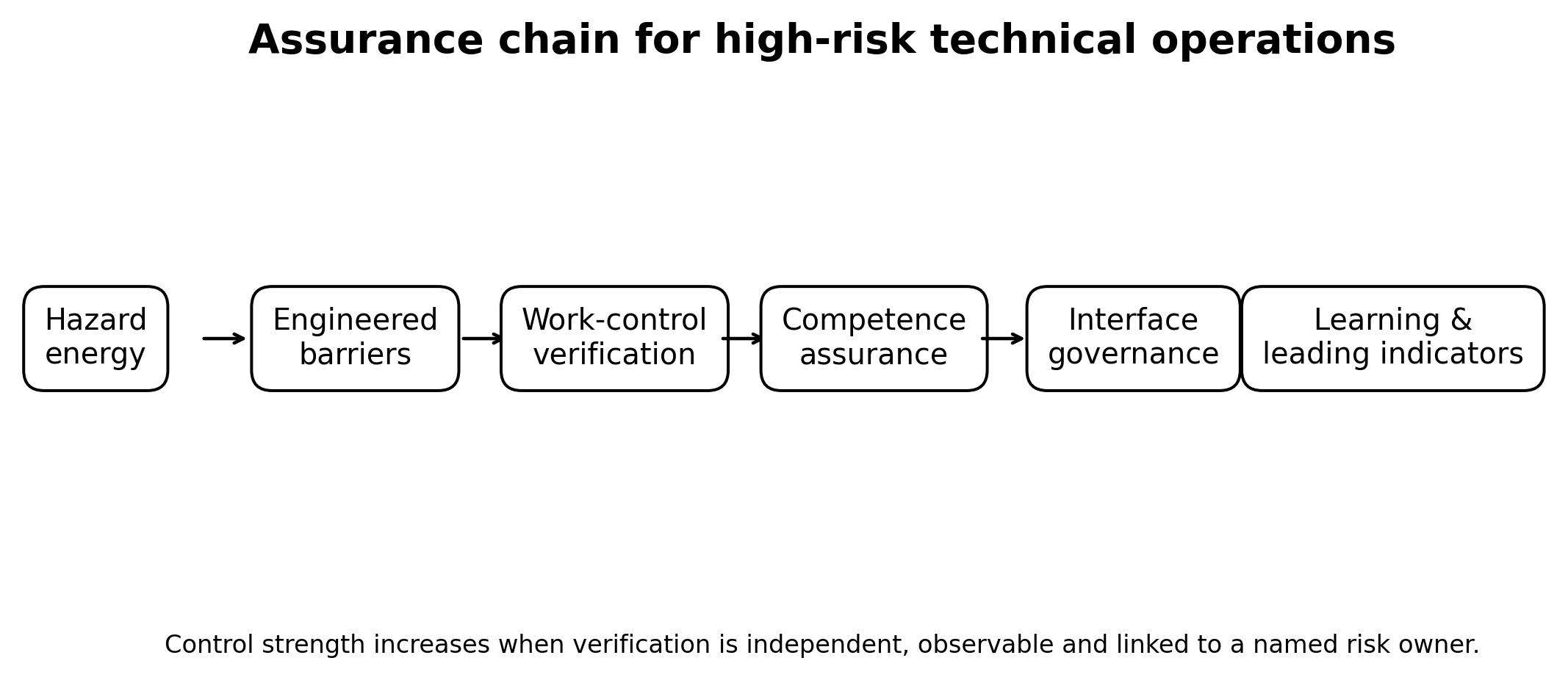
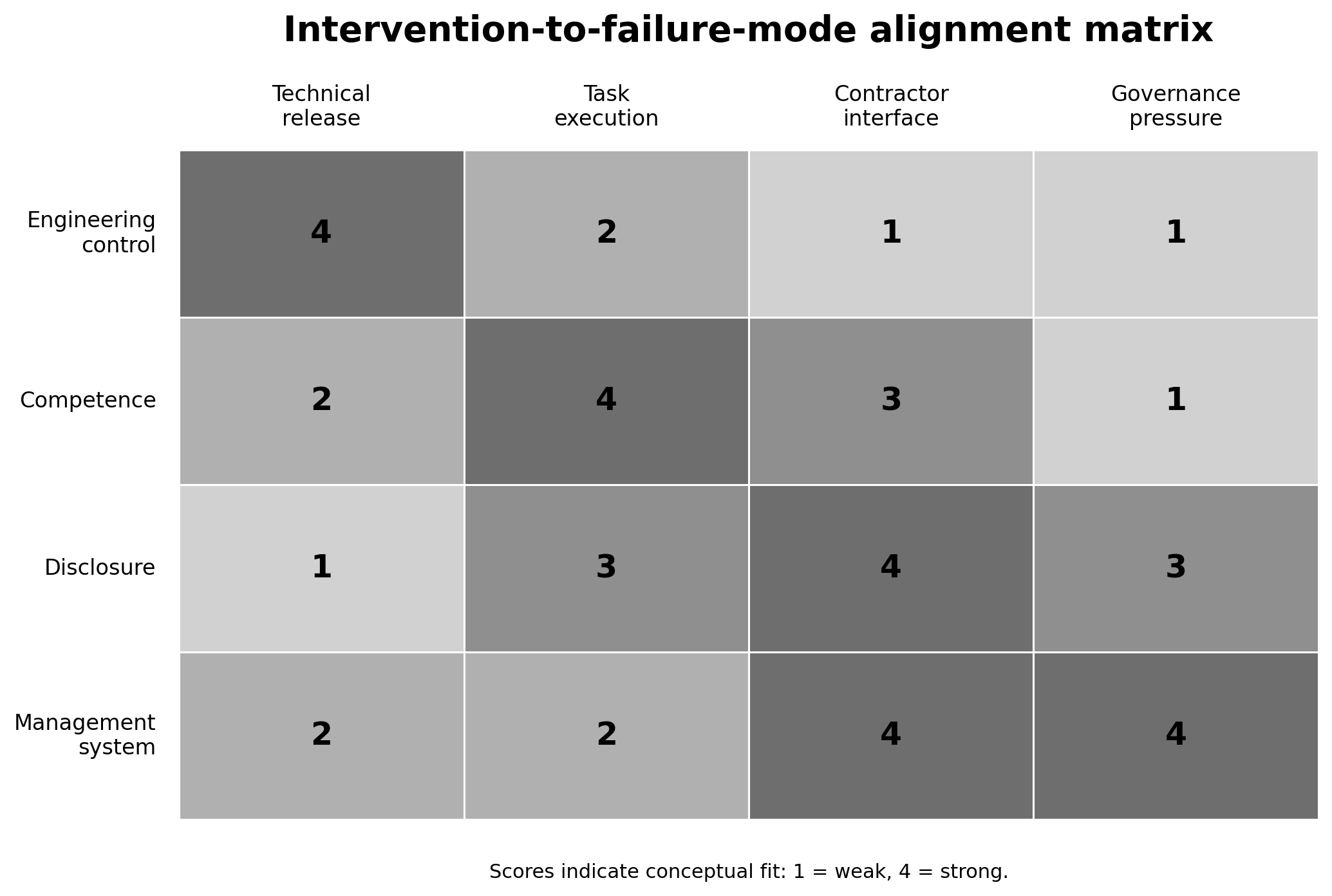
Table 1 summarizes the intervention families, while Figure 1 shows the assurance chain from hazard to learning. Figure 2 illustrates that different intervention classes have different strengths against technical, behavioural, interface and governance failure modes. The matrix is conceptual rather than a quantitative effect estimate. Its purpose is to prevent a common management error: selecting an intervention because it is familiar rather than because it matches the failure mechanism.
A practical implication is that safety dashboards should separate personal-safety activity from major-hazard assurance. Both matter, but their evidence should not be blended into one score. A project can have high training completion and still have weak isolation verification. Conversely, a technically robust barrier program does not excuse poor control of routine occupational exposures. A balanced system retains distinct indicators and makes trade-offs visible to management.
The framework also clarifies the place of technology. Digital systems should be evaluated against the same five questions. If a wearable device detects heat stress, the hazard, measurement, threshold and response must be explicit. If computer vision monitors exclusion zones, the system should define coverage gaps, false-alarm tolerance and intervention authority. If an electronic permit system is used, its value lies in preventing conflicting work and improving state visibility, not in digitizing paper without changing verification quality. The governing criterion is whether the technology strengthens the causal chain from hazard recognition to control recovery.
Cross-sector comparison further indicates that intervention portfolios should be tested against credible failure scenarios, not against generic compliance expectations. A control that performs well during routine work may require additional verification during start-up, shutdown, abnormal weather, or simultaneous operations. This distinction matters because technical operations often compress decision time while increasing uncertainty about equipment state and organizational boundaries. Where uncertainty is high, escalation criteria should be conservative enough to preserve margin without creating unmanageable volumes of low-value stoppages. The quality of a leading indicator also depends on response discipline, since measurement without a predetermined action threshold can become passive reporting. Independent assurance is particularly valuable when commercial incentives favor continuity, because the verifier should not depend on the same schedule assumptions as the work team. Management reviews should therefore examine both indicator level and indicator credibility, including missing data, overdue checks, and repeated administrative overrides. Worker participation is strongest when frontline concerns can modify plans, rather than being acknowledged without changing the conditions that generated the concern. Competence systems should recognize that experienced workers can also be vulnerable when familiar routines are transferred to unfamiliar equipment, interfaces, or temporary configurations. Interface controls should be rehearsed before critical phases so that organizations know how conflicting permits, ownership questions, or emergency changes will be resolved. Digital dashboards can make risk visible, but visualization should preserve distinctions between verified facts, inferred states, and unresolved assumptions. A useful assurance record identifies the source of evidence, time of verification, responsible person, acceptance criteria, and action taken after any deviation. Safety leadership becomes operationally meaningful when leaders protect verification time, challenge degraded barriers, and accept schedule consequences for unresolved critical controls. Conversely, leadership messages lose credibility when productivity decisions repeatedly contradict formal statements about stop-work authority and conservative decision making. The framework can also support audit design by directing sampling toward high-consequence controls, temporary changes, and interfaces where responsibility is distributed. Audits should test work as actually performed, because documentary conformity can coexist with field adaptations that change the effectiveness of the control. The same principle applies to corrective actions: closure should require evidence that the barrier was restored and that recurrence risk was addressed at system level. Organizations may also benefit from tracking the age of open safety-critical deviations, since prolonged temporary conditions often become normalized through familiarity. Indicator thresholds should be reviewed after organizational changes, new contractors, major design revisions, or evidence that previous thresholds no longer discriminate risk. The intervention architecture is therefore dynamic, with controls strengthened or simplified according to evidence about failure mechanisms, workload, and actual performance.
| Assurance domain | Indicator | Interpretation | Management response |
|---|---|---|---|
| Barrier health | Critical safeguards unavailable or degraded | Count and age of impaired critical barriers | Escalate when tolerance or restoration time is exceeded |
| Work control | Permit or isolation conflict | Unresolved conflicts per high-risk work package | Suspend affected work until state is reconciled |
| Competence | Capability gap in safety-critical role | Authorization and revalidation status | Replace, supervise or reassess before task execution |
| Disclosure | Weak signals not converted into action | Closure quality and recurrence of critical reports | Review underlying planning and control assumptions |
| Governance | Schedule pressure eroding assurance | Verification time compression, repeated extensions, deferred actions | Executive review of risk-versus-schedule decision |
For implementation, the framework should be reviewed at each major project transition because mobilization, commissioning, handover, shutdown and restart alter hazard pathways and organizational interfaces. Management should confirm that critical-control owners remain current, verification evidence is accessible, escalation thresholds still reflect exposure, and contractor responsibilities have not become ambiguous. This transition review guards against assumptions carried forward from an earlier phase when conditions, people and equipment were materially different.
6Practical and managerial implications
For project leaders, the first priority is to identify a limited set of safety-critical controls for each high-risk operation and assign named owners. Assurance should then focus on the quality of those controls rather than on the total volume of safety activity. Independent verification is especially important where the person performing the work also experiences schedule pressure. Organizations should define which barriers require second-person checking, which digital records constitute acceptable evidence, and which deviations automatically trigger work suspension or management escalation.
Contractor governance should be designed before mobilization. Common rules for permits, isolations, lifting, temporary works and simultaneous operations reduce ambiguity, but the system must also specify interface ownership and conflict resolution. Leading indicators should be reviewed at the same management level as cost and schedule so that safety signals are not separated from the decisions that create pressure. Table 2 provides a practical indicator set emphasizing barrier condition, competence, disclosure, interface quality and control recovery.
7Limitations and future research
The evidence remains heterogeneous. Many studies measure climate, behaviour or technology performance rather than direct prevention of severe events, and cross-sectional designs limit causal inference. Research should therefore test intervention packages longitudinally across multiple projects, with outcomes that include barrier health, exposure duration, quality of control recovery and major-hazard precursors. Future studies should also compare independent verification models, contractor-interface arrangements and digital assurance tools under realistic schedule pressure. Stronger evidence is needed on how organizations maintain control during transitions, including commissioning, shutdowns, handovers and rapid changes in contractor composition.
8Conclusion
Safety intervention in high-risk technical operations should be organized around failure modes and verifiable controls. Recent evidence supports safety climate, training, digital monitoring and proactive indicators, but none is universally effective. Engineering barriers are strongest against hazardous energy, competence controls are essential for judgement-intensive work, disclosure mechanisms surface weak signals, and governance controls protect decisions at contractor and schedule interfaces. Leading indicators become meaningful when they measure the health of these controls and trigger defined action. The resulting assurance model shifts attention from counting safety activities to demonstrating that critical protections are present, owned, verified and recoverable before exposure becomes consequence.
References
- [1]Umar T (2020). Safety climate factors in construction – a literature review. Policy and Practice in Health and Safety, 18(2), 80–99. https://doi.org/10.1080/14773996.2020.1777799
- [2]Alkaissy M, Arashpour M, Ashuri B, Bai Y, Hosseini R (2020). Safety management in construction: 20 years of risk modeling. Safety Science, 129, 104805. https://doi.org/10.1016/j.ssci.2020.104805
- [3]Sanni-Anibire MO, Mahmoud AS, Hassanain MA, Salami BA (2020). A risk assessment approach for enhancing construction safety performance. Safety Science, 121, 15–29. https://doi.org/10.1016/j.ssci.2019.08.044
- [4]Mosly I, Makki AA (2020). Safety climate perceptions in the construction industry of Saudi Arabia: The current situation. International Journal of Environmental Research and Public Health, 17(18), 6717. https://doi.org/10.3390/ijerph17186717
- [5]Esmaeili B, Hallowell MR, Rajagopalan B (2020). The association between subcontractor safety management programs and worker perceived safety climate in commercial construction projects. Journal of Safety Research, 74, 279–288. https://doi.org/10.1016/j.jsr.2020.06.010
- [6]Guo BHW, Zou Y, Fang Y, Goh YM, Zou PXW (2021). Computer vision technologies for safety science and management in construction: A critical review and future research directions. Safety Science, 135, 105130. https://doi.org/10.1016/j.ssci.2020.105130
- [7]Xia N, Xie Q, Hu X, Wang X, Meng H (2021). A review of construction safety climate: Definitions, factors, relationship with safety behavior and research agenda. Safety Science, 142, 105391. https://doi.org/10.1016/j.ssci.2021.105391
- [8]Paneru S, Jeelani I (2021). Computer vision applications in construction: Current state, opportunities & challenges. Automation in Construction, 132, 103940. https://doi.org/10.1016/j.autcon.2021.103940
- [9]Xu Z, Zheng N (2021). Incorporating virtual reality technology in safety training solution for construction site of urban cities. Sustainability, 13(1), 243. https://doi.org/10.3390/su13010243
- [10]Ajmal M, Isha ASN, Nordin SM, Al-Mekhlafi ABA (2022). Safety-management practices and the occurrence of occupational accidents: Assessing the mediating role of safety compliance. Sustainability, 14(8), 4569. https://doi.org/10.3390/su14084569
- [11]Alruqi WM, Hallowell MR (2022). Analysis of safety climate factors and safety compliance relationships in the oil and gas industry. Safety Science, 151, 105744. https://doi.org/10.1016/j.ssci.2022.105744
- [12]Yadav N, Sadeghi N, Kang J (2022). On-body placement of wearable safety promotion devices based on wireless communication for construction workers-on-foot: State-of-the-art review. Sensors, 22(9), 3134. https://doi.org/10.3390/s22093134
- [13]Gao R, Mu B, Lyu S, Wang H, Yi C (2022). Review of the application of wearable devices in construction safety: A bibliometric analysis from 2005 to 2021. Buildings, 12(3), 344. https://doi.org/10.3390/buildings12030344
- [14]Xu J, Cheung C, Manu P, Ejohwomu O, Too J (2023). Implementing safety leading indicators in construction: Toward a proactive approach to safety management. Safety Science, 157, 105929. https://doi.org/10.1016/j.ssci.2022.105929
- [15]Bayramova A, Edwards DJ, Roberts C, Rillie I (2023). Enhanced safety in complex socio-technical systems via safety-in-cohesion. Safety Science, 164, 106176. https://doi.org/10.1016/j.ssci.2023.106176
- [16]Alkaissy M, Arashpour M, Golafshani EM, Hosseini MR, Khanmohammadi S, Bai Y, Feng H (2023). Enhancing construction safety: Machine learning-based classification of injury types. Safety Science, 162, 106102. https://doi.org/10.1016/j.ssci.2023.106102
- [17]Cavalcanti M, Lessa L, Vasconcelos BM (2023). Construction accident prevention: A systematic review of machine learning approaches. Work, 76(2), 507–519. https://doi.org/10.3233/WOR-220533
- [18]Dobrucali E, Demirkesen S, Sadikoglu E, Zhang C, Damci A (2024). Investigating the impact of emerging technologies on construction safety performance. Engineering, Construction and Architectural Management, 31(3), 1322–1347. https://doi.org/10.1108/ECAM-07-2022-0668
- [19]Golabchi H, Abellanosa AD, Lefsrud L, Pereira E, Mohamed Y (2024). A comprehensive systematic review of safety leading indicators in construction. Safety Science, 172, 106433. https://doi.org/10.1016/j.ssci.2024.106433
- [20]Sarvari H, Edwards D, Rillie I, Posillico JJ (2024). Building a safer future: Analysis of studies on Safety-I and Safety-II in the construction industry. Safety Science, 178, 106621. https://doi.org/10.1016/j.ssci.2024.106621
- [21]Larbi JA, Tang LC, Larbi RA, Abankwa DA, Danquah RD (2024). Developing an integrated digital delivery framework and workflow guideline for construction safety management in a project delivery system. Safety Science, 175, 106486. https://doi.org/10.1016/j.ssci.2024.106486
- [22]Zhang Y, et al. (2024). Causal inference of construction safety management measures towards workers’ safety behaviors: A multidimensional perspective. Safety Science, 172, 106432. https://doi.org/10.1016/j.ssci.2024.106432
- [23]Li X, et al. (2024). Study on construction safety management in megaprojects from the perspective of resilient governance. Safety Science, 173, 106442. https://doi.org/10.1016/j.ssci.2024.106442
- [24]Xia N, Ding S (2024). Safety climate in construction: A systematic literature review. Engineering, Construction and Architectural Management, 31(10), 3973–4000. https://doi.org/10.1108/ECAM-11-2022-1074
- [25]Niu M, Leicht RM (2024). Evaluating the safety climate in construction projects: A longitudinal mixed-methods study. Buildings, 14(12), 4070. https://doi.org/10.3390/buildings14124070
- [26]Maali O, Ko CH, Nguyen PHD (2024). Applications of existing and emerging construction safety technologies. Automation in Construction, 158, 105231. https://doi.org/10.1016/j.autcon.2023.105231
- [27]Rabbi ABK, Jeelani I (2024). AI integration in construction safety: Current state, challenges, and future opportunities in text, vision, and audio based applications. Automation in Construction, 164, 105443. https://doi.org/10.1016/j.autcon.2024.105443
- [28]Kim JM, Yum SG, Adhikari MD, Bae J (2024). A deep-learning approach to leveraging natural hazard indicators for improved safety on construction sites. Safety Science, 177, 106596. https://doi.org/10.1016/j.ssci.2024.106596
- [29]Liu W, Meng Q, Li Z, Chong HY, Li K, Tang H (2025). Linking organizational safety support and construction workers’ safety behavior: the roles of safety motivation, emotional exhaustion and psychosocial safety climate. Engineering, Construction and Architectural Management, 32(10), 6536–6565. https://doi.org/10.1108/ECAM-02-2024-0182
- [30]Shafei H, Rahman RA, Lee YS (2025). Evaluating Construction 4.0 technologies in enhancing safety and health: Case study of a national strategic plan. Journal of Engineering, Design and Technology, 23(4), 1211–1242. https://doi.org/10.1108/JEDT-08-2023-0330