Performance Monitoring and Corrective Action
Data-Driven HSE Performance Monitoring and Corrective Action Management in Saudi Oil and Gas Drilling Operations
Published October 2026
Abstract
Drilling organizations require performance information that identifies weakened controls and supports effective corrective action. This paper develops a conceptual framework for data driven health, safety and environmental monitoring in Saudi oil and gas drilling operations. A purposive integrative review combines peer reviewed leading indicator research with primary technical guidance and descriptive corporate disclosures. It distinguishes occupational safety, occupational health, environmental management and process safety, arguing that aggregate injury indicators cannot represent every consequential exposure. The proposed framework connects validated reporting, risk triage, cause analysis, accountable intervention and independent effectiveness verification. Three analytical tables specify evidence boundaries, indicator definitions and a corrective action workflow. A graph illustrates selected published corporate measures without attributing them to drilling sites. The analysis identifies denominator consistency, contractor interfaces, reporting protection and verification quality as conditions for useful monitoring. Three propositions support future field testing. No original rig observations or causal estimates are claimed. The framework offers a practical research agenda for operational capability and responsible industrial development associated with Vision 2030.
Keywords: HSE; drilling operations; Saudi Arabia; leading indicators; corrective action; process safety; Vision 2030
1Introduction
Drilling combines complex equipment, changing subsurface conditions, mobile workforces and tightly coordinated contractor activities. A routine task can create serious exposure when energy isolation, lifting control, well integrity or communication fails. Health, safety and environmental performance therefore requires more than recording injuries after occurrence. Operators need information about whether protective controls remain effective during actual work and whether identified weaknesses are corrected before similar conditions recur.
In Saudi Arabia, drilling services also operate within a national development agenda emphasizing productive capability and industrial modernization (Saudi Vision 2030, n.d.). The connection to Vision 2030 is practical: reliable operations, workforce competence and responsible resource management support sustainable industrial participation. Nevertheless, installing a digital dashboard does not establish these outcomes. A system can report completion percentages while critical safeguards remain unavailable. This paper examines how performance information can support corrective decisions rather than merely document administrative activity.
The research question is: how can drilling organizations connect validated HSE indicators to corrective action and verified risk reduction? The paper develops a conceptual operating framework through published research, technical guidance and descriptive corporate evidence. Its contribution is an explicit link between monitoring and action verification, with proposed measures that future Saudi drilling studies can test. No interviews, proprietary rig records or experimental intervention results are presented.
The distinction between occupational safety and process safety is fundamental. Injury indicators describe outcomes affecting workers, while process safety concerns loss of control over hazardous systems. Environmental and occupational health exposures introduce additional consequences with different measurement timescales. Combining these dimensions into one score can hide unacceptable performance in a critical domain. The proposed framework therefore maintains separate views while integrating investigation, accountability and organizational learning.
2Review methodology
The study adopts a purposive integrative review, drawing on the methodological distinction between synthesizing existing knowledge and estimating effects from original observations (Snyder, 2019). Sources were selected for direct relevance to leading indicators, investigation, management systems, drilling hazards, environmental management and publicly reported HSE performance. The evidence base comprises peer reviewed articles and primary organizational publications. This is a bounded conceptual review; it is not presented as an exhaustive systematic review or a completed Scopus database search.
Evidence was examined through four questions: what is measured, which risk mechanism is represented, what decision becomes possible, and how effectiveness is demonstrated. Peer reviewed studies inform the conceptual argument. Technical publications inform practical design. Corporate disclosures supply limited descriptive context. The analysis separates published observations from the author's proposed procedures and research propositions. It makes no statistical claim that a particular indicator causes fewer incidents in Saudi drilling operations.
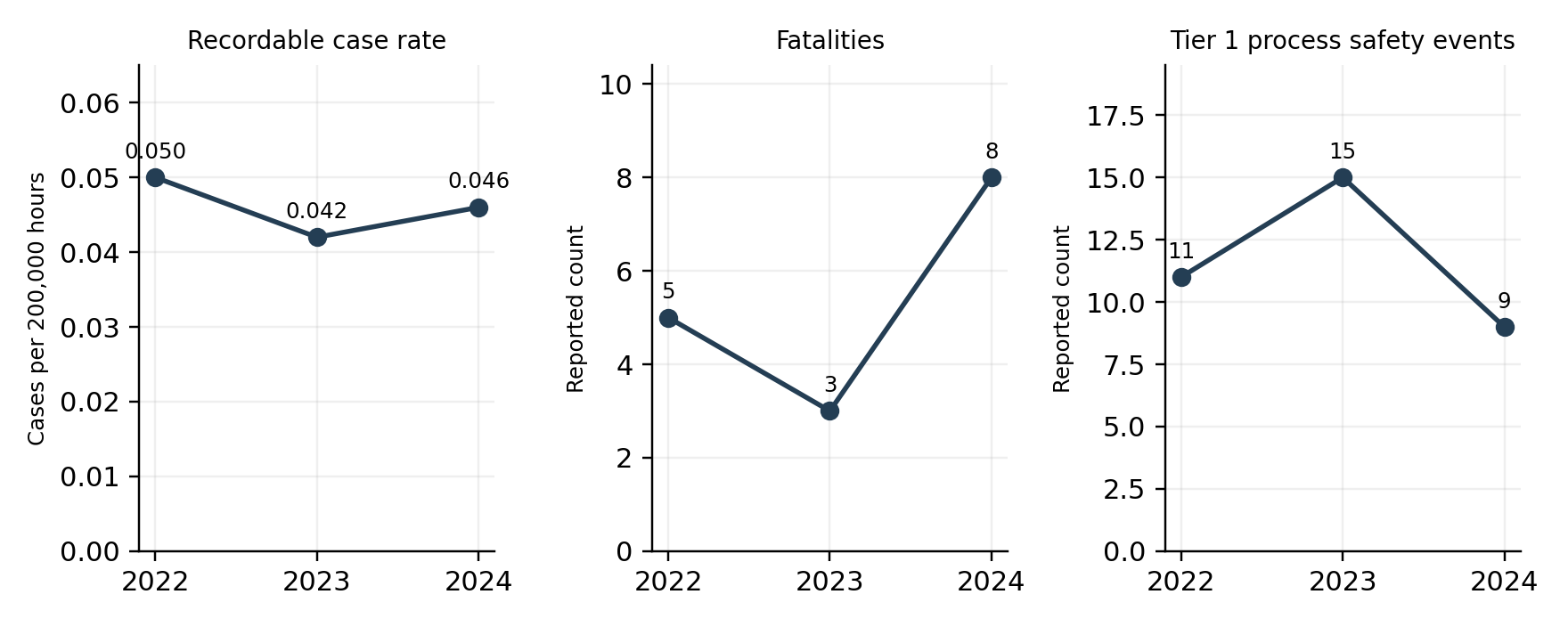
Aramco's Sustainability Report 2024 supplies a three year series for selected corporate measures. Table 1 and Figure 1 reproduce these reported values without creating a new dataset of drilling events. The reporting boundary includes operationally controlled entities beyond Saudi drilling activities. Counts and rates are therefore not evidence of performance at a specific Saudi rig. The graph uses separate panels because injury rates and event counts have different units. No correlations, forecasts or significance tests are calculated from three annual observations.
The proposed indicator dictionary and corrective action workflow are analytical outputs rather than validated instruments. Their applicability would require assessment against actual contracts, operating procedures and organizational responsibilities. International guidance is used as technical reference material, not as a statement of Saudi legal obligations. The study's principal limitation is the absence of comparable rig records linking exposure, barrier condition, corrective action timing and subsequent recurrence.
| Measure | 2022 | 2023 | 2024 |
|---|---|---|---|
| Recordable case rate | 0.050 | 0.042 | 0.046 |
| Lost time injury/illness rate | 0.014 | 0.018 | 0.021 |
| Fatalities | 5 | 3 | 8 |
| Tier 1 process safety events | 11 | 15 | 9 |
Note: Data from Aramco (2025), pp. 122–123. Rates use 200,000 work hours. Operational control boundary includes entities beyond Saudi drilling; these are not rig level observations.
Sources were located through publisher websites and official organizational portals using combinations of drilling, HSE monitoring, leading indicators, process safety and corrective action. Inclusion required identifiable authorship, direct relevance and traceable publication details. Unverifiable material and unrelated applications were excluded. Appraisal considered relevance, measurement clarity and transferability; foundational studies were retained alongside recent reviews. Selection was purposive, and no database screening totals or exhaustive coverage are claimed.
3Drilling risks and performance monitoring needs
Research distinguishes lagging indicators, which describe realized events, from leading indicators, which provide information about activities or conditions preceding outcomes. Sinelnikov et al. (2015) connect effective leading indicators with practical implementation and organizational commitment. Bayramova et al. (2023) identify substantial variation in how safety literature defines and constructs these measures. Consequently, calling an indicator “leading” does not demonstrate that it reliably predicts injury or verifies a protective barrier (Reiman & Pietikäinen, 2012). Its practical value depends on an explicit mechanism and a decision that follows the measurement.
Golabchi et al. (2024) examine leading indicators in construction, an adjacent setting characterized by changing workplaces and contractor interfaces. This literature supports attention to competence, planning and organizational conditions, but its findings cannot simply be transferred to drilling. Well control, hazardous inventories and specialized equipment create distinct risk mechanisms. A drilling indicator must therefore specify the task, barrier and exposure it represents. Counting toolbox meetings, for example, measures delivery activity; observing whether workers understand a lifting exclusion zone provides different evidence about control implementation (Hallowell et al., 2013; Xu et al., 2023).
ISO 45001 offers a management system context for occupational health and safety, including systematic improvement and worker participation (ISO, 2018). It provides a useful organizational reference, although a documented system does not establish effective performance on every shift. Likewise, the IOGP process safety indicator guidance emphasizes measures relevant to upstream operations and barrier management (IOGP, 2023). These sources support complementary measurement rather than an assumption that occupational injury rates adequately describe major accident prevention.
The corrective action literature and investigation guidance introduce a second distinction: correction versus prevention of recurrence. Removing an immediate hazard may restore safe conditions without addressing why the hazard appeared. HSE investigation guidance links information gathering and analysis to controls and implemented action plans (HSE, 2004). Applied to drilling, the relevant question is whether the investigation identifies conditions capable of producing another event, including maintenance planning, procurement, supervision or interfaces between organizations. An instruction to “be more careful” rarely resolves these underlying conditions.
This paper treats monitoring as a control process. Information is useful when it reveals a consequential deviation, reaches an accountable decision maker and produces an intervention whose effectiveness can be checked. The relationship is conditional, not automatic. Better reporting may initially increase recorded deficiencies, and fewer reports may indicate silence rather than improvement. Dashboard interpretation must therefore consider reporting culture, work exposure and the quality of verification alongside numerical trends.
Drilling research strengthens the distinction between major accident prevention and occupational injury monitoring. Skogdalen et al. (2011) examine indicators for deepwater blowout prevention, while Zhen et al. (2022) review major accident indicators in offshore petroleum. These offshore studies inform barrier selection but cannot establish performance at Saudi land rigs. Hopkins (2009) and Swuste et al. (2016) further caution against assuming that indicator categories alone resolve measurement difficulties. HSE (2006) provides a practical assurance approach focused on critical risk controls.
Drilling performance monitoring should begin with a task and barrier inventory rather than available software fields. OSHA's drilling and servicing guidance identifies hazards across land based operations, while NIOSH describes demanding work and exposure challenges in extraction activities (OSHA, n.d.; NIOSH, 2024). These references help identify questions for local assessment. They do not establish the frequency of particular hazards in Saudi operations or justify assuming that all rigs have identical equipment and work patterns.
For occupational safety, the inventory should distinguish lifting, work at height, energy isolation, vehicle movement and confined space entry where applicable. Each activity requires observations of the controls that make the work acceptable. A permit count alone cannot show that isolation points were verified or that simultaneous operations were compatible. Monitoring should record the relevant control condition, the work exposure and the response to failure. Critical deviations require immediate operational decisions under approved site procedures.
Occupational health requires additional attention because harmful exposure may precede symptoms by substantial periods. Noise, airborne contaminants, fatigue and heat cannot be adequately represented by injury counts. Heat assessment should consider workload, protective clothing, environmental conditions and acclimatization, rather than relying on air temperature alone (NIOSH, 2026). Monitoring can combine competent exposure assessment with records of control availability and actual use. Personal medical details should remain confidential; supervisors generally need actionable restrictions and control requirements, not unrestricted access to clinical records.
Environmental monitoring should connect activities to pathways such as spills, waste handling and potential releases. IOGP and IPIECA (2020) emphasize environmental management throughout exploration and production. For the proposed system, an environmental observation should identify the material, affected medium, containment condition and immediate response. Disposal documentation is important but cannot substitute for confirming that storage and transfer controls function in practice. Environmental indicators should retain their own denominators and significance criteria rather than being converted into equivalent injury points.
Process safety monitoring addresses the integrity of barriers controlling hazardous energy and fluids. Assurance activities may include examinations of relevant well control equipment, critical maintenance and approved operating limits. The precise checks must come from competent technical authorities and applicable procedures. HSE software should not create generic thresholds that override engineering decisions. Instead, it should preserve the current status of critical controls and make unresolved impairments visible to authorized operational personnel.
Contractor interfaces require special treatment. One organization may own equipment, another supervise work and another authorize an activity. An observation can remain unresolved if the database identifies only the reporting company. Each action needs one accountable owner with access to the resources and authority required for completion (IOGP, 2014). Dependencies on the operator, supplier or specialist should be recorded separately. Accountability becomes clearer when contractual responsibility and operational coordination are reflected in the workflow.
IOGP Life Saving Rules provide a reference for fatality prevention communication and related start work checks (IOGP, n.d.). Environmental monitoring has a complementary management system foundation in ISO 14001:2026 (ISO, 2026). Neither reference replaces task specific assessment. The system should connect their relevant controls to observations and corrective decisions, rather than merely count briefings or certificates.
4Data and monitoring foundation
A useful architecture begins with consistent identifiers for rig, equipment, task, shift, contractor and event. The same deficiency may appear in inspection, maintenance and incident records. Linking these entries prevents duplicate actions and allows reviewers to determine whether apparent recurrence reflects a new failure or repeated reporting of one unresolved condition. Where connectivity is unreliable, controlled offline collection can preserve timestamps and synchronize records when communication becomes available. An audit trail should retain changes to classification, deadlines and closure decisions.
Data quality has at least four dimensions: completeness, accuracy, timeliness and comparability. Mandatory fields can improve completeness but may encourage meaningless default entries. Supervisors therefore need sampling checks against source evidence and field observations. Reporting timeliness should distinguish the moment of discovery from later data entry. Comparability requires stable definitions; a change in what counts as a recordable case can create a trend break unrelated to operational improvement. Definitions and changes should remain accessible to users.
Table 2 proposes a compact indicator dictionary. Each measure links a numerator and denominator to a decision and an interpretation limit. The dictionary intentionally includes positive assurance and unresolved risk. For example, critical barrier verification measures whether checks were completed acceptably, while overdue high risk actions reveal whether known weaknesses persist. These measures provide different information and should not be averaged into a single performance score. A severe unresolved defect warrants attention even when routine compliance is high.
| Indicator | Calculation or evidence | Decision and limitation |
|---|---|---|
| Critical control assurance | Acceptable verifications / required verifications × 100 | Investigate failures; completion alone is insufficient. |
| Overdue high risk actions | Overdue open high risk actions / open high risk actions × 100 | Escalate persistent exposure; disclose deadline changes. |
| Verified closure | Actions passing effectiveness review / actions reviewed × 100 | Reopen failures; review sample selection. |
| Comparable recurrence | Repeat deficiencies by barrier and task | Revise controls; changes in detection affect counts. |
| Health control availability | Required controls available during sampled exposed tasks | Restore controls; availability differs from correct use. |
| Environmental deviations | Events by material, pathway and significance | Inspect containment; preserve activity context. |
Note: Author proposed measures. Zero denominators are reported as not applicable; values must never be silently replaced with zero.
Injury rates require reliable work hours and consistent classification. For comparisons, organizations must also disclose the population, contractor coverage and normalization factor. A rate expressed per 200,000 hours cannot be placed beside a rate per million hours without conversion and a discussion of scope. Even after conversion, different work mixes and reporting practices limit interpretation. Low counts also produce unstable annual rates. The proposed system therefore presents counts, exposure and definitions together rather than displaying a ranking without context.
Leading indicators should be tested for actionability. An indicator is actionable when its deterioration triggers a defined review, intervention or escalation (OSHA, 2019). The number of observations submitted is weak on its own because increased participation and increased hazards can both raise the count. Adding potential severity, barrier category, reporting delay and recurrence makes the measure more interpretable. Managers should reward useful reporting and timely control restoration, while avoiding targets that encourage workers to conceal events or submit trivial observations.
The interface should support distinct audiences. A rig supervisor needs current impairments and imminent deadlines. A contractor manager needs recurring causes and resource constraints. An executive needs assurance that high consequence exposures receive attention across the portfolio. Each view should allow examination of underlying evidence. Automatically generated summaries can support triage, but responsibility for stopping work, accepting risk and closing critical actions must remain explicitly assigned to competent people.
5Published evidence and analytical interpretation
The corporate series in Table 1 shows different movement across selected measures. The injury rate does not move identically to total recordable cases, and neither describes the whole picture represented by fatalities and process safety events. Figure 1 visualizes this divergence without implying causation. These observations support a measurement principle: one favorable trend cannot establish that every important control is effective. Different consequence types require separate interpretation and accountable review (Aramco, 2025).
The data cannot identify why annual outcomes changed, whether drilling contributed to them or whether a corrective action program improved performance. Corporate aggregation may conceal variation between activities and entities. Counts also depend on operating exposure, and the available series is too short for credible modeling. The practical use here is to illustrate why dashboards should preserve multiple dimensions, reporting boundaries and units rather than simplify performance into an unsupported narrative of improvement.
For corrective actions, a similar interpretive issue arises when completion percentages increase. The denominator may exclude deferred cases, or closure criteria may become less demanding. A meaningful dashboard should show newly raised actions, unresolved actions, age distribution, risk category, reopened cases and sampled effectiveness findings. Managers can then distinguish rapid administrative processing from sustained control restoration. This distinction is a proposed analytical principle; the current study does not estimate how often these problems occur in Saudi organizations.
Three propositions follow from the synthesis. First, barrier specific indicators should provide more actionable information than activity counts when the required response is predefined. Second, closure supported by independent effectiveness evidence should better identify unresolved causes than closure based only on implementation records. Third, stable definitions and protected reporting should improve the interpretability of trends. These propositions require empirical testing and should not be reported as demonstrated findings.
6Proposed framework for Saudi drilling operations
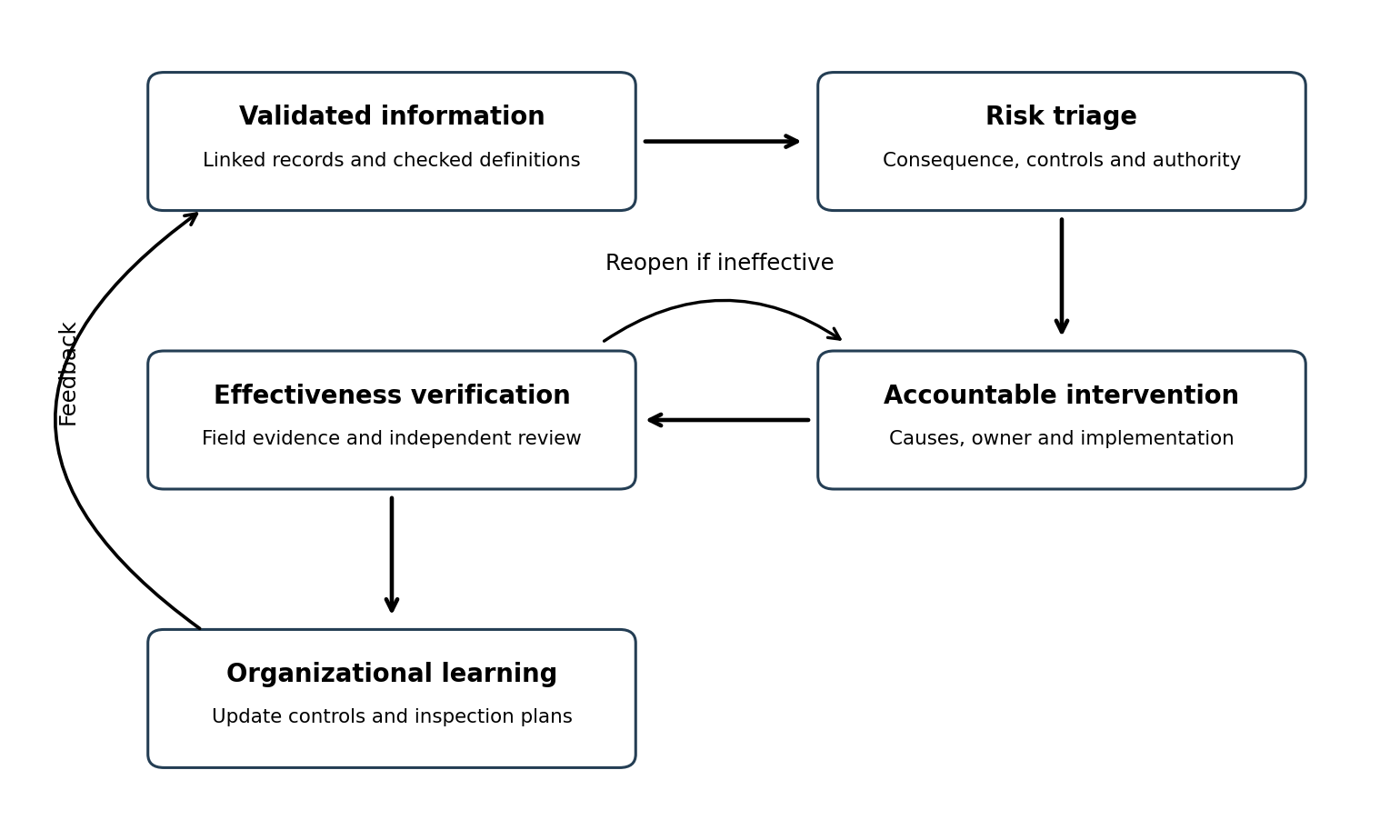
Figure 2 connects validated information, risk triage, intervention, effectiveness verification and organizational learning. The feedback loop is essential: unsuccessful verification returns the action for revision, while verified learning updates inspection plans and control expectations. The framework rejects the assumption that uploading a photograph or marking a task complete establishes risk reduction. Evidence should match the original failure mechanism and the consequence that the action is intended to prevent.
The first stage is containment. Personnel address immediate exposure through approved procedures and notify responsible operational staff. A digital record should never delay an urgent response. The second stage establishes a clear problem statement: what requirement was not met, where, under which conditions and with what potential consequence? Separating observed facts from interpretations improves investigation quality. Where evidence is incomplete, the system should record uncertainty rather than inventing a confident cause.
Risk triage determines investigation depth and escalation. Actual outcome and credible potential consequence should both be considered. A near miss with serious potential warrants more attention than its absence of injury might suggest. Classification should follow an approved organizational method with competent review. High consequence cases may need multidisciplinary investigation, while minor isolated deficiencies may justify simpler analysis. The software should record the basis of prioritization so that later reviewers can understand changes.
Cause analysis examines how controls failed or were absent. Relevant questions include whether procedures were usable, equipment suitable, staffing sufficient, competence demonstrated and responsibilities understood. Worker involvement helps reveal differences between prescribed and actual work. The analysis should avoid treating the last visible human action as a complete explanation. A contractor's mistake may also reflect incomplete handover, incompatible instructions or unavailable equipment. Corrective measures must address these contributing conditions within the responsible organizations.
Action design should specify the intended mechanism, accountable owner, completion date, resources and verification method. Engineering or organizational changes may provide stronger protection than repeated reminders, depending on the hazard. Training is appropriate when a demonstrated competence gap contributes to the problem, but its delivery alone does not prove improvement. The action record should state what will be observed afterward to establish that the relevant task is now performed acceptably.
Verification should occur at two levels. Implementation verification establishes that the promised change exists. Effectiveness verification checks whether it works under representative operating conditions. For a revised isolation procedure, implementation may involve approval and briefing; effectiveness requires competent observation of the relevant isolation process. The reviewer should have sufficient independence from the action owner to challenge inadequate evidence, particularly for serious risks. Administrative closure follows successful verification, with unresolved dependencies remaining visible.
Table 3 defines an illustrative workflow, including reopening conditions. Deadlines should be risk based and locally approved rather than copied from arbitrary universal targets. An action extension requires a recorded explanation, interim controls and authorized review. Repeated extensions are a management signal even when the revised dates are technically current. Reviewers should examine time since discovery as well as compliance with the latest deadline, preventing deadline changes from concealing persistent exposure.
| Stage | Required evidence | Exit requirement |
|---|---|---|
| Contain | Exposure, immediate response, responsible person | Authorized temporary control established. |
| Investigate | Facts, barrier failure, contributing conditions | Cause analysis accepted by competent reviewer. |
| Design | Owner, resources, mechanism, verification plan | Action and risk based deadline approved. |
| Implement | Change record and supporting documentation | Promised intervention exists. |
| Verify | Representative field observation or technical test | Effectiveness demonstrated; otherwise reopen. |
| Learn | Shared findings and revised assurance plan | Learning assigned and tracked. |
Note: Author proposed workflow informed by HSE (2004). Operational authority and technical acceptance remain governed by approved site procedures.
7Implementation priorities and discussion
Implementation should begin with a bounded pilot covering selected rigs, activities and contractor interfaces. Before software configuration, the participating organizations should agree definitions, authority, data ownership and verification requirements. Existing records can establish baseline data quality, but missing information must remain visible. A pilot can focus on a few consequential controls and action categories, expanding only after users demonstrate that the measures support decisions and that verification is feasible during operations.
Training should address both system use and interpretation. Workers need clear reporting channels, feedback and confidence that reporting a hazard will receive a constructive response. Supervisors need practical instruction on evidence quality, prioritization and closure review. Managers need to distinguish an increase in detection from an increase in underlying risk. Multilingual communication and accessible descriptions can support consistent understanding where teams use different working languages. Participation should include subcontracted workers rather than only employees with permanent system access.
Information governance should limit access by role and separate sensitive health information from general operational records. Data retention, contractor access and record transfer need explicit arrangements. Cybersecurity and backup practices protect availability and integrity, especially when safety decisions depend on current information. Automated alerts should have named recipients, acknowledgment rules and an escalation pathway. Excessive low value notifications can create alert fatigue and obscure the conditions requiring immediate intervention.
A future evaluation could compare matched rigs or use a phased implementation design. The primary outcomes should include verified control restoration, recurrence of comparable deficiencies and time to effective resolution, with injury outcomes treated cautiously because serious events are relatively rare. Analysis should account for task mix, work hours, equipment, contractor structure and reporting changes. Interviews and field observations can help explain whether the system changes decisions or simply adds documentation. Ethical and organizational permissions are required before accessing identifiable worker information.
The evaluation should preregister outcome definitions and distinguish administrative closure from verified effectiveness. Baseline and follow up windows should be long enough to observe comparable activities, without inventing a universal duration. Independent samples of closed actions can estimate verification quality. Transparent reporting should describe missing records, classification changes and concurrent initiatives. Such a design would allow the conceptual framework to become an empirical contribution grounded in actual Saudi drilling operations.
8Conclusion
Data driven HSE management is most useful when information changes the handling of risk. The review shows why drilling dashboards need a balanced architecture covering occupational safety, health, environment and process safety. Indicators must retain their definitions, exposure bases and boundaries. Corrective action records must explain the problem, intended remedy and verification evidence. Otherwise, digitization can reproduce weak practices at greater speed and create an appearance of control that the underlying operations do not support.
For Saudi drilling organizations, the proposed contribution to Vision 2030 is stronger operational capability through competent personnel, dependable controls and traceable learning. This alignment is conceptual. The framework makes responsibilities and verification evidence explicit, but requires field validation. Future research should test control reliability and recurrence under representative operating conditions.
Declarations
Study type: conceptual review with published secondary evidence. No human participants or confidential operational records were used. The framework requires empirical validation.
References
- [1]Aramco (2025). Sustainability Report 2024: Data. pp. 120–123. https://www.aramco.com/-/media/publications/corporate-reports/sustainability-reports/report-2024/english/2024-data-en.pdf
- [2]Bayramova A, Edwards DJ, Roberts C, Rillie I (2023). Constructs of leading indicators: A synthesis of safety literature. Journal of Safety Research, 85, 469–484. https://doi.org/10.1016/j.jsr.2023.04.015
- [3]Golabchi H, Abellanosa AD, Lefsrud L, Pereira E, Mohamed Y (2024). A comprehensive systematic review of safety leading indicators in construction. Safety Science, 172, 106433. https://doi.org/10.1016/j.ssci.2024.106433
- [4]Hallowell MR, Hinze JW, Baud KC, Wehle A (2013). Proactive construction safety control: Measuring, monitoring, and responding to safety leading indicators. Journal of Construction Engineering and Management, 139(10), 04013010. https://doi.org/10.1061/(ASCE)CO.1943-7862.0000730
- [5]Health and Safety Executive (HSE) (2004). Investigating accidents and incidents: A workbook for employers, unions, safety representatives and safety professionals. HSG245. https://www.hse.gov.uk/pubns/books/hsg245.htm
- [6]Hopkins A (2009). Thinking about process safety indicators. Safety Science, 47(4), 460–465. https://doi.org/10.1016/j.ssci.2007.12.006
- [7]HSE (2006). Developing process safety indicators: A step-by-step guide for chemical and major hazard industries. HSG254. https://www.hse.gov.uk/pubns/books/hsg254.htm
- [8]International Association of Oil & Gas Producers (IOGP) (2023). Process safety—Recommended practice on key performance indicators. Report 456, third edition. https://idms.iogp.org/Documents/545
- [9]International Organization for Standardization (ISO) (2018). ISO 45001:2018: Occupational health and safety management systems—Requirements with guidance for use. https://www.iso.org/standard/45001
- [10]IOGP & IPIECA (2020). Environmental management in oil and gas exploration and production. Report 254, second edition. https://idms.iogp.org/Documents/237
- [11]IOGP (2014). Operating Management System Framework for controlling risk and delivering high performance in the oil and gas industry. Report 510. https://idms.iogp.org/Documents/656
- [12]IOGP (n.d.). Life-Saving Rules. Accessed 12 October 2026. https://www.iogp.org/workstreams/safety/safety/life-savingrules/
- [13]ISO (2026). ISO 14001:2026: Environmental management systems—Requirements with guidance for use. https://www.iso.org/standard/14001
- [14]National Institute for Occupational Safety and Health (NIOSH) (2024). Oil and gas extraction program. https://www.cdc.gov/niosh/research-programs/portfolio/oil-gas-extraction.html
- [15]NIOSH (2026). Workplace recommendations: Heat stress. Updated July 16. https://www.cdc.gov/niosh/heat-stress/recommendations/
- [16]Occupational Safety and Health Administration (OSHA) (n.d.). eTool: Oil and gas well drilling and servicing. Accessed 11 October 2026. https://www.osha.gov/etools/oil-and-gas/
- [17]OSHA (2019). Using leading indicators to improve safety and health outcomes. OSHA 3970. https://www.osha.gov/sites/default/files/publications/OSHA_Leading_Indicators.pdf
- [18]Reiman T, Pietikäinen E (2012). Leading indicators of system safety—Monitoring and driving the organizational safety potential. Safety Science, 50(10), 1993–2000. https://doi.org/10.1016/j.ssci.2011.07.015
- [19]Saudi Vision 2030 (n.d.). Vision 2030. Accessed 12 October 2026. https://www.vision2030.gov.sa/en
- [20]Sinelnikov S, Inouye J, Kerper S (2015). Using leading indicators to measure occupational health and safety performance. Safety Science, 72, 240–248. https://doi.org/10.1016/j.ssci.2014.09.010
- [21]Skogdalen JE, Utne IB, Vinnem JE (2011). Developing safety indicators for preventing offshore oil and gas deepwater drilling blowouts. Safety Science, 49(8–9), 1187–1199. https://doi.org/10.1016/j.ssci.2011.03.012
- [22]Snyder H (2019). Literature review as a research methodology: An overview and guidelines. Journal of Business Research, 104, 333–339. https://doi.org/10.1016/j.jbusres.2019.07.039
- [23]Swuste P, Theunissen J, Schmitz P, Reniers G, Blokland P (2016). Process safety indicators, a review of literature. Journal of Loss Prevention in the Process Industries, 40, 162–173. https://doi.org/10.1016/j.jlp.2015.12.020
- [24]Xu J, Cheung C, Manu P, Ejohwomu O, Too J (2023). Implementing safety leading indicators in construction: Toward a proactive approach to safety management. Safety Science, 157, 105929. https://doi.org/10.1016/j.ssci.2022.105929
- [25]Zhen X, Vinnem JE, Han Y, Peng C, Huang Y (2022). Development and prospects of major accident indicators in the offshore petroleum sector. Process Safety and Environmental Protection, 160, 551–562. https://doi.org/10.1016/j.psep.2022.02.050