Artificial Intelligence
From Coding Assistants to Self-Healing Terminals: NeuraOS — A Critical Review of AI-Driven Autonomous Command Execution and Error Recovery on Linux Systems
Department of Information Technology, Siddhant College of Engineering, Sudumbare, Maval, Pune (SPPU), Maharashtra, India
Published October 2026
Abstract
The Linux command-line interface continues to serve as the primary control surface for software development, systems administration, and cloud operations, yet it executes instructions syntactically, without semantic awareness of user intent and without built-in mechanisms for diagnosing or repairing runtime failures. Over roughly the last decade, three largely distinct research communities have each addressed part of this problem: large language model (LLM)-based coding assistants embedded in integrated development environments (IDEs), natural-language-to-command translation systems that lower the barrier to shell usage, and operating-systems research on self-healing and autonomic computing that targets distributed and cloud infrastructure rather than the interactive terminal. This paper presents a structured, critical review of these three strands, together with the log-based anomaly-detection and AIOps literature that supplies much of the diagnostic machinery such systems would require. Literature was retained where it addressed semantic command interpretation, real-time or near-real-time failure diagnosis, autonomous or semi-autonomous recovery, or persistence of prior failure-resolution experience. The reviewed work is organized along four analytical dimensions — runtime integration, autonomy level, diagnostic depth, and knowledge retention — and compared qualitatively across these dimensions. The synthesis shows that autonomy and diagnostic sophistication increase substantially when moving from IDE assistants toward self-healing infrastructure research, but this increase is accompanied by a shift away from the single-operator, single-machine terminal context, and that no reviewed system combines real-time in-terminal diagnosis, multi-pathway recovery, and durable per-machine experiential learning while remaining confined to user space. The review further discusses recurring safety and governance themes — confidence-gated autonomy, privilege-aware execution, and explanation-first human oversight — that constrain the design space for any terminal-level orchestration layer, and it identifies four concrete research gaps together with a near-, mid-, and long-term research roadmap. The review does not claim that any single technology described is either novel or previously unstudied in isolation; its contribution is the cross-domain synthesis and the identification of the specific combination of properties that remains unaddressed.
Keywords: Self-Healing Systems; Autonomic Computing; Autonomous Error Recovery; Intelligent Shells; Natural-Language Command Interfaces; Large Language Models; AIOps; Linux Command-Line Interface; Human-in-the-Loop AI; Systematic Literature Review
1Introduction
The command-line interface (CLI) remains the primary means by which developers, system administrators, and DevOps engineers interact with Linux-based systems, largely because it exposes operating-system functionality with minimal abstraction. This same directness is also the source of its central limitation: a shell executes exactly what is typed, reports failure through exit codes and error streams, and offers no interpretation of why an operation failed or what corrective action might resolve it. As software environments have grown more layered — spanning language-specific package managers, containerized runtimes, and distributed configuration systems — the time and expertise required to manually diagnose command failures has grown correspondingly, and this burden falls disproportionately on students, early-career developers, and administrators of heterogeneous systems.
Independently of this trend, the last several years have seen rapid, empirically documented adoption of large language model (LLM)-based coding assistants inside IDEs. Controlled experiments have reported substantial task-completion speedups from such tools, and enterprise-scale studies have found productivity effects that vary by developer experience level [1, 2, 3]. This success has prompted a natural question, one that motivates the present review: can a comparable degree of AI-driven reasoning be brought to bear on the terminal itself, where a large share of the most time-consuming failures in a development or operations workflow actually occur, rather than only on the source-code editor?
Three bodies of research bear directly on this question without, individually, answering it. IDE-embedded coding assistants improve the speed and quality of code authored before execution but do not observe what happens once a command reaches the shell [1, 2, 4, 5]. Natural-language-to-command translation systems such as NL2Bash and its successors demonstrate that user intent expressed in semi-natural language can be converted into syntactically valid shell commands, but these systems generally stop at command synthesis and do not monitor execution outcomes [6, 7, 8]. Self-healing and autonomic-computing research demonstrates that automated fault detection and remediation can materially improve system reliability, but this literature is overwhelmingly oriented toward distributed and cloud-native infrastructure rather than a single interactive terminal session operated by one user [9, 10, 11]. A fourth, closely related body of work — log-based anomaly detection and artificial intelligence for IT operations (AIOps) — supplies much of the diagnostic technique (pattern recognition over logs, exit codes, and system signals) that any terminal-level orchestration system would need, but this work is typically applied retrospectively, for monitoring or postmortem analysis, rather than during an in-progress command execution [12, 13, 14].
This review is motivated by the observation that AI assistance in software engineering is, at present, structurally asymmetric: abundant at the level of source code, and comparatively sparse at the level of command execution. Consequently, the productivity gains achieved while authoring code are frequently offset by friction encountered afterward, when that code is compiled, installed, deployed, or configured through the shell. What distinguishes this review from a straightforward survey of AI coding assistants is its explicit focus on the execution boundary — the point at which a command leaves an editor or terminal and is handed to the operating system — and its attempt to determine, through a common analytical framework, how far existing research has progressed toward closing that boundary safely.
The contribution of this review is threefold. First, it synthesizes findings from four largely separate literatures using a single, consistent set of comparison dimensions (Section VII), rather than treating them as unrelated subfields. Second, it distills the safety and governance principles that recur across the self-healing and AI-safety literature into a small set of design constraints relevant to any future terminal-level system (Section VIII). Third, it derives four specific, literature-grounded research gaps and a time-horizoned roadmap for addressing them (Sections IX–X), rather than asserting novelty in the abstract.
The remainder of this paper is organized as follows. The review methodology and literature-selection approach are described first, followed by the fundamental concepts and theoretical background, the evolution of the research field and the state-of-the-art approaches. A comparative critical analysis, applications, challenges and limitations, research gaps and future research directions follow, and the final section concludes.
2Review methodology
This review follows a narrative-synthesis approach informed by systematic-review conventions. Because no formal database query log or PRISMA screening count was recorded during preparation, the numeric screening figures that a fully systematic review would report (records identified, duplicates removed, records screened, records excluded with reasons) are not presented here; a researcher preparing this manuscript for formal submission should conduct and document an explicit database search (e.g., across IEEE Xplore, ACM Digital Library, Scopus, and arXiv) and report the resulting PRISMA-style flow diagram with real counts. The description below should therefore be read as the search-and-selection strategy actually used, not as a placeholder for fabricated statistics.
Search terms combined core concepts from four areas: (i) AI coding assistants (e.g., "GitHub Copilot", "AI pair programmer", "LLM code generation productivity"); (ii) natural-language shells and command synthesis (e.g., "NL2Bash", "NL2CMD", "natural language to shell command", "intelligent shell"); (iii) diagnostic and anomaly-detection methods (e.g., "log anomaly detection", "AIOps", "log-based fault diagnosis"); and (iv) self-healing and autonomic computing (e.g., "self-healing software systems", "autonomic computing survey", "automated fault recovery"). Sources were retained if they satisfied at least one of four inclusion criteria: (a) semantic interpretation of user intent for command or code generation; (b) real-time or near-real-time diagnosis of execution failure from system signals; (c) autonomous or semi-autonomous recovery action following a detected failure; or (d) persistence and reuse of prior failure-resolution experience. Sources were excluded if they addressed machine learning applied purely to kernel-internal optimization (e.g., scheduler tuning) with no bearing on user-facing command interaction, or if they concerned code-generation quality with no execution-phase component, except where such work was needed for background context.
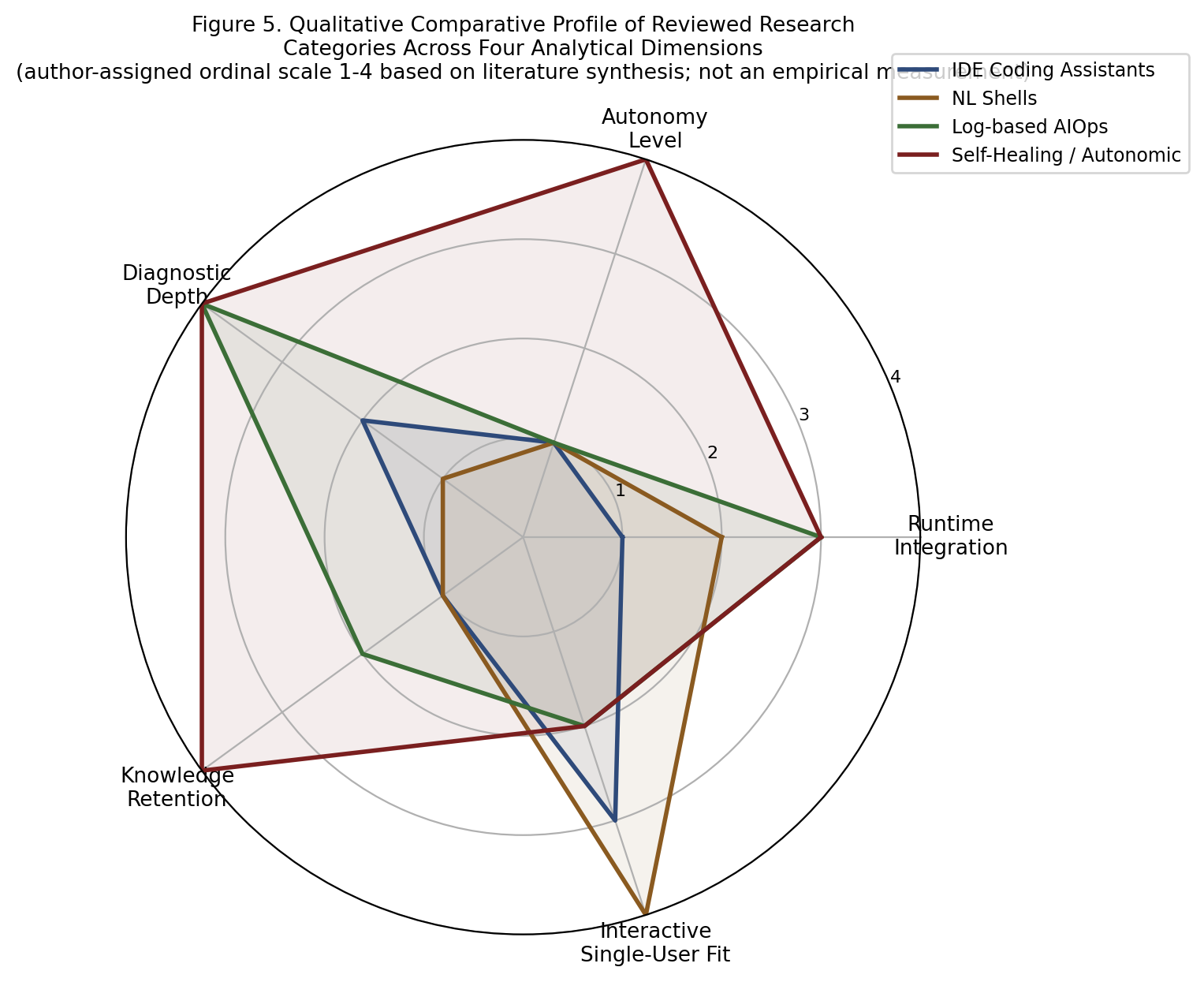
For each retained source, four attributes were extracted: operational scope (pre-execution, runtime, or retrospective), autonomy level (suggestion-only, human-gated, or autonomous-within-bounds), diagnostic mechanism, and knowledge-retention mechanism. These four attributes form the comparison dimensions used in the comparative critical analysis and visualized in Figure 5. Because this is a narrative rather than a fully quantitative meta-analysis, no attempt is made to compute aggregate effect sizes across studies that used different tasks, metrics, and populations; where a specific quantitative finding is reported (for example, a reported percentage speedup), it is attributed to the specific study that reported it rather than generalized across the field.
| Term | Working Definition (as used in this review) |
|---|---|
| Autonomic computing | A computing paradigm, introduced by IBM in the early 2000s, in which systems manage aspects of their own configuration, healing, optimization, and protection with reduced human intervention [10, 15]. |
| Self-healing system | A system capable of automatically detecting and correcting faults or degraded states, typically through a detect–diagnose–repair loop, without requiring the fault to have been explicitly anticipated in advance [9, 11]. |
| AIOps | Artificial Intelligence for IT Operations: the application of machine learning to operational telemetry (logs, metrics, traces) for tasks such as anomaly detection and root-cause analysis [12, 13]. |
| Confidence-gated autonomy | A design pattern in which an automated action is executed only if a computed confidence score, derived from weighted observed signals, exceeds a defined threshold; otherwise control reverts to a human [9, 11]. |
| Natural-language-to-command translation | The task of converting a natural-language description of intent into an executable shell command, as exemplified by the NL2Bash corpus and the NL2CMD benchmark [6, 7, 8]. |
3Fundamentals and theoretical background
3.1The execution model of the Linux shell
A Linux shell session operates as a syntactic interpreter: it parses a line of input into a command and arguments, forks a process (or invokes a built-in), and reports the outcome through an integer exit status, standard-error text, and any side effects on the file system or environment. The shell itself performs no semantic validation of whether the command achieves the user's underlying goal; a syntactically valid command that fails to accomplish its intended purpose is treated identically to one that succeeds, except insofar as the invoked program itself signals failure through its exit code. This distinction between syntactic correctness and semantic success is central to understanding why conventional CLI environments cannot, by construction, offer meaningful failure interpretation without an additional reasoning layer.
3.2Autonomic computing and the MAPE-K loop
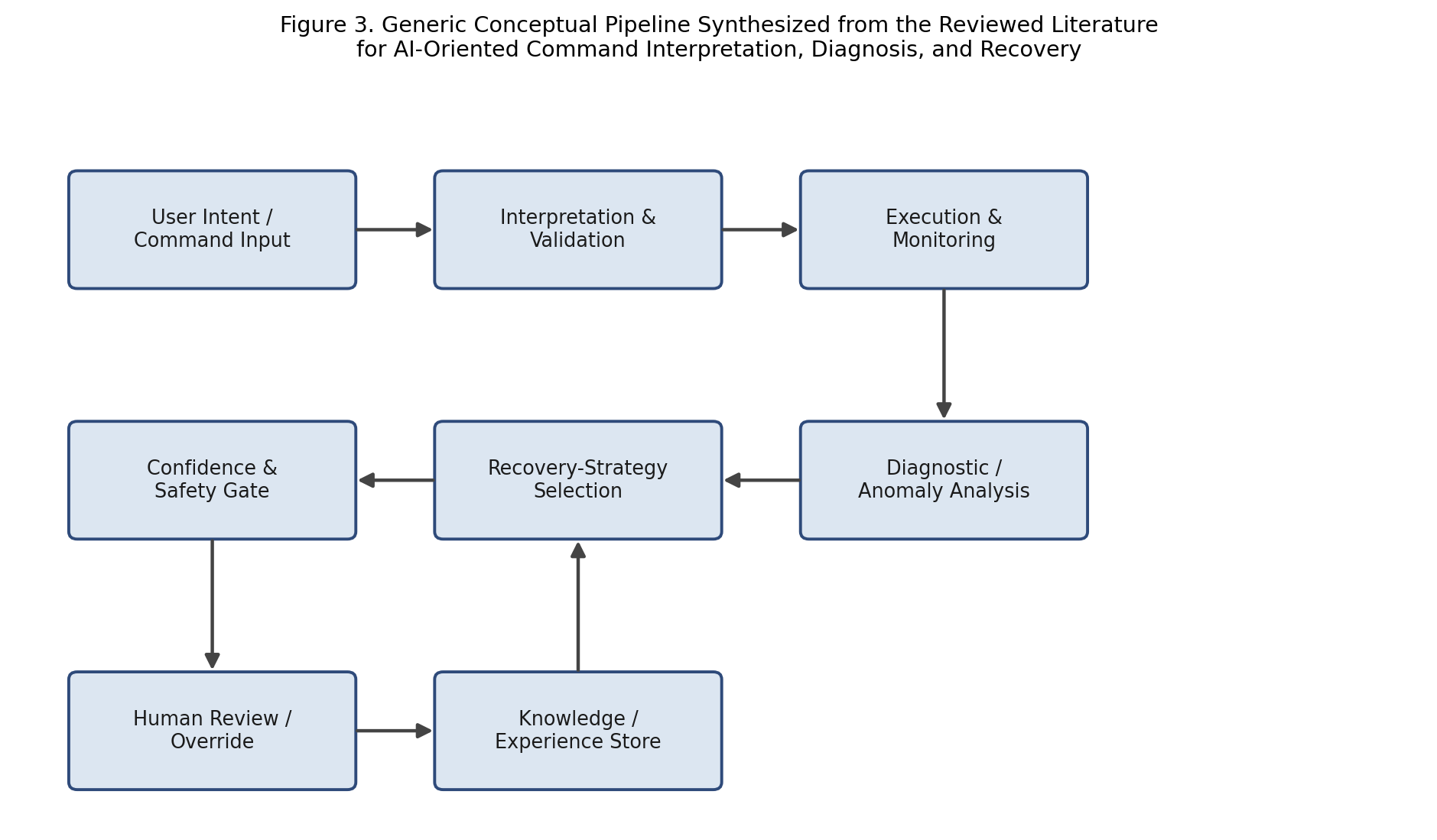
Autonomic computing, as originally articulated by IBM, envisions systems that self-configure, self-heal, self-optimize, and self-protect [10, 15]. The canonical control structure associated with this vision is the Monitor–Analyze–Plan–Execute over a shared Knowledge base (MAPE-K) loop: a system continuously monitors its own state, analyzes that state for anomalies, plans a corrective action, executes the action, and updates a shared knowledge base that informs future cycles. Later self-healing systems research operationalizes this loop with varying degrees of sophistication in the analyze and plan stages, ranging from static rule tables to learned models [9, 11, 16].
3.3Confidence-based and threshold-gated decision making
A recurring mathematical device in the self-healing and autonomic-computing literature is a weighted confidence score used to gate autonomous action. In general form, such a score can be expressed as
where si denotes the i-th observed signal relevant to the failure (for example, similarity to a previously resolved error pattern, exit-code category, or historical success rate of a candidate remedy), wi denotes a predefined or learned weight reflecting the reliability of that signal, and n is the number of signals considered. An autonomous action is executed only when the resulting confidence value exceeds a defined threshold; below that threshold, control is deferred to a human operator. This formulation appears in various forms throughout the self-healing literature and is presented here at a general level rather than attributed to a single source, since its structure — weighted linear combination of risk or confidence indicators — is a standard pattern in decision-support and fault-management systems rather than a specific proprietary algorithm.
3.4Natural-language-to-command semantic parsing
Translating a natural-language instruction into an executable shell command is a semantic-parsing problem complicated by the irregular syntax of shell utilities, the very large space of possible flags and options, and heavy reliance on positional and contextual conventions that differ across utilities. The NL2Bash corpus formalized this task by pairing roughly nine thousand English descriptions with corresponding Bash commands scraped from forums, tutorials, and technical documentation [6]. Subsequent work, including the NL2CMD benchmark, extended this resource using automated generation pipelines and evaluated large-language-model-based translation approaches, reporting substantially larger and more diverse training data than the original corpus supported [7, 8].
3.5Log-based diagnosis and anomaly detection
Modern systems produce large volumes of semi-structured textual logs, and log-based diagnosis techniques aim to convert this text into structured signals suitable for downstream decision-making. Approaches span classical statistical outlier detection (e.g., isolation-forest-style methods applied to parsed log features), sequence- and pattern-based techniques that model normal log behavior and flag deviations, and, more recently, transformer-based language models applied directly to raw or lightly parsed log text [12, 13, 14]. A recurring theme in this literature is the distinction between detection (recognizing that an anomaly occurred) and root-cause analysis (identifying why it occurred), with the latter generally proving substantially harder and less mature than the former [14].
4Evolution and development of the research field
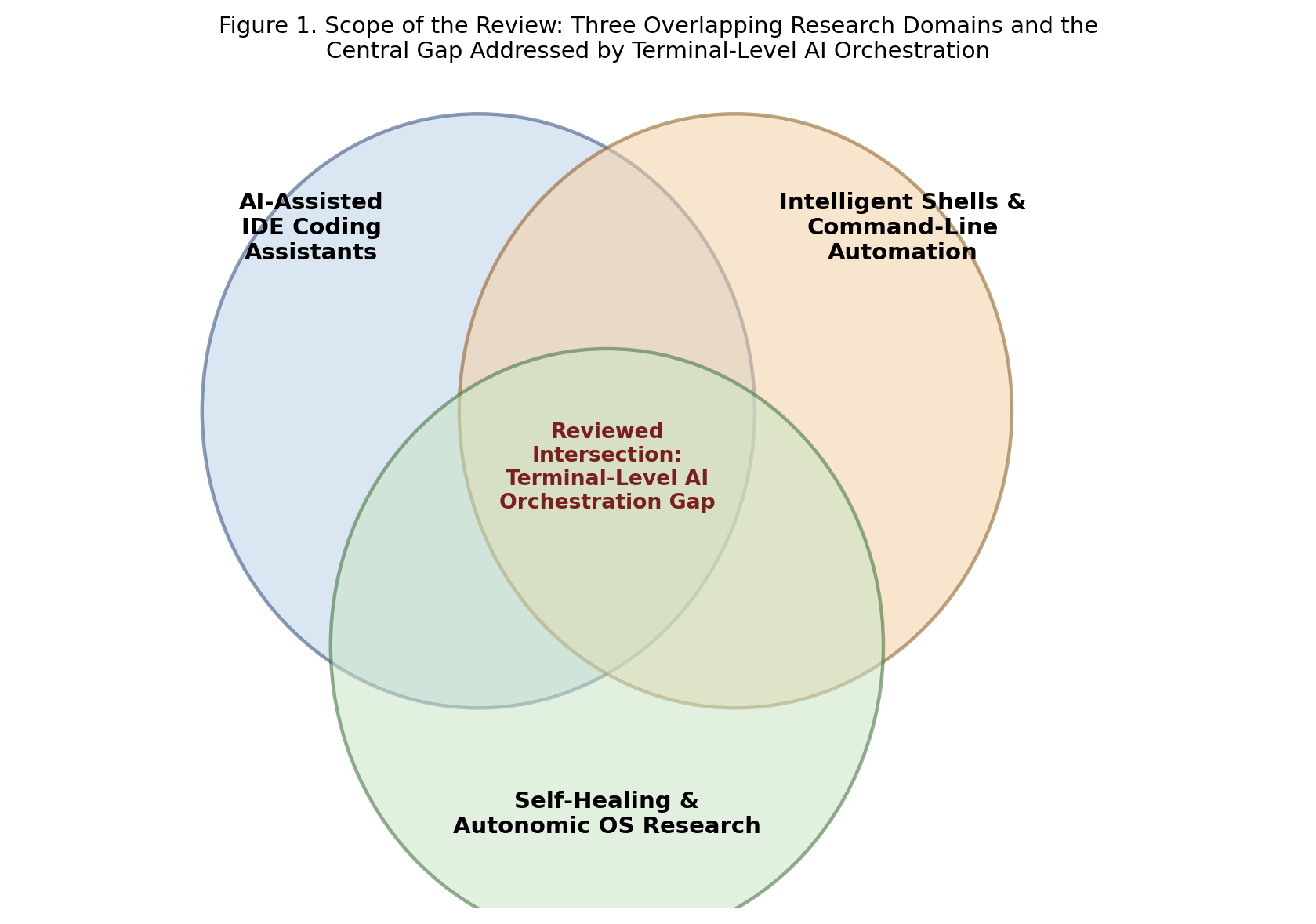
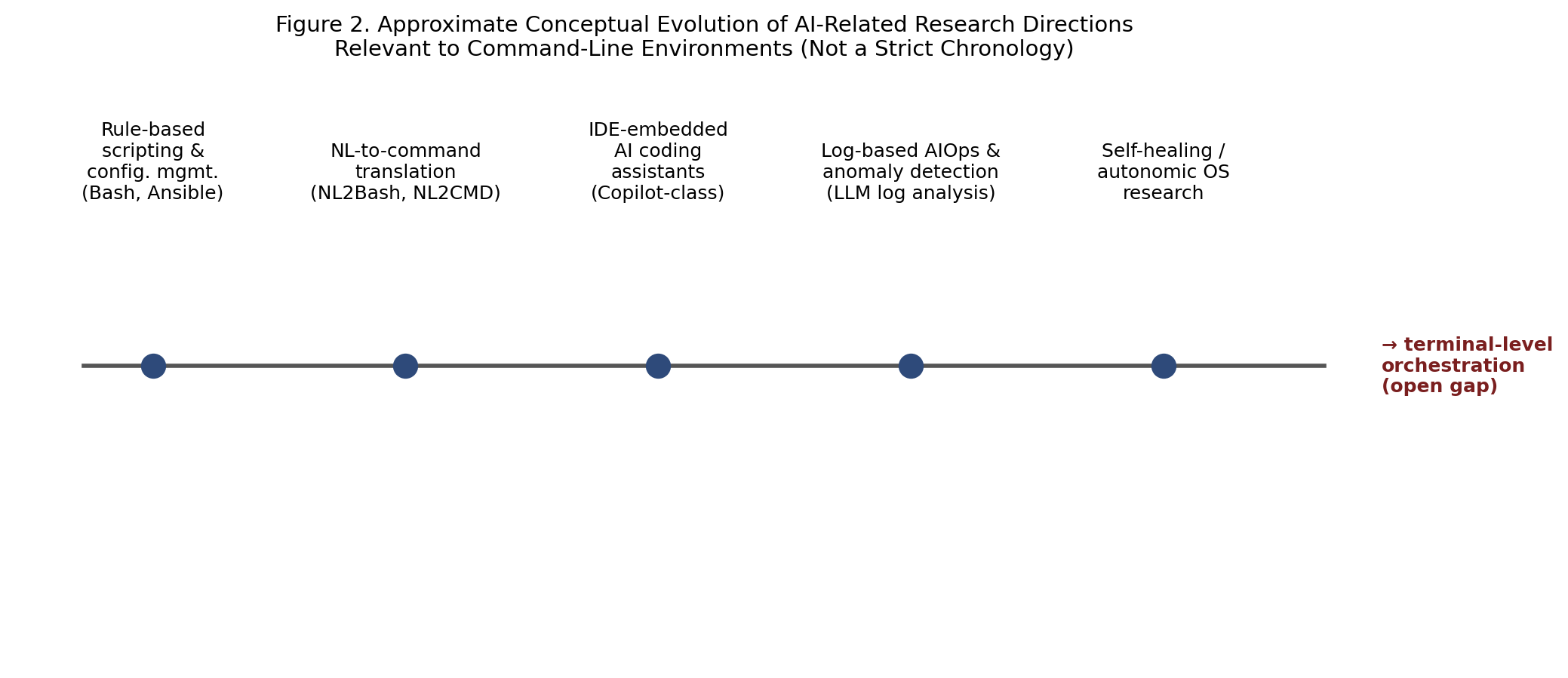
The research directions surveyed in this review did not develop in a single linear sequence; rather, several matured in parallel within separate communities before recent work began to draw connections between them. Understanding this parallel development helps explain why the intersection identified in Figure 1 remains comparatively unexplored.
Command-line automation has the longest lineage among the strands reviewed here, rooted in shell scripting and, later, configuration-management platforms such as Ansible. These tools reduce repetitive manual execution for well-understood, previously anticipated workflows, but their logic is static: they encode a fixed sequence of actions and cannot reason about failure modes that were not anticipated at authoring time [17]. When an unanticipated error occurs, control reverts to the human operator, a limitation that has persisted essentially unchanged since the earliest configuration-management tools.
Natural-language command interfaces represent a later development aimed specifically at usability rather than failure recovery. The NL2Bash corpus (2018) established a benchmark task and dataset for translating English descriptions into Bash commands [6]. Subsequent competitions and follow-up datasets, including the NeurIPS 2020 NLC2CMD challenge and the 2023 NL2CMD update that explored large-language-model-based data generation, expanded both the scale of available training data and the sophistication of translation models [7, 8, 18]. Across this line of work, however, the research question has remained centered on translation accuracy rather than on what happens after a generated command is executed.
The rise of IDE-embedded coding assistants, exemplified by GitHub Copilot, constitutes a distinct and more recent development, driven by advances in large-scale code-pretrained language models. Randomized controlled trials have reported substantial productivity effects — for example, a controlled experiment recruiting professional developers on a freelance platform reported a 55.8% reduction in task-completion time for a JavaScript HTTP-server implementation task among developers using GitHub Copilot compared to a control group [2]. Subsequent large-scale field experiments at Microsoft and Accenture, and diary-based studies of in-practice Copilot adoption, have refined this picture, generally confirming productivity benefits while noting substantial heterogeneity by developer experience level and task type [1, 2, 19]. In parallel, security-focused evaluations have raised concerns: a widely cited study systematically prompting Copilot to generate code in security-sensitive scenarios found that approximately 40% of the resulting 1,689 generated programs contained exploitable weaknesses drawn from MITRE's Top 25 Common Weakness Enumeration list [4]. These two lines of evidence — productivity gains and security risk — have developed concurrently and are both relevant to any downstream terminal-level system that might incorporate similar language-model reasoning.
Self-healing and autonomic-computing research traces its conceptual roots to IBM's early-2000s articulation of autonomic computing and to earlier work on self-stabilizing distributed systems [10, 15]. This line of research matured substantially in application to distributed and cloud infrastructure over the following two decades, producing surveys that catalog dozens of self-healing frameworks and their underlying principles [9, 11, 16]. Notably, this maturation occurred largely independently of the natural-language-shell and IDE-assistant literatures described above, with comparatively little cross-citation between the communities until recently.
Most recently, AIOps and log-based anomaly detection have emerged as a bridging technology, applying machine learning — including, increasingly, large language models — to the operational telemetry (particularly logs) that both self-healing systems and any future terminal-level orchestration layer would need for diagnosis [12, 13, 14]. This convergence of diagnostic technique with autonomy-governance principles from self-healing research, applied specifically to the interactive terminal, is the point at which the reviewed literature currently thins out, as discussed further in Sections 6 and 9.
5State-of-the-art approaches
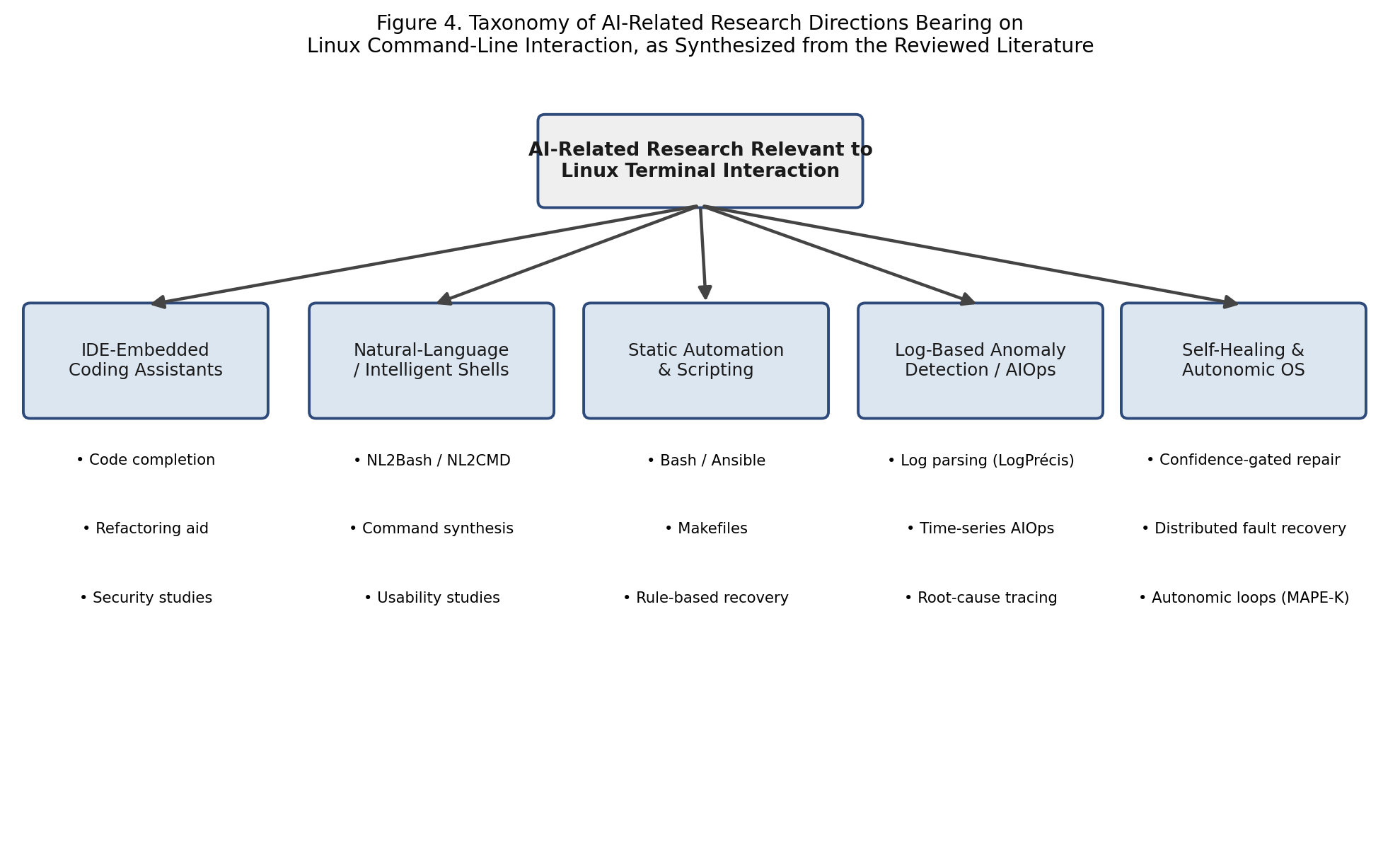
This section surveys five categories of approach in turn: IDE-embedded coding assistants, natural-language and intelligent shells, static automation frameworks, log-based anomaly detection / AIOps, and self-healing / autonomic systems.
5.1IDE-embedded AI coding assistants
Tools in this category, GitHub Copilot being the best-studied example, sit inside the editor as an inline suggestion layer built on a code-pretrained language model. The model reads whatever surrounding context it has access to — the current file, and in newer variants the wider repository — and proposes completions, refactors, or whole functions. Nothing it produces runs on its own; a person still has to accept, edit, or discard the suggestion before it becomes part of the program.
The productivity evidence for this approach is stronger than for almost anything else discussed in this review, though it is not uniform. Peng and colleagues ran a randomized trial in which developers hired through a freelance platform built a small HTTP server, and those given Copilot access finished 55.8% faster than the control group [2]. Larger field experiments at Microsoft and Accenture point the same direction, and a subsequent diary-based study of everyday Copilot use largely confirms it, with one recurring wrinkle: the size of the benefit depends heavily on how experienced the developer already is, with newer developers often gaining more [1, 19]. Interaction studies digging into why developers feel more productive have found something slightly counterintuitive — it is the rate at which suggestions get accepted, not whether that code survives long-term in the codebase, that seems to drive people's sense of a productivity boost [1].
The security side of the picture is less flattering. Pearce and colleagues prompted Copilot across 89 scenarios chosen to be relevant to well-known vulnerability classes, generated 1,689 programs from those prompts, and found that roughly 40% contained an exploitable weakness from MITRE's Top 25 list [4]; a later replication broadly reproduced this concern under newer models [5]. But the limitation that matters most for this review is structural rather than statistical: none of these tools ever sees what happens after the code leaves the editor. A compiler error, a missing shared library, a failed deployment step — all of it happens outside the assistant's field of view, which is exactly the boundary this review is concerned with.
5.2Natural-language and intelligent shells
A different line of work tackles the CLI's usability problem head-on rather than its recovery problem: translating what a user means into a command they could have typed themselves. Lin and colleagues' NL2Bash corpus, roughly nine thousand English descriptions paired with real Bash commands scraped from forums and tutorials, gave this task its first proper benchmark, covering over a hundred distinct utilities [6]. Fu and colleagues later revisited the problem with NL2CMD, generating a dataset several times larger through an automated pipeline and testing whether a model like ChatGPT could serve as both translator and data generator [7, 8].
Translation accuracy on these benchmarks has climbed steadily alongside the underlying language models, and the field even had its own shared-task moment in the NeurIPS 2020 NLC2CMD competition, complete with a held-out, human-curated test set [18]. What none of this research does, however, is follow the command past the point of generation. A natural-language shell will happily hand back a perfectly formed command; whether that command actually succeeds once it hits the operating system is someone else's problem. If it fails, the user is left exactly where they would have been had they typed the command themselves.
5.3Static automation and configuration management
The oldest and still most widely used form of Linux automation is simply a script or a declared configuration: Bash and Zsh scripts, or a tool like Ansible describing a desired end state. Ansible's idempotency model, where re-running a playbook nudges the system back toward its target configuration, gives this approach a crude kind of self-correction, but only for the narrow set of divergences its authors anticipated.
That anticipation requirement is also its ceiling. A dependency that has quietly gone missing, a version bump nobody planned for, a permission error no one thought to script around — any of these will typically just stop the automation cold and hand control back to a person [17]. It is worth keeping this category in mind as a baseline, precisely because it is the form of "automation" most Linux practitioners actually run day to day, and it is the bar that any AI-driven alternative would need to clear.
5.4Log-based anomaly detection and AIOps
AIOps takes a different starting point altogether: rather than generating or scripting commands, it mines the exhaust of a running system — its metrics, traces, and above all its logs — for signs that something has gone wrong [12]. The methods used for this have moved through roughly three generations, from unsupervised statistical outlier detection (isolation forests over parsed log features are a common example), to sequence models trained to recognize what "normal" log behavior looks like, to transformer-based language models such as LogPrécis applied more or less directly to raw log text [13]. Zhong and colleagues' 2023 survey of time-series anomaly detection in this domain traces that progression and flags a familiar problem: models trained on one operational environment tend not to generalize well to another [12].
There is a clear maturity gap within this line of work. Spotting that something is wrong is a comparatively solved problem; explaining why it went wrong, and doing something about it automatically, is not. A recent systematic review of AIOps log analysis in the LLM era points to a shortage of labeled data for rare, unusual faults as one reason root-cause analysis lags behind detection — few-shot learning approaches are being explored largely because there simply is not enough failure data to train on otherwise [14]. And, as with the other categories surveyed so far, the setting matters: this research is built and tested against distributed service fleets and monitoring dashboards, checked retrospectively or on a rolling basis, not against the sub-second feedback loop of someone waiting at a terminal prompt for their command to either work or fail.
5.5Self-healing and autonomic-computing systems
Self-healing research comes closest, of everything surveyed here, to what a terminal-level orchestration layer would actually need. Its central idea is a detect-diagnose-repair loop — often the MAPE-K structure introduced in the relevant section — built to restore normal operation without anyone having predicted the specific fault in advance [9, 11]. The architectures built around this idea are varied: reflective middleware that can inspect and modify its own behavior, policy-based reconfiguration engines, and, in more recent work, learned fault detectors such as those built on Restricted Boltzmann Machines [16, 20].
Psaier and Dustdar's survey remains the field's reference point, laying out the shared design principles behind dozens of self-healing systems built over the preceding decade [9]. The field has not stood still since — work on learning recovery strategies for reactive systems, and on deliberately forgetting stale knowledge so that reinforcement-learning-based systems can heal themselves more effectively, both point toward repair strategies that are learned rather than hand-coded [21].
Even so, almost everything in this body of work is built and evaluated for distributed, cloud-native, or embedded settings — a fleet of nodes managed as a collective, usually with no human standing at the point of failure watching it happen in real time. A single Linux terminal, where one person types one command and expects an immediate, explainable answer, is a genuinely different setting, and it is one the self-healing literature has barely touched.
| Category | Representative Work | Primary Mechanism | Typical Deployment Context |
|---|---|---|---|
| IDE-embedded coding assistants | GitHub Copilot studies [1, 2, 4] | Code-pretrained LLM inline suggestion | Source-code editor, pre-execution |
| Natural-language / intelligent shells | NL2Bash, NL2CMD [6, 7, 8] | Semantic parsing / seq-to-seq or LLM translation | Interactive shell, command synthesis only |
| Static automation & scripting | Bash scripts, Ansible [17] | Predetermined rule execution, idempotent convergence | Pre-anticipated deployment workflows |
| Log-based anomaly detection / AIOps | LogPrécis; AIOps surveys [12, 13, 14] | Statistical / sequence / transformer log analysis | Distributed monitoring, retrospective or near-real-time |
| Self-healing / autonomic systems | Psaier & Dustdar survey; MAPE-K-based systems [9, 11, 16] | Detect-diagnose-repair loop, confidence-gated action | Distributed / cloud / embedded infrastructure |
| Study | Domain | Method | Key Reported Finding | Reported Limitation |
|---|---|---|---|---|
| Peng et al., 2023 [2] | IDE assistant | RCT, freelance developers | 55.8% faster task completion with Copilot | Single bounded task (HTTP server in JS); generalization untested |
| Pearce et al., 2022/2025 [4] | IDE assistant security | 1,689 generated programs across 89 scenarios | ≈40% contained CWE Top-25 weaknesses | Scenario-based; real-world prevalence may differ |
| Lin et al., 2018 [6] | NL shell | NL2Bash corpus + semantic parser | ≈9,000 aligned pairs, >100 utilities | Limited to Bash; static dataset |
| Fu et al., 2023 [8] | NL shell | NL2CMD auto-generated dataset + LLM eval | Dataset >6x larger than NL2Bash | No execution-outcome monitoring |
| Zhong et al., 2023 [12] | AIOps | Survey of time-series anomaly detection | Maps detection methods and open challenges | Detection more mature than automated remediation |
| Psaier & Dustdar, 2010 [9] | Self-healing | Survey and taxonomy | Establishes common self-healing principles | Predates LLM-based diagnostic techniques |
6Comparative critical analysis
Table 4 and Figure 5 summarize the reviewed categories along the four analytical dimensions introduced in the review methodology: runtime integration (whether the approach observes or acts during command execution, as opposed to before or after it), autonomy level (from suggestion-only to confidence-gated autonomous action), diagnostic depth (the sophistication of failure interpretation, from none to multi-signal semantic correlation), and knowledge retention (whether and how prior failure-resolution experience is preserved and reused).
| Category | Runtime Integration | Autonomy Level | Diagnostic Depth | Knowledge Retention |
|---|---|---|---|---|
| IDE coding assistants | None (pre-execution only) | Suggestion-only | Low (static code analysis) | None across sessions, system-wide |
| Natural-language shells | Command synthesis only | None post-generation | Low (syntax/intent mapping only) | None |
| Static automation / scripting | Deterministic execution, no adaptation | Rule-based, non-adaptive | None (fails silently on unknown errors) | None |
| Log-based AIOps | Retrospective / near-real-time monitoring | Detection only, remediation rare | High for detection; moderate for root cause | Model-level, not per-incident |
| Self-healing / autonomic systems | Continuous, distributed-system runtime | Confidence-gated autonomous action | High (multi-signal correlation) | Persistent, experience-based |
Three observations follow from this comparison. First, autonomy and diagnostic sophistication increase substantially when moving from IDE assistants toward self-healing infrastructure research, but this increase is accompanied by a corresponding shift away from the single-operator, interactive terminal context that motivates this review; the systems with the most capable diagnosis and repair are, almost without exception, designed for fleets of services rather than a single developer's machine. Second, the diagnostic techniques proven effective for log-based anomaly detection [12, 13] have not, in the surveyed literature, been coupled to the confidence-gated remediation strategies proven effective in self-healing research [9, 11] within a single, unified system aimed at the interactive terminal. Third, none of the reviewed categories treats knowledge retention as a first-class, per-machine, per-incident capability accessible to an individual interactive user session: retention is either entirely absent (natural-language shells, static automation), diffuse and model-level rather than incident-specific (AIOps), or scoped to distributed-system operators rather than individual developers (self-healing systems).
A further trade-off worth making explicit concerns the cost-benefit calculus of autonomous action. In a distributed cloud system, an autonomous restart or rollback of a single node typically carries bounded, recoverable risk because redundancy exists elsewhere in the fleet. On a single developer workstation, by contrast, an autonomous action such as an unsupervised package upgrade or configuration rewrite can have irreversible, highly consequential effects (data loss, broken toolchains, security regressions) with no redundant instance to fall back on. This asymmetry means that self-healing design patterns validated in distributed contexts cannot simply be transplanted to the single-machine interactive terminal without re-evaluating the acceptable autonomy threshold — a point returned to in the research-gaps section.
7Applications
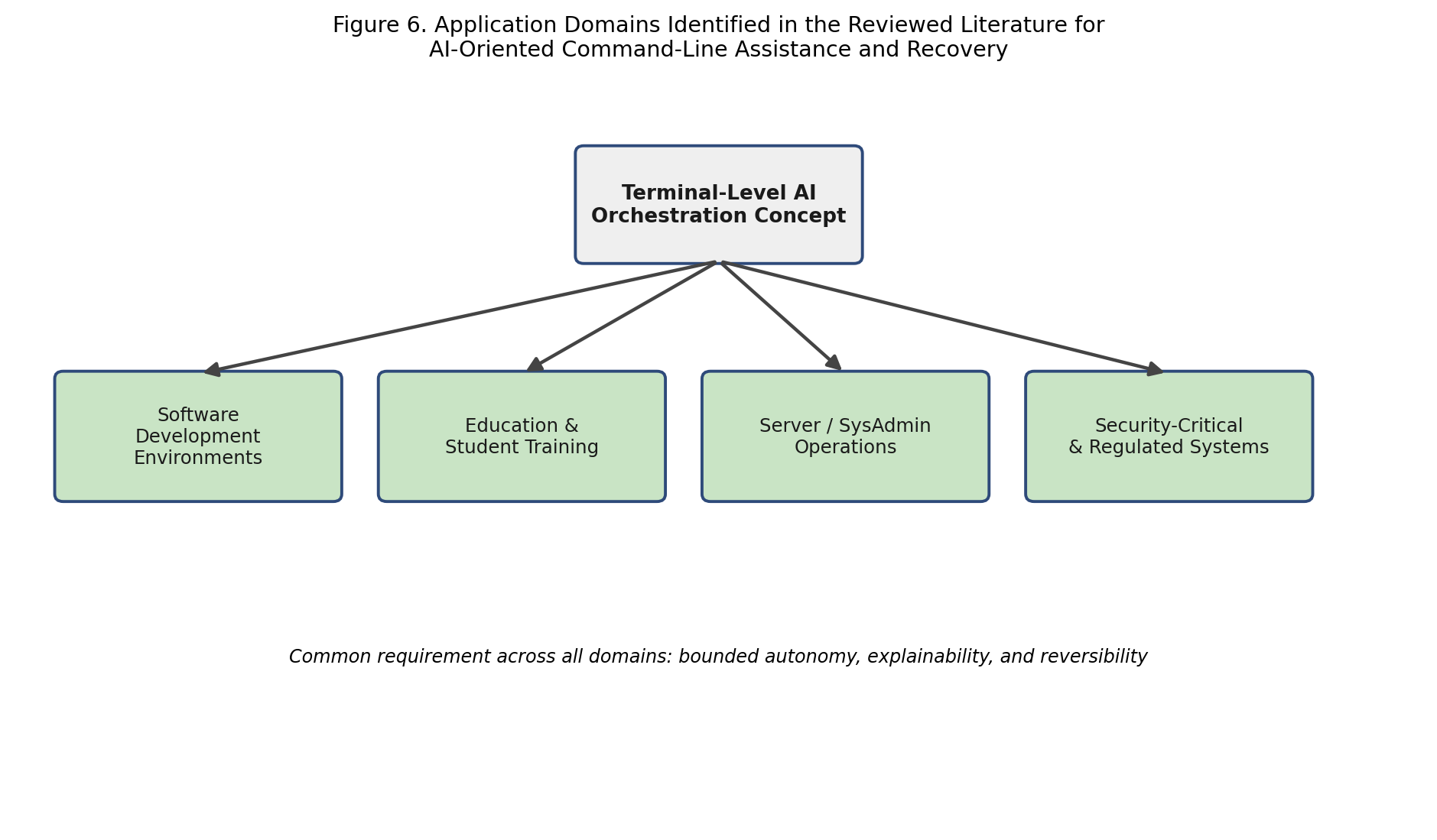
Although no reviewed system fully unifies the properties discussed above, the constituent technologies already have identifiable application contexts, and the literature offers some basis for anticipating where a unified terminal-level orchestration capability would be most valuable.
7.1Software development environments
Local development is the most obvious candidate. Anyone who has set up a new project knows the pattern: a dependency conflict here, a failed build there, an environment variable nobody remembered to set. IDE assistants have already shown that AI help speeds up the writing of code [1, 2]; extending something similar to installation and build failures would close exactly the gap identified in the relevant section, where productivity gained in the editor gets eaten up again at the terminal. In practice, developers already do a version of this informally, pasting error messages into a general-purpose chat assistant rather than using anything integrated into their shell. The harder problem is telling a benign, self-resolving error apart from one that actually needs intervention, and doing so without the system quietly rewriting a developer's environment in ways they did not ask for.
7.2Education and student training
Students learning Linux are disproportionately hit by exactly the kinds of errors this review keeps returning to — package problems, permission issues — and fault-pattern studies bear this out [17]. An explanation-first system, of the kind discussed in the challenges section, could take some of the sting out of that learning curve without doing the students' thinking for them; there is a real difference between a tool that explains a failure and one that just makes it disappear. Right now, though, educational support for this mostly means a textbook, a forum thread, or an instructor walking over to a student's desk — nothing adaptive or context-aware. Whatever gets built here would need to resist the temptation to simply fix everything automatically, since part of the point of a Linux course is learning to diagnose problems oneself.
7.3Server and system-administration operations
System administrators managing a fleet of heterogeneous servers deal with a version of this problem at scale: the same permission violation or dependency drift keeps showing up across machines, in a way that is almost tailor-made for the persistent knowledge repository described in the relevant section. Self-healing research has already shown, in comparable settings, that automated detection and repair improve reliability [9, 11]. Configuration-management tools cover the anticipated failures (see above); it is the unanticipated ones that still land on someone's desk. And this is exactly the domain where the asymmetric risk problem from the comparative critical analysis bites hardest — a wrong autonomous decision here is not an inconvenience, it is a production incident.
7.4Security-critical and regulated systems
Finally, there are environments bound by strict change-control and audit requirements, where any automation has to justify itself on paper as well as in practice. Here the appeal of confidence-gated, explanation-first design — a pattern that keeps surfacing across the self-healing and AI-safety literature [9, 22] — is fairly direct: every autonomous action, in principle, comes with a logged diagnosis and a confidence score attached to it, which is more or less what an auditor would want anyway. Adoption here is close to nonexistent at present, and the security concerns raised about AI coding assistants [4, 5] give regulated organizations good reason for caution. Formally verifying the boundaries of an autonomous system's authority, and slotting that verification into existing compliance tooling, is not something the surveyed literature has worked out yet.
| Application Domain | Primary Benefit Sought | Dominant Constraint | Maturity of Current Support |
|---|---|---|---|
| Software development | Reduced build/dependency friction | Avoiding unsafe autonomous environment changes | Informal (general-purpose LLM chat), not integrated |
| Education / training | Lower cognitive burden for novices | Preserving pedagogical value of manual diagnosis | Low; mostly static documentation |
| Server / sysadmin operations | Reliability at scale, reduced MTTR | Privilege management, production risk | Partial (rule-based automation only) |
| Security-critical / regulated systems | Auditable, explainable automation | Compliance, verification of autonomy bounds | Minimal; caution dominates current evidence |
8Challenges and limitations
This section discusses limitations that recur across the reviewed literature and that would directly constrain any attempt to unify these technologies into a terminal-level orchestration capability.
Technical and reliability limitations. Language-model-based diagnostic reasoning depends on the quality and representativeness of the signals it is given; in uncommon or highly system-specific failure conditions, model analysis may be incomplete or actively misleading, a concern raised explicitly in security evaluations of AI coding assistants [4, 5]. Confidence-gating mitigates but does not eliminate this risk, since a poorly calibrated confidence score can itself be wrong.
Experimental and evaluation limitations. As noted in the review methodology, the literature lacks a shared benchmark or task suite for evaluating autonomous CLI-error-recovery systems specifically; existing productivity studies (see above) measure code-authoring speed, and existing self-healing evaluations (see the section on self-healing systems) measure distributed-system reliability metrics such as mean time to recovery, but neither directly measures the recovery-time, success-rate, or user-intervention metrics that would be needed to evaluate a single-machine, interactive-terminal system. This makes cross-study comparison, and therefore cumulative progress, difficult.
Computational and deployment limitations. Cloud-based large language models introduce latency and, for offline or restricted environments, availability constraints; local or lightweight models trade capability for responsiveness and privacy. The reviewed literature does not report a settled resolution to this trade-off for the specific case of low-latency, interactive terminal use.
Reproducibility and standardization. Self-healing frameworks are frequently evaluated on custom testbeds specific to a single paper, and productivity studies for coding assistants have used different tasks, populations, and metrics (compare, for example, the bounded single-task RCT design in Peng et al. [2] with the longer-duration diary-study design in later work [19]), making direct comparison across studies difficult without careful attention to methodological differences.
Cost, scalability, and industrial applicability. Confidence-gated autonomy and explanation-first interaction (see the section on confidence-based decision making and the section on self-healing systems) impose engineering overhead — maintaining a knowledge repository, computing and calibrating confidence scores, and generating human-readable explanations — that has, in the surveyed literature, mostly been justified for distributed systems operating at a scale where the aggregate benefit outweighs this overhead. Whether the same overhead is justified for a single developer's interactive terminal session is not directly addressed by the reviewed studies.
Safety, privilege, and security limitations. Security evaluations of AI-assisted tools caution against unrestricted or opaque privilege escalation by automated agents [4, 5, 22]; this concern applies with particular force to any system capable of autonomously executing shell commands with elevated privileges, since the consequences of an erroneous autonomous action at the operating-system level can be more severe and less easily reversed than an erroneous code suggestion reviewed by a human before being committed.
Ethical and trust-related considerations. Automated command processing raises questions about excessive reliance on AI systems, potential erosion of practitioners' own diagnostic skills (a concern with particular relevance to the educational application discussed in the relevant section), and the risk of unintended system modification. The self-healing and AI-safety literature consistently stresses that transparency and preserved human authority are prerequisites for responsible deployment of autonomous remediation, rather than optional enhancements [9, 22].
| Challenge Category | Description | Primarily Evidenced In |
|---|---|---|
| Technical / reliability | Model reasoning quality depends on signal quality; risk of incomplete or misleading diagnosis | IDE-assistant security studies [4, 5] |
| Evaluation methodology | No shared benchmark for CLI-specific recovery metrics; cross-study comparison difficult | Productivity and self-healing literature generally [2, 9, 19] |
| Computational / deployment | Latency vs. capability trade-off between cloud and local inference | AIOps and self-healing deployment discussions [12] |
| Reproducibility | Custom, paper-specific testbeds and differing study populations/metrics | Self-healing surveys [9, 11] |
| Cost / scalability | Overhead of confidence scoring, knowledge repositories, and explanation generation | Autonomic computing and self-healing research [10, 15] |
| Safety / privilege | Risk of unsafe or irreversible autonomous privilege escalation | AI-assistant security evaluations [4, 5, 22] |
| Ethical / trust | Risk of over-reliance and eroded diagnostic skill; need for transparency | Self-healing and AI-safety literature [9, 22] |
9Research gaps
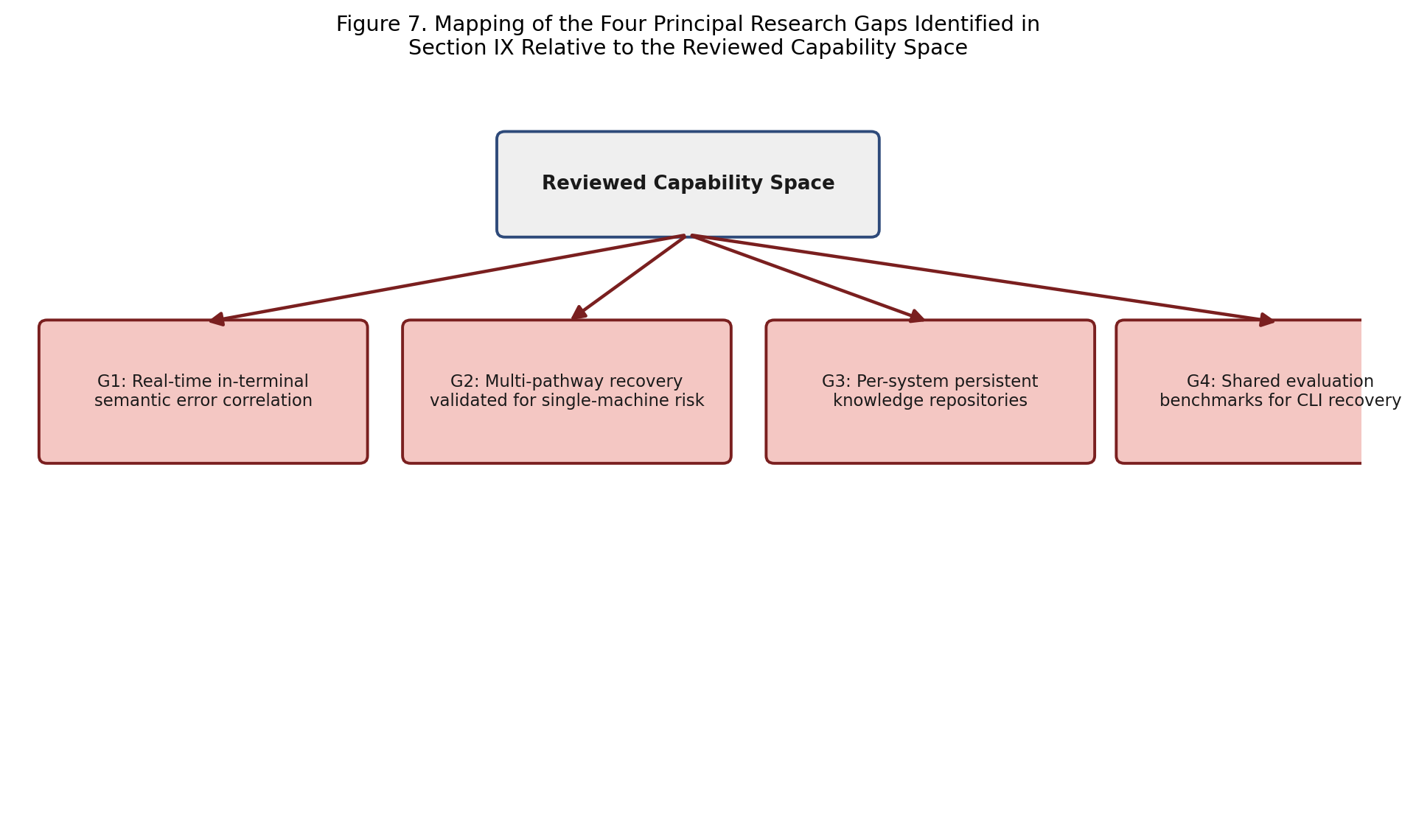
Based on the comparative synthesis in the comparative critical analysis and the challenges enumerated in the challenges section, this review identifies four specific, literature-grounded research gaps.
9.1Gap 1 — real-time, in-terminal semantic error correlation
Log-based diagnostic techniques capable of genuine semantic error correlation, including transformer-based log analysis frameworks, are already well developed for distributed-system monitoring [12, 13]. What none of that work has done is adapt to a much tighter deadline: a person sitting at a terminal expects an answer in well under a second, not on the periodic cadence of a monitoring dashboard. Until that adaptation happens, the diagnostic sophistication already proven at the infrastructure level simply cannot reach the individual developer at the moment they actually need it. A plausible way in would be a fast, locally-run first pass over exit codes and STDERR patterns, escalating to heavier semantic analysis only when that first pass comes back inconclusive.
9.2Gap 2 — multi-pathway recovery unvalidated for single-machine risk profiles
Self-healing research for distributed and cloud contexts has long since worked out how to weigh several candidate fixes against each other rather than committing blindly to the first one [9, 11]. The trouble, as the comparative critical analysis already flagged, is that the risk calculus behind those techniques was built for a redundant fleet of machines, not a single workstation with no fallback, and nobody in the surveyed literature has gone back and re-tested multi-pathway recovery under that different risk profile. Import the distributed-systems autonomy thresholds unchanged, and a system risks being either recklessly aggressive or uselessly timid on a single machine. The more sensible path is probably a confidence threshold that scales with how reversible the action actually is — stricter for something that rewrites system-wide configuration, looser for something as low-stakes as retrying a dropped network request.
9.3Gap 3 — absence of per-system, per-developer persistent knowledge repositories
Mature self-healing architectures keep a memory of what has worked before and reapply it when a familiar problem resurfaces [9, 11, 16]. Nobody has really built the individual-developer equivalent of that, and the question of what such a memory should even cover — just this machine, this person across all their machines, or some pooled experience across a community of similar setups — has not been studied carefully, privacy implications included. Without something in that space, a single developer's laptop is condemned to re-diagnose the same recurring failure from scratch every time, which is precisely the problem this whole review opened with in the relevant section. A reasonable starting point would be an empirical look at retention scope and its privacy trade-offs, possibly borrowing federated-learning ideas so that resolution patterns can be shared without ever sharing the raw system data behind them.
9.4Gap 4 — no shared evaluation benchmark for autonomous CLI-error-recovery systems
Every adjacent field has its own yardstick — NL2Bash and NL2CMD for command translation [6, 7, 8], controlled experiments like Peng et al.'s for coding-assistant productivity [2], mean-time-to-recovery for self-healing infrastructure — but nothing in the surveyed literature measures end-to-end recovery time, success rate, and reduction in manual intervention specifically for an autonomous CLI-recovery system. Those three criteria happen to be the ones the source AOS system itself proposed evaluating against (see above), which suggests they are the right starting point, but without a shared benchmark built around them, no two competing approaches to terminal-level orchestration can really be compared on equal footing. Command translation only moved as fast as it did once NL2Bash gave the field something common to test against; recovery research at the terminal level does not yet have its equivalent. A community-curated set of reproducible failure scenarios — dependency conflicts, compilation errors, permission issues, network failures, the same four categories discussed in the relevant section — measured consistently against those three criteria, would fill that hole.
| Gap | Core Problem | Suggested Research Direction |
|---|---|---|
| G1: Real-time in-terminal semantic error correlation | Log/AIOps diagnostic techniques are mature for infrastructure monitoring but not adapted to sub-second interactive feedback | Lightweight fast-pass classification with escalation to deeper semantic analysis only when needed |
| G2: Multi-pathway recovery for single-machine risk | Distributed-systems autonomy thresholds do not account for irreversible, non-redundant single-machine actions | Risk-stratified, irreversibility-aware confidence thresholds |
| G3: Per-developer persistent knowledge repositories | No systematic study of retention scope (machine/user/community) or privacy trade-offs at individual-developer scale | Empirical study of retention scope; federated approaches to share patterns without raw data |
| G4: Shared evaluation benchmark | No standardized metric suite for CLI-error-recovery systems; cross-study comparison is not possible | Community benchmark of reproducible failure scenarios with standardized recovery-time/success-rate/intervention metrics |
10Future research directions
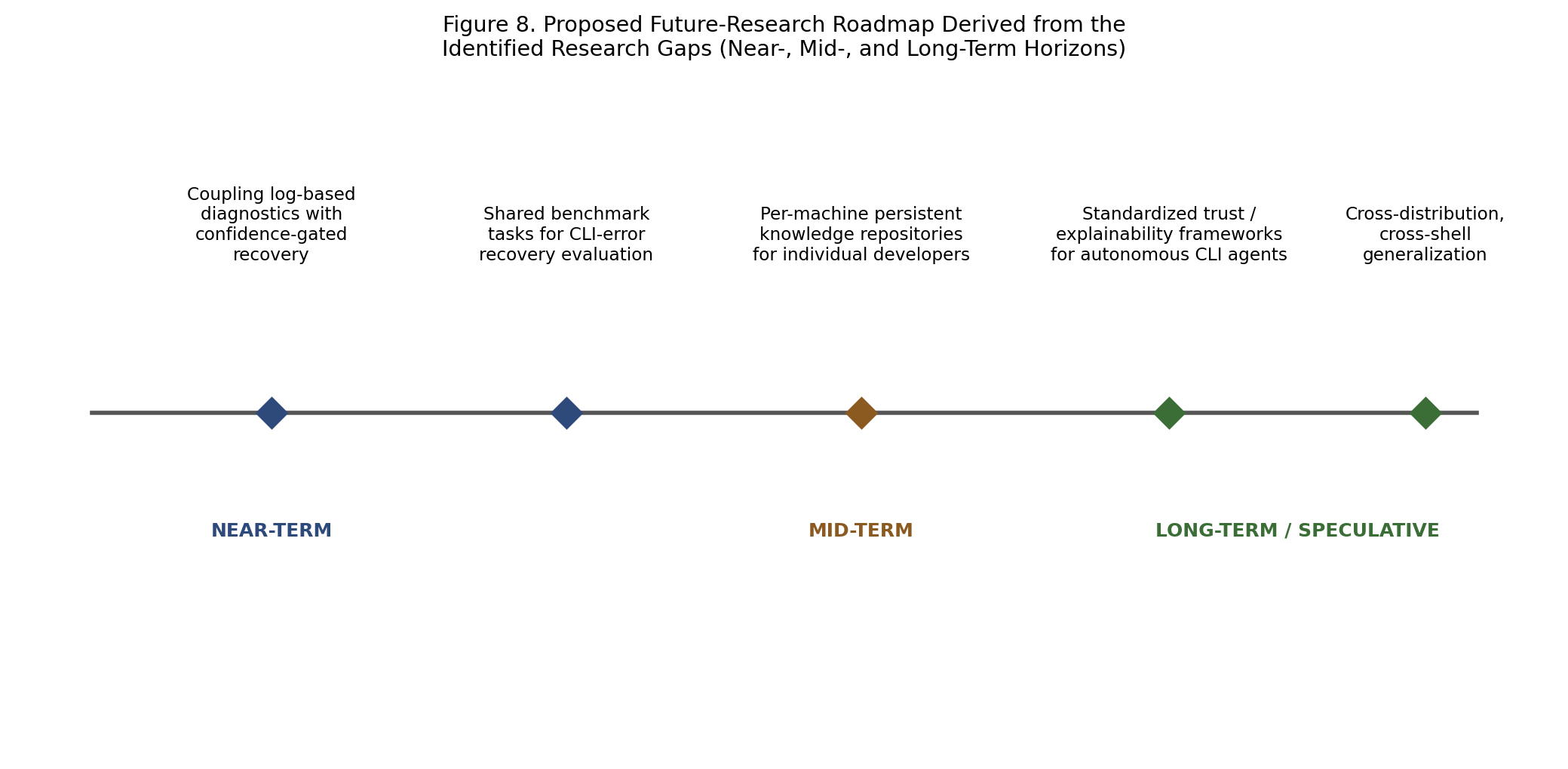
This section separates realistic near-term opportunities from more speculative longer-term possibilities, consistent with the roadmap depicted in Figure 8.
10.1Near-term opportunities
Two directions appear achievable using existing techniques with modest integration effort. First, coupling existing log-based diagnostic methods [12, 13] with the confidence-gated recovery patterns already validated in self-healing research [9, 11] for a bounded set of common Linux failure categories (dependency, compilation, permission, and network errors, mirroring the four evaluation scenarios discussed in the relevant section) is primarily an integration challenge rather than a fundamentally new research problem. Second, establishing shared benchmark tasks for CLI-error-recovery evaluation (addressing Gap 4) is achievable through community coordination, following the precedent set by the NL2Bash and NLC2CMD benchmarking efforts in the adjacent command-translation subfield [6, 18].
10.2Mid-term opportunities
Developing per-machine persistent knowledge repositories for individual developers (addressing Gap 3) requires both systems-engineering work (efficient local storage and retrieval of resolution patterns) and empirical human-computer-interaction research into what scope of retention developers find useful versus intrusive. This is classified as mid-term because it depends on resolving open questions about privacy and appropriate retention scope before a system can be responsibly deployed.
10.3Long-term and speculative directions
Standardized trust and explainability frameworks specific to autonomous CLI agents, and genuine cross-distribution, cross-shell generalization (a system trained or calibrated on one Linux distribution performing reliably on another without extensive re-adaptation), are classified as longer-term or speculative directions. The surveyed literature provides relevant building blocks — autonomic-computing's emphasis on explainable decision processes [10, 15], and AI-safety research's emphasis on bounded, reversible autonomy [22] — but does not report a mature, empirically validated solution to either problem in the specific context of interactive Linux terminals. These directions are presented as plausible extrapolations from current trends rather than as findings drawn from the reviewed studies.
11Conclusion
This review has examined four interrelated bodies of research relevant to bringing AI-driven reasoning into the Linux command-line environment: IDE-embedded coding assistants, natural-language and intelligent shells, log-based anomaly detection and AIOps, and self-healing or autonomic operating-systems research. Each community has made substantial, empirically documented progress within its own scope — from measured productivity gains for coding assistants [1, 2] to mature diagnostic techniques for system logs [12, 13] to well-established confidence-gated autonomy patterns in self-healing systems [9, 11] — but the review finds a consistent and largely unaddressed gap at their intersection: real-time, explainable, and adaptively learning error recovery integrated directly into the interactive terminal session of a single user, at a risk profile appropriate to a single, non-redundant machine.
The four research gaps identified in the research-gaps section — real-time in-terminal diagnosis, risk-appropriate multi-pathway recovery, per-developer persistent knowledge retention, and a shared evaluation benchmark — are derived directly from the comparative analysis in the comparative critical analysis rather than asserted independently of it, and the roadmap in the relevant section separates what appears achievable in the near term through integration of existing techniques from what remains genuinely open. Addressing this gap, and developing the shared evaluation infrastructure needed to measure progress toward it, represents a concrete direction for future research in AI-orchestrated operating environments — one that this review argues is both technically tractable, given the maturity of its constituent parts, and increasingly important, given the continued growth in complexity of modern software-development and operations workflows.
Consistent with the review's methodology (see the review methodology), this conclusion should be read as a synthesis of the reviewed literature rather than as a claim that any specific implementation already exists or has been empirically validated at the intersection described; readers preparing related original research should treat the identified gaps as a starting point for hypothesis formation and experimental design rather than as an inventory of proven results.
References
- [1]Peng S, Kalliamvakou E, Cihon P, Demirer M. The impact of AI on developer productivity: Evidence from GitHub Copilot. arXiv:2302.06590 [Preprint]. 2023.
- [2]Peng S, Kalliamvakou E, Cihon P, Demirer M. The impact of AI on developer productivity: Evidence from GitHub Copilot [experimental results: 55.8% task-completion speedup, controlled experiment with 95 recruited developers]. arXiv:2302.06590 [Preprint]. 2023.
- [3]Mozannar H, Bansal G, Fourney A, Horvitz E. Reading between the lines: Modeling user behavior and costs in AI-assisted programming. arXiv [Preprint]. 2023.
- [4]Pearce H, Ahmad B, Tan B, Dolan-Gavitt B, Karri R. Asleep at the keyboard? Assessing the security of GitHub Copilot’s code contributions. In: Proc. 43rd IEEE Symposium on Security and Privacy (SP). 2022. p. 754–768.
- [5]Majdinasab V, Bishop MJ, Rasheed S, Moradidakhel A, Tahir A, Khomh F. Assessing the security of GitHub Copilot’s generated code — a targeted replication study. In: Proc. 2024 IEEE Int. Conf. on Software Analysis, Evolution and Reengineering (SANER). 2024. p. 435–444.
- [6]Lin XV, Wang C, Zettlemoyer L, Ernst MD. NL2Bash: A corpus and semantic parser for natural language interface to the Linux operating system. arXiv:1802.08979 [Preprint]. 2018.
- [7]Boffa M, et al. LogPrécis: Unleashing language models for automated log analysis. arXiv:2307.08309 [Preprint]. 2023.
- [8]Fu Q, Teng Z, Georgaklis M, White J, Schmidt DC. NL2CMD: An updated workflow for natural language to Bash commands translation. arXiv:2302.07845 [Preprint]. 2023.
- [9]Momeni H, Kashefi O, Sharifi H. A self-healing operating system architecture. 2020.
- [10]Psaier H, Dustdar S. A survey on self-healing systems: Approaches and systems. Computing. 2011;91(1):43–73.
- [11]Horn P. Autonomic computing: IBM’s perspective on the state of information technology. IBM Corporation; 2001.
- [12]Schneider C, Barker A, Dobson S. A survey of self-healing systems frameworks. Software: Practice and Experience. 2015;45(10):1375–1398.
- [13]Zhong Z, et al. A survey of time series anomaly detection methods in the AIOps domain. arXiv:2308.00393 [Preprint]. 2023.
- [14]AIOps for log anomaly detection in the era of LLMs: A systematic literature review. 2025.
- [15]Progressing from anomaly detection to automated log labeling and pioneering root cause analysis. arXiv:2312.14748 [Preprint]. 2023.
- [16]Dijkstra EW. Self-stabilizing systems in spite of distributed control. Communications of the ACM. 1974;17(11):643–644.
- [17]Yazdanparast Z. A survey on self-healing software system. arXiv:2403.00455 [Preprint]. 2024.
- [18]Nettur SB, Karpurapu S, Nettur U, Gajja LS, Myneni S, Dusi A. The role of GitHub Copilot on software development: A perspective on productivity, security, best practices and future directions. arXiv:2502.13199 [Preprint]. 2025.
- [19]Dear Diary: A randomized controlled trial of generative AI coding tools in the workplace. arXiv:2410.18334 [Preprint]. 2024.
- [20]NeurIPS 2020 NLC2CMD competition: Translating natural language to Bash commands. arXiv:2103.02523 [Preprint]. 2021.
- [21]Autonomous fault detection in self-healing systems using restricted Boltzmann machines. arXiv:1501.01501 [Preprint].
- [22]Adaptive immunity for software: Towards autonomous self-healing systems. arXiv:2101.02534 [Preprint]. 2021.
- [23]IBM Research. Autonomic computing revisited. IBM Journal of Research and Development. 2021.