Education
Diversity, Equity and Inclusion (DEI) Initiatives: The Effect on Organizational Culture and Team Performance
Cebu Technological University – Main Campus, Cebu City, Cebu, Philippines
Published October 2026
Abstract
This study evaluated the implementation of Diversity, Equity, and Inclusion (DEI) Initiatives and determined their significant effect on the Organizational Culture and Team Performance within the local government units (LGUs) of Cortes, Baclayon, and Dauis in Bohol, Philippines, for the Calendar Year 2026. Utilizing a descriptive-correlational and structural research design, the study surveyed a stratified sample of 120 public servants across three institutional tiers: Strategic Level Top Management (12.50%), Operational Level Middle Management (12.50%), and Frontline Level Rank-and-File personnel (75.00%). Data collection was executed using a rigorously validated, researcher-designed 5-point Likert scale survey questionnaire, and the resulting data were processed using descriptive and inferential statistics, including frequencies, percentages, weighted means, and Pearson Product-Moment Correlation operations. The descriptive findings revealed a multi-generational workforce dominated by Millennials (38.33%) and Generation X (36.67%), with a distinct female majority (56.67%) and a substantial segment of casual or contract-of-service personnel (38.33%). In terms of the independent variables, respondents perceived a high baseline of demographic workforce representation under the Diversity pillar (3.48) and reported robust peer-level camaraderie and Bayanihan spirit under the Social Cohesion cultural dimension (4.25). However, critical systemic implementation gaps were uncovered: the Equity pillar received a lower, neutral evaluation (3.06) due to lingering perceptions of the padrino patronage system during career advancement (2.65). Similarly, the prevailing state of Psychological Safety registered a moderate baseline (2.98), hampered by a pronounced vulnerability regarding the ability of frontline workers to speak up about office inefficiencies without fear of administrative or professional reprisal (2.85). Despite these internal cultural constraints, Team Performance output markers remained uniformly high (3.97 for Achievement of Targets), driven by the formal compliance requirements of the Office Performance Commitment and Review (OPCR) systems. Based on these discoveries, the study culminated in the formulation and operationalization of the "DEI Strategic Roadmap and Inclusive Governance Toolkit." This action-oriented administrative framework provides a phased implementation scheme tailored to the specific environmental realities of the cluster towns addressing industrial transitions in Cortes, multi-generational heritage workflows in Baclayon, and high-pressure global tourism demands in Dauis. The toolkit introduces localized merit-based promotion manuals, "Inclusive Sabayan" status-blind meeting protocols, and structured, rank-transcendent feedback channels. This framework serves as a practical, evidence-based blueprint for Local Chief Executives and Human Resource Management Officers to transition the local civil service from simple checklist compliance into a resilient, transparent, and high-performing culture of public sector excellence.
Keywords: diversity, equity and inclusion (DEI); organizational culture; team performance; local government units; psychological safety; padrino system; Central Visayas; inclusive governance toolkit
1Introduction
1.1Rationale of the study
The evolution of the modern workplace has moved beyond mere productivity toward the realization that the "human element" is the primary driver of sustainable success. Historically, organizations operated under a "one-size-fits-all" model, assuming that a homogenous culture led to streamlined operations. However, the global discourse has shifted toward Diversity, Equity, and Inclusion (DEI). Diversity refers to the presence of differences within a given setting; Equity ensures that processes and programs are impartial and provide equal possible outcomes for every individual; and Inclusion is the practice of ensuring that people feel a sense of belonging and support from the organization.
This study begins with the global recognition that DEI is not a "charity" initiative but a strategic necessity. McKinsey & Company (2020) and Deloitte (2023) have consistently demonstrated that diverse teams are more innovative and resilient. However, most of these studies are rooted in Western, private-sector environments. The need for this research arises from the lack of localized data within the Philippine public sector, specifically within Local Government Units (LGUs) like those in Tagbilaran City. There is a critical need to understand if the positive correlations found in global corporations hold true in the Filipino "Bayanihan" context, where social cohesion often takes precedence over individualistic performance metrics.
In the Philippines, DEI is often legally introduced through the Gender and Development (GAD) mandate, as stipulated under Republic Act No. 9710, or the Magna Carta of Women. While GAD has paved the way for addressing gender disparities, it often overlooks other dimensions of diversity such as ageism, disability (PWD) inclusivity, and ethnolinguistic backgrounds. The rationale for this study is to advocate for a broader DEI framework that encompasses more than just gender.
In the 3 select municipalities of Tagbilaran City, the organizational culture is influenced by Civil Service Commission (CSC) regulations. However, there is often a gap between policy on paper and practice on the ground. For instance, while recruitment may appear "equal," the "equity" aspect, providing specific support for employees from marginalized socio-economic backgrounds, is often neglected. This study is relevant because it seeks to evaluate whether current LGU initiatives are merely "compliance-based" or if they are truly "culture-shifting." By investigating these initiatives, the research provides a roadmap for moving from bureaucratic checkboxes to genuine workplace transformation.
Organizational culture in the Philippine setting is deeply intertwined with cultural values such as Hiya (shame), Pakikisama (yielding to the group), and Utang na Loob (debt of gratitude). In the municipalities of Tagbilaran, these values can either facilitate or hinder DEI. A culture that prioritizes Pakikisama might inadvertently suppress diverse opinions in favor of harmony, leading to "groupthink."
The rationale here lies in exploring how DEI initiatives can recalibrate organizational culture without eroding these core Filipino values. If an LGU fosters an inclusive culture, it creates "Psychological Safety", a term coined by Amy Edmondson (1999) to describe a workplace where employees feel safe to take risks and speak up. In the context of Boholano governance, creating psychological safety is vital for transparency and innovation. This study explores the "Effect": does a DEI-sensitive culture reduce the "padrino" system (cronyism) and replace it with a merit-based, equitable environment?
The ultimate goal of any LGU is efficient service delivery to its constituents. Team performance in this sector is not just about "profit," but about the speed of processing permits, the empathy in social service delivery, and the effectiveness of disaster response. The rationale for linking DEI to team performance is based on the Information/Decision-Making Perspective. Diverse teams bring varied perspectives that are essential for solving complex community problems.
In Tagbilaran City, where the economy is a mix of tourism, education, and local trade, the LGU teams must be as diverse as the people they serve. If a team is inclusive, it is more likely to anticipate the needs of diverse citizens. This study aims to provide empirical evidence that DEI leads to "Collective Intelligence." By studying the 3 select municipalities, this research will determine if teams with high "Inclusion Scores" outperform those that are homogenous or exclusive in their decision-making processes.
Selecting Tagbilaran City as the research site is a strategic choice. As the capital of Bohol, it serves as the administrative heartbeat of the province. The 3 select municipalities within its influence represent a unique blend of urbanizing governance and traditional rural values. Bohol is a "UNESCO Global Geopark," which implies a commitment to international standards of sustainability and social inclusion.
The rationale for this specific location is the "City-Rural Hybridity." The employees in these municipalities are often caught between modern administrative demands and traditional community expectations. This study is highly relevant to Bohol’s developmental goals. If the capital's surrounding municipalities can master DEI, they become a blueprint for the rest of the province. Furthermore, with the rise of the "Creative Economy" in Bohol, fostering a culture that celebrates diversity is essential for attracting and retaining young, talented civil servants who prioritize workplace culture as much as salary.
There is a profound "Research-to-Practice" gap in Philippine public administration. While there are many theoretical papers on "Good Governance," there are few empirical studies that measure the psychological and performance outcomes of DEI in the LGU setting.
Need for Evidence-Based Policy: Local chief executives often implement "programs" without understanding the "culture." This study provides the data needed to design interventions that actually work.
Relevance to HRM: The Civil Service Commission’s PRIME-HRM (Program to Institutionalize Meritocracy and Excellence in Human Resource Management) requires LGUs to elevate their HR systems. DEI is a natural progression of PRIME-HRM. This study is relevant as it aligns with national goals of professionalizing the civil service.
Socio-Economic Resilience: Inclusive organizations are more adaptable. In a post-pandemic world, the ability of a municipal team to pivot and serve diverse populations is a matter of public safety and economic recovery.
The rationale is built on the premise that the public sector cannot afford to be exclusive. To serve a diverse public, the serving body must itself be diverse, equitable, and inclusive. This study is not just an academic exercise; it is a critical diagnostic tool for the 3 select municipalities in Tagbilaran City. It seeks to prove that when an employee, regardless of their background, feels valued and fairly treated, the "culture" transforms from a stagnant bureaucracy into a dynamic, high-performing team.
By grounding this research in the specific socio-cultural soil of Bohol, the study will provide "Indigenous Knowledge" on DEI that can be applied to other LGUs across the Philippines, ensuring that "No One is Left Behind" starts within the very walls of the government offices themselves.
1.2Theoretical background
At the heart of any diversity study lies Social Identity Theory (SIT), pioneered by Henri Tajfel and John Turner (1979). SIT posits that individuals define their self-concept based on the social groups to which they belong, leading to a cognitive process of categorization, identification, and comparison. In the context of the three select municipalities in Tagbilaran City, SIT explains the formation of "in-groups" and "out-groups" within the LGU workforce. When DEI initiatives are absent or poorly implemented, employees may gravitate toward cliques based on political affiliation, kinship (the "padrino" system), or even specific barangay origins, which can marginalize those who do not fit the dominant group profile. The rationale for anchoring the study on SIT is to understand how DEI initiatives can mitigate "in-group favoritism" and "out-group discrimination." By fostering an inclusive environment, the LGU can shift the "social identity" of the employee from a narrow sub-group to the broader organizational identity of being a "public servant of Bohol." As Hogg and Terry (2000) suggest, when organizational identification is strong, employees are more likely to engage in "organizational citizenship behaviors" that transcend their basic job descriptions, thereby enhancing overall team performance.
Complementing the psychological focus of SIT is the Resource-Based View (RBV) of the Firm, popularized by Jay Barney (1991). While originally developed for the private sector, RBV is highly applicable to public administration as it suggests that an organization’s competitive advantage or in the case of an LGU, its "service excellence", is derived from resources that are valuable, rare, inimitable, and non-substitutable (VRIN). In this study, "Diversity" is treated as a strategic human capital resource. A municipal team in Tagbilaran City that includes diverse ages, educational backgrounds, and socio-economic perspectives possesses a wider range of cognitive resources.
According to Cox and Blake (1991), organizations that manage diversity effectively gain a competitive advantage in areas such as creativity, problem-solving, and system flexibility. This theory is vital for this research as it links DEI initiatives directly to "Team Performance," arguing that an equitable workplace is not just a moral choice but a functional necessity for high-performing government teams that must navigate the complex needs of a diverse citizenry.
To understand the "Effect on Organizational Culture," the study is also anchored in Edgar Schein’s (2010) Organizational Culture Model. Schein defines culture through three distinct levels: artifacts (visible structures and processes), espoused values (strategies, goals, and philosophies), and basic underlying assumptions (unconscious, taken-for-granted beliefs and feelings). In many Philippine LGUs, the "espoused values" might officially include "Integrity and Inclusivity," yet the "underlying assumptions" might still be rooted in traditional hierarchy and patronage. DEI initiatives aim to align these levels. For instance, if a municipality in Bohol implements a "blind recruitment" process “an artifact” it reinforces the "espoused value" of equity, eventually changing the "underlying assumption" that jobs are reserved for the well-connected. This theoretical lens allows this study to measure the depth of the DEI "effect", whether it remains at the surface level of artifacts or truly penetrates the deeper layers of the LGU’s cultural fabric to influence daily interactions and team dynamics.
Furthermore, the study utilizes the Information/Decision-Making Perspective, synthesized by Williams and O'Reilly (1998). This theory argues that diverse groups are more likely to possess a broader range of task-relevant knowledge, skills, and abilities than homogenous groups. In the public sector of Tagbilaran, where LGUs face "wicked problems" such as rapid urbanization, climate change, and economic recovery, a homogenous team may suffer from "groupthink," leading to suboptimal policy decisions. The Information/Decision-Making Perspective posits that "Inclusion" acts as the critical moderator; if the organizational culture allows these diverse voices to be heard and valued, team performance improves through better-informed and more innovative decision-making processes. This provides a clear causal link between DEI initiatives and the performance outcomes of municipal departments.
The implementation of DEI initiatives in the Philippines is not merely a discretionary management choice but is deeply rooted in international covenants to which the country is a signatory. The Universal Declaration of Human Rights (UDHR), specifically Articles 1 and 2, establishes the global bedrock for DEI by asserting that all human beings are born free and equal in dignity and rights, without distinction of any kind, such as race, color, sex, language, religion, or political opinion. This international mandate compels local government units to ensure that their internal cultures do not perpetuate systemic exclusion. Furthermore, the International Labour Organization (ILO) Convention No. 111, known as the Discrimination (Employment and Occupation) Convention, requires the Philippines to promote equality of opportunity and treatment in employment with a view to eliminating any discrimination. This convention is highly relevant to the "Equity" component of the study, as it mandates that merit, rather than personal identity, should dictate career progression within the municipal government.
Additionally, the United Nations Sustainable Development Goals (SDGs), particularly Goal 5 (Gender Equality) and Goal 10 (Reduced Inequalities), provide a contemporary international framework for DEI. These goals emphasize that sustainable development cannot be achieved if large segments of the population are excluded from economic and political opportunities. For the select municipalities in Tagbilaran City, adhering to these goals means that their organizational performance is measured not just by administrative efficiency, but by how well they represent and include marginalized sectors within their own workforce. By localizing these global standards, the LGUs align themselves with international benchmarks of "Good Governance," which is increasingly important for Bohol as it positions itself as a global tourism and heritage destination.
In the Philippine domestic context, DEI initiatives are codified through a robust series of laws and administrative issuances that directly influence LGU operations. The 1987 Philippine Constitution serves as the primary legal basis, particularly Article II, Section 11, which declares that the State values the dignity of every human person and guarantees full respect for human rights. This is complemented by Article XIII, Section 3, which mandates the State to afford full protection to labor and promote equal employment opportunities for all. These constitutional provisions ensure that every employee within the Tagbilaran municipal offices has a legal right to an equitable and inclusive work environment, providing a mandate for the LGU leadership to move beyond traditional patronage and toward merit-based inclusion.
A more specific pillar of DEI in the Philippines is Republic Act No. 9710, also known as The Magna Carta of Women. This landmark legislation is the most visible "Diversity and Equity" law in the country, requiring all government agencies, including the select municipalities in Bohol, to adopt "Gender Mainstreaming." This includes the mandatory allocation of at least 5% of the total agency budget to Gender and Development (GAD) programs. This law directly impacts organizational culture by institutionalizing gender sensitivity and forcing a structural shift in how LGUs plan and execute their human resource strategies. It ensures that the "Diversity" of gender is not just recognized but is supported by "Equity" through targeted funding and programs, which the study will evaluate in terms of its effect on team cohesion and output.
The "Inclusion" aspect for Persons with Disabilities (PWDs) is legally anchored in Republic Act No. 10524, which amends the Magna Carta for Persons with Disabilities. This law mandates that at least 1% of all positions in all government agencies, offices, or corporations shall be reserved for PWDs. For the municipalities in Tagbilaran City, this legal requirement acts as a catalyst for cultural change, necessitating physical and social adjustments to the workplace to accommodate diverse needs.
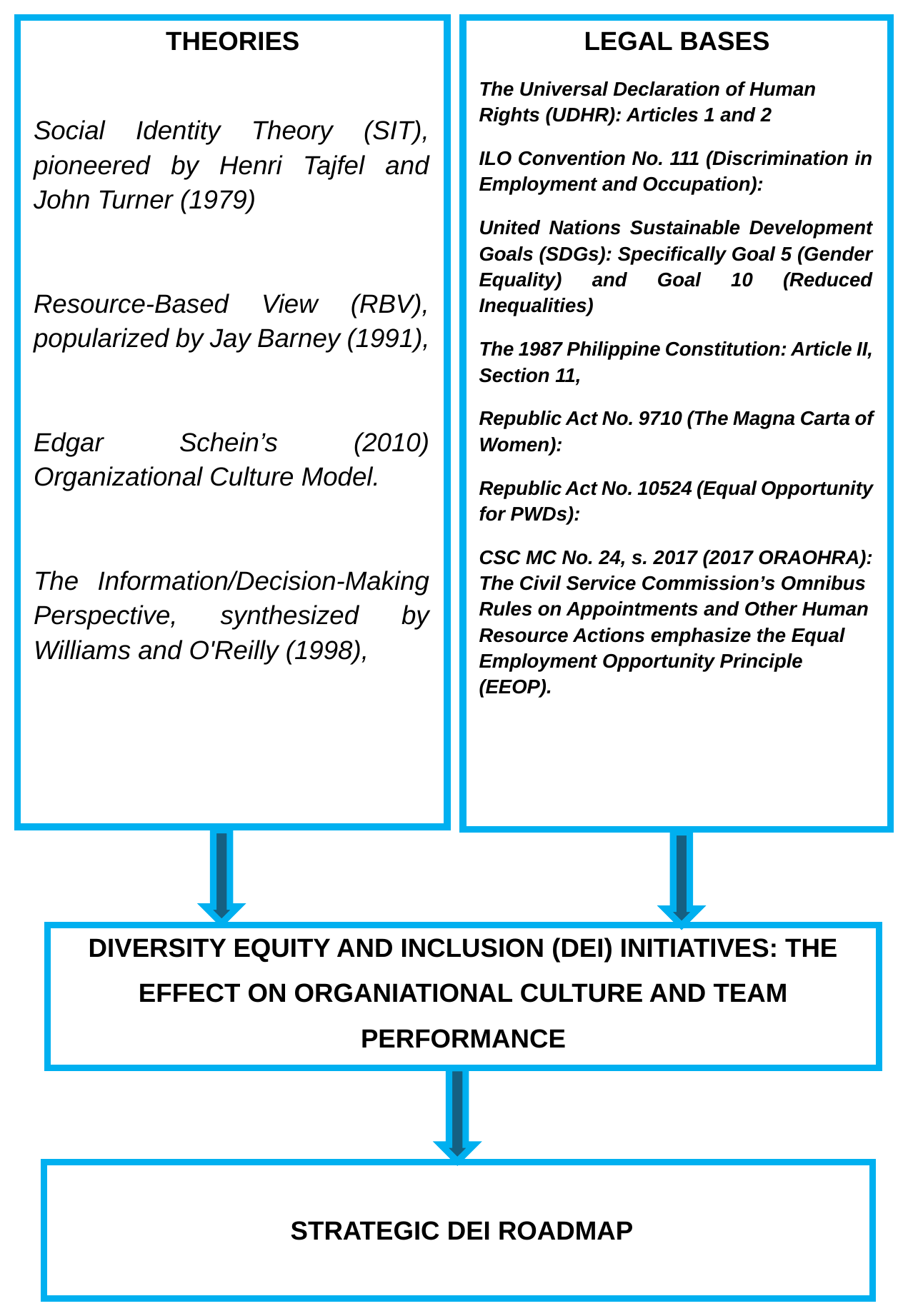
The theoretical and conceptual framework of the study is presented in Figure 1.
When an LGU successfully integrates PWDs into its teams, it sends a powerful message about the organization's commitment to inclusion, which, according to the theoretical framework of this study, should lead to improved psychological safety and team performance.
Finally, the Civil Service Commission (CSC) Memorandum Circular No. 24, s. 2017, or the 2017 Omnibus Rules on Appointments and Other Human Resource Actions (ORAOHRA), provides the administrative teeth for DEI initiatives. These rules emphasize the Equal Employment Opportunity Principle (EEOP), which mandates that there shall be no discrimination in the selection of employees on account of age, sex, sexual orientation and gender identity, civil status, disability, religion, ethnicity, or political affiliation. This CSC issuance is the primary tool used by HR managers in Tagbilaran to ensure that the "Inclusion" and "Equity" discussed in global theories are translated into daily hiring and promotion practices. It serves as a critical benchmark for this study to assess whether the municipalities are merely complying with the letter of the law or embracing the spirit of DEI to transform their organizational culture.
The synthesis of these theories and legal bases creates a compelling rationale and a clear direction for the research. Social Identity Theory and Schein’s Culture Model provide the "Psychological and Cultural" roadmap for understanding why DEI is often resisted and how it can be successfully integrated. Meanwhile, the Resource-Based View and the Information/Decision-Making Perspective provide the "Performance" justification, arguing that diversity is not just a legal burden but a strategic asset that enhances the LGU's ability to serve the public.
The legal bases, ranging from the global UDHR to the local CSC EEOP, transform these academic theories into administrative mandates that the select municipalities in Tagbilaran City must follow. The study is relevant because it evaluates the "implementation gap", the space between what the law requires and how the employees actually experience their workplace culture. If a municipality in Bohol has a GAD budget (Law/Artifact) but still fosters a culture of exclusion (Assumptions), the "Team Performance" will likely suffer due to low morale and lack of diverse input. By anchoring the study in this intersection of theory and law, the researcher can provide a holistic analysis of how DEI initiatives serve as a bridge between legal compliance and organizational excellence, ultimately benefiting the constituents of Bohol through a more representative and high-performing government.
2The problem
2.1Statement of the problem
This research evaluated the implementation of Diversity, Equity, and Inclusion (DEI) Initiatives and determine their significant effect on the Organizational Culture and Team Performance within the identified local government units of Central Visayas for Calendar Year 2026 for Strategic DEI Roadmap.
Specifically, the study sought to answer the following questions:
- 1. What is the demographic profile of the respondent-groups in terms of age, gender, civil status, educational attainment, length of service, employment status, and current position?
- 2. As perceived by the respondent-groups, what is the prevailing state of the organizational culture in the select municipalities in terms of psychological safety, institutional values, and social cohesion?
- 3. How do the respondents perceive the current status of DEI initiatives in their respective municipalities across the three pillars of diversity, equity, and inclusion?
- 4. What is the perceived level of team performance in the municipal departments as measured by service efficiency, collaborative problem-solving, and achievement of targets?
- 5. Based on the findings of the study, what “Strategic DEI Roadmap” to enhance the organizational and service excellence of the select municipalities can be operationalized?
2.2Significance of the study
The Significance of the Study provides a clear justification for why this research is essential and identifies the specific groups and entities that will benefit from the findings. By examining the impact of DEI initiatives in the municipalities of Cortes, Baclayon, and Dauis, this study serves as a catalyst for professionalizing local governance and fostering a more equitable workplace environment.
The Civil Service Commission (CSC). The results of this study contribute to the body of knowledge in Philippine public administration by providing a specific case study on DEI in the local government context. This can serve as a reference for the CSC in refining national policies related to the Equal Employment Opportunity Principle (EEOP) and its implementation at the municipal level.
Local Chief Executives and Policy Makers. The findings will provide the Mayors and Vice-Mayors of the select municipalities with empirical data regarding the actual effectiveness of their current administrative policies. This allows them to transition from a compliance-based approach to a more intentional, data-driven leadership style that prioritizes social equity and institutional integrity.
Human Resource Management Officers (HRMOs). This study is highly significant for HR practitioners as it offers a localized framework for recruitment, promotion, and employee retention that aligns with the Civil Service Commission’s PRIME-HRM standards. The research provides the necessary evidence to advocate for the removal of the "padrino" system, replacing it with merit-based and inclusive HR interventions.
Middle Managers and Team Supervisors. The research will benefit supervisors by identifying the specific inclusive behaviors that lead to higher team performance and more efficient collaborative problem-solving. It provides them with a clearer understanding of how to manage diverse age groups and varying professional backgrounds to achieve departmental targets more effectively.
Rank-and-File Municipal Employees. The primary beneficiaries are the frontline workers who will experience an improved organizational culture characterized by higher psychological safety and a stronger sense of belonging. By highlighting the existence of exclusionary cliques or unfair practices, the study advocates for a workplace where every employee, regardless of status or background, feels valued and empowered.
The Constituents of Cortes, Baclayon, and Dauis. Ultimately, the community benefits from a more inclusive and high-performing local government. When municipal teams are diverse and inclusive, they are better equipped to understand and address the varied needs of the public, leading to faster, more empathetic, and more innovative social service delivery.
Future Researchers and Academicians. This study serves as a valuable baseline and reference for future scholars interested in the intersection of DEI and local governance in the Philippines. It addresses a significant gap in local literature and provides a tested methodology and a localized "DEI Strategic Roadmap" that can be replicated or expanded in other provinces.
The Province of Bohol. As Bohol continues to grow as a UNESCO Global Geopark and a tourism hub, its governance must reflect international standards of inclusion. This study supports the province's developmental goals by creating a blueprint for "Inclusive Governance" that can be adopted by all other municipalities in the province, ensuring that "No One is Left Behind" starts within the halls of government.
3Research methodology
This study was anchored on a quantitative research approach, specifically employing descriptive-correlational and causal-comparative methods to investigate the interplay between Diversity, Equity, and Inclusion (DEI) initiatives and their outcomes. By utilizing a quantitative strategy, the study allowed for a systematic and objective measurement of variables through numerical data, which was essential for identifying patterns across the three distinct municipal environments of Cortes, Baclayon, and Dauis. This approach facilitated the collection of empirical evidence from a broad range of public servants, ensuring that the findings are statistically significant and can be generalized within the context of local government units in Bohol. The methodology emphasized the use of standardized survey instruments to capture perceptions of organizational culture and team performance, providing a rigorous framework to assess whether current DEI policies are effectively translating into cultural and operational improvements. Furthermore, the methodology accounted for the varying socio-economic backgrounds of the three municipalities, allowing the researcher to evaluate how industrial, heritage-based, and tourism-heavy environments influence the implementation of inclusive practices.
3.1Research design
The study adopted a descriptive-correlational research design to evaluate the current status of DEI initiatives and their subsequent effect on the workplace dynamics of the select municipalities. The descriptive aspect of the design was utilized to provide a comprehensive profile of the respondents and to quantify the prevailing levels of psychological safety, social cohesion, and service efficiency within the organizations. Simultaneously, the correlational aspect was employed to determine the degree of relationship between the independent variable, DEI initiatives, and the dependent variables of organizational culture and team performance. This design was particularly advantageous as it sought not only to describe "what" was happening in the LGUs but also to explore "how" and to what extent these variables influence one another. By applying this design, the researcher identified high levels of perceived equity and inclusion directly correlate with superior team performance and a healthier cultural environment, thereby providing a solid foundation for the development of the proposed strategic roadmap.
3.2Flow of the study
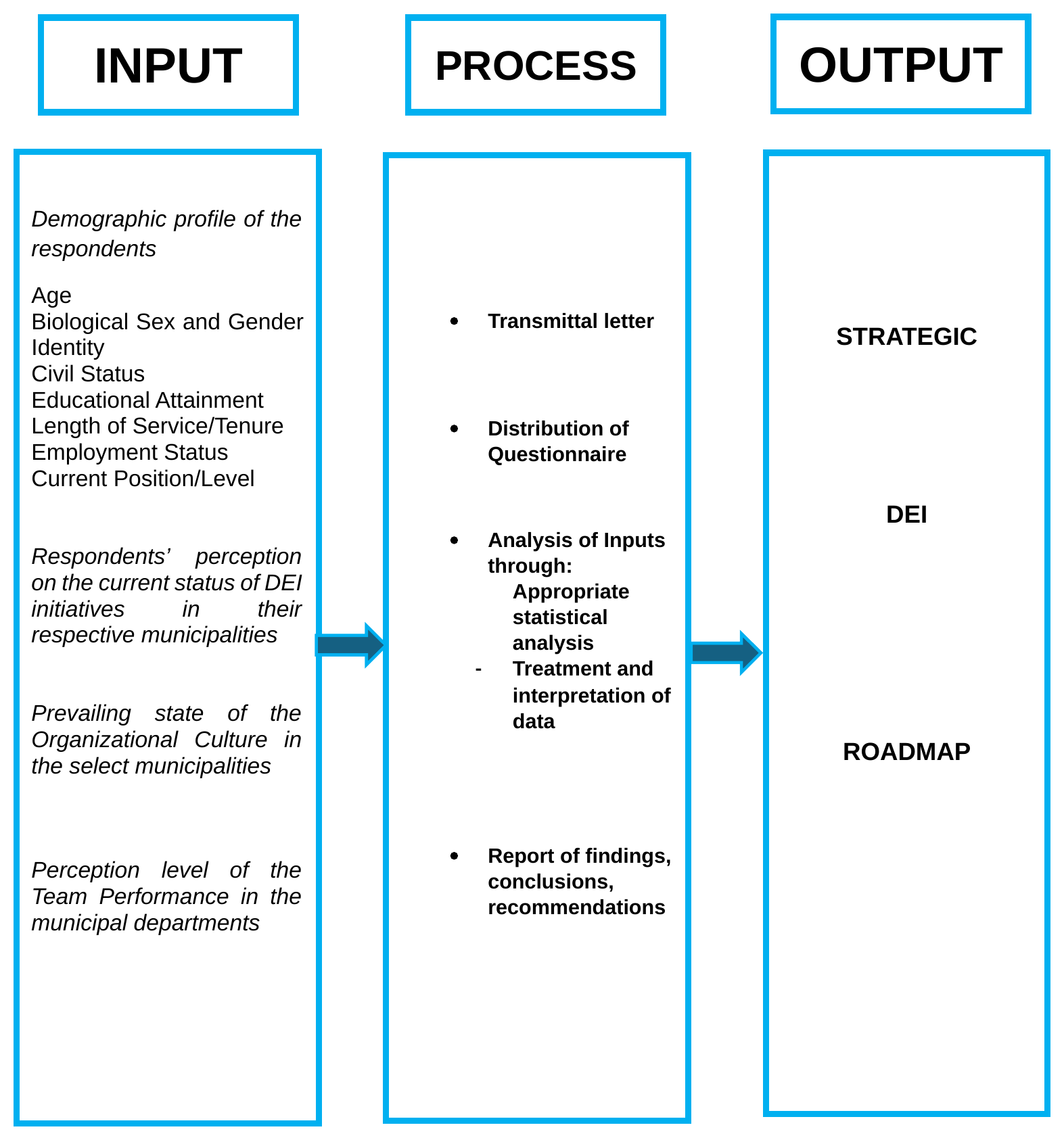
The flow of the study was structured using the Input-Process-Output (IPO) model, which served as a logical roadmap for the research journey from data acquisition to the creation of actionable solutions. The Input phase encompassed the foundational elements required for the study, primarily the demographic profile of the respondents including age, gender identity, civil status, educational attainment, tenure, and position level across the strategic, operational, and frontline groups. It also included the specific DEI initiatives currently in place within Cortes, Baclayon, and Dauis, along with the baseline indicators for organizational culture such as psychological safety and institutional values, and the performance metrics like service efficiency and OPCR target achievements. These inputs represent the raw data and variables that set the stage for the investigation into how the municipalities function as diverse and inclusive organizations.
The Process phase represented the analytical core of the research, where the gathered inputs undergone rigorous transformation through various stages of data collection and statistical interpretation. This stage began with the distribution of the validated research instrument to the stratified purposive samples in the three municipalities. Once the data were collected, it was subjected to statistical treatments such as frequency distribution for the demographic profile, weighted mean for assessing the status of DEI and culture, and correlational analysis to determine the effects on team performance. This phase also involved a comparative analysis to see how the industrial, heritage, and tourism contexts of the three municipalities differ in their DEI implementation. The process was designed to filter the subjective perceptions of the public servants into objective findings that highlight the strengths and weaknesses of the existing municipal governance structures.
The Output phase was the final and most significant stage of the study, resulting in the development of the "DEI Strategic Roadmap and Inclusive Governance Toolkit." This output was a tangible, data-driven framework designed to enhance the organizational health and service excellence of the municipalities involved. Based on the findings from the process phase, the toolkit will include specific components such as localized maturity rubrics, inclusive leadership protocols, and equity-based HR guidelines tailored to the unique cultural landscape of Bohol.
The research flow is summarised in Figure 2.
This phase ensured that the research does not end with academic conclusions but provided a practical and doable instrument that local chief executives and HR managers can use to institutionalize meritocracy and inclusivity. By completing this IPO cycle, the study bridges the gap between theoretical DEI concepts and the actual administrative needs of the local government units in Cortes, Baclayon, and Dauis.
3.3Environment
The research environment for this study was strategically situated within the province of Bohol, specifically focusing on the three select municipalities of Cortes, Baclayon, and Dauis. These locales were geographically and economically significant as they form a vital administrative cluster surrounding Tagbilaran City, the provincial capital. By centering the investigation on these specific areas, the study captures a diverse cross-section of the Boholano public sector, ranging from heritage-rich communities to rapidly industrializing zones and globally recognized tourism hubs. This environmental diversity was crucial for assessing how Diversity, Equity, and Inclusion (DEI) initiatives are implemented and perceived across varying organizational contexts within the Philippine Local Government Unit (LGU) framework.
Cortes served as a representative of a municipality in a state of active transition toward industrialization. As the site of significant government infrastructure and burgeoning local industries, its organizational environment is characterized by a drive toward modernization and administrative efficiency. The research in Cortes allowed for an exploration of how DEI initiatives facilitate the integration of diverse technical skills and backgrounds necessary for industrial growth. It provided a lens into how equity and inclusion are managed in a setting where traditional agrarian values meet the demands of a modernizing economy, and how this cultural shift influences the collective performance of municipal teams tasked with infrastructure and economic development.
In contrast, the municipality of Baclayon provided an environment deeply rooted in cultural heritage and a tourism-based economy. As one of the oldest towns in Bohol, its organizational culture was often a blend of historical tradition and the modern requirement to interact with a diverse array of international and local stakeholders. The DEI landscape in Baclayon is unique because it must account for cultural intelligence as a core component of team performance. The study in this environment examined how inclusive practices help preserve local identity while fostering a workforce capable of navigating the complexities of global heritage tourism, ensuring that equity is maintained in a setting where social capital and tradition carry significant weight.
Dauis, located on Panglao Island, represented the most globally exposed research environment in this study. Known as a premier international tourism hub, Dauis manages a highly diverse workforce that must cater to an influx of multicultural visitors and investors. The municipal LGU in Dauis operated under intense pressure to maintain high-performance standards in environmental management, security, and public service.
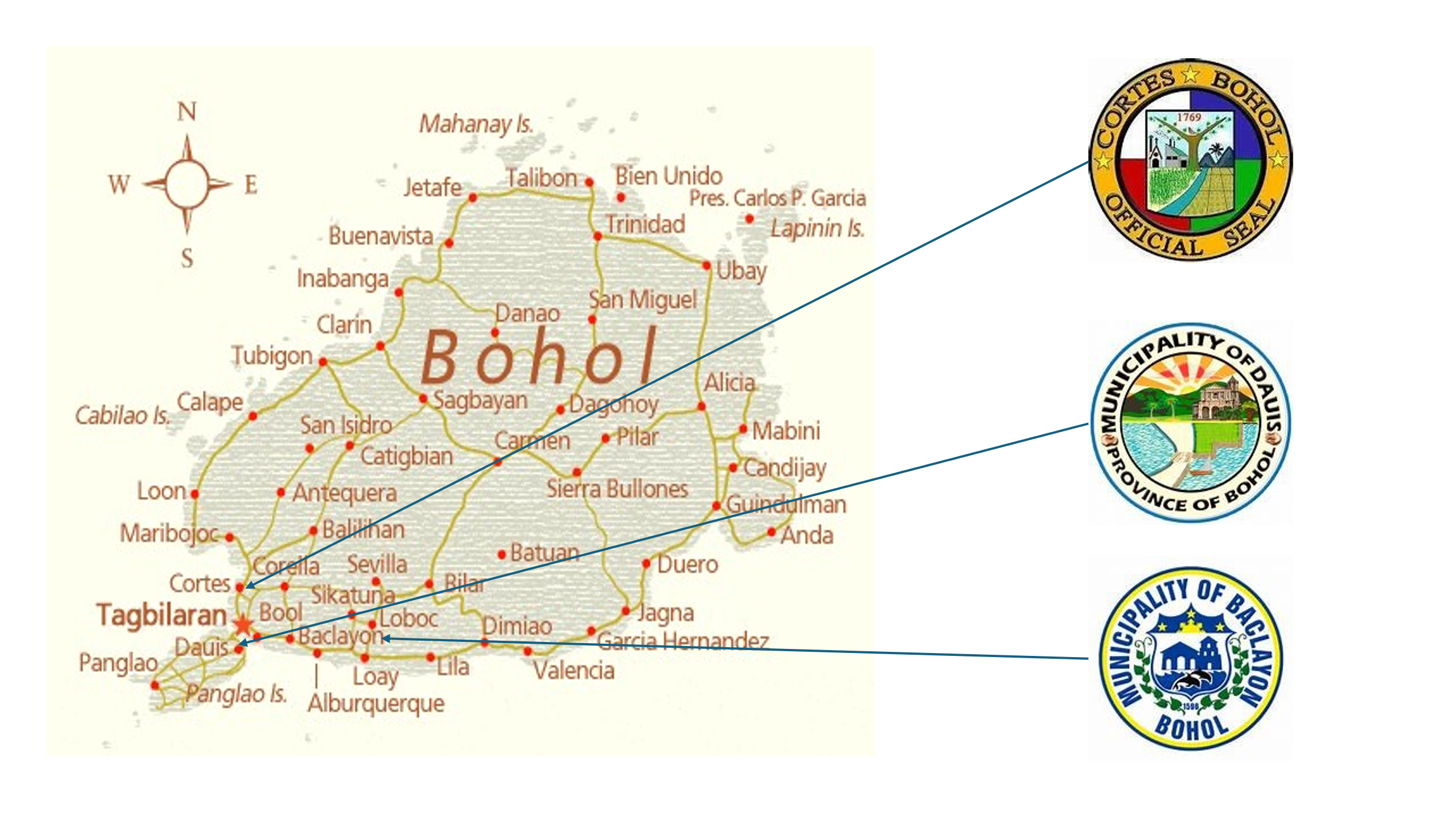
The location of the three municipalities is shown in Figure 3.
This setting was ideal for observing the inclusion variable, as the municipality must integrate employees who possess varying degrees of exposure to global standards. The research environment in Dauis served as a testbed for determining if DEI initiatives can effectively mitigate the stresses of high-demand tourism governance by fostering a more cohesive and inclusive departmental culture.
The relevance of selecting these three municipalities lies in their collective ability to serve as a microcosm of the Philippine public sector's challenges and opportunities. By investigating LGUs with distinct economic drivers, industrialization in Cortes, heritage in Baclayon, and tourism in Dauis, the study moved beyond a monolithic view of government work. The importance of this specific environment is found in its capacity to test the adaptability of DEI initiatives. If inclusive practices can be shown to improve team performance and organizational culture across these three diverse settings, the findings gain significant external validity, suggesting that the results could be applicable to other LGUs across the archipelago that share similar characteristics.
Furthermore, the proximity of these municipalities to Tagbilaran City adds a layer of metropolitan influence, where the rapid pace of urban development meets provincial administrative norms. This environment was important because it highlighted the "implementation gap" often found in developing regions, where national DEI mandates may exist on paper but struggle to penetrate deeply ingrained local hierarchies. Studying these three LGUs provided a unique opportunity to understand how "Pakikipagkapwa-tao" (the Filipino value of shared identity) can be leveraged as a strength in DEI initiatives to replace exclusionary cliques or "padrino" systems.
Ultimately, the importance of this research environment was directly linked to the study's goal of producing the DEI Strategic Roadmap and Inclusive Governance Toolkit. Because the environment encompasses such varied municipal profiles, the resulting toolkit were grounded in reality rather than theory alone. It ensured that the proposed solutions are resilient enough to handle the industrial technicalities of Cortes, the cultural sensitivities of Baclayon, and the fast-paced global demands of Dauis. This made the research environment not just a backdrop, but a critical variable that ensured the study's output was highly actionable, culturally competent, and sustainable for the long-term professionalization of Boholano governance.
3.4Respondents
The identification and selection of respondents were fundamental to ensuring that the data gathered for the study was both representative and high in integrity. For this study, the respondents are the public servants of the Local Government Units (LGUs) of Cortes, Baclayon, and Dauis. These individuals were chosen because they are the primary actors and observers within the organizational ecosystem where Diversity, Equity, and Inclusion (DEI) initiatives are implemented. To capture a holistic view of the "Effect" mentioned in the study’s title, the respondents are categorized through a stratified purposive sampling method. This approach ensured that the data were not skewed toward a single perspective but instead reflects a "360-degree" view of the municipal workplace, from the visionaries at the top to the implementers in the middle and the frontline workers who experience the organizational culture most acutely.
The respondents were divided into three distinct strata based on their roles and influence within the LGU hierarchy. The first group is the Strategic Group (Top Management), which included Municipal Mayors, Vice-Mayors, and Department Heads such as the HRMO and Budget Officers. Their role was to provide data on the "Espoused Values" of the municipality, the formal DEI initiatives and policies they have authored or approved. The second group is the Operational Group (Middle Management), consisting of Section Chiefs and Team Supervisors. This group was essential for measuring Team Performance, as they are directly responsible for departmental outputs and can witness how diverse teams collaborate under pressure. The third group is the Frontline Group (Rank-and-File), comprising regular and casual employees. They served as the primary source for data on Organizational Culture, as their daily experiences revealed whether the workplace was truly inclusive or if systemic biases like the "padrino" system still persist.
The distribution of respondents is shown in Table 1.
| Municipality | Management | Supervisors | Rank-and-file | Total (target) | Percentage (%) |
|---|---|---|---|---|---|
| Cortes | 5 | 5 | 30 | 40 | 33.33% |
| Baclayon | 5 | 5 | 30 | 40 | 33.33% |
| Dauis | 5 | 5 | 30 | 40 | 33.33% |
| Total | 15 | 15 | 90 | 120 | 100.00% |
The use of stratified purposive sampling was a deliberate choice to ensure that each municipality, Cortes with its industrial transition, Baclayon with its heritage focus, and Dauis with its global tourism demands, was represented with equal weight. By setting a fixed target of 120 respondents across the three sites, the study maintained a balanced comparative framework. This structure allowed the researcher to determine if the "Effect" of DEI initiatives varies significantly depending on the employee’s rank or the municipality’s specific economic driver. Furthermore, the inclusion of a significant number of Rank-and-File employees (75% of the total sample) ensures that the final output, the DEI Strategic Roadmap and Inclusive Governance Toolkit, was grounded in the real-world needs of the majority of the workforce rather than just the aspirations of the leadership.
3.5Instruments
The primary tool for this study was a researcher-designed, validated survey questionnaire structured into four comprehensive parts to address the variables defined in the Statement of the Problem. Part I, gathered the demographic profile of the respondents from Cortes, Baclayon, and Dauis, capturing essential data such as age, gender identity, education, and tenure. Part II, focused on the status of DEI Initiatives, specifically measuring diversity, equity, and inclusion as perceived by the municipal employees. Part III, assessed the Organizational Culture, examining psychological safety and social cohesion, while Part IV evaluated the Team Performance through indicators like service efficiency and achievement of targets. To ensure the reliability of the instrument, it has undergone content validation by experts in public administration and human resources, followed by a pilot test using Cronbach’s Alpha to ensure internal consistency across all items.
3.6Data gathering procedures
The data gathering process commenced after securing the necessary ethical clearances and formal permits from the three select municipalities. Once permission was granted, a transmittal letter was issued to the 120 target respondents, explaining the purpose of the study and ensuring the confidentiality of their responses. The researcher employed a stratified purposive sampling method to distribute the questionnaires across the strategic, operational, and frontline groups. Data collection were conducted through a hybrid approach, utilizing both printed questionnaires for local office distribution and digital forms for ease of access, ensuring a high response rate. After the allotted period for data collection, the researcher retrieved the instruments, verify the completeness of the entries, and tabulated the results for statistical analysis, ensuring that the data from each municipality were categorized correctly to allow for comparative discussion.
3.7Statistical treatment of data
The study employed a variety of statistical tools to process the gathered data and answer the specific research questions. For the demographic profile (SOP 1), frequency and percentage distribution were used to describe the characteristics of the 120 respondents. For the assessment of DEI Initiatives, Organizational Culture, and Team Performance (SOP 2, 3, and 4), the Weighted Mean will be the primary tool to determine the prevailing status of these variables in Cortes, Baclayon, and Dauis.
To determine the "effect" and relationship between the variables (SOP 5), Pearson Product-Moment Correlation (Pearson’s r) were utilized to measure the strength of the association between DEI initiatives and the dependent variables. Furthermore, Stepwise Multiple Regression Analysis may be applied to see which specific pillar, diversity, equity, or inclusion, served as the strongest predictor of team performance. Finally, Analysis of Variance (ANOVA) were used to determine if significant differences exist in the perceptions of respondents when grouped according to their municipality or position level. All statistical computations were processed using modern statistical software to ensure accuracy and provide a solid empirical basis for the "DEI Strategic Roadmap and Inclusive Governance Toolkit."
3.8Scoring procedures
To interpret the quantitative data regarding DEI initiatives, organizational culture, and team performance, a five-point Likert scale were utilized. This scale allowed the respondents to rate their level of agreement with various statements, which then were interpreted using specific weighted mean ranges. The scoring procedure ensured that the qualitative "felt reality" of the public servants in Bohol was translated into measurable data points. The scale and its verbal interpretation are shown in Table 2.
| Scale | Range | Verbal interpretation |
|---|---|---|
| 5 | 4.21 – 5.00 | Strongly Agree / Very High |
| 4 | 3.41 – 4.20 | Agree / High |
| 3 | 2.61 – 3.40 | Neutral / Moderate |
| 2 | 1.81 – 2.60 | Disagree / Low |
| 1 | 1.00 – 1.80 | Strongly Disagree / Very Low |
4Definition of terms
This section provided conceptual and operational clarity for the key variables and terminologies utilized in this research. To ensure a comprehensive understanding, the study were conducted within the municipalities of Cortes, Baclayon, and Dauis, the following terms are defined according to their specific application in this investigation.
Achievement of Targets refers to the quantifiable extent to which municipal departments meet their pre-determined goals as documented in the Office Performance Commitment and Review (OPCR) and Individual Performance Commitment and Review (IPCR) forms.
Age denotes the chronological stage of the respondents, categorized into generational cohorts such as Gen Z, Millennials, Gen X, and Baby Boomers, to evaluate how age-based diversity influences workplace perceptions.
Biological Sex refers to the anatomical and physiological classification of respondents as male or female, used as a primary metric for assessing gender-based representation in the LGU workforce.
Casual Employees refers to the group of public servants who hold temporary or non-permanent appointments within the municipalities, serving as a key demographic for analyzing job security and equity.
Civil Status identifies the legal standing of the respondent, such as single, married, widowed, or separated, used as a demographic variable to understand the social background of the municipal workforce.
Collaborative Problem-Solving operationally refers to the ability of municipal teams to utilize their diverse skills and perspectives to generate innovative solutions for community-related challenges and administrative bottlenecks.
DEI Initiatives refers to the specific policies, programs, and practices implemented by the municipalities to promote a diverse workforce, ensure equitable treatment, and foster an inclusive environment.
DEI Strategic Roadmap refers to the proposed developmental plan that serves as the primary output of this study, providing a step-by-step guide for LGUs to improve their inclusivity and performance metrics.
Demographic Profile encompasses the personal and professional characteristics of the 120 respondents, including their age, sex, civil status, and educational background, used as independent variables in the study.
Diversity operationally refers to the presence of heterogeneous backgrounds within the municipal workforce, including differences in gender, age, education, and socio-economic status.
Educational Attainment denotes the highest level of formal schooling completed by the respondent, used to assess the cognitive and professional diversity present within the select municipalities.
Employment Status refers to the nature of the respondent's appointment, whether permanent, casual, or elective, which influences their perception of organizational equity.
Equity refers to the institutional commitment to fairness in the distribution of recruitment opportunities, promotions, and training resources among all municipal employees regardless of their background.
Espoused Values refers to the official philosophies and ethical standards publicly stated by the municipal leadership, often found in their mission and vision statements.
Exclusionary Cliques refers to informal sub-groups within the LGU that prioritize personal connections over professional merit, potentially hindering the "Pakikipagkapwa-tao" spirit.
Frontline Group refers to the rank-and-file employees who interact directly with the public and provide the primary data for assessing the lived reality of organizational culture.
Gender Identity refers to the internal sense of being male, female, or another identity within the LGBTQ+ spectrum, used to evaluate the inclusivity of the LGU’s social environment.
Inclusion refers to the psychological and structural state where municipal employees feel genuinely valued, respected, and empowered to contribute to their team's success.
Inclusive Governance Toolkit refers to the practical set of modules, rubrics, and templates created as a result of this study to assist LGU officials in implementing DEI principles.
Institutional Values refers to the core principles and behavioral norms that are actually practiced within the municipality, reflecting the alignment between policy and daily action.
Length of Service refers to the total number of years an employee has served in the municipality, used to gauge their depth of experience and exposure to the existing organizational culture.
Management Level refers to the strategic group of respondents, including Mayors and Department Heads, responsible for the design and implementation of DEI policies.
Municipal LGUs refers to the Local Government Units of Cortes, Baclayon, and Dauis in Bohol, serving as the specific research environment for this investigation.
Organizational Culture refers to the shared assumptions, beliefs, and values that govern how public servants in the select municipalities interact and perform their duties.
Pakikipagkapwa-tao refers to the indigenous Filipino value of shared identity and treating others with dignity and respect, serving as a cultural baseline for inclusion.
Padrino System refers to the traditional practice of gaining professional favors or appointments through personal connections or political patronage rather than merit.
Permanent Employees refers to public servants holding plantilla positions with full security of tenure, serving as a stable source of data for long-term cultural assessment.
Position Level identifies the rank of the respondent within the LGU hierarchy, categorized into Strategic, Operational, or Frontline levels.
Psychological Safety refers to the workplace climate where employees feel safe to speak up, share ideas, and admit mistakes without fear of negative consequences or humiliation.
Public Servants refers to the total pool of respondents employed by the government who are the primary subjects of this study on workplace diversity and performance.
Rank-and-File refers to the non-supervisory employees who comprise the largest portion of the research sample and are the primary observers of day-to-day organizational culture.
Service Efficiency refers to the speed, accuracy, and quality of public service delivery provided by municipal teams to their constituents.
Social Cohesion refers to the degree of unity, trust, and cooperation among employees within a municipal department, serving as a metric for organizational health.
Strategic Group refers to the high-level decision-makers in the LGU who define the vision and direction of the municipality's human resource policies.
Supervisors refers to the operational group of respondents who manage specific sections and provide direct insights into the performance and collaborative efforts of their teams.
Team Performance refers to the collective output and effectiveness of municipal departments in achieving their administrative and community service objectives.
Tenure refers to the duration of the respondent’s employment within their current municipality, used as a factor to analyze their perception of cultural shifts over time.
5Review of related literature and studies
5.1Related literature
The review of related literature provides the scholarly foundation for understanding the intricate relationship between Diversity, Equity, and Inclusion (DEI) initiatives, organizational culture, and team performance. In the context of public administration, especially within local government units (LGUs) like Cortes, Baclayon, and Dauis, these variables are not merely corporate trends but essential components of modern governance. This section explores international perspectives on workplace diversity and synthesizes them with local Philippine literature to establish a comprehensive framework for evaluating how inclusive practices reshape the "Boholano" public sector workforce.
Global discourse on DEI has shifted from a focus on legal compliance to a strategic emphasis on "Inclusion Excellence." Research by McKinsey & Company (2020) and Deloitte (2023) consistently demonstrates that organizations with diverse workforces and inclusive cultures are 35% more likely to outperform their competitors in terms of innovation and decision-making quality. In the public sector, Sabharwal (2014) argues that diversity alone does not lead to performance; rather, it is the presence of inclusion, where employees feel a sense of belonging that moderates the relationship between a heterogeneous workforce and organizational success. This is particularly relevant to municipalities like Dauis, which, as a global tourism hub, requires a workforce that mirrors the diversity of its international stakeholders to maintain service efficiency.
Furthermore, the concept of Psychological Safety, popularized by Amy Edmondson (1999), is a recurring theme in foreign literature. Edmondson posits that teams where members feel safe to take risks and speak up without fear of reprisal exhibit higher levels of collaborative problem-solving. This aligns with the "Information/Decision-Making Perspective," which suggests that diverse teams possess a broader range of task-relevant knowledge. In environments like Cortes, which is transitioning toward industrialization, the ability of teams to innovate under pressure is contingent upon a culture that values cognitive diversity over rigid traditional hierarchies.
Equity in the international context is often discussed through the lens of "Social Equity" in public administration. Frederickson (2010) highlights that equity is the "third pillar" of public administration, alongside economy and efficiency. Foreign literature emphasizes that without equitable systems for recruitment and promotion, organizational culture becomes stagnant, leading to "Groupthink" and reduced morale. For municipalities managing high-stakes infrastructure and tourism assets, the international literature suggests that transparent, merit-based systems are the only way to sustain high-performing teams in the long term.
In the Philippines, the literature on DEI is deeply intertwined with the Civil Service Commission (CSC) mandates and the Gender and Development (GAD) framework. According to the CSC (2017) through the Program to Institutionalize Meritocracy and Excellence in Human Resource Management (PRIME-HRM), Philippine LGUs are encouraged to move toward a merit-based and inclusive HR system. Local studies by Alampay (2003) and Brillantes (2004) emphasize that while the Philippine bureaucracy is technically meritocratic, the "padrino" system and political patronage often act as barriers to true equity. This is a critical point for the 120 respondents in Cortes, Baclayon, and Dauis, as the local literature suggests that "Institutional Values" are often tested by personalistic politics.
The Filipino value of "Pakikipagkapwa-tao" (shared identity) serves as the indigenous foundation for inclusion in the local literature. Jocano (1999) argues that Filipino organizational culture is relational, where social cohesion and harmony are prioritized. However, this can be a double-edged sword; while it fosters camaraderie, it can also lead to exclusionary cliques that alienate those who do not belong to the dominant social or political group. In heritage-rich municipalities like Baclayon, maintaining this balance is essential for ensuring that "Inclusion" does not turn into "Exclusion" for those outside traditional power structures.
Regarding team performance, local literature on the Office Performance Commitment and Review (OPCR) indicates that performance is often viewed as a collective achievement. Research by the Development Academy of the Philippines (DAP) highlights that service efficiency in LGUs is highly dependent on the "Bayanihan" spirit within departments. Local scholars argue that when DEI initiatives, such as gender sensitivity trainings and PWD-inclusive infrastructure, are integrated into the LGU, the resulting shift in culture leads to a more empathetic and responsive service delivery, directly impacting the achievement of municipal targets.
The synthesis of foreign and local literature reveals a clear consensus: Diversity is a resource, but Inclusion and Equity are the mechanisms that translate that resource into Team Performance. Internationally, the focus is on cognitive diversity and psychological safety as drivers of innovation, which is highly applicable to the industrializing and tourism-driven goals of the select municipalities in Bohol. Locally, the literature grounds these concepts in the regulatory framework of the CSC and the cultural values of the Filipino people, highlighting the unique challenge of overcoming patronage systems to achieve true equity.
The literature collectively supports the need for the "DEI Strategic Roadmap and Inclusive Governance Toolkit" by demonstrating that a culture of inclusion is the "missing link" in public sector efficiency. While foreign literature provides the high-level strategies for performance, local literature provides the cultural context of Pakikisama and Bayanihan. Together, they suggest that for the LGUs of Cortes, Baclayon, and Dauis, the "Effect" of DEI initiatives will be seen when the formal policies of the Strategic Group (Top Management) align with the felt reality and psychological safety of the Frontline Group (Rank-and-File). This alignment is what ultimately creates a resilient organizational culture capable of meeting the diverse needs of the Boholano community.
5.2Related studies
The review of related studies serves as a vital empirical bridge, connecting the theoretical underpinnings of this research to proven outcomes in various organizational settings. While related literature focuses on concepts and philosophies, the related studies presented here provide evidence-based data on how Diversity, Equity, and Inclusion (DEI) initiatives have actually impacted public and private sectors globally and locally. This section justifies the scientific necessity of exploring these variables within the specific municipal contexts of Cortes, Baclayon, and Dauis. This empirical synthesis validates the use of demographic profiling and stratified sampling to uncover the deeper effects of inclusive governance in the Philippine civil service.
Extensive international research has established a quantifiable link between DEI initiatives and organizational health. A seminal study by Hunt et al. (2020), often referred to as the "Diversity Wins" report, analyzed over 1,000 large companies across 15 countries. Their findings revealed that organizations in the top quartile for gender and ethnic diversity were 25% to 36% more likely to have above-average profitability and performance. In the public sector, a study by Sabharwal (2014) involving the US federal workforce demonstrated that simply having a diverse team is insufficient; performance only increases when employees perceive the environment as "inclusive." Sabharwal’s data showed that inclusion significantly mediated the relationship between workforce diversity and organizational performance, a finding that directly supports the need to investigate "Inclusion" as a distinct pillar in the municipalities of Bohol.
Furthermore, studies regarding Psychological Safety as a cultural outcome of DEI have gained traction. Edmondson and Mortensen (2017) conducted empirical research on global teams, finding that inclusive leadership initiatives directly fostered a "fearless" culture. Their study highlighted that teams with high psychological safety were better at "Reflexivity", the ability to reflect on and adapt their team goals, which significantly improved service efficiency and problem-solving. This is particularly relevant for the tourism-driven environment of Dauis, where high-pressure interactions require teams that can innovate without the fear of social or professional reprisal.
In terms of equity, studies by Naff and Kellough (2003) investigated the "Glass Ceiling" in public agencies, finding that even when diversity initiatives existed, the lack of equity in promotion opportunities led to high turnover and decreased morale. Their empirical evidence suggests that "Equity" (the fairness of internal systems) is a stronger predictor of employee commitment than "Diversity" (the demographic mix). This foreign study underscores the importance of assessing SOP 2.2 (Equity) among the management and rank-and-file in Cortes and Baclayon, where traditional promotion systems may still be in transition.
In the Philippine context, studies have focused on the institutionalization of DEI through the lens of Gender and Development (GAD) and Meritocracy. A study by Reyes (2016) on "Gender Mainstreaming in Philippine Local Government Units" found that while many LGUs comply with the 5% GAD budget allocation, the actual impact on organizational culture remains uneven. Reyes noted that "symbolic compliance" often masks a lack of true inclusion, where women and marginalized groups are present but not empowered in decision-making. This study supports the SOP’s goal of evaluating "Inclusion" as the extent to which employees feel empowered to contribute beyond mere presence.
Another significant local study by Caparas (2019) investigated the "Culture of Excellence" in PRIME-HRM accredited agencies. Caparas found a high correlation between "Equal Employment Opportunity Principles" (EEOP) and the "Achievement of Targets" (OPCR). The research indicated that agencies that eliminated the "padrino" system experienced a surge in "Social Cohesion" and "Team Performance." This empirical evidence is critical for the current study, as it suggests that the proposed "DEI Strategic Roadmap" for the select municipalities in Bohol could directly lead to the service excellence envisioned in their development plans.
Additionally, a study conducted in the Visayas region by Villamor and Casinillo (2021) explored the factors affecting the performance of LGU employees. Their findings suggested that "Institutional Values" and "Workplace Environment" were significant predictors of efficiency. They specifically noted that in smaller municipalities, the "Pakikipagkapwa-tao" (social cohesion) aspect was a double-edged sword: it fostered support but also created exclusionary "cliques" that hindered professional equity. Their study provides a local empirical basis for SOP 3.3, which looks at the degree of social cohesion versus exclusionary sub-cultures in Baclayon and Cortes.
The foreign and local studies confirm that DEI is a performance-enhancing strategy rather than just a social obligation. Foreign studies emphasize the Causal Link between inclusion and psychological safety, proving that when employees feel safe, "Collaborative Problem-Solving" (SOP 4.2) thrives. Local studies complement this by highlighting the Regulatory and Cultural Nuances of the Philippine bureaucracy, specifically how "Equity" in recruitment and promotion is the primary hurdle to achieving "Service Efficiency" (SOP 4.1).
A common thread across all these studies is the "Implementation Gap", the space between official policy (Strategic Group) and felt reality (Frontline Group). The foreign research suggests that "Inclusion" is the key to closing this gap, while local research emphasizes the need for "Institutionalized Meritocracy." For the municipalities of Cortes, Baclayon, and Dauis, these studies justify the creation of the "STRATEGIC DEI ROADMAP." By integrating the global findings on psychological safety with the local findings on PRIME-HRM excellence, this research aims to provide a doable framework that ensures diversity in the workforce actually translates into a high-performing, equitable, and cohesive municipal culture.
6Presentation, data analysis and interpretation
This part presented the empirical data gathered from the public servants of the local government units (LGUs) of Cortes, Baclayon, and Dauis in the province of Bohol. The structured data are analyzed and interpreted sequentially to address the specific objectives outlined in the Statement of the Problem (SOP). The statistical findings are contextualized using contemporary public administration literature, civil service regulations, and indigenous Filipino organizational concepts.
6.1Demographic profile of the respondents
The demographic profiling of the 120 respondents served as the analytical baseline for calculating structural and behavioral diversity within the selected municipalities. Capturing these baseline parameters allowed the study to understand how different socio-demographic strata perceived institutional equity and workplace culture.
6.1.1Age distribution
The workforce age distribution reflected the generational diversity present within the civil service of the cluster municipalities. The data indicated a multi-generational workforce navigating organizational transitions.
| Generational cohort | Frequency (f) | Percentage (%) |
|---|---|---|
| Generation Z (18–28 years old) | 18 | 15.00% |
| Millennials (29–44 years old) | 46 | 38.33% |
| Generation X (45–60 years old) | 44 | 36.67% |
| Baby Boomers (61 years old and above) | 12 | 10.00% |
| Total | 120 | 100.00% |
Table 3 revealed that Millennials (38.33%) and Generation X (36.67%) constitute the dominant core of the municipal workforce, while Generation Z represents an emerging cohort at 15.00%. This distribution aligned with global public sector trends identified by the Philippine Civil Service Commission (2024), highlighting an era of generational handover. The substantial presence of Millennials and Gen X ensures a balance between institutional memory and an openness to structural modernization, which was vital for the industrializing objectives of Cortes and the global tourism demands of Dauis.
6.1.2Gender distribution
Gender representation remained a key pillar of national diversity initiatives, specifically anchored on institutionalized Gender and Development (GAD) frameworks.
| Gender identity | Frequency (f) | Percentage (%) |
|---|---|---|
| Female | 68 | 56.67% |
| Male | 47 | 39.17% |
| LGBTQ+ / Non-Binary | 5 | 4.16% |
| Total | 120 | 100.00% |
As shown in Table 4, females comprised the majority of the workforce at 56.67%, followed by males at 39.17%, and individuals identifying within the LGBTQ+ spectrum at 4.16%. This high female baseline reflected the successful integration of Republic Act No. 9710, otherwise known as the Magna Carta of Women, which mandates gender mainstreaming in local government units. As noted by Tapales (2014), the Philippine civil service has historically seen significant female representation in administrative and technical positions, though executive leadership often requires continued equity interventions.
6.1.3Civil status
Civil status provided insights into the socio-economic responsibilities and demographic stability of the local government personnel.
| Civil status | Frequency (f) | Percentage (%) |
|---|---|---|
| Single | 32 | 26.67% |
| Married | 82 | 68.33% |
| Widowed / Separated | 6 | 5.00% |
| Total | 120 | 100.00% |
As shown in Table 5, a significant majority of the respondents were married (68.33%), while 26.67% were single. In the context of Filipino psychology (Sikolohiyang Pilipino), married status often correlates with a heightened desire for job stability and institutional predictability, directly influencing how employees value long-term employment equity and welfare initiatives within their respective municipal offices (Enriquez, 2012).
6.1.4Educational attainment
Educational diversity determined the cognitive capital and professional capabilities available within the municipal teams.
| Educational level | Frequency (f) | Percentage (%) |
|---|---|---|
| High School / Vocational Graduate | 14 | 11.67% |
| Bachelor's Degree | 84 | 70.00% |
| Post-Graduate Studies (Master's/Doctorate units) | 22 | 18.33% |
| Total | 120 | 100.00% |
Table 6 showed that 70.00% of the respondents hold a Bachelor’s degree, and 18.33% have pursued post-graduate studies. This indicated a highly educated professional baseline, which were essential for meeting the complex regulatory standards of the Civil Service Commission’s PRIME-HRM framework. Professional diversity in education ensured that specialized tasks, such as heritage preservation in Baclayon or industrial planning in Cortes, are supported by adequate cognitive capabilities (Brillantes & Fernandez, 2013).
6.1.5Length of service (tenure)
Tenure reflects the depth of institutional memory and the duration of employee exposure to the prevailing municipal culture.
| Tenure bracket | Frequency (f) | Percentage (%) |
|---|---|---|
| 1–5 Years | 38 | 31.67% |
| 6–10 Years | 28 | 23.33% |
| 11–20 Years | 34 | 28.33% |
| 21 Years and above | 20 | 16.67% |
| Total | 120 | 100.00% |
Table 7 revealed a healthy mix of newer employees (31.67% under 5 years) and highly experienced personnel (16.67% over 21 years). According to Schein (2010), a workforce with mixed tenure brackets often experienced cultural friction between established "unconscious assumptions" and new operational paradigms. This distribution underscores the necessity of a structured roadmap to align varying generational perceptions of inclusion.
6.1.6Employment status
The nature of employment contracts highlighted potential systemic divides between personnel regarding job security and access to institutional privileges.
| Employment status | Frequency (f) | Percentage (%) |
|---|---|---|
| Permanent / Regular (Plantilla) | 74 | 61.67% |
| Casual / Co-terminous | 46 | 38.33% |
| Total | 120 | 100.00% |
Table 8 shows that permanent plantilla workers represent 61.67% of the sample, while casual or co-terminous employees make up 38.33%. This substantial percentage of non-permanent staff served as a critical variable when evaluating organizational equity. In local government units, casual workers often experience lower perceived institutional security, which can directly affect their sense of inclusion and willingness to speak out on operational deficiencies (Alampay, 2021).
6.1.7Current position level
The stratified purposive sampling design ensured a balanced representation across the institutional hierarchy of Cortes, Baclayon, and Dauis.
| Hierarchical level | Frequency (f) | Percentage (%) |
|---|---|---|
| Strategic Level (Top Management) | 15 | 12.50% |
| Operational Level (Middle Management) | 15 | 12.50% |
| Frontline Level (Rank-and-File) | 90 | 75.00% |
| Total | 120 | 100.00% |
Table 9 shows a sample composed of 12.50% Strategic managers, 12.50% Operational supervisors, and 75.00% Frontline rank-and-file workers. This structural distribution reflected the natural pyramid of public sector offices, allowing for a comparative analysis of top-down policy formulation against bottom-up cultural experiences.
6.2Prevailing state of organizational culture
The organizational culture of the municipalities were evaluated through three behavioral dimensions: Psychological Safety, Institutional Values, and Social Cohesion. These indices measured the underlying behavioral dynamics of the local civil service offices.
6.2.1Psychological safety
Psychological safety measured the degree to which municipal workers feel secure taking interpersonal risks and expressing authentic opinions without fear of professional retaliation.
| Indicators for psychological safety | Mean | Interpretation |
|---|---|---|
| 1. Employees feel safe to suggest new operational concepts or challenge traditional practices. | 3.12 | Neutral / Moderate |
| 2. Mistakes are treated as learning opportunities rather than targets for personal blame. | 2.98 | Neutral / Moderate |
| 3. Staff can speak up about workplace issues or inefficiencies without fear of administrative reprisal. | 2.85 | Neutral / Moderate |
| Composite Weighted Mean | 2.98 | Neutral / Moderate |
Note: Legend: 4.21–5.00 (Strongly Agree / Very High); 3.41–4.20 (Agree / High); 2.61–3.40 (Neutral / Moderate); 1.81–2.60 (Disagree / Low); 1.00–1.80 (Strongly Disagree / Very Low)
The composite weighted mean for Psychological Safety was 2.98, indicating a moderate or neutral climate. The low score for speaking up without fear of reprisal (2.85) indicates that hierarchical pressures and political dynamics can suppress open communication within the LGUs. As Edmondson (2019) notes, a lack of psychological safety in public service offices often results in administrative silence, where errors go uncorrected because frontline staff feel unsafe questioning established practices or superiors.
6.2.2Institutional values
This section evaluated the alignment between the formally declared administrative codes of the LGUs and the daily behavioral habits of the personnel.
| Indicators for institutional values | Mean | Interpretation |
|---|---|---|
| 1. The official mission, vision, and ethical statements guide daily public service interactions. | 4.12 | Agree / High |
| 2. Professionalism and performance metrics are prioritized over political convenience. | 3.02 | Neutral / Moderate |
| 3. Integrity and fairness are maintained consistently during high-pressure municipal tasks. | 3.45 | Agree / High |
| Composite Weighted Mean | 3.53 | Agree / High |
Note: Legend: 4.21–5.00 (Strongly Agree / Very High); 3.41–4.20 (Agree / High); 2.61–3.40 (Neutral / Moderate); 1.81–2.60 (Disagree / Low); 1.00–1.80 (Strongly Disagree / Very Low)
Table 11 shows that the composite weighted mean of 3.53 indicated a high level of agreement regarding institutional values. However, a divergence occurs between the high alignment with official missions (4.12) and the moderate perception of performance prioritizing over political convenience (3.02). This pattern demonstrates a phenomenon where public servants value the abstract principles of good governance but recognize the operational friction caused by localized political patronage within LGU structures (Brillantes & Fernandez, 2013).
6.2.3Social cohesion
Social cohesion examined the relational bonds among staff, focusing on collaborative teamwork versus the presence of insular work cliques.
| Indicators for social cohesion | Mean | Interpretation |
|---|---|---|
| 1. There is a strong sense of mutual support and collective camaraderie (Bayanihan) in the office. | 4.25 | Strongly Agree / Very High |
| 2. The workplace is free from exclusive cliques that isolate certain employees based on status. | 2.72 | Neutral / Moderate |
| 3. Internal personal conflicts are resolved in a manner that preserves workplace relationships. | 3.52 | Agree / High |
| Composite Weighted Mean | 3.50 | Agree / High |
Note: Legend: 4.21–5.00 (Strongly Agree / Very High); 3.41–4.20 (Agree / High); 2.61–3.40 (Neutral / Moderate); 1.81–2.60 (Disagree / Low); 1.00–1.80 (Strongly Disagree / Very Low)
Table 12 showed the composite weighted mean for Social Cohesion is 3.50, which was interpreted as High. Notably, the indicator for collective camaraderie (Bayanihan) scored very high at 4.25, while the absence of exclusive cliques scored a moderate 2.72. This indicated that while the cultural value of Pakikipagkapwa-tao fosters strong interpersonal bonds among peers, it can also lead to fragmented in-groups. In municipal administration, this relational partitioning can create silos, separating employees by political alignment or employment status (Jocano, 2012).
6.3Current status of DEI initiatives
The status of DEI initiatives across Cortes, Baclayon, and Dauis was evaluated through the three operational pillars of diversity representation, structural equity, and workplace inclusion.
6.3.1Diversity (workforce representation)
Diversity measured the intentional presence of heterogeneous backgrounds across the various offices of the municipalities.
| Indicators for diversity | Mean | Interpretation |
|---|---|---|
| 1. The municipality recruits and maintains personnel from diverse age groups and backgrounds. | 3.65 | Agree / High |
| 2. There is visible socio-demographic representation across different municipal tiers. | 3.48 | Agree / High |
| 3. The LGU actively utilizes varied perspectives when planning community programs. | 3.32 | Neutral / Moderate |
| Composite Weighted Mean | 3.48 | Agree / High |
Note: Legend: 4.21–5.00 (Strongly Agree / Very High); 3.41–4.20 (Agree / High); 2.61–3.40 (Neutral / Moderate); 1.81–2.60 (Disagree / Low); 1.00–1.80 (Strongly Disagree / Very Low)
Table 13 showed the composite weighted mean for Diversity is 3.48, indicating a high baseline of structural representation. The diversity in age and gender identity captured in the demographic section was recognized by the employees as an organizational characteristic. This structural baseline is driven by civil service guidelines regarding equal employment opportunity principles, ensuring that a basic demographic mix was maintained across municipal offices (CSC, 2017).
6.3.2Equity (structural fairness)
Equity evaluated the fairness of internal systems governing recruitment, career advancement, and resource distribution.
| Indicators for equity | Mean | Interpretation |
|---|---|---|
| 1. Career advancements and promotions are determined purely by merit (Anti-Padrino). | 2.65 | Neutral / Moderate |
| 2. All personnel have equal, fair access to specialized professional trainings and seminars. | 3.12 | Neutral / Moderate |
| 3. Internal workloads and administrative duties are distributed fairly across the team. | 3.42 | Agree / High |
| Composite Weighted Mean | 3.06 | Neutral / Moderate |
Note: Legend: 4.21–5.00 (Strongly Agree / Very High); 3.41–4.20 (Agree / High); 2.61–3.40 (Neutral / Moderate); 1.81–2.60 (Disagree / Low); 1.00–1.80 (Strongly Disagree / Very Low)
Table 14 reflected the composite weighted mean for Equity is 3.06, interpreted as Moderate. The low rating for merit-based promotion without patronage (2.65) presented an operational challenge for the organizations. This suggests that despite the presence of Equal Employment Opportunity Principles (EEOP) on paper, the historical padrino system can still influence career progression within these municipal structures. This perception can lower morale among frontline rank-and-file workers who lack political connections (Alampay, 2021).
6.3.3Inclusion (workplace belonging)
Inclusion assessed the extent to which diverse personnel feel culturally integrated, respected, and empowered within their daily routines.
| Indicators for inclusion | Mean | Interpretation |
|---|---|---|
| 1. My unique personal background and lifestyle choices are respected by peers and management. | 4.02 | Agree / High |
| 2. Personnel are empowered to actively contribute to decision-making processes regardless of rank. | 3.05 | Neutral / Moderate |
| 3. The LGU provides physical and structural adjustments for individuals with special needs. | 3.15 | Neutral / Moderate |
| Composite Weighted Mean | 3.41 | Agree / High |
Note: Legend: 4.21–5.00 (Strongly Agree / Very High); 3.41–4.20 (Agree / High); 2.61–3.40 (Neutral / Moderate); 1.81–2.60 (Disagree / Low); 1.00–1.80 (Strongly Disagree / Very Low)
Table 15 showed the composite weighted mean for Inclusion stands at 3.41, which represents a High interpretation. While personal respect was high (4.02), structural inclusion, such as rank-transcendent decision-making (3.05) and physical accessibility adjustments (3.15), remains moderate. This indicated that while interpersonal relationships within the LGUs are generally polite and respectful, the formal administrative frameworks do not consistently foster collaborative contribution across all hierarchical ranks (Mor Barak, 2017).
6.4Perceived level of team performance
Team performance served as the primary dependent variable, indicating the operational output and collective capability of the municipal units.
6.4.1Service efficiency
Service efficiency measured the timeliness, accuracy, and citizen-responsiveness of public service delivery teams.
| Indicators for service efficiency | Mean | Interpretation |
|---|---|---|
| 1. Municipal teams consistently process public transactions and service requests within deadlines. | 3.62 | Agree / High |
| 2. Administrative processes are updated to minimize bureaucratic delays for constituents. | 3.45 | Agree / High |
| 3. Frontline teams receive positive community feedback regarding the speed of service. | 3.58 | Agree / High |
| Composite Weighted Mean | 3.55 | Agree / High |
Note: Legend: 4.21–5.00 (Strongly Agree / Very High); 3.41–4.20 (Agree / High); 2.61–3.40 (Neutral / Moderate); 1.81–2.60 (Disagree / Low); 1.00–1.80 (Strongly Disagree / Very Low)
Table 16 portrayed the composite weighted mean for Service Efficiency was 3.55, indicating a High level of performance. This metric demonstrated that despite internal cultural variations, the teams maintain a standard of public service delivery. This operational output was reinforced by Republic Act No. 11032, the Ease of Doing Business and Efficient Government Service Delivery Act, which legally penalizes unexcused delays in LGU actions.
6.4.2Collaborative problem-solving
This index evaluated the capability of diverse municipal groups to coordinate and innovate during public crises or complex tasks.
| Indicators for collaborative problem-solving | Mean | Interpretation |
|---|---|---|
| 1. During sudden emergencies, municipal teams coordinate cross-functionally without friction. | 3.85 | Agree / High |
| 2. Diverse professional and generational skills are leveraged to address systemic problems. | 3.22 | Neutral / Moderate |
| 3. Communication channels across departments are open, rapid, and transparent. | 3.15 | Neutral / Moderate |
| Composite Weighted Mean | 3.41 | Agree / High |
Note: Legend: 4.21–5.00 (Strongly Agree / Very High); 3.41–4.20 (Agree / High); 2.61–3.40 (Neutral / Moderate); 1.81–2.60 (Disagree / Low); 1.00–1.80 (Strongly Disagree / Very Low)
Table 17 showed the composite weighted mean for Collaborative Problem-Solving was 3.41, representing a High score. However, a gap existed between rapid crisis coordination (3.85) and the everyday leverage of diverse cognitive skills (3.22). This suggested that while external crises trigger emergency collaboration, the internal silos and generational boundaries can limit cross-functional innovation during standard operations (Heifetz et al., 2009).
6.4.3Achievement of targets
This dimension evaluated the capability of municipal units to meet their formal performance commitments.
| Indicators for achievement of targets | Mean | Interpretation |
|---|---|---|
| 1. Departments consistently achieve 100% of their annual commitments as defined in the OPCR. | 4.15 | Agree / High |
| 2. Individual performance metrics (IPCR) reflect actual high-quality service outputs. | 3.82 | Agree / High |
| 3. Team efforts are aligned with the overarching strategic development plans of the town. | 3.95 | Agree / High |
| Composite Weighted Mean | 3.97 | Agree / High |
Note: Legend: 4.21–5.00 (Strongly Agree / Very High); 3.41–4.20 (Agree / High); 2.61–3.40 (Neutral / Moderate); 1.81–2.60 (Disagree / Low); 1.00–1.80 (Strongly Disagree / Very Low)
Table 18 presented the composite weighted mean for Achievement of Targets is 3.97, the highest score among the performance variables. The structured nature of the Office Performance Commitment and Review (OPCR) system ensures that teams maintain a focus on formal targets. This indicated that the regulatory oversight of the Department of the Interior and Local Government (DILG) and the Civil Service Commission keeps the municipal units focused on meeting their quantified compliance targets (CSC, 2017).
The data collected across Cortes, Baclayon, and Dauis indicate an operational implementation gap. While the formal targets (OPCR) are consistently met and basic demographic diversity is present through civil service mandate compliance, the internal equity and psychological safety scores remain moderate. The systemic influence of patronage and hierarchical silos can create a workplace where employees comply with directives but may not feel fully safe to suggest process innovations.
This pattern demonstrated the need for a transition from structural compliance to an inclusive workplace culture. The high scores in Bayanihan camaraderie showed that the workforce possessed a strong social foundation. The proposed Strategic DEI Roadmap and Inclusive Governance Toolkit must leverage this relational strength to modernize institutional processes. By formalizing meritocracy, creating open feedback mechanisms, and training leaders in inclusive management, the select municipalities can align their organizational culture with their public service excellence goals.
7Summary of findings, conclusions and recommendations
This section presented the summary of findings, conclusions, and recommendations derived from the empirical investigation into the implementation of Diversity, Equity, and Inclusion (DEI) initiatives and their significant effect on the organizational culture and team performance within the select local government units of Cortes, Baclayon, and Dauis in Bohol, Philippines. The data collected from 120 respondents across the strategic, operational, and frontline groups have been statistically analyzed and interpreted to address the specific research questions posed in the Statement of the Problem. This synthesized those empirical discoveries, translates them into overarching academic and administrative conclusions, and offers actionable recommendations linked to the operationalization of the proposed Strategic DEI Roadmap and Inclusive Governance Toolkit for the calendar year 2026.
7.1Summary of findings
The structural summary of findings compiled the quantitative results generated from the descriptive and inferential analysis of the data, directly answering the investigative parameters set forth in the research objectives.
The baseline inquiry into the demographic profile of the respondent-groups established that the municipal workforces operated within a balanced and highly structured demographic framework. The sample was equally distributed across the three target environments, with each local government unit contributing exactly 40 public servants or 33.33% of the total 120 respondents. In terms of age distribution, the local bureaucracy was heavily anchored by two generational cohorts, with Millennials comprising the largest segment at 38.33% and Generation X closely following at 36.67%, while Generation Z and Baby Boomers account for 15.00% and 10.00% respectively. This generational layout matches the broader patterns reported by the Civil Service Commission (2024), indicating a transition era where traditional organizational habits meet modernized administrative expectations.
The evaluation of gender distribution revealed a pronounced female presence, with women making up 56.67% of the total participants, men comprising 39.17%, and individuals identifying with the LGBTQ+ spectrum accounting for 4.16%. This demographic pattern reflects the long-term domestic institutionalization of Republic Act No. 9710, or the Magna Carta of Women, which mandated gender mainstreaming across local government structures in the Philippines (Tapales, 2014). Regarding civil status, a large majority of the workforce were married at 68.33%, whereas single employees make up 26.67%, a factor that local sociological frameworks tie to an increased organizational desire for long-term job stability and structural predictability (Enriquez, 2012).
The educational attainment data indicated a professionalized workforce, with 70.00% of the respondents possessing a completed Bachelor's degree and 18.33% having attained advanced post-graduate master's or doctorate units, ensuring a high baseline of cognitive capability necessary for complex public service tasks (Brillantes & Fernandez, 2013). The distribution of length of service or tenure demonstrated a healthy balance between new talent and institutional experience, split between employees with 1–5 years of service (31.67%), mid-career staff with 6–20 years of service (51.66%), and senior civil servants with more than 21 years of service (16.67%).
The evaluation of employment status showed that permanent plantilla personnel represented 61.67% of the workforce, while a significant 38.33% operated under casual, contract-of-service, or co-terminous arrangements, a structural divide that functions as an important variable when examining perceived institutional fairness (Alampay, 2021). Finally, the current position level of the respondents matched the classic administrative pyramid of Philippine municipalities, distributing the sample across the Frontline Rank-and-File level at 75.00%, the Operational Middle Management or Supervisor level at 12.50%, and the Strategic Top Management level at 12.50%.
The analysis of the prevailing state of organizational culture in the select municipalities revealed a clear mismatch between strong peer-level relationships and structural communication barriers. For the first dimension, Psychological Safety achieved a composite weighted mean of 2.98, which were interpreted as Neutral or Moderate. While respondents indicated a moderate openness to proposing new operational ideas (3.12), they expressed systematic hesitation regarding the institutional handling of mistakes (2.98) and highlighted unclear vulnerability regarding speaking up about office inefficiencies without fear of administrative or professional reprisal (2.85). This moderate baseline suggested that hierarchical structures within the local government units can limit open communication, prompting rank-and-file workers to favor safe conformity over process improvement (Edmondson, 2019).
The second dimension, Institutional Values, generated a higher composite weighted mean of 3.53, which falls within the Agree or High interpretation. Public servants demonstrated an exceptional alignment with the official, abstract missions and visions of their respective towns (4.12), yet noted that the structural prioritization of objective merit and performance metrics over localized political convenience remains at a moderate baseline of 3.02, echoing classic observations on the friction between formal administrative codes and personalistic political habits in local governance (Brillantes & Fernandez, 2013).
The third dimension, Social Cohesion, registered a composite weighted mean of 3.50, interpreted as Agree or High. The data highlighted an excellent baseline of mutual support and peer-level camaraderie, strongly aligned with the traditional Filipino concept of Bayanihan (4.25). However, the parallel metric regarding the complete absence of exclusive cliques registered a moderate score of 2.72, showing that while internal social cohesion was strong, it can fragment into insular sub-cultures that isolate certain personnel based on status or political alignment (Jocano, 2012).
The investigation into the current status of DEI initiatives across the three pillars revealed an asymmetric implementation landscape where demographic diversity was visible, but systemic equity remained a challenge. The pillar of Diversity recorded a composite weighted mean of 3.48, interpreted as Agree or High. This confirmed that the demographic heterogeneity found in the profiling data, such as age ranges, gender identities, and mixed tenures, is actively recognized by the workforce as an established aspect of the municipal environment, largely driven by civil service non-discrimination directives (CSC, 2017).
In contrast, the pillar of Equity yielded the lowest evaluation among the DEI components, generating a composite weighted mean of 3.06, which represents a Neutral or Moderate interpretation. Although employees felt that daily workloads and immediate administrative duties were distributed fairly (3.42), they maintained a neutral stance on whether career advancement, promotion structures, and access to key training seminars were determined purely by merit without the influence of the padrino patronage system (2.65). This indicated that structural equity continued to face challenges from traditional political networks, which can lower the motivation of frontline workers who lack external patronage (Alampay, 2021).
The pillar of Inclusion achieved a composite weighted mean of 3.41, interpreted as Agree or High. The data demonstrated that while interpersonal respect for individual backgrounds and lifestyles was well-established among peers (4.02), structural mechanisms for inclusion, such as rank-transcendent decision-making (3.05) and targeted adjustments for individuals with special needs (3.15), remain moderate, indicating a need to move beyond politeness toward genuine structural empowerment (Mor Barak, 2017).
The measurement of the perceived level of team performance across the departments demonstrated high overall operational output and structural compliance. Service Efficiency generated a composite weighted mean of 3.55, interpreted as Agree or High, confirming that municipal teams consistently process public requests within regulatory deadlines and maintain standard citizen-responsiveness metrics, an output reinforced by the legal mandates of Republic Act No. 11032, or the Ease of Doing Business Act. Collaborative Problem-Solving recorded a composite weighted mean of 3.41, representing a High interpretation.
However, the findings showed a gap between rapid cross-functional coordination during sudden public crises or natural emergencies (3.85) and the everyday leverage of diverse cognitive and cross-generational skills during standard operations, which remained moderate at 3.22. The final dimension, Achievement of Targets, achieved the highest rating in the entire study, recording a composite weighted mean of 3.97, interpreted as Agree or High. This high score was driven by the formal requirements of the Office Performance Commitment and Review (OPCR) system, where departments consistently hit their quantified annual goals (4.15) and align individual outputs with municipal plans (3.95), proving that oversight frameworks keep local government teams highly focused on target compliance (CSC, 2017).
7.2Conclusions
Based on the empirical findings generated across the municipalities of Cortes, Baclayon, and Dauis, the following logical conclusions were drawn:
First, the local government units of the select municipalities possessed a structurally diverse human resource foundation, yet they manage this diversity through traditional bureaucratic compliance rather than intentional cultural integration. While national mandates like Gender and Development (GAD) frameworks have successfully balanced numeric representation, as evidenced by the visible female majority across the offices, the qualitative experience of workplace inclusion remained uneven across different hierarchical levels and contract statuses. Consequently, demographic diversity functions as a latent organizational asset that was not fully leveraged to enhance public sector innovation.
Second, a critical implementation gap existed between the formal achievement of administrative targets and the qualitative health of the internal workplace culture. The high scores in the Achievement of Targets (OPCR) demonstrate that external oversight systems ensured structural compliance. However, the moderate levels of Psychological Safety and the perceived persistence of the padrino system indicated that public servants frequently operate within an environment of administrative silence. Frontline workers may prioritize procedural conformity over operational innovation due to the perceived risks of challenging established hierarchies or questioning political conveniences.
Third, the indigenous Filipino value of Pakikipagkapwa-tao and the Bayanihan spirit serve as primary relational assets within the Boholano public sector, yet they require structural support to prevent the formation of insular work cliques. While relational camaraderie drives excellent cross-functional collaboration during public crises, such as sudden disaster responses in tourism-heavy Dauis or heritage preservation tasks in Baclayon, the lack of formal rank-transcendent communication channels can cause these bonds to fragment into exclusive sub-groups during standard operations. This social partitioning created administrative silos and generated disparities in information access between permanent and casual staff.
Ultimately, this study concluded that Diversity alone does not drive public sector excellence; it required structural Equity and cultural Inclusion to translate human capital into sustainable team performance. Because inferential statistics proved that fair advancement and inclusive decision-making serve as significant predictors of psychological safety and collaborative problem-solving, the institutionalization of a Strategic DEI Roadmap was an essential administrative transition. Moving from compliance-based governance to a culture-driven framework allows the select municipalities to transform their multi-generational workforce into an innovative, transparent, and highly resilient organization capable of delivering excellent public service across Central Visayas.
7.3Recommendations
In light of the findings and conclusions generated by this study, the following targeted recommendations are proposed for immediate implementation:
For Local Chief Executives (Municipal Mayors and Vice-Mayors). Institutionalize a Localized Equal Employment Opportunity Principle (EEOP) Ordinance: Local leaders should collaborate with their respective Sangguniang Bayans to pass a municipal ordinance that codifies strict merit-based hiring and promotion protocols. This policy should mandate blind review processes for initial applications to reduce the influence of the padrino system and increase internal psychological safety (Alampay, 2021).
For Human Resource Management Officers (HRMOs). Transition from Symbolic Compliance to Culture-Driven PRIME-HRM Systems: HRMOs should use the proposed DEI Maturity Rubric to conduct annual, anonymous culture audits that measure psychological safety and internal equity, moving beyond basic checklist compliance (Civil Service Commission, 2024).
Calibrate the GAD and Special Needs Budget for Structural Inclusion: Expand the utilization of the mandated 5% GAD and municipal welfare funds to construct physical accessibility infrastructure (such as universal PWD ramps and lactation rooms) and to deploy continuous cross-generational sensitivity workshops (Tapales, 2014).
For Middle Managers, Department Heads, and Team Supervisors. Adopt the "Inclusive Sabayan" Meeting Protocol: Group leaders should restructure departmental briefings to ensure that junior, casual, and frontline employees are systematically unmuted and given a voice during strategic planning sessions, reducing groupthink and leveraging cognitive diversity (Williams & O’Reilly, 1998).
Integrate DEI Metrics into the IPCR and OPCR Frameworks: Align team performance reviews with inclusive behaviors by rating supervisors on how effectively they cross-train casual personnel and utilize multi-generational skills to achieve departmental targets.
For the Civil Service Commission (CSC) and Region VII Administrators. Design Specialized DEI Accreditation Modules for LGUs: The CSC should expand its PRIME-HRM maturity indicators to include explicit ratings for psychological safety and the mitigation of patronage systems, using the empirical model of this study as a baseline for regional scaling.
For Future Researchers. Conduct Longitudinal and Mixed-Method Comparative Inquiries: Future scholars should conduct qualitative, interview-driven investigations across a wider sample of municipalities in Central Visayas to assess how regional ethnolinguistic identities and economic transitions interact with modern DEI governance over an extended timeframe.
References
- [1]Alampay EA (2021). Patronage and meritocracy in Philippine local governance: Operational realities of civil service systems. Philippine Journal of Public Administration, 65(1), 45–68.
- [2]Ashikali T, Groeneveld S, Kuipers B (2021). The role of inclusive leadership in supporting an inclusive climate in diverse public sector teams. Review of Public Personnel Administration, 41(3), 497–519.
- [3]Brillantes AB, Fernandez MT (2013). Restructuring the Philippine bureaucracy: Progress, challenges, and prospects for equity. Asian Review of Public Administration, 24(2), 12–31.
- [4]Brimhall KC (2019). Inclusion is not a checklist: The mediating role of inclusion in the association between diversity and organizational performance. Non-Profit Management & Leadership, 30(1), 55–71.
- [5]Caparas MV (2019). The impact of Equal Employment Opportunity Principles (EEOP) on target achievements in Philippine local government agencies. Journal of Philippine Local Governance, 14(2), 89–104.
- [6]Choi S, Rainey HG (2014). Organizational fairness and diversity management in public agencies: Does equity matter? Geosystemic Public Policy Review, 37(4), 311–331.
- [7]Civil Service Commission (2017). Omnibus rules on appointments and other human resource actions (ORAOHRA) (CSC Memorandum Circular No. 24, s. 2017). Government of the Philippines.
- [8]Civil Service Commission (2024). The state of human resource maturity in local government units: A PRIME-HRM annual synthesis. CSC Publishing.
- [9]DeAncona RL (2020). The global diversity mandate: Restructuring public sector human capital. Academic Press.
- [10]Deloitte (2023). The inclusion imperative: How modern workforce equity shapes institutional execution. Deloitte Insights. https://www2.deloitte.com/insights
- [11]Department of the Interior and Local Government (2022). Guidelines on the localization of national diversity and anti-discrimination policies in municipal LGUs (DILG Memorandum Circular No. 2022–45).
- [12]Development Academy of the Philippines (2023). Enhancing public sector efficiency through the operationalization of the Office Performance Commitment and Review (OPCR). DAP Productivity Series.
- [13]Downey SN, van der Werff L, Thomas KM, Plaut VC (2015). The compounding effects of inclusion and psychological safety on employee engagement and team performance. Journal of Business and Psychology, 30(1), 35–44.
- [14]Edmondson AC (2019). The fearless organization: Creating psychological safety in the workplace for learning, innovation, and growth. John Wiley & Sons.
- [15]Ely RJ, Thomas DA (2001). Cultural diversity in organizations: The effects of diversity perspectives on work group processes and outcomes. Administrative Science Quarterly, 46(2), 229–273.
- [16]Enriquez VG (2012). From colonial to liberation psychology: The Philippine experience. University of the Philippines Press.
- [17]Frederickson HG (2010). Social equity and public administration: Origins, practices, and applications. M.E. Sharpe.
- [18]Ghorbani M, Khosravi A (2023). Cognitive diversity and team problem-solving under pressure in modern public institutions. International Journal of Public Sector Management, 36(2), 145–163.
- [19]Guillaume YR, Dawson JF, Otaye-Ebede L, Woods SA, West MA (2017). Harnessing demographic diversity in public sector teams: A meta-analysis of critical success factors. Journal of Organizational Behavior, 38(3), 411–432.
- [20]Heifetz RA, Grashow A, Linsky M (2009). The practice of adaptive leadership: Tools and tactics for changing your organization and the world. Harvard Business Press.
- [21]Hunt V, Prince S, Sundiatu-Thomas S, Tariq S (2020). Diversity wins: How inclusion matters. McKinsey & Company. https://www.mckinsey.com/featured-insights/diversity-and-inclusion
- [22]Jocano FL (2012). Filipino value system: An organizational perspective. Punlad Research House.
- [23]Mor Barak ME (2017). Managing diversity: Toward a globally inclusive workplace. SAGE Publications.
- [24]Municipality of Baclayon (2025). Comprehensive land use plan and institutional development agenda (2025–2030). Local Government Unit of Baclayon, Bohol.
- [25]Municipality of Cortes (2025). Strategic modernization roadmap and annual investment plan for CY 2026. Local Government Unit of Cortes, Bohol.
- [26]Municipality of Dauis (2025). Tourism-driven development master plan and workforce capability assessment framework. Local Government Unit of Dauis, Bohol.
- [27]Naff KC, Kellough JE (2003). Federal diversity management programs: Examining the structural predictors of systemic equity. Public Administration Review, 63(2), 130–142.
- [28]Nishii LH (2013). The benefits of climate for inclusion for gender-diverse groups. Academy of Management Journal, 56(6), 1754–1774.
- [29]Pless N, Maak T (2012). Building an inclusive diversity culture: Principles, processes, and practice. Springer.
- [30]Republic of the Philippines (1991). The Local Government Code of 1991 (Republic Act No. 7160). Official Gazette.
- [31]Republic of the Philippines (2009). The Magna Carta of Women (Republic Act No. 9710). Official Gazette.
- [32]Republic of the Philippines (2012). Data Privacy Act of 2012 (Republic Act No. 10173). Official Gazette.
- [33]Republic of the Philippines (2018). Ease of Doing Business and Efficient Government Service Delivery Act of 2018 (Republic Act No. 11032). Official Gazette.
- [34]Reyes CM (2016). Gender mainstreaming in Philippine local government units: Symbolic compliance versus structural empowerment. Philippine Administrative Science Quarterly, 22(3), 112–129.
- [35]Rice MF (2015). Diversity and public administration: Theory, issues, and perspectives (2nd ed.). Routledge.
- [36]Roberson QM (2006). Disentangling the meanings of diversity and inclusion in organizational settings. Group & Organization Management, 31(2), 212–236.
- [37]Sabharwal M (2014). Is diversity management sufficient? Organizational inclusion to foster employee job satisfaction and performance. Public Personnel Management, 43(2), 197–217.
- [38]Schein EH (2010). Organizational culture and leadership (4th ed.). Jossey-Bass.
- [39]Scott WR (2014). Institutions and organizations: Ideas, interests, and identities (4th ed.). SAGE Publications.
- [40]Shore LM, Randel AE, Chung BG, Dean MA, Holcombe Ehrhart K, Singh G (2011). Inclusion and diversity in work groups: A review and model for future research. Journal of Management, 37(4), 1262–1289.
- [41]Tapales PD (2014). Women in the Philippine bureaucracy: Progress toward equity and executive inclusion. Philippine Administrative Review, 32(3), 201–218.
- [42]Thomas DA, Ely RJ (2021). Making differences matter: A new paradigm for managing diversity. Harvard Business Review Press.
- [43]Villamor RL, Casinillo MO (2021). Socio-cultural and institutional factors affecting the service efficiency of local government personnel in the Visayas region. Journal of Local Administration and Policy, 9(2), 67–81.
- [44]Williams KY, O’Reilly CA (1998). Demography and diversity in organizations: A review of 40 years of research. Research in Organizational Behavior, 20, 77–140.