Cold Chain Logistics
Optimising Cold Chain Warehousing Through Autonomous Robotics, IoT Monitoring and Intelligent Inventory Management in Saudi Arabia’s Food Distribution
Published October 2026
Abstract
Cold-chain warehouses are expected to preserve food safety while meeting increasingly variable distribution demand. Yet robotics, environmental monitoring and inventory software are often assessed independently, leaving the mechanisms through which their integration affects product quality insufficiently explained. This critical integrative review synthesises 30 DOI-identifiable publications from 2020–2025 and interprets their relevance to Saudi Arabian food distribution. Its aim is to develop a safety-led operating model linking autonomous material handling, connected temperature evidence, remaining shelf-life estimation and stock allocation. The review distinguishes demonstrated findings from proposed applications, compares technical and organisational constraints, and identifies measurable implementation requirements. The synthesis indicates that robotic throughput is valuable only when product release decisions remain governed by validated temperature histories, traceability and quality rules. A proposed layered architecture connects sensors, warehouse systems, predictive models and supervised robotic execution. An associated performance framework balances temperature excursions, expiry losses, service reliability, worker safety and refrigeration energy. Saudi deployment priorities include heat-resilient infrastructure, segregated food categories, reliable connectivity, verifiable data governance and staged piloting. Evidence for integrated implementations in Saudi facilities remains limited; consequently, claims of productivity or waste reduction require local field validation rather than extrapolation from unrelated warehouses.
Keywords: cold-chain warehousing; autonomous mobile robots; Internet of Things; food distribution; remaining shelf life; inventory optimisation; Saudi Arabia; energy efficiency
1Introduction
Food distribution facilities must reconcile two objectives that are not naturally compatible: rapid fulfilment and preservation of temperature-sensitive products. In ambient warehouses, a faster pick can generally be interpreted as an operational improvement. In chilled and frozen operations, however, movement also exposes stock to loading-bay heat, changes airflow and creates opportunities for broken temperature histories. Food cold-chain reviews identify monitoring, traceability and human practice as persistent weaknesses, even as digital tools become more accessible [1]. The managerial problem is therefore not whether automation increases movement speed, but whether it improves the proportion of safe, saleable food delivered within an acceptable operating cost.
Saudi Arabia provides a consequential setting for this question. High outdoor temperatures, geographically dispersed urban markets, seasonal demand peaks and dependence on dependable refrigerated distribution make handling delays and thermal transitions operationally significant. These considerations do not establish that every Saudi facility performs poorly; they explain why imported warehouse optimisation assumptions require contextual testing. Recent Saudi food-security analysis also underscores the importance of resilient provision and coordinated policy when planning distribution infrastructure [29]. Digital investment can support the Kingdom’s logistics and food-security priorities, provided performance is measured by verified product condition as well as delivery speed.
Much published research separates the fields that a warehouse manager experiences as one problem. Robotics studies optimise routing, workstation scheduling and storage assignment, while food engineering studies measure product temperature, quality deterioration and remaining shelf life [2, 10, 13]. Refrigeration investigations focus on electricity demand and plant control [20–23]. Integrating these perspectives exposes possible conflicts: a dispatch sequence that minimises robot travel might extend a vulnerable product’s dwell time; energy-saving control might increase recovery time after a busy unloading period; and nominal inventory accuracy might conceal deterioration in a correctly counted pallet.
1.1Aim, objectives and review questions
The aim is to formulate an evidence-grounded framework for optimising Saudi cold-chain warehousing through coordinated robotic execution, connected product monitoring and quality-aware inventory decisions. Four objectives guide the analysis: establish how each technology affects warehouse processes; identify dependencies and failure modes across their interfaces; translate the literature into a feasible deployment architecture; and define a performance and validation agenda suited to Saudi food distributors. Unlike a technology catalogue, the analysis evaluates where interactions generate additional value or introduce risk.
The review asks how product condition should modify robot tasks, what information is necessary before shelf-life estimates can inform dispatch, how energy and labour considerations change the operating optimum, and which claims can be transferred credibly to Saudi facilities. These questions place food safety and evidence integrity ahead of speculative automation benefits. The resulting contribution is conceptual and practical; it does not report a new field experiment or assert measured improvements for a Saudi warehouse.
2Review methodology
A structured critical review was undertaken using a targeted set of 30 identifiable journal publications dated 2020–2025. Sources were located through topic-led academic searches covering cold-chain logistics, refrigerated storage, wireless sensing, product-temperature estimation, autonomous mobile robots, robotic fulfilment, perishable inventory control and energy optimisation. Search combinations joined warehouse or intralogistics terms with robotics, temperature, shelf life, inventory, quality or energy. Saudi Arabia and food distribution were treated as contextual filters rather than compulsory terms, because imposing them across every search would exclude important technical evidence developed elsewhere.
Eligibility required a relevant peer-reviewed research or review article within the date window, a discoverable DOI and a defensible link to at least one research question. Papers about non-food robotics contributed only to handling and scheduling arguments; experimental food studies informed quality or monitoring claims; and refrigeration articles informed the energy discussion. Sources were examined for study setting, technology, outcome measures, methodological type and transferability. Conflicting findings were interpreted in relation to product type, unit of analysis and operating conditions instead of averaged into a single performance estimate.
The synthesis followed four analytical categories: sensing and data trust, autonomous physical execution, quality-aware inventory intelligence, and organisational or infrastructural readiness. Within each category, empirical demonstrations were distinguished from simulations, reviews and conceptual proposals. Cross-category comparison then identified dependencies needed for integrated operation. This is a selective integrative evidence review, not a claim of exhaustive retrieval or statistical meta-analysis; no invented search totals, pooled effects or site observations are presented. The 30-entry reference list is the traceable evidence base for the arguments developed below.
3Thermal integrity as the primary design constraint
A cold room is not a uniform environment. Air movement, door opening, stacking geometry, pallet mass and equipment loading produce spatial and temporal temperature variation. Crucially, an air probe reading is not equivalent to the internal temperature of every food unit. Zou and colleagues demonstrate the relevance of initial product condition, door status and unloading activity when estimating food temperatures from multiple signals [4]. Consequently, an automated stock decision based on a single ambient reading may misclassify a product even when sensor calibration is accurate. The proper unit of decision is the traceable batch, pallet or case with a defensible condition history.
Monitoring architecture should combine fixed sensors at thermally vulnerable locations, equipment diagnostics and selectively placed product-adjacent identifiers. Waldhans and colleagues found that environmental information is often poorly shared between cold-chain actors and that unloading transitions can expose weaknesses not visible in routine static checks [7]. Research on wireless, battery-free and resonant indicators offers additional sensing options, although performance at packaging depth, reader distance and low temperatures needs validation [9, 27]. These technologies complement rather than replace calibrated reference instruments, documented sampling plans and procedures for sensor failure.
Time and temperature must be interpreted together. A short excursion and prolonged exposure at the same peak temperature need not have equivalent consequences for freshness or microbial risk. Product-specific rules should therefore distinguish warning, investigation, quarantine and release decisions. Optical freshness indicators can provide supplementary evidence about quality change, as demonstrated in laboratory-oriented sensing research [28], but they cannot automatically certify microbiological safety. Quality assurance retains authority over acceptability thresholds, supporting records and disposal decisions. The technology’s role is to detect, explain and preserve the evidence needed for that judgement.
3.1Data integrity, uncertainty and traceability
A trustworthy temperature record requires more than frequent readings. Each observation needs a device identity, calibration status, timestamp, location, associated inventory unit and evidence of transmission completeness. Duplicate messages, clock drift, battery depletion and poor wireless coverage may otherwise create false continuity. Edge processing can preserve temporary records when connectivity fails, followed by controlled synchronisation that retains original observation times. Device authentication and role-based permissions should prevent routine warehouse users from altering monitoring histories. Where records are incomplete, the system should increase uncertainty explicitly rather than fill gaps with apparently precise values.
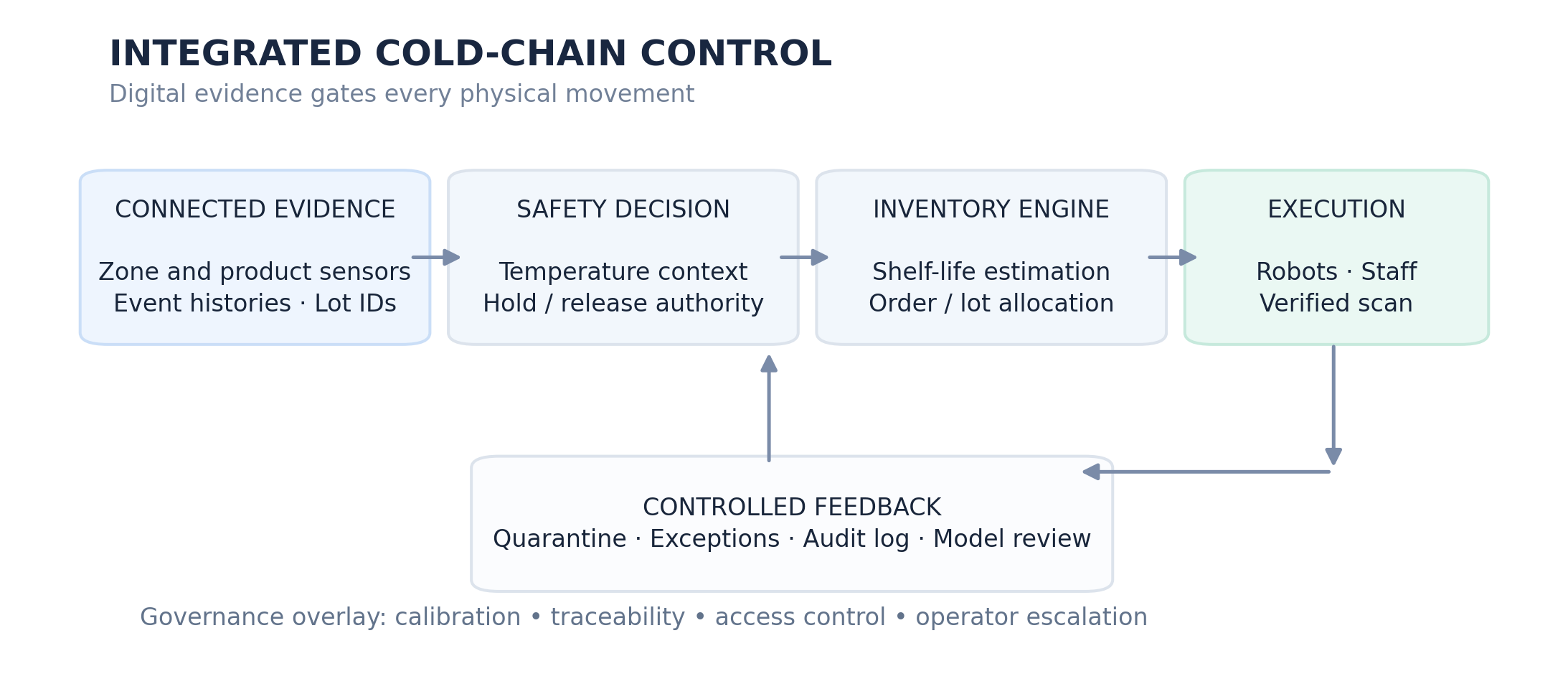
The proposed control logic links environmental evidence to warehouse management transactions. An inbound pallet is assigned a lot identifier, temperature class and provenance record. Sensor exceptions generate a hold status before storage or picking instructions are issued; a quality-approved release restores eligibility. A robot receives a job only after checking that eligibility. In this arrangement, traceability is an active operational constraint rather than an archive consulted after complaints. More sophisticated models may estimate unobserved product temperatures, but any prediction should expose confidence bounds and its supporting observations [3, 5]. Wu and colleagues also illustrate how a connected service platform can integrate cold-storage events with indoor positioning and decision support [6]. The proposed information and control architecture is shown in Figure 1.
4Autonomous robotics within refrigerated operations
Autonomous mobile robots differ from fixed-route guided vehicles in their ability to perceive and navigate changing environments, although effective deployment still requires traffic rules, task management and safe human interaction [10]. Robotic storage systems can bring racks to operators, consolidate transfers or reduce repetitive walking. However, cold environments introduce constraints often missing from mainstream fulfilment studies: condensation on sensors, reduced battery performance, slippery floors, insulated clothing, restricted maintenance windows and transitions between temperature zones. A robot specified for ambient retail storage should not be assumed suitable for chilled or frozen food handling.
The literature establishes that scheduling decisions are strongly coupled. Robot allocation, order sequencing, workstation balance and storage placement determine queue formation and unnecessary rack movement [13–18]. For perishable products, that coupling extends to dwell time outside designated thermal zones. A route optimiser should penalise warm exposure, congestion at temperature-controlled doors and interruptions to high-priority orders. Directly minimising travel distance could be counterproductive if the shortest path causes prolonged waiting beside a loading dock. The dispatch objective should therefore be food-condition adjusted, with hard safety rules before economic preferences.
Human roles remain essential. Personnel inspect compromised packaging, undertake sampling, resolve identity mismatches, maintain refrigeration equipment and authorise exceptional releases. Human–robot coordination studies show that scheduling must account for picker availability and physical workstation states rather than treating labour as inexhaustible [30]. Training should cover safe crossing zones, emergency stops, manual recovery, hygiene requirements and incident escalation. Measured success is not simply fewer workers on the floor, but fewer hazardous interactions, lower unnecessary handling and more dependable execution of quality-approved tasks.
4.1Storage assignment and dispatch sequencing
Robotic fulfilment research demonstrates that placing frequently co-ordered items intelligently can reduce rack visits or improve picking efficiency [13, 14]. Cold-chain assignment also requires compatibility between products, separation of raw and ready-to-eat goods where appropriate, and documented temperature-class restrictions. High-turnover items should be accessible without creating thermal bottlenecks, while vulnerable lots may need the most stable storage locations. The best storage policy is therefore a constrained allocation problem rather than a pure popularity ranking.
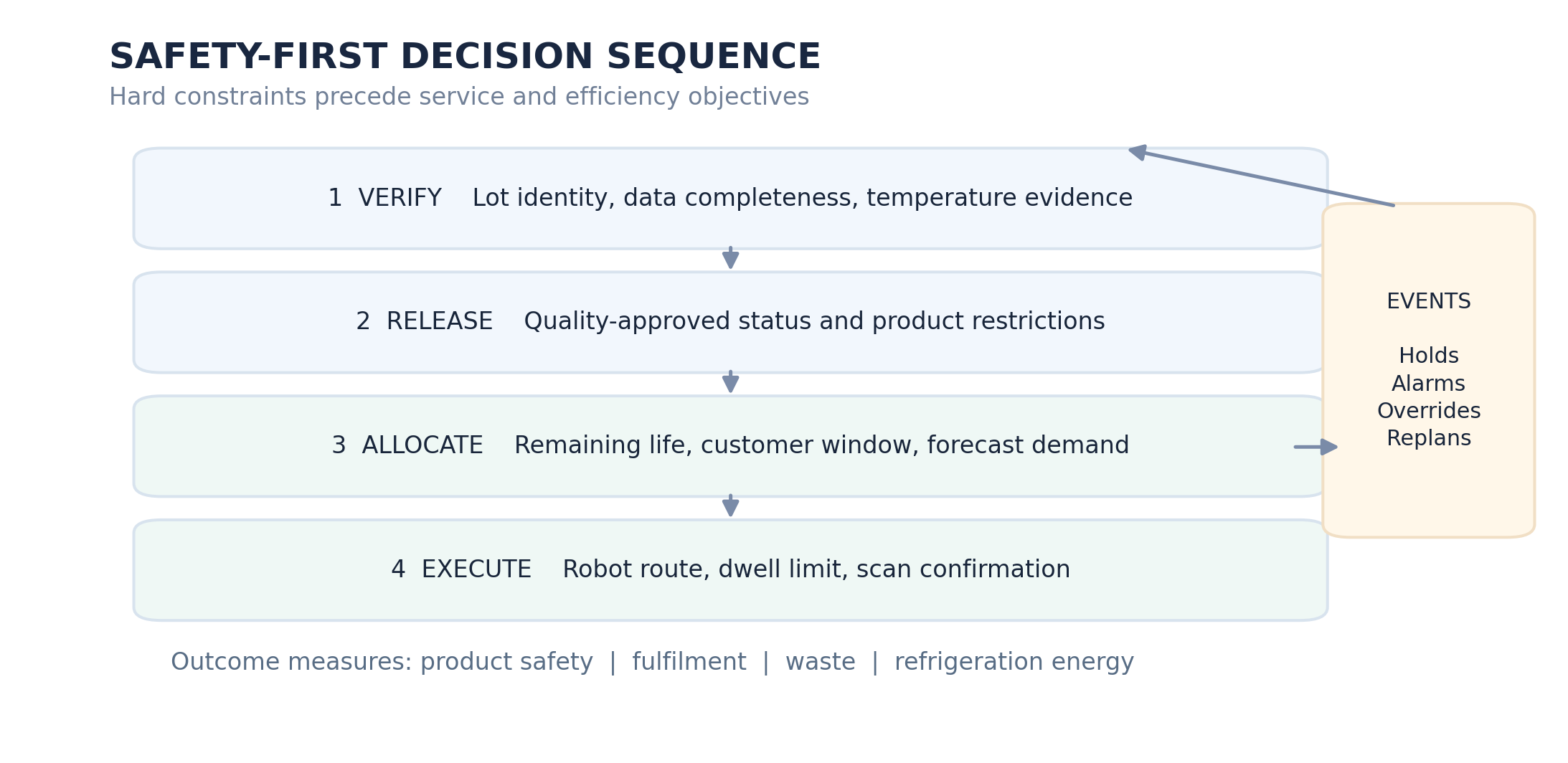
First-expired-first-out decisions are attractive, yet expiry dates alone neglect different temperature histories. A remaining-shelf-life estimate could reorder eligible lots when sufficiently validated [2, 5]. Forecast demand, customer delivery duration and receiving capacity would then determine which lot provides acceptable residual life on arrival. This is distinct from indiscriminately shipping the oldest stock: a batch with uncertain safety status must remain quarantined regardless of commercial priority. The recommended decision hierarchy is release eligibility, validated product life, fulfilment commitments and operating efficiency.
5IoT-enabled intelligence and inventory control
Inventory records usually capture quantity, location and stated expiry. Intelligent perishable inventory management must additionally represent condition, uncertainty and future demand. Sensors supply the observation layer; a digital twin or calibrated deterioration model translates observations into an estimate of product state; and inventory software converts that estimate into an action. Defraeye and colleagues explain how virtual representations of horticultural products can link observed environments to quality evolution [2]. Subsequent field-oriented digital-twin studies illustrate possibilities for scenario comparison and more precise shelf-life assessment [3, 5]. Such models remain product- and context-dependent rather than universal temperature calculators.
Demand forecasts determine replenishment quantities but should not override product condition. For Saudi distributors, demand can vary across ordinary weekdays, promotional periods, institutional orders and major seasonal events. A forecasting hierarchy should reconcile daily outlet demand with broader regional forecasts, while separating genuine consumption changes from sales lost through stockouts. Forecast errors can otherwise trigger excess chilled stock, creating costly spoilage that is incorrectly attributed to weak refrigeration. Robust perishable inventory modelling under uncertain demand offers useful methods, but real deployment requires reliable transactions and accurate shelf-life information [26].
An integrated control loop would recalculate available-to-promise stock after receiving, a sensor event, a quality inspection or a material change in predicted demand. Orders are allocated only to released lots with sufficient residual life for handling, transport and agreed customer requirements. A robot then receives the corresponding location and pick instruction. On completion, inventory is updated from verified scans rather than presumed task success. Exception queues cover damaged packaging, missing barcodes, inconsistent weights, sensor outages and expired reservations. Such explicit states prevent autonomous execution from disguising unresolved quality uncertainty.
5.1Models, explainability and operational safeguards
Predictive tools should begin with transparent baselines, including product-specific threshold rules, classical demand methods and simple shelf-life approximations. More complex learning models are justified only where they improve out-of-sample prediction under realistic disturbances. Studies of multi-source temperature estimation show why door events and starting conditions matter [4], while neural-network approaches to cold-chain alerts highlight the tension between predictive accuracy and sensor cost [8]. Models trained on a single supplier, product or weather season may perform poorly after operational changes. Continuous monitoring of input drift and calibration is therefore part of safety management.
A practical model record should state which observations produced a recommendation, what confidence applies and why a lot was selected or held. Staff must be able to override a suggested robot route or stock allocation with a reason captured in the audit history. Override frequency then becomes a diagnostic signal: persistent manual corrections may indicate poor data, unsuitable rules or weak change management rather than staff resistance. Model governance should include version control, revalidation after equipment changes and separation between advisory predictions and authorised product-release decisions. Table 1 summarises the evidence across the three technology layers and their boundary conditions.
| Layer | Documented contribution | Critical boundary | Indicative sources |
|---|---|---|---|
| Sensing | Time-stamped temperature evidence; product-status indicators; early warning | Calibration, placement, missing data, package-level variability | [4,7–9,27,28] |
| Robotics | Task routing, rack movement and order sequencing | Cold suitability, traffic safety, warm dwell, human handover | [10–18,30] |
| Inventory intelligence | Quality-aware allocation, stock release and uncertainty-aware planning | Validated kinetics, demand shift, limited transferability | [2,3,5,26] |
| Refrigeration and systems | Thermal stability, load management and energy-aware controls | Site climate, equipment reliability, power and coordination | [19–24] |
6Integrating physical flow, quality evidence and decisions
Integration changes the optimisation question from selecting a better device to orchestrating an accountable sequence of decisions. The proposed architecture has four linked functions: observing product and equipment status, determining release eligibility, ranking eligible inventory against demand, and executing tasks through robots or staff. Feedback records whether the requested action occurred and whether it preserved temperature requirements. The sequence prevents an efficiency objective from defeating a safety rule, while leaving room for operators to select a different permissible route when congestion or equipment failure occurs.
Interfaces matter because warehouse management systems, refrigeration controllers and robot fleet software rarely share identical identifiers or clock conventions. A common event definition should include lot, case or pallet identification, storage zone, thermal class, event time, source system and decision authority. Integration should be tested at message loss, delayed updates, duplicate scans and conflicting stock states, not merely during routine throughput trials. Nasiri and colleagues show that digital transformation delivers relational value through associated smart capabilities and collaboration rather than software adoption alone [19]. Shared operational rules are thus as important as data exchange protocols.
The objective function must recognise several kinds of cost. Direct costs include energy, labour, robot maintenance and stockholding; indirect costs include rejected deliveries, recalls, food waste and missed service commitments. Constraints include product safety, sanitation, robot access, equipment capacity and delivery deadlines. Rather than assign an arbitrary money value to every risk, the framework prioritises compliance constraints, then seeks an acceptable balance between spoilage, fulfilment and energy outcomes. Evaluation should report separate measures because a composite score can hide a serious deterioration in one dimension. Figure 2 shows the hierarchical operating decisions and feedback gates.
7Energy, resilience and Saudi implementation
Cold storage consumes energy even when no orders move. Door openings, compressor cycling, evaporator performance and warehouse loading make energy use sensitive to handling policies. Refrigeration studies show that control strategies, storage configuration and tariff conditions influence consumption, but the optimum depends on local operating conditions [20–22]. Network-level optimisation further illustrates the trade-offs between transport costs and refrigeration demand [23]. Robotic deployment therefore requires a facility-wide assessment: faster picking may reduce door exposure, while charging losses, additional electrical equipment or poor traffic design may offset the benefit.
Saudi climatic exposure strengthens the need for thermally protected interfaces between trucks, docks and storage areas. Facility operators should assess door sealing, dock shelters, staging duration and emergency refrigeration capacity before deploying sophisticated dispatch algorithms. Power interruptions require a defined sequence: preserve refrigeration where possible, stop unsafe robot motion, protect event data, classify vulnerable lots and authorise recovery. The order is operationally important because maintaining electronic throughput without cooling integrity can convert a manageable disruption into widespread product loss.
Implementation readiness also depends on organisational arrangements. Food producers, third-party warehouses, carriers and retailers may hold different parts of the temperature record, creating incentives to dispute responsibility after an excursion. Work on cold-chain energy-efficiency barriers suggests that benefits and investment decisions frequently sit across organisational boundaries [24]. Contracts should specify sensor ownership, record access, alarm response, evidence retention and authority to quarantine stock. Any system producing risk alerts without an accountable decision maker creates visibility but not resilience.
7.1Staged deployment and local validation
A suitable adoption sequence begins with process mapping and thermal-risk assessment. Establish traceable lot identities, test sensor coverage and reconcile inventory records before authorising automated stock selection. A limited robot pilot should then focus on one product family and temperature zone, with defined human oversight. Only after operational reliability and data completeness are demonstrated should condition-based dispatch be tested against existing allocation rules. The final stage evaluates coordinated refrigeration, inventory and fleet controls, with safeguards remaining active throughout.
A comparison should match order mix, product category, initial stock age and seasonal conditions as far as possible. A baseline period must capture failures and workarounds instead of recording only typical shifts. Operators should publish prespecified definitions for temperature excursions, spoilage, on-time in-full delivery, inventory accuracy, pick errors, worker incidents and kilowatt-hours per accepted dispatched unit. Differences can then be examined alongside product temperatures and external heat exposure. An apparent improvement in throughput that coincides with a higher quarantine rate would not support a successful cold-chain optimisation claim. Table 2 sets out the proposed pilot scorecard and its evidence requirements.
| Objective | Operational indicator | Validation evidence | Decision owner |
|---|---|---|---|
| Food integrity | Excursion duration; rejected lots; residual shelf life | Calibrated sensor histories; documented quality decisions | Quality lead |
| Inventory reliability | Lot-location match; avoidable expiry; forecast bias | Cycle counts; shipment and disposal traceability | Inventory manager |
| Robotic fulfilment | Completed picks/hour; waiting time; safety incidents | Fleet logs; video or incident reviews; workstation audits | Operations lead |
| Environmental performance | kWh/accepted dispatch; door-open minutes | Submetering; weather; cooling-load logs | Facilities engineer |
| System governance | Data gaps; overrides; recovery time | Interface tests; access history; incident records | Digital systems lead |
7.2Conditions for reliable scaled deployment
Differences between dairy, seafood, fresh produce and frozen prepared foods should be recognised explicitly in the control rules. Each category has different deterioration mechanisms, packaging requirements and tolerance of handling transitions. A distribution centre handling several categories cannot safely apply one default temperature-excursion interpretation to every pallet. Condition models should be calibrated to the specific product and quality attribute they estimate, and their outputs should be interpreted alongside applicable food-safety procedures. This distinction matters particularly when software recommends a change in lot sequence based on an estimated remaining life.
Demand planning introduces another source of uncertainty because historical sales are an imperfect record of customer needs. Holidays, changes in food-service activity, supplier failures and promotional campaigns can alter ordering patterns without warning. Forecast models should therefore be evaluated on unusual trading weeks as well as ordinary periods. Replenishment decisions also need to account for minimum delivery quantities and shelf-life obligations imposed by customers. Where forecasts remain uncertain, managers can compare smaller deliveries, alternative suppliers and temporary capacity buffers instead of relying exclusively on larger refrigerated inventories.
System integration should be assessed against clear failure scenarios. If a barcode cannot be read, the item must not silently inherit the identity of a nearby pallet. If a robot loses localisation, the warehouse should prevent a guessed completion message from altering stock records. If temperature data stop arriving, the application should flag an information gap instead of treating the last observation as continuing indefinitely. These events require operationally tested recovery paths, not simply technical error notifications. The broader principle is that uncertainty must remain visible when systems regain service.
Commercial scalability requires attention to maintenance and interoperability. Robot fleets, software platforms and sensing equipment may have different replacement cycles and support contracts. Before purchasing integrated systems, operators should demonstrate that essential temperature and inventory histories can be exported without proprietary interpretation. The pilot should also assess spare-part availability, planned downtime and the feasibility of manual fulfilment when automation is offline. A facility that becomes faster in normal conditions but cannot continue safely after a supplier outage has not achieved resilient optimisation.
The practical implication is to distinguish an alarm from an automated decision. An alert that merely appears on a dashboard may arrive too late to prevent mishandling. A useful alert pauses the appropriate transaction, identifies the affected stock and assigns an accountable person to review its condition. The system must also record when that person responded and what evidence justified the outcome. This creates a demonstrable relationship between data availability and operational control.
A further implementation risk concerns the boundary between suppliers and distributors. Products may arrive with inconsistent labels, incompatible data formats or incomplete temperature records. Receiving procedures should therefore establish a minimum information requirement and a separate exception path for incomplete consignments. Standardising these handovers can be more valuable initially than deploying a complicated forecasting algorithm, because allocation quality cannot exceed the reliability of the underlying batch identity and condition information.
The transition to intelligent systems also changes the competencies needed on site. Equipment technicians need familiarity with networked alarms, quality staff need to interpret uncertain estimates, and warehouse planners need to understand robotics constraints. Cross-functional incident exercises can reveal where accountability becomes ambiguous. A planned simulation of sensor loss or dock congestion offers useful evidence before live systems are allowed to issue increasingly autonomous instructions.
Procurement decisions should require evidence that components operate reliably within intended thermal conditions. Sensor enclosures, wireless equipment, scanning devices, charging infrastructure and moving machinery should be evaluated against actual washdown and condensation conditions. Vendors should explain their failure behaviours, support arrangements and data export capabilities. This reduces dependence on opaque proprietary tools and supports staged replacement of individual components without jeopardising product traceability.
Operational reporting should resist selective presentation of favourable shifts. Measurements taken during mild weather, low utilisation or unusually homogeneous orders may substantially understate ordinary risk. Balanced evaluation requires peak-hour observations, diverse product categories and deliberate testing of abnormal events. A defensible pilot report should explain which conditions were not encountered and where additional field evidence remains necessary.
The interpretation of sustainability should also include discarded stock and the indirect resources embodied in that food. Lower electricity consumption is desirable, but it should not be pursued through refrigeration settings that increase preventable spoilage. A credible assessment considers product losses, dispatch reliability and energy use in parallel. It should acknowledge that equipment manufacture, refrigerant leakage and replacement cycles may influence life-cycle outcomes, even when they fall outside the operational pilot boundary.
This distinction is material because a technically successful integration can still fail to protect the product. The evaluation protocol should be approved before performance observations are gathered.
8Discussion: Contributions, tensions and research gaps
The principal theoretical contribution is a shift from throughput-centred warehouse automation towards condition-constrained orchestration. Existing robotic algorithms offer sophisticated task optimisation, but their objective functions generally do not represent biological product deterioration [13–18]. Conversely, cold-chain condition models establish increasingly detailed quality evidence without necessarily determining which robot should retrieve a specific lot [2–5]. The proposed integration links these streams through a common eligibility and allocation decision. It also makes explicit that better sensing cannot compensate for inadequate cooling or inaccurate lot identities.
A second contribution concerns the distinction between measurable proxy improvements and final outcomes. More sensor messages do not prove safer food; fewer robot metres do not prove less spoilage; and reduced electrical demand does not necessarily signify lower life-cycle impact. Smart packaging research illustrates the diversity of condition proxies and associated reliability challenges [25]. Energy and supply-chain reviews similarly warn against interpreting isolated efficiencies without considering broader network effects [1, 22, 23]. Evaluation must therefore pair proximal technical metrics with verified product, service and environmental outcomes.
Evidence gaps remain substantial. Few studies test a complete cycle joining product-adjacent monitoring, quality-approved inventory selection and mobile robot execution in actual refrigerated food warehouses. Research is also limited on multi-zone movement, hygienic design, freezing-related device failures, cyber resilience and the long-term maintenance burden of integrated systems. Direct evidence from Saudi operations is thinner still, especially across seasonal demand surges and extreme outdoor temperatures. This prevents a credible universal claim about payback, spoilage reduction or energy savings. Such claims should emerge from site-specific controlled pilots rather than arbitrary percentage estimates.
9Conclusion
Cold-chain warehousing is optimised when the right quantity of food reaches the right destination in a demonstrably acceptable condition, not merely when handling becomes faster. The reviewed evidence supports the separate technical promise of connected monitoring, robotic execution, predictive quality modelling and energy-aware storage. Their joint value depends on linking lot-level identity and validated condition evidence to safe allocation decisions before tasks are dispatched. A Saudi implementation should begin with instrumentation, data integrity and controlled operational trials, then expand towards supervised autonomous coordination. Future research should assess complete facilities longitudinally, report trade-offs transparently and validate outcomes across product classes, seasons and distribution channels. Until such evidence exists, the framework provides a testable management design rather than proof of achieved performance.
References
- [1]Mustafa MFMS, Navaranjan N, Demirovic A. Food cold chain logistics and management: A review of current development and emerging trends. Journal of Agriculture and Food Research. 2024;18:101343. https://doi.org/10.1016/j.jafr.2024.101343
- [2]Defraeye T, et al. Digital twins are coming: Will we need them in supply chains of fresh horticultural produce? Trends in Food Science & Technology. 2021;109:245–258. https://doi.org/10.1016/j.tifs.2021.01.025
- [3]Shoji K, Schudel S, Shrivastava C, Onwude D, Defraeye T. Optimizing the postharvest supply chain of imported fresh produce with physics-based digital twins. Journal of Food Engineering. 2022;329:111077. https://doi.org/10.1016/j.jfoodeng.2022.111077
- [4]Zou Y, Wu J, Wang X, Morales K, Liu G, Manzardo A. An improved artificial neural network using multi-source data to estimate food temperature during multi-temperature delivery. Journal of Food Engineering. 2023;351:111518. https://doi.org/10.1016/j.jfoodeng.2023.111518
- [5]Zou Y, Wu J, Meng X, Wang X, Manzardo A. Digital twin integration for dynamic quality loss control in fruit supply chains. Journal of Food Engineering. 2025;397:112577. https://doi.org/10.1016/j.jfoodeng.2025.112577
- [6]Wu W, Shen L, Zhao Z, Harish AR, Zhong RY, Huang GQ. Internet of Everything and Digital Twin enabled Service Platform for Cold Chain Logistics. Journal of Industrial Information Integration. 2023;33:100443. https://doi.org/10.1016/j.jii.2023.100443
- [7]Waldhans C, Albrecht A, Ibald R, Wollenweber D, Sy S-J, Kreyenschmidt J. Temperature Control and Data Exchange in Food Supply Chains: Current Situation and the Applicability of a Digitalized System of Time–Temperature-Indicators to Optimize Temperature Monitoring in Different Cold Chains. Journal of Packaging Technology and Research. 2024;8:79–93. https://doi.org/10.1007/s41783-024-00165-2
- [8]Meng X, Xie R, Liao J, Shen X, Yang S. A cost-effective over-temperature alarm system for cold chain delivery. Journal of Food Engineering. 2024;368:111914. https://doi.org/10.1016/j.jfoodeng.2023.111914
- [9]Wan Z, Chen X, Song D, Wu Z, Zhang R, Wang M, Xiao X. Battery-free flexible wireless temperature sensing for food storage. FlatChem. 2024;47:100709. https://doi.org/10.1016/j.flatc.2024.100709
- [10]Fragapane G, de Koster R, Sgarbossa F, Strandhagen JO. Planning and control of autonomous mobile robots for intralogistics: Literature review and research agenda. European Journal of Operational Research. 2021;294:405–426. https://doi.org/10.1016/j.ejor.2021.01.019
- [11]Grover AK, Ashraf MH. Autonomous and IoT-driven intralogistics for Industry 4.0 warehouses: A thematic analysis of the literature. Transportation Journal. 2024;63:42–61. https://doi.org/10.1002/tjo3.12002
- [12]Silva A, Coelho LC, Darvish M, Renaud J. Manual and robotic storage and picking systems: A literature review. INFOR. 2024;62:313–343. https://doi.org/10.1080/03155986.2024.2336280
- [13]Zhuang Y, Zhou Y, Hassini E, Yuan Y, Hu X. Improving order picking efficiency through storage assignment optimization in robotic mobile fulfillment systems. European Journal of Operational Research. 2024;316:718–732. https://doi.org/10.1016/j.ejor.2024.02.025
- [14]Zhuang Y, Zhou Y, Yuan Y, Hu X, Hassini E. Order picking optimization with rack-moving mobile robots and multiple workstations. European Journal of Operational Research. 2022;300:527–544. https://doi.org/10.1016/j.ejor.2021.08.003
- [15]Zhang S, Zhuge D, Tan Z, Zhen L. Order picking optimization in a robotic mobile fulfillment system. Expert Systems with Applications. 2022;209:118338. https://doi.org/10.1016/j.eswa.2022.118338
- [16]Lamballais T, Merschformann M, Roy D, de Koster MBM, Azadeh K, Suhl L. Dynamic policies for resource reallocation in a robotic mobile fulfillment system with time-varying demand. European Journal of Operational Research. 2022;300:937–952. https://doi.org/10.1016/j.ejor.2021.09.001
- [17]Justkowiak J-E, Kovalyov MY, Pesch E. A dynamic programming algorithm for order picking in robotic mobile fulfillment systems. Networks. 2024;84:481–490. https://doi.org/10.1002/net.22245
- [18]Boysen N, Schwerdfeger S, Ulmer MW. Robotized sorting systems: Large-scale scheduling under real-time conditions with limited lookahead. European Journal of Operational Research. 2023;310:582–596. https://doi.org/10.1016/j.ejor.2023.03.037
- [19]Nasiri M, Ukko J, Saunila M, Rantala T. Managing the digital supply chain: The role of smart technologies. Technovation. 2020;96–97:102121. https://doi.org/10.1016/j.technovation.2020.102121
- [20]Wang J, Wang Q, Yang P, Yu J, Xiao L. Energy consumption analysis and optimization of cold stores considering differential electricity price. Energy and Buildings. 2024;310:114094. https://doi.org/10.1016/j.enbuild.2024.114094
- [21]Niu H, Wang B, Yang Z, Liu X, Liu X, Shi W. Impact of control strategies on energy consumption in cold storage facilities. Energy and Buildings. 2024;322:114736. https://doi.org/10.1016/j.enbuild.2024.114736
- [22]Niu H, Liu X, Wang B, Shi W. Development, research and policy status of logistics cold storage in the context of carbon neutrality: An overview. Energy and Buildings. 2024;320:114606. https://doi.org/10.1016/j.enbuild.2024.114606
- [23]Accorsi R, Ferrari E, Guidani B, Manzini R, Ronzoni M. An optimization framework for energy-driven food cold chain network design. Journal of Cleaner Production. 2025;514:145767. https://doi.org/10.1016/j.jclepro.2025.145767
- [24]Neusel L, Hirzel S. Energy efficiency in cold supply chains of the food sector: An exploration of conditions and perceptions. Cleaner Logistics and Supply Chain. 2022;5:100082. https://doi.org/10.1016/j.clscn.2022.100082
- [25]Zuo J, Feng J, Gameiro MG, Tian Y, Liang J, Wang Y, Ding J, He Q. RFID-based sensing in smart packaging for food applications: A review. Future Foods. 2022;6:100198. https://doi.org/10.1016/j.fufo.2022.100198
- [26]Cholodowicz E, Orlowski P. Switching robust neural network control of perishable inventory with fixed shelf life products under time-varying uncertain demand. Journal of Computational Science. 2023;70:102035. https://doi.org/10.1016/j.jocs.2023.102035
- [27]Chan YJ, Anwar N, Reuel NF. Cold and ultra-cold chain integrity monitoring via embedded resonant sensor indicators. Sensors and Actuators A: Physical. 2024;372:115346. https://doi.org/10.1016/j.sna.2024.115346
- [28]Cao Y, Chen M, Li J, Liu W, Zhu H, Liu Y. Continuous monitoring of temperature and freshness in cold chain transport based on the dual-responsive fluorescent hydrogel. Food Chemistry. 2024;438:137981. https://doi.org/10.1016/j.foodchem.2023.137981
- [29]Yusuf N, Kooli C, Khoj H, Bajnaid NO. Strategizing sustainable food security in Saudi Arabia: A policy and scenario approach to agricultural resilience. Outlook on Agriculture. 2025;54:77–90. https://doi.org/10.1177/00307270241302091
- [30]Allgor R, Cezik T, Chen D. Algorithm for Robotic Picking in Amazon Fulfillment Centers Enables Humans and Robots to Work Together Effectively. INFORMS Journal on Applied Analytics. 2023;53:266–282. https://doi.org/10.1287/inte.2022.1143