Oil and Gas Pipeline and Pumping Station
Integrated Mechanical Completion, Pre-Commissioning and Performance Verification for Long-Distance Oil and Gas Pipeline and Pumping Station Projects in Saudi Arabia
Published October 2026
Abstract
Long-distance pipeline programmes can reach apparent construction completion while retaining unresolved threats to safe start-up, including undocumented weld repairs, inaccessible test boundaries, unstable pump controls and incomplete operating information. This critical review examines how mechanical completion, pre-commissioning and performance verification can be integrated into one auditable assurance process for Saudi Arabian oil and gas transmission projects. Its aim is to establish a technically defensible sequence of evidence-based release decisions rather than equate physical progress with operational readiness. Four objectives guide the synthesis: distinguish completion certificates from functional proof; evaluate pipeline cleaning, gauging, pressure testing and reinstatement; connect pumping-station dynamic testing with line-wide hydraulic behaviour; and develop a risk-sensitive handover framework appropriate to remote routes and multiple contractors. Relevant publications from 2020 to 2025 were examined using a structured narrative review and comparative assessment of commissioning, process safety, pipeline integrity, hydraulic transients and asset information research. The literature supports complementary but unequal forms of evidence. Static examination demonstrates installation conformity, pressure tests demonstrate bounded containment under specified conditions, and dynamic trials assess equipment and controls across representative operating states. None independently guarantees system readiness. An original five-gate assurance model is consequently proposed, with traceable test records, explicit hold points, configuration control and joint owner–contractor authorisation. Its application to Saudi infrastructure is presented as a reasoned adaptation of international findings, not as an empirically validated national benchmark. The review identifies outstanding needs for operationally representative acceptance trials, uncertainty-aware performance criteria and independent verification of electronic handover records.
Keywords: mechanical completion; pipeline pre-commissioning; pumping stations; performance verification; operational readiness; Saudi Arabia
1Introduction
Pipeline megaprojects convert dispersed construction work into an interconnected system in which one unfinished interface can compromise an otherwise completed route. Thousands of welds, coatings, valves, instruments and communications links may be accepted by different teams before the owner attempts a coordinated start-up. A signed mechanical completion certificate therefore answers a narrower question than whether hydrocarbons can safely be introduced. The former addresses conformity with an approved scope; the latter requires evidence that interfaces, protective functions, operating procedures and personnel can collectively sustain controlled operation. Digital commissioning research identifies fragmented records as a recurrent obstacle to demonstrating that transition [1].
For Saudi Arabia, the practical stakes involve long distances between facilities, desert access constraints, high ambient temperatures, elevation changes, remote block valves and dependence on pumping or compression assets. These features are engineering considerations rather than evidence that every national project shares an identical configuration. A defensible assurance system must be adapted to fluid properties, terrain, equipment duty and applicable owner specifications. Historical confidence derived from construction inspections is insufficient when transient pressures, dynamic seal behaviour or communication delays emerge only during energisation and flow. The separation between installed condition and operating condition is important for isolation, leak detection and emergency shutdown arrangements [9–12].
The research problem is organisational as well as mechanical. Pipeline quality records are frequently indexed by construction spread or contract, whereas operators accept systems based on functional boundaries. A hydrotest package may cover several route sections; a pumping-station completion dossier may exclude upstream valve logic; and a control-room test may rely on simulated inputs that have not been checked against field devices. Evidence-based handover studies demonstrate why information completeness and receiver participation deserve the same attention as physical equipment readiness [5–8].
This review asks which forms of evidence should be required at successive release points, how technical exceptions should be managed and what constitutes credible whole-system performance. Its contribution is an integrated decision framework linking pipeline fabrication and test packs to hydraulic operations, safety barriers, asset data and final acceptance. It does not propose a new numerical design code or reinterpret mandatory pressure limits. Instead, it examines how accepted engineering tests can be sequenced, reconciled and evaluated against project-specific criteria.
2Review design and evidence appraisal
A structured critical narrative approach was selected because the subject spans commissioning governance, materials verification, hydraulic modelling and operations research, with incompatible measurement units and diverse study designs. The reference window was restricted to 2020–2025. Search concepts included mechanical completion, pre-start-up safety review, pipeline hydrotesting, cleaning pigs, commissioning digitalisation, centrifugal-pump monitoring, hydraulic transients, handover data and risk-based integrity management. Eligible material comprised peer-reviewed research articles, technically documented reviews and relevant engineering conference proceedings with identifiable digital object identifiers. Older technical requirements are discussed conceptually but are not counted as studies in the review corpus.
The material was examined by theme, study design and transferability. Direct evidence concerning oil and gas pipeline construction or commissioning received greater weight than studies of building handover or water-pumping systems. The latter were used to explain transferable information-management and hydraulic principles, with their sector limitations identified. Risk assessments, laboratory investigations, model-based studies and case reports were not treated as interchangeable proof of field effectiveness. In particular, successful fault classification on a test rig cannot establish detection reliability during the changing conditions of line filling or first product delivery [18–20].
The synthesis used four analytical questions. First, which hazard or failure mode does each activity actually challenge? Second, what observable evidence can an independent reviewer inspect? Third, which assumptions cease to hold when equipment is connected to adjacent systems? Fourth, which unresolved issue demands a hold point rather than an administrative waiver? These questions were applied to quality dossiers, fluid-handling tests, protective functions, performance curves and turnover information. The comparative matrix in Table 1 translates this appraisal into specific acceptance evidence; it is a proposed practical synthesis rather than a reported result from a common multi-site dataset.
The review has deliberately bounded claims. No unpublished Saudi owner procedures, project incident database or proprietary commissioning checklists were available for examination. Consequently, the framework is not validated against project delay rates, production losses or measured improvement in safety performance. Bibliographic coverage is selective rather than exhaustive, and the cited studies do not measure a single common outcome. The value of the method lies in transparent cross-domain reasoning and identification of what a future prospective field study must measure. Assertions about technical adequacy remain conditional on the governing design basis, approved procedures, code editions and owner acceptance criteria.
3Completion boundaries and systems thinking
Mechanical completion requires more than the physical presence of equipment. It entails a reconciled installation baseline: approved drawings, verified material identity, weld traceability, nondestructive examination, calibrated test instruments, valve orientation, electrical continuity and instrument loop records. The completion system should identify uniquely numbered subsystems and define interfaces so that no component falls between contracting scopes. Digital workflows can make this relationship visible, but they only improve assurance if field evidence is accurate and linked to the correct asset identifiers [1, 6, 8].
An effective boundary separates installed plant from equipment still exposed to construction or testing. Temporary strainers, test blinds, electrical jumpers and inhibited trip functions must therefore appear in a controlled reinstatement register. Otherwise, the project can achieve a nominal completion percentage while concealing hazards introduced to facilitate temporary operations. Di Vito's examination of pre-start-up review illustrates how safety obligations accumulate through engineering, procurement and construction, and why closure requires multiple participants rather than a single discipline [2]. The later implementation study by Abu Bakar and Abdul Aziz emphasises structured evaluation and documented approval of review findings [3].
The accepted unit should be a functionally meaningful system, not an arbitrary kilometre interval. A route section may be suitable for standalone strength testing yet remain incapable of controlled isolation until its actuator power, remote indication and supervisory control links are operational. Conversely, a station pump can satisfy workshop performance testing while experiencing different suction conditions when connected to the full pipeline. The gate design must preserve both scopes: package-level conformity for traceability and integrated functional boundaries for operation. The changeover of custody must be recorded when testing responsibilities move from construction to commissioning and from commissioning to the owner.
Exception management is a further critical distinction. Safety-critical defects or absent proof of protective functions should block the relevant release; cosmetic or genuinely non-operational exceptions may be managed through accountable completion dates. A generic category label is inadequate without a description of failure consequence, interim safeguards, responsible authority and evidence required for closure. Independent review should challenge whether the proposed temporary safeguard remains effective during all planned test states. Research on project handover and information loss reinforces the operational cost of transferring open issues without dependable identifiers, ownership or contextual documents [7, 8].
The interaction between work fronts also demands an explicit simultaneous-operations plan. One contractor may still be welding near a section that another team wishes to pressurise, while electricians may require access to panels being prepared for functional tests. Spatial separation alone is insufficient if common electrical supplies, drainage systems, control networks or emergency access routes are affected. A boundary review should therefore identify energy sources, shared utilities, concurrent permits and the command hierarchy for stopping work. A permit to work controls a particular task; it cannot replace approval for a changing system configuration. Integrated delivery research suggests that coordination and governance must be designed into the project rather than introduced at the moment of final handover [27, 28].
4Pipeline pre-commissioning as controlled evidence
The first major challenge after installation is to demonstrate that the continuous pipe bore is clean, passable, structurally adequate and ready for its intended fluid. Cleaning and gauging should follow a route-specific plan addressing internal debris, geometry restrictions, launcher and receiver compatibility, pig tracking, bypass arrangements and disposal of recovered material. Pig runs confirm particular aspects of accessibility and bore condition; they do not independently establish weld soundness or prove external coating integrity. A published case of a lodged intelligent inspection tool during a pre-commissioning baseline demonstrates that the inspection activity itself can introduce damage, making tool compatibility and contingency planning indispensable [22].
Pressure testing adds controlled evidence of system strength and leak tightness within explicitly stated test boundaries. Acceptance depends on qualified pressure instruments, stable test medium, recorded temperatures, relevant elevations, calibrated measurement chains and the prescribed hold sequence. A declining test pressure cannot be interpreted without examining thermal effects, trapped gas, stabilization periods and possible leakage. The governing project specification should determine the pressure envelope, test duration, criteria and permissible alternatives; this review intentionally supplies no universal values. Comparative discussion of pipeline hydrotest design standards shows that apparently similar requirements may embody different assumptions about line class and allowable stress [21].
The test package must document the configuration at the time of the trial, including temporary closures and excluded components. After successful pressure testing, controlled depressurisation, dewatering, drying and reinstatement may be necessary before admitting the operating medium. Fluid-sensitive criteria matter: residual water creates different consequences in dry-gas service than in a crude-oil system, while an aggressive cleaning method may harm internal coatings or delicate internals. Each transition changes the physical state of the asset and therefore warrants positive evidence rather than a retrospective checklist signature. Equipment removed for a test must be reinstated and independently checked against the approved flow path.
Inspection records should be interpreted according to their detection limits [26]. Visual examination confirms accessible features; radiography and ultrasonic techniques interrogate selected flaw classes; in-line tools report within their validated sensing and sizing envelopes. Neither a clean inspection report nor a successful strength test rules out every future deterioration mechanism. Risk-based integrity literature provides a rationale for retaining as-built defect, coating and test records as the foundation for subsequent inspection planning [9, 16, 17]. This continuity is especially valuable where burial, difficult access and later terrain disturbance constrain direct inspection.
A receiver may be ready mechanically but lack a verified pressure indication or adequate isolation arrangement; an apparently minor station drain may represent an uncontrolled release path. The completion authority should confirm that each test condition is represented in an agreed isolation plan, with line-of-fire hazards, trapped energy and communication protocols addressed. Evidence should include route and station drawings updated after field changes, witness signatures associated with actual test steps, and exception reports traceable to corrective work. Such discipline transforms pre-commissioning from a collection of contractor activities into a documented argument for safe transition.
| Workstream | Primary failure exposure | Acceptable evidence | Important limitation |
|---|---|---|---|
| Fabrication | Wrong material or hidden weld discontinuity | Heat traceability; weld map; qualified examination; repair closure | Not proof of site operational behaviour |
| System definition | Omitted tie-ins or unsafe test exclusions | Tagged boundary drawing; walkdown; isolation review | Boundary may change during reinstatement |
| Cleaning and gauging | Debris, restrictions and pig obstruction | Approved run record; pig tracking; debris assessment | Not a strength or leak-tightness test |
| Pressure test | Containment failure within test envelope | Pressure/temperature trace; calibration; witness release | Does not represent every future transient |
| Drying/reinstatement | Residual water or temporary blinds | Moisture criterion where required; physical recheck | Requirements vary by product and service |
| Remote isolation | Incorrect feedback or delayed shutdown | Loop evidence; command-to-final-element proof | Simulations may bypass real equipment |
5Pumping-station functional and performance verification
A pumping station cannot be accepted solely because the driver turns and measured vibration remains within a local threshold. Its duty is to deliver required throughput against the system resistance while maintaining inlet pressure, mechanical limits, stable control and available protective functions. The test programme must therefore reconcile certified equipment curves, liquid density and viscosity, variable-speed operation, station hydraulic losses and the system operating envelope. A sequence that begins with lubrication, seal systems, alignment and motor protection should proceed to interlock proof, permissive logic, controlled startup, duty-point testing and verified shutdown. Exceptions discovered during cold checks must not be normalised during wet commissioning.
Steady-state verification should report flow, suction and discharge pressure, rotational speed, power and relevant fluid properties at defined operating points. Pump differential head should be corrected for appropriate elevation and velocity terms rather than inferred from an unqualified gauge difference. Electrical input power alone is not hydraulic efficiency, because motor and drive losses intervene. Instruments require documented calibration and uncertainty, especially where acceptance margins are narrow. Multimodal centrifugal-pump research demonstrates the diagnostic benefit of examining electrical and mechanical information together, although such results from experimental rigs do not substitute for site acceptance against duty requirements [19, 20].
Transient behaviour warrants a separate proof. Start-up, load rejection, emergency trip, rapid valve closure and changeover between parallel units can produce pressure excursions exceeding those observed at normal flow. Pipe length, wave propagation, air pockets, check-valve dynamics and the control system's response determine the magnitude and location of these events. Investigation of start-up and shutdown acoustics in a complex piping network demonstrates why dynamic excitation can differ materially from steady loading [18]. For the full project, verified transient models should be compared with recorded field pressures and event timing at selected critical locations, not regarded as validated merely because numerical simulations converge.
Functional testing must challenge failures as well as intended commands. A pump-trip simulation should prove the actual shutdown pathway from detector through logic solver to final elements, including status feedback where required. The same principle applies to remote emergency-stop inputs, low-suction permissives, bearing alarms, overpressure protection and anti-surge arrangements where relevant to the equipment type. Proof testing needs explicit bypass management, restoration records and control-room acknowledgement. A simulated output that bypasses the real valve or final element gives narrower assurance than an end-to-end functional test; these results should never be recorded as equivalent.
The performance-verification period must also be representative. A short run at one stable duty point cannot establish credible response to off-design flow, seasonal temperature changes, pump sequencing or loss of grid supply. The test protocol should select operating cases from a risk assessment, distinguish obligatory from informative measurements and specify criteria before results are known. If the project cannot safely reproduce a credible worst case, validated simulation with transparent boundary conditions may complement restricted field trials. Data quality is essential: synchronized timestamps, sensor location and the calibration state of all instruments should be retained so that later discrepancies can be investigated.
Final acceptance must resolve the difference between machinery health and contractual duty. Reduced vibration does not prove minimum capacity; achieved capacity does not establish adequate net positive suction head margin; and a successful trip test does not demonstrate accurate custody metering. The owner should therefore receive a reconciled evidence set covering availability, stable operating range, protective functions, hydraulics and test limitations. Only this combined view can support an unambiguous performance decision across a station and its connected route.
A further challenge is the treatment of uncertainty when measured performance sits near a contractual boundary. Flow meters, differential-pressure transmitters, density measurements and electrical power analysers have finite accuracy; their errors may be correlated through common calibration or data acquisition. Acceptance should distinguish instrument uncertainty from process variability and repeatability. A nominal curve fit alone cannot establish a guaranteed point if the required correction methods and tolerances are undocumented. Diagnostic studies based on learned vibration signatures may help locate faulty components, but classification accuracy under controlled conditions does not prove hydraulic efficiency, allowable vibration over the full envelope or future service life [20, 29]. Performance reports should identify whether an apparent shortfall reflects machine behaviour, system resistance, measurement error or an unsuitable test configuration.
6Leak detection, control systems and first-product assurance
Introduction of product creates a new category of consequences, because a loss of containment can now involve flammable or environmentally damaging inventory. Before this step, the owner must verify valve status, emergency isolation, pressure protection, communications, fire and gas detection where applicable, and available response procedures. A pre-start-up review should involve engineering, operations, maintenance, control systems and safety functions, with the resulting authorisation tied to a specific plant configuration [2–4]. The distinction is not administrative: a control function proven before final cable termination or loop modification may no longer represent the installed system.
Leak detection requires special treatment during filling and stabilisation. Computational methods based on mass balance, pressure waves or transient models have different sensitivity and false-alarm characteristics, and operating changes can resemble leaks [10–15]. It is inappropriate to promise one detection threshold across steady and dynamic phases without evidence. The acceptance plan should therefore test instrumentation health, communications latency, alarm routing and operator response, then verify detection performance under feasible controlled scenarios. When a method cannot be validated for first-fill conditions, this limitation must be formally recorded together with temporary monitoring arrangements.
A credible product-introduction procedure defines the progression from isolation checks and inert states to line packing, progressive pressurisation and stabilised delivery. It also identifies who may authorise each transition and who can halt the sequence. Stations and route valves need a common operating picture; otherwise one team may interpret local permissives as equivalent to corridor-wide readiness. Studies of leakage detection indicate that hybrid information can reduce dependence on a single signal, but they do not justify treating multiple uncalibrated measurements as independent safety barriers [11–15]. Validation should examine common-cause failures, false alarms and expected behaviour during controlled line transients.
Alarm governance becomes more difficult where long lines are filled in stages. The relationship between flow discrepancy and actual loss is obscured by changing inventory, thermal expansion and imperfect synchronization of widely separated meters. An operator confronted with repeated nuisance indications may suppress a signal just when consequences are increasing. The response design should therefore specify alarm priorities, escalation delays, acknowledgement responsibility and recovery of any temporarily inhibited function. A Saudi-authored review of pipeline detection approaches offers regionally relevant context for technique selection, but it does not validate a particular owner's installation [30]. Performance demonstration must ultimately use site-specific instrumentation and recorded response, with simulation and historical evidence identified as supporting rather than substitutive material.
7Digital turnover and configuration integrity
Electronic completion systems promise faster retrieval of inspection packs, punch records, certificates and test results. Their value, however, depends on data association rather than dashboard appearance. Each record should map to a verified tag, location, line list, drawing revision and test boundary. The transfer should preserve instrument calibration history, software versions, parameter settings, safety bypass registers and deviations that affect future operation. Research on digital commissioning supports traceability advantages, while studies of construction handover warn that data can remain incomplete or unusable despite being delivered electronically [1, 5–8].
Configuration control is especially important during prolonged parallel construction and commissioning. A late weld repair changes the physical baseline; a revised pump-control setting changes dynamic behaviour; a relocated transmitter alters both response and maintenance access. Neither change is adequately managed by updating an isolated file. The alteration should trigger identification of affected tests, drawings, training documents and acceptance authorities. Digital pipeline studies suggest a longer-term opportunity to connect commissioning baselines with asset-monitoring models, although successful operational integration remains dependent on reliable data, uncertainty treatment and continuous validation [24, 25].
Handover should thus be assessed for usability through a small set of retrieval tests. Can an operator locate the last approved shutdown logic? Can maintenance identify the serial number and service history of a pressure transmitter? Can integrity engineers reconstruct the tested configuration of a buried section? If the answer requires manual reconciliation among incompatible contractor spreadsheets, the information handover is not yet complete. Ownership of unresolved data defects should be as explicit as ownership of outstanding mechanical work.
8Integrated readiness model and decision criteria
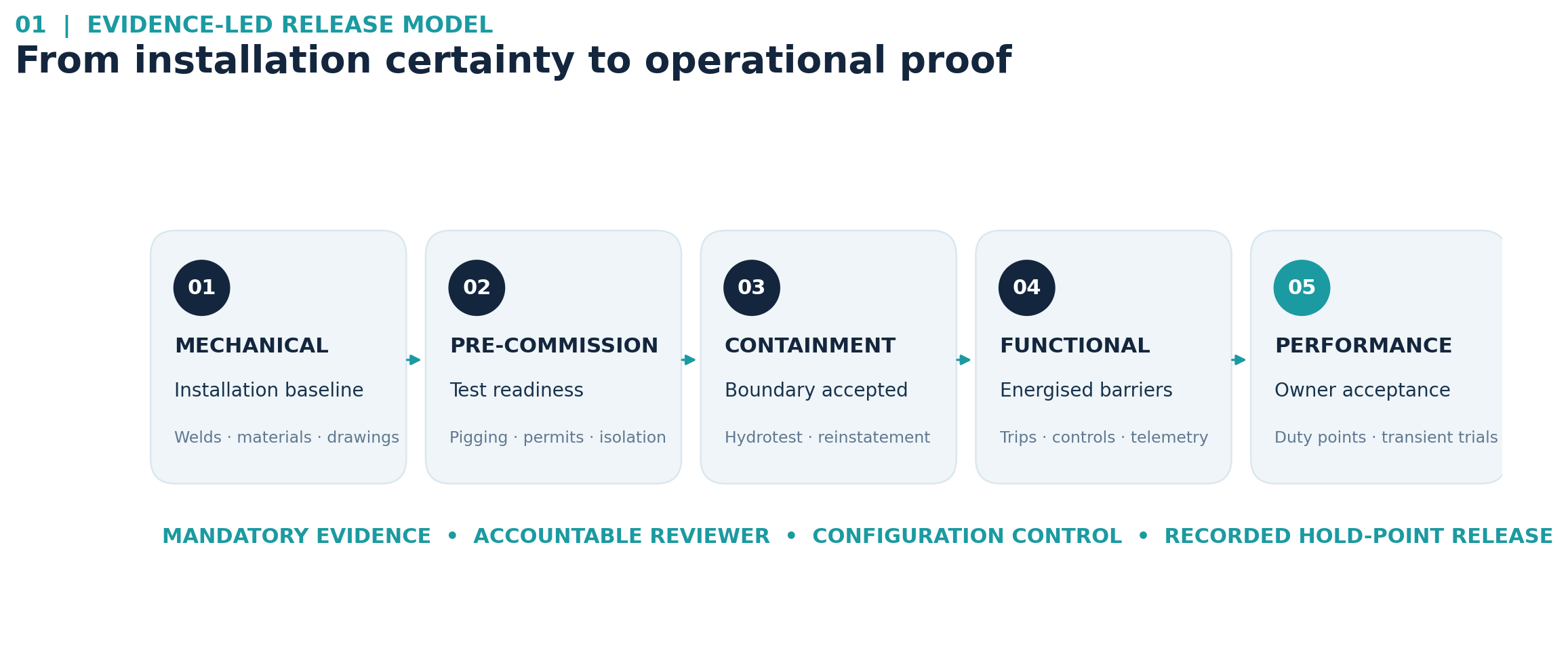
Figure 1 presents the proposed five-gate sequence: verified construction baseline, pre-commissioning readiness, containment and reinstatement, energised functional proof, and integrated performance acceptance. Each gate has a defined owner, bounded scope, documentary output and prohibition on advancing with unresolved high-consequence defects. The sequence is conceptual rather than a substitute for a particular client's procedures. Activities may run in parallel across independent segments, but shared equipment should not be treated as ready until all essential upstream and downstream interfaces meet the relevant release criteria.
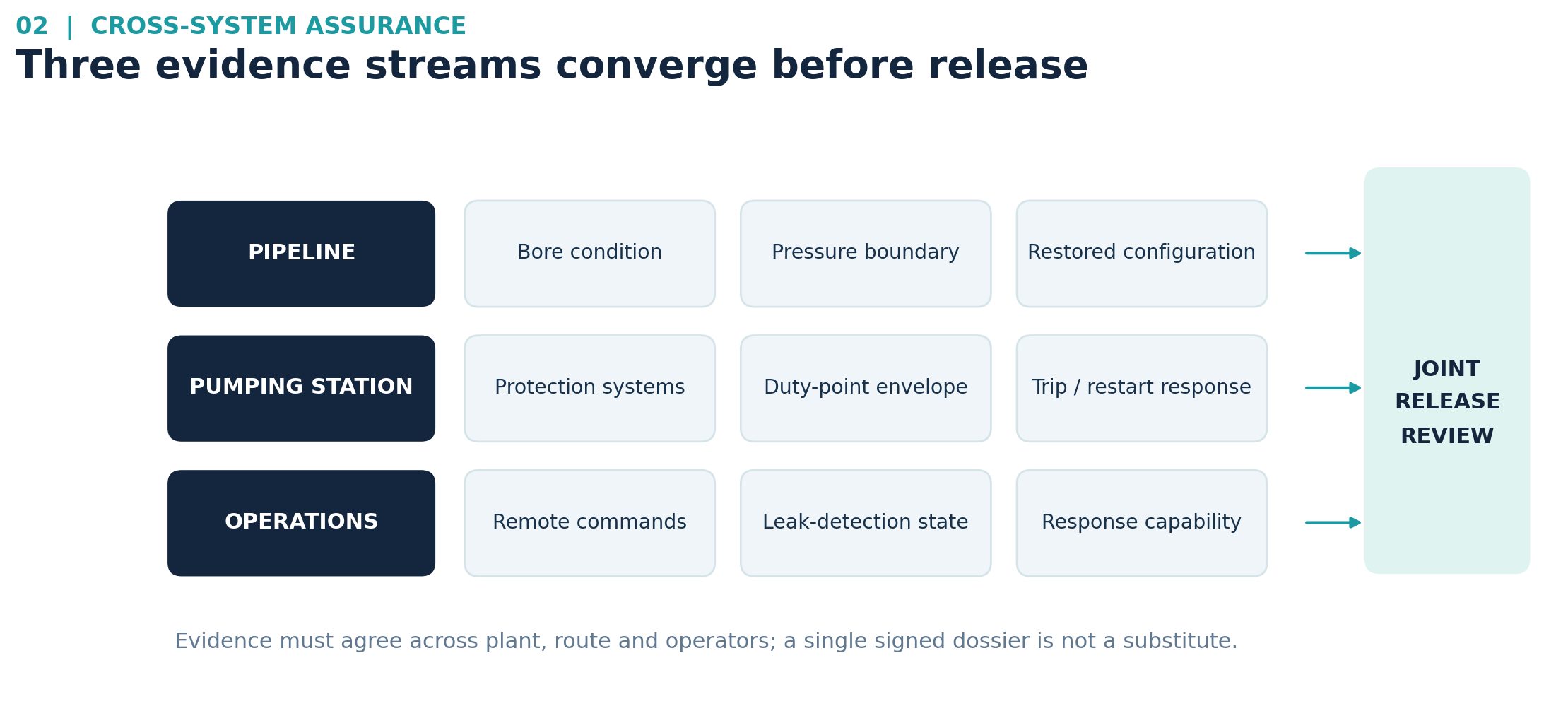
At the first gate, the completion team confirms drawing status, quality records, component traceability, weld examinations, instrument installation and punch classification. At the second, pre-commissioning confirms cleaning plans, qualified test configurations, isolation arrangements, competent crews and test-instrument calibration. The third captures pressure-test acceptance, dewatering or drying, full reinstatement and signed boundary reconciliation. The fourth demands end-to-end electrical, instrumentation, communications and protective-function testing under controlled energisation. The fifth requires operating-envelope measurements, hydraulic transient assessment, leak-detection readiness and training before final owner acceptance. Figure 2 locates these evidence streams against the project's physical and information interfaces.
The decision rule is intentionally conservative. A signed certificate is a record of an activity, not evidence of adequacy without its measurement data and approved criteria. A failed test should generate documented technical disposition and retesting where required, not merely a replacement signature. Conditional acceptance may be justified for noncritical deviations when their risks are assessed, safeguards are active and closure ownership is recorded. It is not defensible where a missing protective function, unverified test boundary or uncertain material identity could undermine safe start-up. Table 2 provides the suggested evidence owners and release constraints for these decisions.
Three performance indicators would make future application measurable: first-pass completion of gate evidence, the proportion of critical exceptions closed before product introduction, and the number of commissioning tests invalidated by subsequent configuration changes. These metrics should be combined with results from duty-point trials and verified safety-function tests rather than reduced to a single readiness score. A composite percentage can hide one unacceptable barrier failure behind numerous minor completed activities. The framework therefore treats readiness as a conjunction of mandatory conditions supported by transparent exception handling, with management summaries secondary to engineering evidence.
| Gate | Release evidence | Acceptance authority | Release blocker |
|---|---|---|---|
| 1 · Constructed | Verified tag list, drawings, material/weld dossier | Construction quality + owner representative | Unknown material or unresolved critical defect |
| 2 · Test-ready | Isolation plan, risk review, qualified instruments | Pre-commissioning + HSE | Uncontrolled simultaneous operations |
| 3 · Contained | Pressure-test trace, punch closure, reinstatement | Test lead + mechanical authority | Missing test proof or unverified blind removal |
| 4 · Functional | End-to-end loop, trip, telemetry and bypass proofs | Controls + operations + safety | Unproven protective function |
| 5 · Accepted | Hydraulic envelope, transient review, operator records | Owner operations / commissioning authority | Unsatisfied mandatory duty or unsafe deviation |
9Saudi application and engineering implications
The Saudi Arabian application should begin with route segmentation informed by elevation profiles, access constraints, pump locations, product properties and consequence-sensitive locations. Desert heat may affect instrument exposure, test-medium temperature and personnel arrangements, while long communications paths complicate remote actuation and command confirmation. These are prompts for design-specific verification, not arguments for relaxing acceptance standards. Where facilities are assembled by multiple contracting organisations, the owner should maintain a single tag dictionary and interface schedule that remains authoritative during package handover.
The approach is relevant to national ambitions for resilient energy logistics, local technical capability and disciplined infrastructure delivery under Vision 2030, but those policy aims do not constitute measured evidence that a particular commissioning intervention will improve output. Research on intelligent pipeline technology offers a lifecycle rationale for linking construction data with operational management [25]. A Saudi implementation would require validation using anonymised project evidence: test-pack closure dates, punch-list severity, protection-system findings, unplanned repeat tests, transient pressure traces and early-operation reliability. Without those records, financial savings and safety improvements should be described as hypotheses rather than results.
Priorities differ across asset types. Crude-oil pumping stations demand particular attention to changing viscosity, suction conditions and duty-point efficiency; refined-product lines require robust batch identification and transition management; gas systems place additional emphasis on drying, contamination control and compressible-flow behaviour. Common governance principles can be shared while technical criteria remain fluid-specific. Alignment with owner requirements, national regulations and adopted technical codes is non-negotiable. The proposed model is therefore best implemented as a disciplined decision architecture that sits above, rather than replaces, approved engineering specifications.
Verification should also address the maintainability of assets after the contractor's temporary facilities are removed. Instruments selected for commissioning convenience may be inaccessible from permanent walkways; drains used during hydrotesting may be capped without clear records; and buried isolation points may lack updated location references. These shortcomings can remain invisible in a successful short test yet affect the first emergency intervention. A representative operator walkdown must ask whether critical devices can be reached, isolated, calibrated and repaired under realistic access restrictions. Research on pipeline integrity and inspection-tool tracking illustrates the operational value of preserving location and inspection evidence in forms that remain usable after construction [9, 23].
10Limitations and research agenda
The principal limitation is the lack of prospective comparison between projects using integrated gate reviews and comparable projects employing conventional package handover. Much of the reviewed literature assesses specialised technologies or individual facilities, while commissioning success is multidimensional and context-dependent. Digital systems may improve document availability without reducing defect escape; enhanced pump diagnostics may identify anomalies without establishing contractual performance; and conservative hold points can reduce technical risk while extending the schedule. Future research must quantify these trade-offs instead of assuming all integration is beneficial.
A multi-project evaluation should pre-register completion and readiness outcomes, separate routine from safety-critical defects, and record reasons for test repetition. Site trials should also examine whether transient models predict actual commissioning events within measured uncertainty, whether remote shutdown tests remain reliable after software changes, and whether maintenance teams can retrieve the complete operating baseline. Independent assessors should compare field data against the original criteria rather than only post-project interviews. The model would be supported if improved traceability coincided with fewer invalid tests and lower rates of safety-critical findings after first product; contrary results would require revising gate scope, staffing or decision thresholds.
11Conclusions
Mechanical completion, pre-commissioning and performance verification provide different assurances and cannot legitimately be collapsed into one certificate. Quality dossiers establish what was installed; cleaning, gauging and pressure testing examine bounded aspects of pipeline readiness; dynamic trials demonstrate how pumps, controls and connected sections behave under selected operating conditions. Safe product introduction further depends on functioning barriers, coherent configuration records and capable operating teams. The reviewed literature supports an integrated, evidence-led handover process but does not establish a universal field-validated commissioning formula.
The proposed five-gate framework offers a practical structure for Saudi long-distance pipeline projects: stable system boundaries, explicit hold points, traceable measurements, conservative exception management and documented owner release. Its central proposition is that readiness must be demonstrated through the combined adequacy of evidence, not inferred from construction progress. Prospective Saudi project studies are required to evaluate operational outcomes, schedule effects and the reliability of digital turnover. Until that evidence exists, transparent limitations and independent technical judgement remain essential to responsible acceptance.
References
- [1]Nascimento DLM, Roeder AB, Calvetti D, Lopez AC, Gonzalez FR, Araujo F. Digital commissioning processes for the oil and gas sector. In: Proceedings of the 39th International Symposium on Automation and Robotics in Construction (ISARC). 2022. p. 520–523. https://doi.org/10.22260/ISARC2022/0073
- [2]Di Vito F. Pre-startup Safety Review Performance and Close-out Management for a New Licensed Petrochemical Plant. Chemical Engineering Transactions. 2020;82:25–30. https://doi.org/10.3303/CET2082005
- [3]Abu Bakar A, Abdul Aziz H. Development of pre-startup safety review implementation tool for safe operation in process plant. Process Safety Progress. 2024;43(S1):S71–S77. https://doi.org/10.1002/prs.12602
- [4]Kumaran S, Musab AR. Assessment on PSM implementation maturity among major hazard installations in Malaysia. Process Safety and Environmental Protection. 2021;149:485–496. https://doi.org/10.1016/j.psep.2020.11.013
- [5]Singh J, Anumba CJ. Building commissioning process and documentation: a literature review and directions for future research. International Journal of Construction Management. 2024;24(1):75–85. https://doi.org/10.1080/15623599.2023.2211409
- [6]Chime KC. Advancing portfolio project delivery and operation handover assurance through digitalization in the oil and gas. In: ADIPEC Conference Proceedings. 2024. SPE-222654-MS. https://doi.org/10.2118/222654-MS
- [7]Too J, Ejohwomu O, Bukoye T, Hui F, Oshodi O. Standardising the route to project handover to improve the delivery of major building projects. International Journal of Business Performance Management. 2023;24(2):175–199. https://doi.org/10.1504/IJBPM.2023.129847
- [8]Abdelkarim SB, Ahmad AM, Naji K. A BIM-Based Framework for Managing Handover Information Loss. Journal of Management in Engineering. 2024;40(5). https://doi.org/10.1061/JMENEA.MEENG-5623
- [9]Khan F, Yarveisy R, Abbassi R. Risk-based pipeline integrity management: A road map for the resilient pipelines. Journal of Pipeline Science and Engineering. 2021;1(1):74–87. https://doi.org/10.1016/j.jpse.2021.02.001
- [10]Yuan J, Mao W, Hu C, Zheng J, Zheng D, Yang Y. Leak detection and localization techniques in oil and gas pipeline: A bibliometric and systematic review. Engineering Failure Analysis. 2023;107060. https://doi.org/10.1016/j.engfailanal.2023.107060
- [11]Korlapati NVS, Khan F, Noor Q, Mirza S, Vaddiraju S. Review and analysis of pipeline leak detection methods. Journal of Pipeline Science and Engineering. 2022;2(4):100074. https://doi.org/10.1016/j.jpse.2022.100074
- [12]Sekhavati J, Hashemabadi SH, Soroush M. Computational methods for pipeline leakage detection and localization: A review and comparative study. Journal of Loss Prevention in the Process Industries. 2022;77:104771. https://doi.org/10.1016/j.jlp.2022.104771
- [13]Idachaba F, Rabiei M. Current technologies and the applications of data analytics for crude oil leak detection in surface pipelines. Journal of Pipeline Science and Engineering. 2021;1(4):436–451. https://doi.org/10.1016/j.jpse.2021.10.001
- [14]Wu T, Chen Y, Deng Z, Shen L, Xie Z, Liu Y, et al. Oil pipeline leakage monitoring developments in China. Journal of Pipeline Science and Engineering. 2023;3(4):100129. https://doi.org/10.1016/j.jpse.2023.100129
- [15]Rahman MA, Barooah A, Khan MS, Hassan R, Hassan I, Sleiti AK, et al. Single and multiphase flow leak detection in onshore/offshore pipelines and subsurface sequestration sites: An overview. Journal of Loss Prevention in the Process Industries. 2024;90:105327. https://doi.org/10.1016/j.jlp.2024.105327
- [16]Huang Y, Qin G, Yang M. A risk-based approach to inspection planning for pipelines considering the coupling effect of corrosion and dents. Process Safety and Environmental Protection. 2023;180:588–600. https://doi.org/10.1016/j.psep.2023.10.025
- [17]Jiang F, Zhao E. Development of a hybrid cost-based risk integrity assessment model for burst failure of pipeline systems with interacting corrosion defects. Ocean Engineering. 2023;284:115154. https://doi.org/10.1016/j.oceaneng.2023.115154
- [18]Ahmed F, Eames I, Azarbadegan A, Moeendarbary E. Acoustics and vibrations in a complex piping network with pump startup–shutdown transients. International Journal of Mechanical Sciences. 2022;227:107357. https://doi.org/10.1016/j.ijmecsci.2022.107357
- [19]Han Y, Zou J, Gong B, Luo Y, Wang L, Presas Batlló A, et al. The use of model-based voltage and current analysis for torque oscillation detection and improved condition monitoring of centrifugal pumps. Mechanical Systems and Signal Processing. 2024;111781. https://doi.org/10.1016/j.ymssp.2024.111781
- [20]Fu Q, Liu Y, Zhang R, Ye Z, Qin H, Tao F, et al. Intelligent condition monitoring for the vertical centrifugal pump using multimodal signals and hybrid models. Measurement. 2024;115813. https://doi.org/10.1016/j.measurement.2024.115813
- [21]Cheng H, Guo Z, Zhang C, Liu W, Hao T, Song J, et al. Discussion on design standards of hydrostatic testing of gathering pipelines in oversea oil and gas fields. Oil & Gas Storage and Transportation. 2021;40(4):474–480. https://doi.org/10.6047/j.issn.1000-8241.2021.04.018
- [22]Reda A, Sultan IA, Shahin MA, McKee KK, Lagat C. Fitness-for-service analysis for corrosion resistant alloy clad pipeline damaged due to lodged intelligent pig. International Journal of Pressure Vessels and Piping. 2022;198:104683. https://doi.org/10.1016/j.ijpvp.2022.104683
- [23]Zhu C, Pu Y, Yang Y, Lyu Z, Li C, Yang Q. Localizing and tracking of in-pipe inspection robots based on distributed optical fiber sensing. Advanced Engineering Informatics. 2024;60:102424. https://doi.org/10.1016/j.aei.2024.102424
- [24]Wang T, Feng K, Ling J, Liao M, Yang C, Neubeck R, Liu Z. Pipeline condition monitoring towards digital twin system: A case study. Journal of Manufacturing Systems. 2024;73:256–274. https://doi.org/10.1016/j.jmsy.2024.02.006
- [25]Li Z, Liang Y, Liang Y, Liao Q, Wang B, Huang L, et al. Review on intelligent pipeline technologies: A life cycle perspective. Computers & Chemical Engineering. 2023;175:108283. https://doi.org/10.1016/j.compchemeng.2023.108283
- [26]Subramanian C, et al. Leakage of gasoil from side cut piping in crude distillation unit of a petroleum refinery. Journal of Pipeline Science and Engineering. 2022;2(1):97–108. https://doi.org/10.1016/j.jpse.2021.05.001
- [27]Ikudayisi AE, Chan APC, Darko A, Adedeji YMD. Integrated practices in the Architecture, Engineering, and Construction industry: Current scope and pathway towards Industry 5.0. Journal of Building Engineering. 2023;73:106788. https://doi.org/10.1016/j.jobe.2023.106788
- [28]Zhan H, Hwang B-G, Abdul Jabbar SBB. An Integrated Approach to Assessing Digitalization of Integrated Digital Delivery Projects. Journal of Construction Engineering and Management. 2025;151(6). https://doi.org/10.1061/JCEMD4.COENG-16149
- [29]Prasshanth CV, Venkatesh SN, Mahanta TK, Sakthivel NR, et al. Fault diagnosis of monoblock centrifugal pumps using pre-trained deep learning models and scalogram images. Engineering Applications of Artificial Intelligence. 2024;136:109022. https://doi.org/10.1016/j.engappai.2024.109022
- [30]Aljameel SS, Alabbad DA, Alomari D, Alzannan R, Alismail S, et al. Oil and Gas Pipelines Leakage Detection Approaches: A Systematic Review of Literature. International Journal of Safety and Security Engineering. 2024;14(3):773–786. https://doi.org/10.18280/ijsse.140310