Material Management Systems
Web-Based Material Management Systems: A Literature Review and a Proposed Implementation
Department of Computer Science & Engineering, Sanjay Ghodawat Institute, Kolhapur, Maharashtra, India
Published October 2026
Abstract
Material management relies on accurate stock records, clear accountability and transactions that can be traced. This focused narrative review examines 16 peer-reviewed studies on construction material control, automated tracking, cloud and BIM integration, and digital supply chains. The literature documents extensive use of RFID for identification and location, alongside broader work on digital coordination; it does not support the general claim that inventory software is absent. Against this background, the DecoStone capstone Material Management System is presented as a transaction-focused web application for material records, issue and return, role-based access, dashboards and reports across godowns. It is built with HTML, CSS, JavaScript, Node.js, Express.js and SQLite. The supplied project record documents local functional checks of login, issue and return, but reports no performance, usability or security evaluation. Accordingly, this review separates implemented functions from proposed work and identifies priorities for subsequent evaluation.
Keywords: material management; inventory control; warehouse operations; web application; role-based access; literature review
1Introduction
Organizations rely on equipment and materials to conduct routine operations. Coordination, resource planning and accountability all depend on knowing what is in stock, where it is held, who has taken it and when it is returned.
When records are distributed across registers, spreadsheets or separate applications, locating information and preparing reports can take considerable time. Managers may need to reconcile several sources to establish stock levels; store staff may likewise have to match issue and return entries manually.
Digital material-control methods span database-centered inventory applications, RFID, GPS, BIM and cloud-enabled tracking [1–16]. They address distinct operating contexts and are not interchangeable. A location-tracking pilot, for instance, answers different questions from a transaction system that records who issued stock, where it went and whether it came back.
This paper pursues three aims: to synthesize relevant research, specify the practical scope of the DecoStone capstone system, and identify the evidence still required to evaluate it. The literature is first reviewed by theme; representative studies are then compared, the project is positioned in relation to that evidence, the system and its reported checks are described, and conclusions and future work are presented.
2Literature review
Review scope and approach. This focused narrative review is not a protocol-based systematic review. Peer-reviewed journal and conference papers were selected from publisher pages and institutional repositories through searches combining material management, inventory, construction logistics, RFID, BIM, cloud tracking and digital supply chain. The selected set brings together foundational tracking studies and reviews published through 2026. Studies were included when they described a system, field case, framework or review relevant to material records and movement. The summaries report each study’s stated method and scope; they should not be read as evidence that the cited systems were independently replicated.
2.1Inventory and material-control frameworks
Kasim [2] used a literature review and exploratory case studies to develop a framework for ICT-enabled material tracking and inventory control in complex projects. Ren, Anumba and Tah [3] subsequently presented RFID-facilitated management across planning, ordering, inventory, site use and monitoring in a water-supply project. Lee et al. [5] structured RFID control around material types and lifecycle checkpoints, then demonstrated the framework in construction-site trials. Across these studies, reliable stock information depends on recording events throughout the material lifecycle. Their evidence and workflows, however, arise from construction settings and RFID-supported processes. Moon et al. [9] examined supplier-side scaffold stock in an Australasian supply chain. This case extends the tracking perspective beyond the construction site, although its focus on scaffolding and a particular supplier limits its application to general-purpose stock operations.
2.2Automated identification, location and visibility
Song, Haas and Caldas [1] proposed automatic RFID-based material location using readers carried by field supervisors or handling equipment in combination with GPS. Demiralp et al. [4] examined RFID for prefabricated components through a supply-chain case and simulation; their analysis also raised questions about investment and cost sharing. Valero et al. [6] reviewed RFID applications across construction phases, mapping a broad and technically focused evidence base. Ko, Azambuja and Lee [7] developed a cloud-based tracking prototype that combines RFID and barcodes for small and medium contractors, and assessed it through simulation and feasibility evaluations. Fang et al. [8] integrated RFID localization, BIM visualization and cloud services, testing the system on a full-scale construction site for localization accuracy, latency and remote viewing. Taken together, these studies show the visibility that automated identification can provide. They also make clear that location-level tracking requires tags, readers, site infrastructure and integration with project data.
2.3Planning, supply-chain coordination and recent reviews
Kasim et al. [10] examined material-tracking practices in Malaysian construction projects through case studies and practitioner interviews. In the studied context, they reported continued reliance on manual processes and basic ICT. Chen et al. [11] connected BIM and RFID data with look-ahead plans to align site demand with material supply. In a renovation case, Zhao et al. [12] combined real-time indoor tracking of workers and material kits with schedule data, making it possible to assess whether labor and kits reached work locations as planned. These studies link inventory visibility with planning, but their applications depend on construction-specific schedules, tracking infrastructure or case conditions.
At the field level, Yevu, Yu and Darko [13] used mixed review methods to map digital supply-chain and procurement research in the built environment, identifying fragmentation and the need for integration. Liao, Yang and Quan [14] reviewed construction supply-chain management, analyzing a large article set quantitatively and a focused subset qualitatively to develop a resilience-oriented framework. Antai, Lenka and Achtenhagen [15] synthesized work on digital-platform adoption and integration in AEC. Lopes and Turkan [16] reviewed 53 studies on RFID-BIM integration for circular construction. Across these reviews, interoperability, data integration and stakeholder adoption recur as central concerns. Their scope extends beyond routine warehouse transactions, while the RFID-BIM review remains focused on digitally tracked construction assets.
| No. | Author, Year | Method / Technology | Advantage | Limitation |
|---|---|---|---|---|
| 1 | Zhao et al., 2021 [12] | Real-time indoor tracking of workers and material kits with schedule data | Links material presence with planned work | Single renovation case; tracking infrastructure required |
| 2 | Ren et al., 2011 [3] | RFID-based material planning, inventory, site use and monitoring | Connects several material-control stages | Water-supply case and RFID-specific workflow |
| 3 | Moon et al., 2018 [9] | RFID tracking for scaffold-supplier stock | Extends visibility into supplier stock | Specialized supplier and material context |
| 4 | Ko et al., 2016 [7] | Cloud prototype integrating RFID and barcodes | Designed for accessible SMB contractor tracking | Tags and readers remain part of the solution |
| 5 | Fang et al., 2016 [8] | BIM, cloud and RFID indoor localization | Tests location, latency and remote visualization | Site infrastructure and BIM integration required |
| 6 | Chen et al., 2020 [11] | BIM-RFID workflow with look-ahead plans | Matches site demand with material supply | Depends on planning and tracking data |
| 7 | Liao et al., 2023 [14] | Systematic review of construction supply-chain management | Maps resilience and integration themes | Broad sector review; not a product evaluation |
| 8 | Antai et al., 2025 [15] | Systematic review of digital platforms in AEC | Explains adoption and integration themes | Not focused on warehouse stock transactions |
3Comparison of the studies
Table 1 presents eight representative papers from the 16-study review. Their aims and evidence differ: some propose tracking frameworks, others evaluate prototypes or field deployments, and the more recent reviews synthesize broader research trends. Improved information visibility is a common objective, but technologies, users and evaluation settings vary substantially. Comparisons with the project should therefore attend to workflow and scope; a tracking pilot should not be treated as equivalent to a complete inventory application.
4Project position
The literature reviewed here covers inventory frameworks, RFID and barcode prototypes, supplier and construction-site cases, BIM-cloud integrations, and broader supply-chain reviews. It would be inaccurate to suggest that web-based or integrated inventory systems are absent; Ko et al. [7], for example, describe a cloud-based materials-tracking prototype. The DecoStone project’s more specific contribution lies in applying routine stock transactions and role-based workflows across godowns without requiring physical tracking hardware.
For this capstone, four practical distinctions also define the evidence still needed:
- 1. Operating context: Much of the empirical literature concerns construction projects, prefabricated components or specialized suppliers. By contrast, this project addresses routine material records and stock transactions across multiple storage locations.
- 2. Technology choice: RFID, GPS, BIM and cloud systems support physical tracking or model integration. The current project is a browser-based transaction-recording application; it does not automatically identify or locate materials.
- 3. Workflow focus: The application combines material records, issue and return, role-based access, dashboard information and reports. This project-specific combination should be described on its own terms, not as a first-of-its-kind result.
- 4. Evaluation: The available test record documents login, material issue and return in a local environment. Before broader operational claims are warranted, the system still needs testing of role permissions, reports, stock reconciliation, concurrent use, security and usability.
5Proposed work
5.1System overview
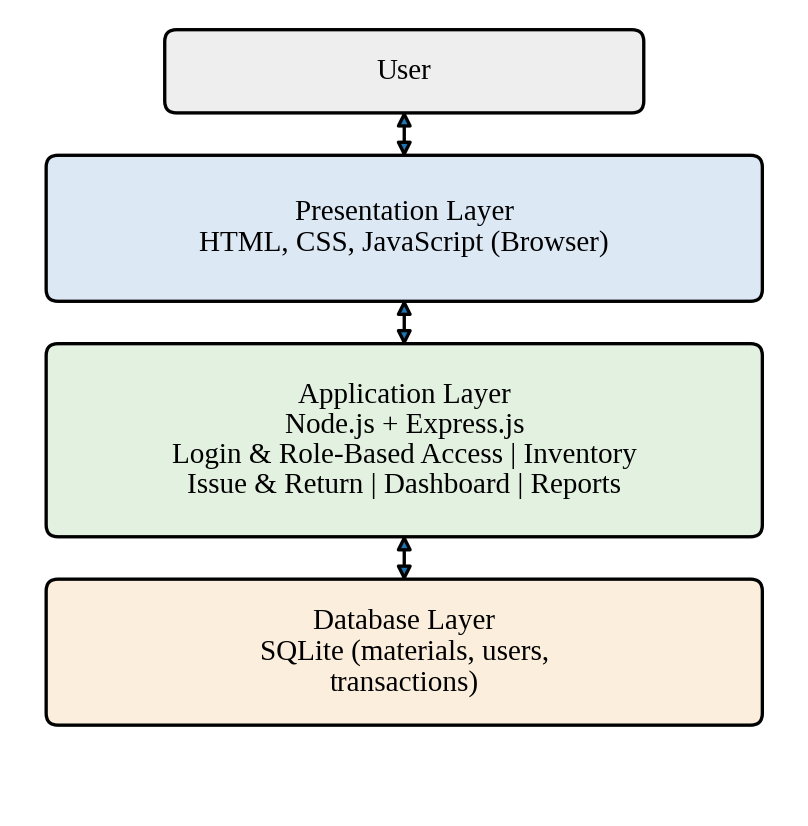
The DecoStone capstone Material Management System is designed to maintain material records and support routine stock operations across godowns. Its stated modules comprise material inventory, material issue and return, role-based login, an administrative dashboard and reports. The system uses a web application and relational database; it does not use RFID, GPS or automated physical identification. These boundaries distinguish the current project scope from the tracking and coordination technologies discussed above.
5.2Technologies and architecture
HTML provides the page structure, CSS governs presentation, and JavaScript supports browser interactions. Node.js and Express.js handle application requests and logic; SQLite stores the application data. Figure 1 depicts the browser-facing presentation layer, server-side application layer and database layer. This account follows the supplied project synopsis and should not be interpreted as a deployment or security assessment.
5.3Modules
The inventory module maintains material records, while issue and return operations document stock leaving and re-entering storage. Authentication and role-based authorization are intended to limit functions according to assigned access. The dashboard summarizes operational information; reports provide views derived from stored records. Although the paper describes all of these modules as supported, the recorded functional checks address only login, issue and return.
5.4Development method
Development proceeded through six stages: requirements identification, frontend development, backend development, database integration, module integration and functional checking. This sequence describes the project’s development work; it does not constitute a formal process-improvement or comparative study.
5.5Functional checks
According to the project test record, the application was checked on a local computer using the three workflows listed in Table 1I. No independent test log or quantitative performance measurements are available.
| Test case | Observed outcome | Status |
|---|---|---|
| Login | Login worked during testing | Passed |
| Material issue | Issue operation worked | Passed |
| Material return | Return operation worked | Passed |
All three workflows in the local check were reported as passed. That result does not establish that every module or route works correctly, and it provides no measure of inventory accuracy, response time, concurrent-user behavior or user satisfaction. Further testing should specify inputs and expected results, then verify the resulting database state.
5.6Security and deployment considerations
Before deployment, the application should be assessed for password hashing, server-side authorization on every protected operation, parameterized database access, input validation, session and cookie settings, error handling, backup and restore, and transport security. These items are recommendations for review. The supplied test record does not show that they have been implemented or tested for security.
6Conclusion and future scope
Conclusion. This review synthesized 16 studies spanning material-control frameworks, construction tracking technologies, cloud and BIM integration, and digital supply-chain research. The evidence does not support a general claim that integrated inventory software is absent. Rather, the DecoStone capstone is positioned as a transaction-focused web application for routine material records and role-based operations across godowns. The supplied local test record documents login, issue and return only. Claims about complete functionality, quality or operational benefit require further testing.
Future scope. Subsequent evaluation should document test cases for every role and route, verify stock balances against transaction histories, reconcile database records with physical counts, and assess backup recovery, concurrent use, security and mobile usability. Performance and user feedback should be measured under a defined test plan. Barcode or QR scanning and notifications could be considered later, if operational requirements justify them.
References
- [1]Song J, Haas CT, Caldas CH. Tracking the location of materials on construction job sites. Journal of Construction Engineering and Management. 2006;132(9):911–918. https://doi.org/10.1061/(ASCE)0733-9364(2006)132:9(911)
- [2]Kasim NB. Towards a framework for ICT-enabled materials management in complex projects. Journal of Techno-Social. 2010;2(1). https://journal.uthm.edu.my/index.php/JTS/article/view/315
- [3]Ren Z, Anumba CJ, Tah J. RFID-facilitated construction materials management (RFID-CMM): A case study of water-supply project. Advanced Engineering Informatics. 2011;25(2):198–207. https://doi.org/10.1016/j.aei.2010.02.002
- [4]Demiralp G, Guven G, Ergen E. Analyzing the benefits of RFID technology for cost sharing in construction supply chains: A case study on prefabricated precast components. Automation in Construction. 2012;24:120–129. https://doi.org/10.1016/j.autcon.2012.02.005
- [5]Lee JH, Song JH, Oh KS, Gu N. Information lifecycle management with RFID for material control on construction sites. Advanced Engineering Informatics. 2013;27(1):108–119. https://doi.org/10.1016/j.aei.2012.11.004
- [6]Valero E, Adan A, Cerrada C. Evolution of RFID applications in construction: A literature review. Sensors. 2015;15(7):15988–16008. https://doi.org/10.3390/s150715988
- [7]Ko HS, Azambuja M, Lee HF. Cloud-based materials tracking system prototype integrated with radio frequency identification tagging technology. Automation in Construction. 2016;63:144–154. https://doi.org/10.1016/j.autcon.2015.12.011
- [8]Fang Y, Cho YK, Zhang S, Perez E. Case study of BIM and cloud-enabled real-time RFID indoor localization for construction management applications. Journal of Construction Engineering and Management. 2016;142(7):05016003. https://doi.org/10.1061/(ASCE)CO.1943-7862.0001125
- [9]Moon S, Xu S, Hou L, Wu C, Wang X, Tam VWY. RFID-aided tracking system to improve work efficiency of scaffold supplier: Stock management in Australasian supply chain. Journal of Construction Engineering and Management. 2018;144(2):04017115. https://doi.org/10.1061/(ASCE)CO.1943-7862.0001432
- [10]Kasim N, Sarpin N, Mohd Noh H, Zainal R, Mohamed S, Manap N, et al. Automatic materials tracking practices through RFID implementation in construction projects. MATEC Web of Conferences. 2019;266:05001. https://doi.org/10.1051/matecconf/201926605001
- [11]Chen Q, Adey BT, Haas C, Hall DM. Using look-ahead plans to improve material flow processes on construction projects when using BIM and RFID technologies. Construction Innovation. 2020;20(3):471–508. https://doi.org/10.1108/CI-11-2019-0133
- [12]Zhao J, Zheng Y, Seppänen O, Tetik M, Peltokorpi A. Using real-time tracking of materials and labor for kit-based logistics management in construction. Frontiers in Built Environment. 2021;7:713976. https://doi.org/10.3389/fbuil.2021.713976
- [13]Yevu SK, Yu ATW, Darko A. Digitalization of construction supply chain and procurement in the built environment: Emerging technologies and opportunities for sustainable processes. Journal of Cleaner Production. 2021;306:129093. https://doi.org/10.1016/j.jclepro.2021.129093
- [14]Liao L, Yang C, Quan L. Construction supply chain management: A systematic literature review and future development. Journal of Cleaner Production. 2023;382:135230. https://doi.org/10.1016/j.jclepro.2022.135230
- [15]Antai I, Lenka S, Achtenhagen L. Digital platforms and the construction supply chain: Trends and emerging themes in extant AEC research. Construction Management and Economics. 2025;43(2):113–129. https://doi.org/10.1080/01446193.2024.2396592
- [16]Lopes IT, Turkan Y. Digital enablers for circular construction: A systematic review of RFID and BIM integration. ASCE OPEN: Multidisciplinary Journal of Civil Engineering. 2026;4(1). https://doi.org/10.1061/AOMJAH.AOENG-0104