Internet of Things
A Smart Scheduling System for EV Charging Stations
Department of Computer Science and Engineering, City Engineering College, Bengaluru, Karnataka, India
Published October 2026
Abstract
The growing adoption of electric vehicles (EVs) calls for smart charging systems that can manage demand well and make charging easier for users. Old EV charging systems usually do not provide real-time monitoring, do not let users reserve slots before they arrive and lack centralized control. This causes waits, wasted resources and a bad experience for users. This paper proposes an Electric Vehicle Charging Station Locator and Slot Booking Application that gives a user-friendly way to manage EV charging. The system lets users find charging stations with location services, see which slots are free right now and book charging slots ahead of time using a web app. After booking, an automatic email tells the user if the slot was booked or not. The app is made with HTML, CSS and JavaScript. Firebase Cloud Services handle user login, store data and keep booking information in sync in real time. An admin part lets charging station operators update station details, manage slots and handle user bookings. The design makes the system scalable, keeps data consistent and protects access. Tests show that the system cuts charging waiting times, uses stations better and works more efficiently than old walk-in models. The solution supports smart transportation and contributes to a sustainable smart city transport system.
Keywords: EV Charging Station; Slot Booking; Firebase; Location-Based Services; Smart Transportation; Email Confirmation; Web Application
1Introduction
The world is moving from cars that use fossil fuels to electric vehicles (EVs). This change speeds up because people worry more about the environment, fuel is getting more expensive and governments support the transition.
EVs are a preferred choice because they cut greenhouse gases and rely less on non-renewable fuels. Because of this more people are buying EVs in cities, which makes the need for good and reliable EV charging stations grow.
Even though EV technology has improved, managing charging stations is still hard. Few stations are available, they are not spread evenly, and there is no real-time information. Users often wait a long time. In current systems users go to a station without knowing if a slot is free which causes crowds, wasted resources and unhappy users. These problems show that we need systems that make charging easier and better for users.
Because most people own smartphones and app development has grown, digital solutions work well to solve infrastructure problems. Web and mobile EV charging apps can give real-time station info help with directions and let users book from afar so they can plan charging. Adding cloud computing and real-time databases makes the system grow easily keeps data reliable and lets users reach it from anywhere.
This paper shows an Electric Vehicle Charging Station Locator and Slot Booking Application that addresses the limitations of existing charging systems. The app lets users find nearby charging stations with location services, see which slots are free now and reserve a slot ahead of time using a simple interface. After each booking the system emails the user to say whether the slot was booked or not. The system uses HTML, CSS and JavaScript. Firebase acts as the backend for login storing data and keeping booking info in sync. An admin part lets station operators update station details watch bookings and change slot availability on the fly.
The system wants to cut waiting time at stations, use resources better and improve how things run. By providing an automatic booking way the app helps smart transport grow and supports green city travel. Testing shows that the system can make the whole EV charging experience better for users and for those who run the stations.
2Architecture of the website
The proposed EV Charging Station and Slot Booking system uses a cloud-based, multi-layer web architecture that is made to support real-time charging management, secure access and scalable deployment. The architecture has three layers that work together: a presentation layer, an application layer and a data layer. The presentation layer is built with web technologies such as HTML, CSS and JavaScript. It gives EV users and administrators role-based interfaces to see station information, real-time slot availability and booking services. The application layer runs the core business logic. It handles station discovery, slot allocation booking validation, conflict prevention and email confirmation of booking status. It also adds location-based services for navigation. Backend services use Firebase cloud infrastructure. Firebase gives authentication, authorization and real-time event handling for booking updates. The data layer uses a cloud-hosted NoSQL database. The database stores user profiles, charging station details, slot schedules and booking records. It keeps data consistent and always available. This architecture lets users use charging resources reduces waiting time supports many users at once and gives a central place to monitor and manage EV Charging Station operations.
3Related work
Recent studies on vehicle charging infrastructure show that there is a growing need for systems that can manage charging demand cut waiting time and make the user experience better. Early research on EV Charging Station mainly looked at station locators and manual queue-based charging. Those early solutions did not give real-time availability updates or allow people to book slots in advance. Research added mobile and web apps that used map services to find nearby EV Charging Stations. Many of those apps still had limited features and did not solve slot conflict problems or make the backend scale well. When cloud computing grew several studies suggested platforms that use cloud databases to keep track of EV Charging Station status and user activity. Those platforms made data easier to access and the system more reliable. Recent work has looked at real-time Slot Booking, Internet-of-Things chargers and integration with smart grids to make energy distribution and charging more efficient. With these new ideas many existing solutions still have problems. They do not scale well and do not give role-based management. They give administrators little control over station operations. Many commercial products are also proprietary, with little academic study of flexible cloud-native designs for EV Charging Station systems. The proposed system closes these gaps. It gives a real-time, role-based web application that brings together EV Charging Station discovery, Slot Booking and central administration in one platform.
4Methodology
The creation of the EV Charging Station and Slot Booking application follows a design-first method that is meant to solve real problems with EV charging management. First the team looks at EV charging habits and points out problems. These problems include no real-time slot visibility, slow manual booking and bad use of charging resources. Next the team gathers functional and non-functional requirements. These requirements set the goals for the system, such as making the system scalable, keeping data in sync in real time and protecting access. With those goals the team designs an architecture that uses a multi-layer cloud model. The design joins a user interface, a central business logic layer and a cloud-hosted database. The system is built with web tools and cloud services. This lets users discover EV Charging Stations in real time, reserve slots, and lets administrators manage the system. At the end the team tests the application. They check that it works, that it performs well and that it is reliable. These tests confirm that the system can give the slot to the right user cut waiting time and make the operation smoother. This proves that the chosen method works.
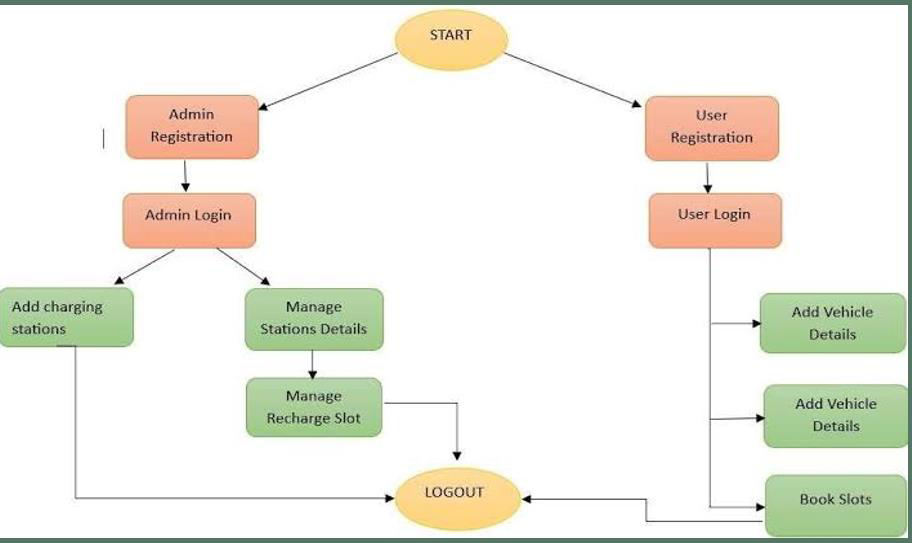
The overall flow of the system is shown in Figure 1.
4.1Problem identification and requirements analysis
In this phase I focus on spotting the main problems in current electric vehicle charging systems and setting the goals for a better solution. When I look at how EV charging works today I find several limitations. There is no real-time slot availability. People still rely on walk-in charging. The charging infrastructure is not used well. Station operators have no control. These problems cause waits, unhappy users and wasteful operations.
To address these challenges I list the functional requirements. They include user registration, finding stations by location showing real-time slot availability booking a slot ahead sending an email that confirms booking status allowing booking cancellations and giving administrators control over stations and slots. I also note the non-functional requirements. They are system scalability, data consistency, security, real-time sync and high availability. These are vital to serve many users at once and to meet growing charging demand. This analysis gives a base for designing a cloud-based EV charging station and slot booking system. It will improve the user experience and use charging resources more efficiently.
4.2Architectural design (the proposed artifact)
The proposed artifact is built as a cloud-native, multi-tier web architecture that lets me manage electric vehicle charging stations and book slots in real time. The design uses layers. A responsive presentation layer lets users and administrators interact. An application layer runs the logic—finding stations assigning slots validating bookings and resolving conflicts. A data layer stores data reliably and can grow as needed.
Location-based services sit inside the application layer to give map-based station views and help navigation. Cloud services handle login, permission checks and real-time event processing. They keep slot availability updated instantly for every user. A central admin interface lets operators manage stations set up slots and watch system usage. This design guarantees scalability, real-time responsiveness, secure role-based access and efficient use of charging infrastructure. It works well for deployments in cities.
4.3Technology stack and development environment
I build the EV charging station and slot booking system with a cloud-oriented stack to keep it scalable, reliable and fast. The web interface uses HTML, CSS and JavaScript. It is responsive and works well on all devices. The backend runs on Firebase Cloud Services. It takes care of user login, role control and real-time data sync. Firebase Firestore, a NoSQL cloud database holds station details, slot schedules, user profiles and booking records. It supports concurrent access and high availability. Map services give location-based features for station maps and navigation.
I use cloud-hosted infrastructure. This makes deployment and maintenance easier. With this stack I can develop quickly integrate parts smoothly and manage EV charging operations in the real world.
4.4Prototype development and module implementation
I built a working web prototype of the EV charging station and slot booking app. It shows the proposed architecture and key features. I focused on core modules: user login, station management, real-time slot status and booking processing. The user part lets EV owners register, log in find stations see open slots and book or cancel times.
After every booking attempt the system sends an email to the registered user. It tells them if the slot was booked or if it failed. This gives them proof without checking the app. The admin part lets operators add stations set up slots and watch booking activity. Real-time sync updates slot status instantly when a booking is confirmed or canceled. This stops clashes and duplicate bookings. I built the prototype in steps. Each step lets me test and tweak modules. This shows that the system works, is easy to use and helps manage EV charging.
4.5System integration and API testing
System integration was carried out to make sure that the user interface, the application logic and the cloud-based backend services of the EV Charging Station and Slot Booking system all work together smoothly. All parts of the system talk to one another through APIs that handle user authentication charging station data retrieval slot availability updates and booking transactions.
We carried out integration testing to check that data moves correctly between modules so that booking requests, confirmations and cancellations show up accurately in time across the system. We also tested the email confirmation to make sure that a message is sent after every booking transaction and that the message content matches the result whether the booking succeeded or failed. API testing checked that requests are handled correctly, responses are accurate and errors are managed properly in different situations proving that the system behaves consistently even when many users access it at the same time. This phase made sure that all system components work reliably together and that data stays consistent throughout the application.
4.6Performance and load evaluation
Performance and load evaluation was carried out to see how fast, how big and how reliable the system is when usage changes. We simulated user interactions to measure performance metrics like how fast the system responds how long it takes to confirm a booking and how stable the system stays when many users are active at the same time. The cloud-based backend and real-time database handled users looking at station data and booking slots without losing speed. The evaluation showed that the system can grow on its own to meet demand keeping response times good and making sure that charging services are always available. That makes the system ready for real-world use in city areas.
4.7Security and validation framework
Security and validation were built into parts of the EV Charging Station and Slot Booking system to keep user data safe and to make sure only the right people can use the system. We added authentication to check who each user is and we used role-based access control to limit what users can do based on whether they are an EV user or an administrator. We also put data validation in place during booking transactions so bad or conflicting requests are caught before they cause problems. We ran security tests to find any weaknesses that could let someone get in without permission or change data. The validation framework proved that the system follows all security rules keeping data correct, private and making sure the EV Charging Station and Slot Booking Application works reliably.
5Detailed overview of pages in the EV charging system
5.1Login page
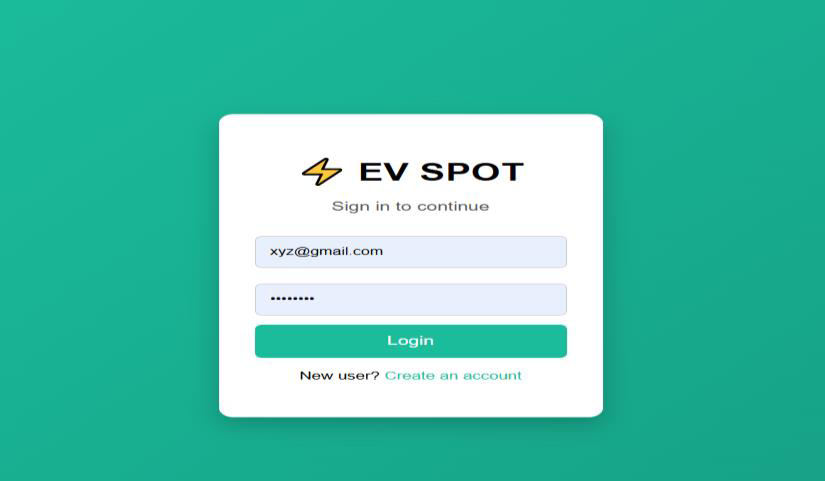
The Login Page gives users a way to enter the EV Charging Station and Slot Booking Application by checking who they are. If a user already has an account they can log in with their email and password. If the user does not have an account they are sent to the registration page to make one. After the system confirms the user’s identity the user is taken to the dashboard that lets them see charging station details and book slots. This page keeps the system secure and makes sure only authorized people can get in.
The login page is shown in Figure 2.
5.2Register page
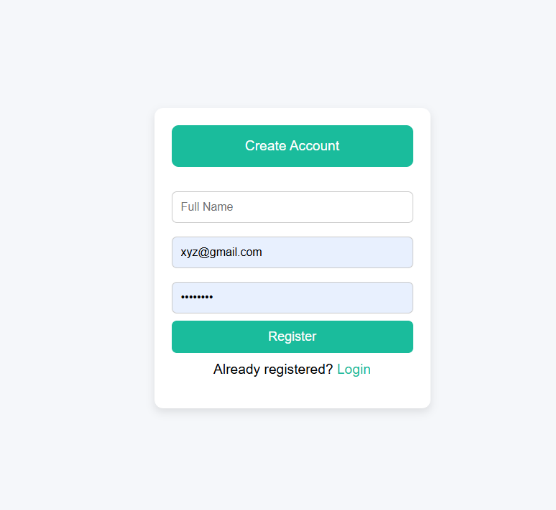
The Registration Page lets new people create an account for the EV Charging Station and Slot Booking Application. Users must give details like their name, email address and password to finish the sign-up. Once the account is made the user can log in and use all system features such as finding charging stations and booking slots. This page makes sure new users join safely and that authorized people can use the system.
The registration page is shown in Figure 3.
5.3Dashboard page
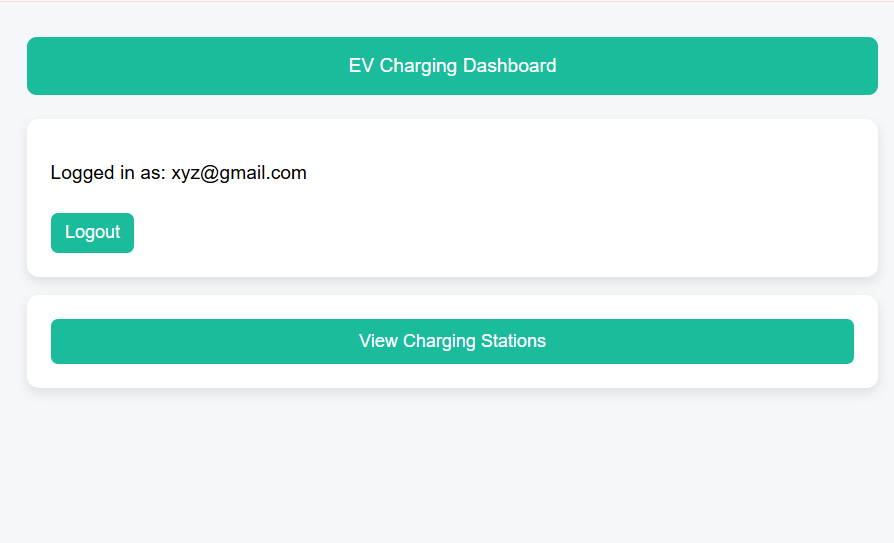
The User Dashboard Page is the screen for people who have logged into the EV Charging Station and Slot Booking Application. It shows the user’s details and gives quick links to the most important tasks like looking at available charging stations and handling bookings. The dashboard also has a logout button so users can end their session safely. This page makes the system easier to use by putting everything in one place.
The user dashboard is shown in Figure 4.
5.4Charging station page
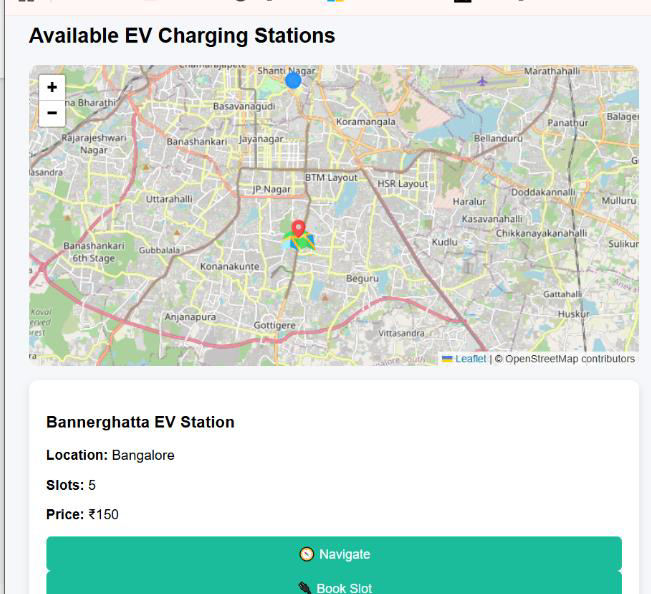
The Charging Stations Page shows a list of all EV charging stations and their locations on a map. Users can see details, such as the station’s location, how many slots are open and how much it costs to charge. The page also lets users get directions and book a slot making it easier for them to find and reserve a spot.
The charging station page is shown in Figure 5.
5.5Slot booking page
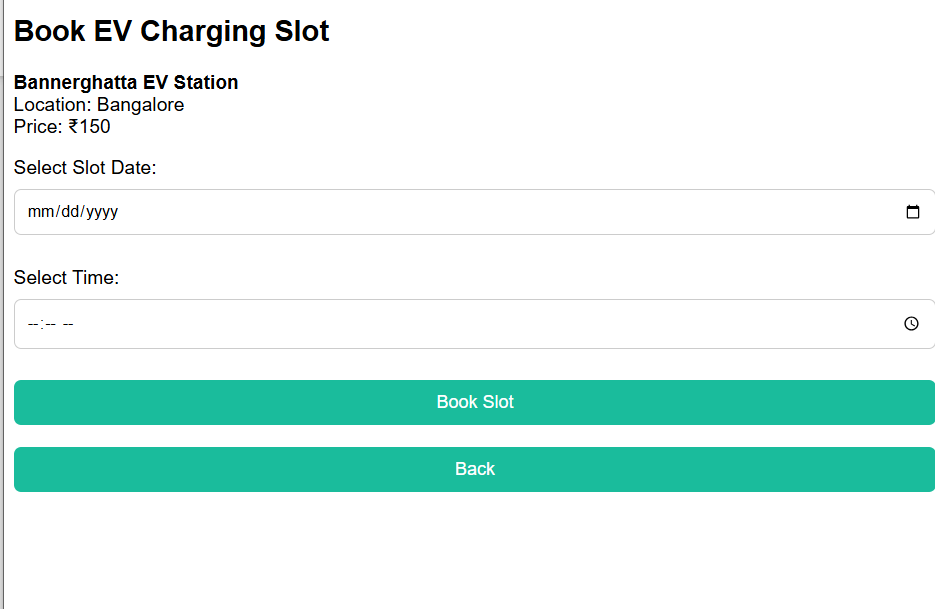
The Slot Booking Page lets users reserve a charging slot at a chosen station. The page shows the station’s location and price and lets the user pick a date and time for charging. When the user confirms, the booking is processed and an email confirmation is sent. This page helps users schedule quickly and reduces waiting time at stations.
The slot booking page is shown in Figure 6.
5.6Email confirmation of slot booking
The Email Confirmation feature notifies the user of the outcome of every booking attempt made on the Slot Booking Page. Once the booking request is processed the system sends an email to the registered email address of the user. If the slot is reserved the Email Confirmation email confirms that the slot was booked successfully along with the booking details such as station name, date and time. If the booking could not be completed, for example because of a slot conflict or a processing error the Email Confirmation email informs the user that the booking was not successful so that another slot can be chosen. This feature gives users a written record of their booking reduces uncertainty about whether a reservation was made and avoids unnecessary visits to charging stations.
5.7Admin dashboard page
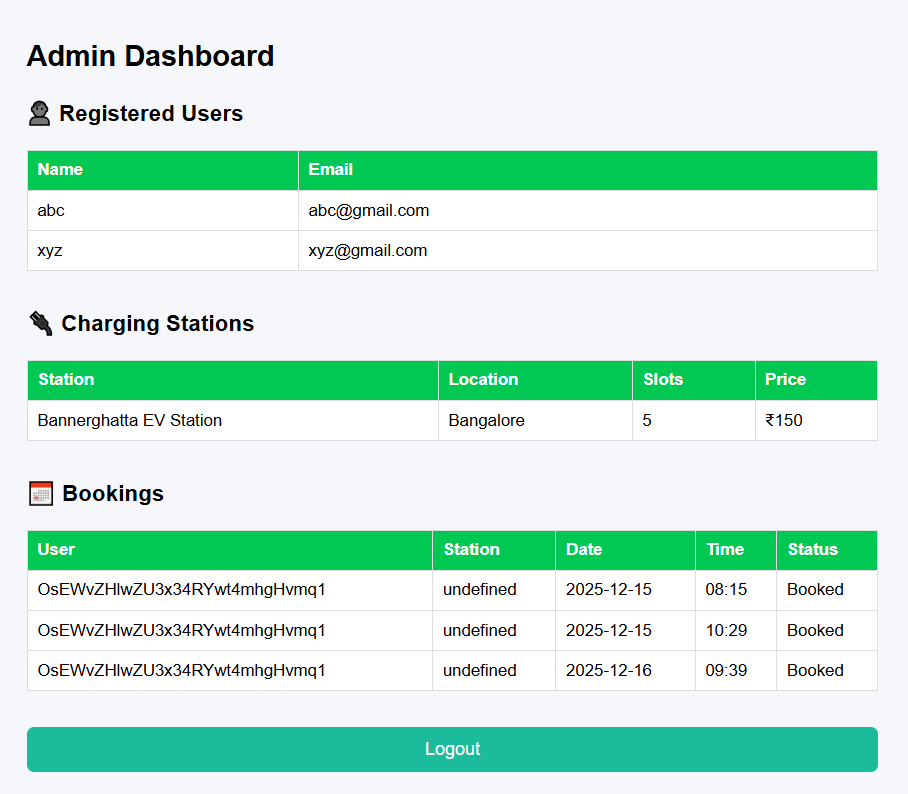
The Admin Dashboard Page provides control and monitoring of the EV Charging Station and Slot Booking Application. It displays user details charging station information and booking records in a structured format. Administrators can monitor slot usage, booking status and station details to ensure smooth system operation. This page supports management and oversight of the EV charging infrastructure.
The admin dashboard is shown in Figure 7.
6Future updates
Future updates of the EV Charging Station and Slot Booking Application will focus on improving intelligence, scalability and user experience. Planned updates include the integration of real-time IoT-enabled charging stations for automatic status monitoring demand prediction for optimized slot allocation and support for online payment gateways. The system can be extended with a mobile application, smart grid integration for energy management and reminder notifications before the booked slot time in addition to the existing Email Confirmation. These enhancements aim to make the system more efficient, intelligent and suitable for large-scale city deployments.
7Conclusion
This paper presented the design and implementation of an EV Charging Station and Slot Booking Application aimed at improving the efficiency and accessibility of EV charging infrastructure. The proposed system provides real-time charging station information, advance slot booking, Email Confirmation of booking status and centralized administrative control through a cloud-based web platform. By reducing waiting time and optimizing charging resource utilization the application enhances user convenience and operational efficiency. The system demonstrates the feasibility of integrating location-based services and real-time data management to support sustainable and smart transportation solutions.
References
- [1]Electric vehicle charging infrastructure: Concepts and challenges [Internet]. ScienceDirect Topics. https://www.sciencedirect.com/topics/engineering/electric-vehicle-charging
- [2]Smart charging management for electric vehicles [Internet]. https://www.sciencedirect.com/science/article/pii/S2352484719305351
- [3]Google. Google Maps Platform documentation [Internet]. https://developers.google.com/maps/documentation
- [4]Google. Firebase documentation: Authentication and Cloud Firestore [Internet]. https://firebase.google.com/docs
- [5]OpenStreetMap and Leaflet documentation [Internet]. https://leafletjs.com; https://www.openstreetmap.org
- [6]JavaScript Tutorial. Cloud-based web application development [Internet]. https://www.javascripttutorial.net/
- [7]Bender B, Bertheau C, Gronau N. Future ERP systems: A research agenda. In: Proceedings of the 23rd International Conference on Enterprise Information Systems (ICEIS 2021). Vol. 2. SciTePress; 2021. p. 776–783. https://doi.org/10.5220/0010477307760783
- [8]Katuu S. Enterprise resource planning: Past, present, and future. New Review of Information Networking. 2020;25(1):37–46. https://doi.org/10.1080/13614576.2020.1742770