Bioremediation
Dose- and Time-Dependent Attenuation of Total Petroleum Hydrocarbons, Polycyclic Aromatic Hydrocarbons and BTEX in Spent-Engine-Oil-Contaminated Soil Amended with African Breadfruit (Treculia africana) Compost
Department of Agricultural and Environmental Engineering, Rivers State University, Nkpolu-Oroworukwo, Port Harcourt, Nigeria
Published November 2026
Abstract
Spent engine oil contaminates soil with persistent and toxic hydrocarbon compounds. This study investigated the effectiveness of African breadfruit (Treculia africana) compost as a biostimulant for remediating spent-engine-oil-contaminated sandy-loam soil. Each reactor contained 4.0 kg of soil and 500 g of spent engine oil, amended with 0, 0.5, 1.0, or 1.5 kg of compost (control, T1, T2, and T3, respectively), with three replicates per treatment. Total petroleum hydrocarbons (TPH), polycyclic aromatic hydrocarbons (PAHs), and benzene, toluene, ethylbenzene, and xylenes (BTEX) were monitored on days 0, 14, 28, 42, and 56. Data were analysed using two-way factorial ANOVA on log10-transformed concentrations, partial eta-squared effect sizes, Tukey’s honestly significant difference tests, and apparent first-order attenuation models. Compost dosage, incubation duration, and their interaction significantly influenced all contaminant groups (p < 0.001). By day 56, T3 achieved the highest attenuation of TPH (88.10%), PAHs (87.13%), and BTEX (90.98%), compared with 70.71%, 72.37%, and 73.77%, respectively, in the control. T3 also exhibited the highest apparent first-order rate constants and shortest half-lives across all contaminant groups. However, residual concentrations remained above the protocol’s target values, indicating incomplete remediation. African breadfruit compost demonstrates potential as a locally available biostimulant, although extended incubation, contaminant mass-balance assessments, microbial mechanism investigations, and field validation are necessary to establish its practical applicability.
Keywords: African breadfruit; biostimulation; total petroleum hydrocarbons; BTEX; compost; polycyclic aromatic hydrocarbons
1Introduction
Petroleum contamination remains a major constraint on soil ecological function, agricultural use and groundwater protection. Spent engine oil is especially complex because use in engines alters the original lubricant and enriches it in weathered hydrocarbons, polycyclic aromatic compounds and combustion- or wear-derived constituents. Its disposal around informal vehicle-repair facilities creates persistent exposure pathways for soil organisms, plants and nearby communities. Recent research on Nigerian auto-parts markets has indicated that spent oil disposal can change soil chemistry and cause environmental problems beyond the actual disposal site [1]. The hydrocarbon mixture is functionally heterogeneous too: total petroleum hydrocarbons (TPH) are an aggregate measure of petroleum mass, but polycyclic aromatic hydrocarbons (PAH) and benzene–toluene–ethylbenzene–xylene (BTEX) are toxicologically important fractions with different persistence, mobility and biodegradability [2], [3].
Bioremediation relies on metabolic transformation by indigenous or inoculated microorganisms [4] and is highly regarded for its low energy requirement and potential for in situ treatment [5], [6]. However, the biodegradation of hydrocarbons in soil is often limited by nutrient imbalance, low bioavailability of the contaminants, unsuitable moisture or aeration conditions and toxicity of the pollutant matrix. This limitation is partially overcome by biostimulation , which involves the addition of nutrients or organic substrates to support the local degrader populations . Biostimulation enhances TPH removal through three primary mechanisms: nutrient supply, organic-matter conditioning, and microbial habitat improvement, but its performance remains site- and substrate-dependent [7]. Thus, compost may serve simultaneously as an organic-matter amendment, a habitat for microbial activity, and a source of nutrients, rather than simply a chemical remediation agent.
Research on organic amendments corroborates this rationale although results are variable. Vermicompost increased nutrient availability and microbial activity in hydrocarbon-contaminated soil, but recalcitrant hydrophobic compounds were still present, indicating that increased biological activity does not necessarily imply total cleaning [8]. Pig dung, animal manures and other organic residues have also been reported to enhance spent-oil or petroleum degradation in microcosm [9], [10]. These findings justify testing underused regional residues, while requiring careful separation of treatment effects from natural attenuation and explicit assessment of residual concentrations.
African breadfruit (Treculia africana Decne, Moraceae) is an indigenous tree of West and Central Africa, and seeds and processing residues are abundant in southern Nigeria [11], [12]. The seeds contain nutritionally relevant organic constituents and minerals [13], while phytochemical investigations have reported alkaloids, tannins, phenolics and other secondary metabolites [14], [15]. Fermented fruit residues may consequently provide biodegradable carbon and nutrients. Nevertheless, the value of African breadfruit compost for remediating spent-engine-oil-contaminated soil has not been adequately established, and qualitative phytochemical presence alone cannot demonstrate a remediation mechanism.
This study therefore evaluated the dose- and time-dependent performance of African breadfruit compost in contaminated soil, at laboratory-scale, over 56 days. The specific objectives were to: (i) quantify changes in TPH, PAH and BTEX under three compost doses relative to an unamended control; (ii) determine treatment, time and treatment × time effects with effect-size estimates and endpoint mean comparisons; (iii) estimate apparent first-order attenuation constants and half-lives; and (iv) interpret contaminant removal alongside qualitative phytochemical screening and regulatory benchmarks.
2Materials and methods
2.1Study location, soil, and amendment
The experiment was conducted at the Environmental/Soil and water laboratory in the Department of Agricultural and Environmental Engineering of Rivers State University, Port Harcourt, Nigeria (approximately 4°48′18.50″ N, 6°58′39.12″ E). The area has a humid tropical climate and lies within the Niger Delta petroleum-producing region. Its environmental and petroleum-contamination context has been documented by [16], [17]. Agricultural soil was collected from a farm garden along Aker Road, Iwofe, Obio/Akpor Local Government Area, Rivers State. Particle-size analysis using the Bouyoucos hydrometer procedure gave 40% sand, 40% silt and 20% clay; the soil was managed as a loamy matrix in the experiment.
Spent engine oil was obtained from a mechanical workshop at Aker Road, Rumuolumeni. African breadfruit material was purchased locally and fermented in a covered polythene bag for 30 days. Seeds were removed after fermentation, and the remaining decomposed material was used as African breadfruit compost. Baseline characterization was performed on the uncontaminated soil, compost and spent engine oil. For phytochemical screening, washed plant material was air-dried, ground and extracted in ethanol or methanol for 48 h; qualitative tests were then conducted for alkaloids, flavonoids, saponins, tannins, phenols, glycosides and terpenoids.
2.2Experimental design and reactor operation
Four treatment groups were established: contaminated soil without compost (control) and contaminated soil amended with 0.5, 1.0 or 1.5 kg compost (T1, T2 and T3). Each reactor contained 4.0 kg soil and 500 g spent engine oil. Thus, compost represented 0, 500, 1,000 or 1,500 g per reactor, equivalent to 0, 10, 20 or 30% of the soil–oil–compost mixture on a mass basis. The control provided an estimate of attenuation under the same incubation and handling conditions without compost. Three replicate reactors were used per treatment. Plastic reactors were approximately 0.30 m in diameter and depth. The mixtures were tilled twice weekly to homogenize the matrix and improve aeration. Samples were collected on days 0, 14, 28, 42 and 56 for chemical, physicochemical and microbiological measurements. Treatment compositions are summarized in Table 1. This study adopted replicate-level treatment and sampling-time structure: four compost doses × five sampling times × three replicates, giving 60 observations per response variable. This formulation directly tests the dose- and time-dependent hypotheses of the study.
| Treatment | Soil (kg) | Spent oil (g) | Compost (kg) | Compost in total mixture (%) |
|---|---|---|---|---|
| Control | 4.0 | 500 | 0 | 0 |
| T1 | 4.0 | 500 | 0.5 | 10 |
| T2 | 4.0 | 500 | 1.0 | 20 |
| T3 | 4.0 | 500 | 1.5 | 30 |
Note. Three replicate reactors were established per treatment (12 reactors in total). Percentage compost was calculated on a soil + oil + compost mass basis.
2.3Hydrocarbon analyses
TPH analysis followed the gas chromatography–flame ionization detection approach described in United States Environmental Protection Agency (USEPA) Method 8015B, using dichloromethane extraction, extract dehydration and silica-gel fractionation [18], [19]. The chromatographic system was an Agilent 7890B GC-FID equipped with a DB-1 capillary column and helium carrier gas. Calibration covered the C8–C40 range with 1-chlorooctadecane as surrogate. Aggregate PAH and BTEX concentrations were determined on the treated soil extracts using the laboratory’s chromatographic procedures and reported in mg kg−1.
2.4Attenuation, kinetic, and statistical analyses
Arithmetic means and sample standard deviations were calculated from the three replicate measurements for each treatment–time combination. Percentage attenuation at time t was calculated from the day-0 and corresponding time-point mean concentrations using Equation (1). To distinguish compost-associated improvement from attenuation in the unamended control, net concentration reduction relative to the control was calculated at day 56 using Equation (2).
Apparent first-order models were fitted by ordinary least-squares regression of the natural logarithm of treatment-mean concentration against incubation time, as shown in Equation (3). The apparent rate constant k was obtained from the slope, and the corresponding half-life was calculated using Equation (4). Confidence intervals for k were derived from the regression standard error with three residual degrees of freedom. These parameters describe empirical concentration decline and do not, by themselves, distinguish biodegradation from volatilization, sorption, leaching or other loss processes.
For each contaminant class, concentrations were log10-transformed to stabilize scale-dependent variation and analysed by two-way factorial analysis of variance (ANOVA), with compost treatment, sampling time and their interaction as fixed effects. The balanced design had 40 residual degrees of freedom. Partial eta squared (ηp2) was computed as the ratio of each effect's sum of squares to the total corrected sum of squares [SS effect/(SS effect + SS error]. Day-56 treatments were compared using Tukey’s honestly significant difference test on the transformed scale at a family-wise α of 0.05. Levene’s test assessed homogeneity of variance across treatment–time cells, and residual normality was examined with the Shapiro–Wilk test. Because residual normality departed marginally from the test’s expectation despite homogeneous variances, heteroscedasticity-consistent HC3 inference was also applied; all treatment, time and interaction conclusions remained p < 0.001. Analyses were conducted in Python 3.12 using SciPy 1.16.2 and statsmodels 0.14.5. Results are reported as arithmetic mean ± standard deviation in the original measurement units, with exact F statistics and effect sizes. Statistical significance was accepted at p < 0.05.
3Results
3.1Baseline characteristics of soil, compost and spent engine oil
The baseline characteristics of the uncontaminated soil, African breadfruit (Treculia africana) compost and spent engine oil used in the study are presented in Table 2. These characteristics establish the initial conditions for evaluating changes in soil hydrocarbon concentrations and physicochemical properties following compost application.
| Parameter | Uncontaminated soil | African breadfruit compost | Spent engine oil |
|---|---|---|---|
| TPH (mg kg−1) | 0.00 | - | 740.00±61.42 |
| PAH (mg kg−1) | 0.00 | - | 54.21±3.63 |
| BTEX (mg kg−1) | 0.00 | - | 0.45±0.046 |
| Sand (%) | 40.00 | - | - |
| Silt (%) | 40.00 | - | - |
| Clay (%) | 20.00 | - | - |
Note: TPH, PAH, and BTEX values represent means of three observations ± standard deviations.
TPH = total petroleum hydrocarbons; PAH = polycyclic aromatic hydrocarbons; BTEX = benzene, toluene, ethylbenzene, and xylene; - = not measured or not applicable.
3.2Total petroleum hydrocarbon (TPH) attenuation
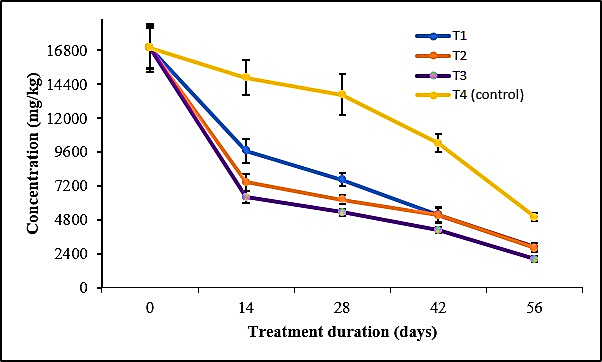
The temporal variation in total petroleum hydrocarbon (TPH) concentrations across the treatments is presented in Figure 1. The results illustrate the changes in residual hydrocarbon levels during incubation and the influence of African breadfruit compost application rate on hydrocarbon reduction relative to the untreated control.
3.3Polycyclic aromatic hydrocarbon (PAH) attenuation
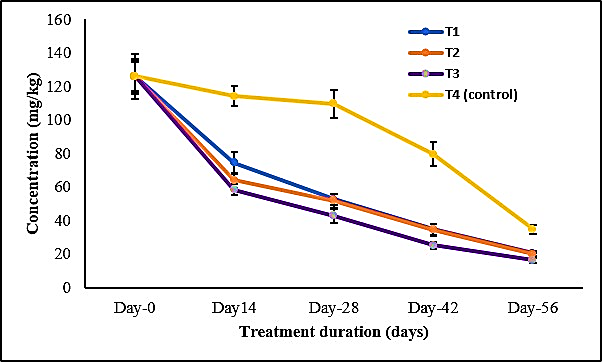
The changes in aggregate polycyclic aromatic hydrocarbon (PAH) concentrations during incubation are presented in Figure 2. The results show the temporal variation in residual PAH levels across the treatments, highlighting the influence of African breadfruit compost application rate on PAH reduction compared with the untreated control.
3.4Benzene, toluene, ethylbenzene, and xylene (BTEX) attenuation
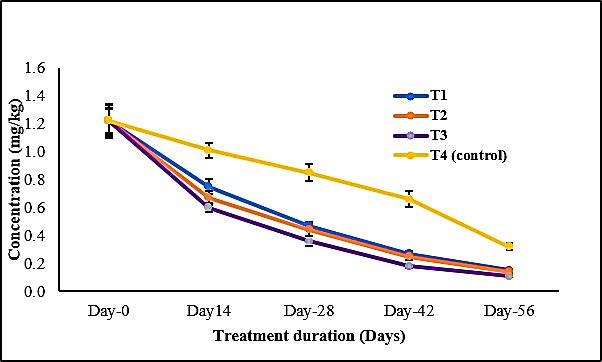
The temporal changes in aggregate benzene, toluene, ethylbenzene, and xylene (BTEX) concentrations during incubation are presented in Figure 3. The results illustrate the influence of African breadfruit compost application rate on BTEX reduction over the incubation period relative to the untreated control.
3.5Factorial effects, dose–time dependence and attenuation kinetics
The effects of compost treatment, incubation time, and their interaction on hydrocarbon concentrations were evaluated using two-way factorial analysis of variance (ANOVA). The statistical significance of these effects and their associated effect sizes for TPH, PAH, and BTEX are summarised in Table 3.
| Response | Effect | df | F | p | ηp2 |
|---|---|---|---|---|---|
| TPH | Treatment | 3, 40 | 210.477 | < 0.001 | 0.940 |
| TPH | Time | 4, 40 | 717.992 | < 0.001 | 0.986 |
| TPH | Treatment × time | 12, 40 | 14.486 | < 0.001 | 0.813 |
| PAH | Treatment | 3, 40 | 209.779 | < 0.001 | 0.940 |
| PAH | Time | 4, 40 | 790.848 | < 0.001 | 0.988 |
| PAH | Treatment × time | 12, 40 | 16.347 | < 0.001 | 0.831 |
| BTEX | Treatment | 3, 40 | 248.012 | < 0.001 | 0.949 |
| BTEX | Time | 4, 40 | 1161.897 | < 0.001 | 0.991 |
| BTEX | Treatment × time | 12, 40 | 22.935 | < 0.001 | 0.873 |
Note. ANOVA was conducted on log10-transformed concentrations (60 observations per response). df = numerator and residual degrees of freedom; ηp2 = partial eta squared. HC3 sensitivity inference retained p < 0.001 for every effect.
The extent of hydrocarbon attenuation and the apparent first-order degradation kinetics across treatments were assessed to characterise treatment performance and hydrocarbon dissipation during incubation. Table 4 presents the attenuation indices, estimated rate constants, confidence intervals, half-lives, and goodness-of-fit statistics for TPH, PAH, and BTEX.
| Response | Treatment | Attenuation (%) | Net reduction (%) | k (day−1) | 95% CI for k | Half-life (days) | R² |
|---|---|---|---|---|---|---|---|
| TPH | Control | 70.71 | - | 0.02021 | 0.00362-0.03680 | 34.30 | 0.8337 |
| TPH | T1 | 83.24 | 42.78 | 0.02999 | 0.02225-0.03773 | 23.11 | 0.9807 |
| TPH | T2 | 83.54 | 43.79 | 0.02847 | 0.01386-0.04307 | 24.35 | 0.9277 |
| TPH | T3 | 88.10 | 59.38 | 0.03366 | 0.01665-0.05067 | 20.59 | 0.9297 |
| PAH | Control | 72.37 | - | 0.02095 | 0.00033-0.04157 | 33.09 | 0.7770 |
| PAH | T1 | 83.78 | 41.30 | 0.03144 | 0.02738-0.03549 | 22.05 | 0.9951 |
| PAH | T2 | 84.28 | 43.11 | 0.03083 | 0.02197-0.03970 | 22.48 | 0.9761 |
| PAH | T3 | 87.13 | 53.42 | 0.03530 | 0.02689-0.04371 | 19.63 | 0.9835 |
| BTEX | Control | 73.77 | - | 0.02216 | 0.00781-0.03651 | 31.28 | 0.8895 |
| BTEX | T1 | 87.70 | 53.13 | 0.03724 | 0.03386-0.04062 | 18.61 | 0.9976 |
| BTEX | T2 | 88.52 | 56.25 | 0.03797 | 0.03438-0.04156 | 18.26 | 0.9974 |
| BTEX | T3 | 90.98 | 65.63 | 0.04297 | 0.03826-0.04768 | 16.13 | 0.9965 |
Note. Attenuation compares day-56 and day-0 treatment means. Net reduction is relative to the day-56 control; - = reference group. Apparent first-order fits used five treatment-mean concentrations. k = rate constant; CI = confidence interval.
3.6Phytochemical profile
The phytochemical composition of African breadfruit extract was qualitatively assessed to identify major classes of secondary metabolites that may contribute to its potential role in soil remediation. The screening observations and corresponding detection results are presented in Table 5.
| Phytochemical | Qualitative observation | Result |
|---|---|---|
| Alkaloids | Reddish precipitation | + |
| Flavonoids | Yellowish coloration | + |
| Saponins | Stable form formed | + |
| Tannins | Blue-black colour | + |
| Phenols | Green colouration | + |
| Glycosides | Brown ring formed | + |
| Terpenoids | Reddish-brown interface | + |
4Discussion
4.1Baseline characteristics of uncontaminated soil, African breadfruit compost, and spent engine oil
Results of the baseline characteristics of uncontaminated soil, African breadfruit compost and spent engine oil (Table 2) showed that the uncontaminated soil had no detectable petroleum hydrocarbon contamination and was therefore a suitable reference to assess the effects of subsequent oil contamination and remediation. The sandy loam texture of the soil can affect the mobility of contaminants, moisture retention, aeration, and microbial activity during treatment. The spent engine oil was found to contain measurable TPH, PAH and BTEX confirming its suitability as the source of petroleum contamination for the experimental investigation. Also, the presence of these contaminant groups offers a basis to monitor changes in hydrocarbon concentrations over the course of remediation. The organic amendment was African breadfruit compost, but the baseline characteristics of the compost are not presented in the table. Such information would be useful for interpretation of its possible effect on soil quality and hydrocarbon degradation.The baseline compost chemistry is consistent with the established organic and mineral composition of T. africana materials [12], [11], although the concentrations in the present compost are process-specific and should not be generalized to all breadfruit residues.
The percentage composition of sand, silt and clay of the unpolluted soil indicates loamy texture as per the USDA soil textural classification system. This texture composition indicates a soil that contains a combination of relatively coarse and fine particles, which may influence water holding capacity, aeration, contaminant mobility, and microbial activity. The sand fraction can improve drainage and aeration, while the silt and clay fractions can improve water retention and adsorption of some hydrocarbon constituents. These characteristics are important to the remediation process because soil moisture, oxygen availability, and contaminant-soil interactions can affect biodegradation of petroleum hydrocarbons.
4.2Overall attenuation and contribution of compost amendment
The concentration profiles (Figures 1-3) indicate substantial attenuation of TPH, total PAH and BTEX over 56 days in both compost-amended treatments and the unamended control. The highest compost dose (T3; 1.5 kg) had the lowest final mean concentration and the largest reduction for each indicator: 88.1% for TPH (Figure 1), 87.1% for total PAH (Figure 2) and 91.0% for total BTEX (Figure 1). In contrast, the unamended control showed 70.7%, 72.4% and 73.8% reductions, respectively. Thus, the data are consistent with an additional benefit associated with compost amendment, particularly at the highest dose, but they also demonstrate that a large fraction of the measured concentration decline occurred in the absence of compost.
This result is broadly consistent with the premise of biostimulation: organic amendments can add nutrients and organic substrates and may modify soil microenvironments that favour indigenous microbial activity [20]-[22]. Nigerian work by [15] found 50–95% hydrocarbon losses following nutrient addition and oxygen exposure in oil-contaminated agricultural soil in Port Harcourt. The 83–88% TPH reductions in the present compost-amended treatments fall within that reported range. Nevertheless, this comparison is contextual rather than a direct ranking because [15] studied crude oil and used nutrient fertilizer and oxygen-exposure treatments rather than the same spent engine oil, compost material and sampling design.
Similarly, [10] reported decreases in TPH during treatment of spent-engine-oil-contaminated soil with pig dung, and [23] reported approximately 66–70% biodegradation with selected indigenous fungi under their experimental conditions. These findings support the broader proposition that biological and organic amendments can improve attenuation of spent engine oil. However, the percentage values are not directly interchangeable because starting concentrations, treatment conditions, experimental duration, and analytical endpoints differ. The results from this study should therefore be considered as evidence for the performance of the specific breadfruit-compost system, not as proof that it outperforms all other amendments.
4.3Interpreting the substantial decline in the control
The unamended control declined considerably over the experiment: TPH was reduced by 70.7%, total PAH by 72.4% and BTEX by 73.8%. This is a key interpretive feature rather than a minor detail. Since the control was mixed or turned for aeration, it was an unamended control rather than a completely undisturbed natural-attenuation control. The observed losses could have arisen from indigenous microbial activity, aeration-enhanced oxidation, volatilisation (particularly for BTEX), redistribution among soil phases, or a combination of these processes.
Consequently, the treatment-versus-control difference offers a more appropriate estimate of the added benefit associated with compost than the percentage decline in an amended reactor considered in isolation. On a final-concentration basis, T3 was 59.4% lower than the control for TPH, 53.4% lower for total PAH and 65.6% lower for BTEX. The unamended control’s decline also shows why it would be inaccurate to attribute all 83–91% losses in the amended treatments to African breadfruit compost or to label the entire concentration loss as biodegradation.
This interpretation is consistent with the broader literature on bioremediation and landfarming, which treats oxygen availability, management, indigenous microbial activity and site-specific conditions as important influences on observed hydrocarbon losses [15], [24], [25]. [26], for example, reported different outcomes for bioslurry and biopiling in hydrocarbon-contaminated soils, reinforcing that performance is treatment- and context-dependent rather than governed by one universal remediation rate. More rigorous attribution would require, at minimum, identified replicate reactors, an unamended but otherwise identically managed control, appropriate killed or abiotic controls where feasible, recovery-corrected analytical results and a mass-balance design.
4.4Factorial effects, dose–time dependence and attenuation kinetics
The day-56 Tukey comparisons (Table 3) confirmed that all compost treatments contained significantly less TPH than the control (all adjusted p ≤ 0.0002). T3 also differed significantly from T1 (adjusted p = 0.0054) and T2 (adjusted p = 0.0071), whereas T1 and T2 were statistically indistinguishable (adjusted p = 0.9959). This pattern indicates a meaningful high-dose advantage but little evidence of separation between the two lower doses at the endpoint.
At day 56, all compost groups differed significantly from the control (all adjusted p ≤ 0.0001). T3 also differed from T1 (adjusted p = 0.0235) and T2 (adjusted p = 0.0465), while T1 and T2 did not differ significantly (adjusted p = 0.9592) (Table 3). The significant interaction between treatment and time demonstrates that PAH removal trajectories, not merely overall mean concentrations, depended on compost dose.
Tukey comparisons (Table 3) again separated every compost treatment from the control (all adjusted p < 0.001) and T3 from T1 (adjusted p = 0.0058) and T2 (adjusted p = 0.0234); T1 and T2 did not differ (adjusted p = 0.7153). BTEX also had the largest apparent attenuation rates, particularly in T3. This is consistent with the generally greater susceptibility of several monoaromatic compounds to aerobic transformation compared with heavier petroleum fractions. Aeration through twice-weekly tilling may have supported both microbial oxidation and physical volatilization.
Two-way ANOVA provided strong evidence that compost treatment, incubation time and their interaction influenced all three contaminant classes (Table 3). Time was the dominant source of variation (ηp2 = 0.986–0.991), reflecting the universal decline in concentration. Treatment effects were also large (ηp2 = 0.940–0.949), while interaction effects (ηp2 = 0.813–0.873) confirmed that the shape of the attenuation curve changed with compost dose. Homogeneity-of-variance tests were non-significant, and HC3 sensitivity analyses preserved all inferential conclusions. Nevertheless, the small number of replicates means that the estimated effect sizes should be interpreted as study-specific rather than universal constants.
Apparent first-order models adequately described most treatment-mean trajectories, with R² values of 0.7770–0.9976 (Table 4). T3 consistently produced the highest rate constants: 0.03366 day−1 for TPH, 0.03530 day−1 for PAH and 0.04297 day−1 for BTEX. These values corresponded to half-lives of 20.59, 19.63 and 16.13 days, compared with 34.30, 33.09 and 31.28 days in the control. T1 and T2 were intermediate and broadly similar, consistent with the non-significant endpoint comparisons between these doses.
The kinetics reinforce the central finding that compost altered both the extent and tempo of attenuation. However, the 95% confidence intervals around k were wider for TPH and for the control, reflecting deviation from a single exponential path and the use of five mean time points. First-order kinetics should consequently be treated as a compact comparative descriptor, not as a mechanistic model. Similar scale-up research has shown that laboratory performance must be validated under field heterogeneity, where moisture, temperature, oxygen and contaminant bioavailability fluctuate more [8, [26].
4.5Mechanistic interpretation of phytochemical profile
Qualitative screening of African breadfruit extract revealed the presence of alkaloids, flavonoids, saponins, tannins, phenols, glycosides and terpenoids (Table 5). These results are in conformity with phytochemical studies reported on T. africana seeds and related materials [14], [15]. The presence of saponins is particularly interesting because surface-active natural compounds can increase apparent aqueous solubility and potentially alter hydrocarbon desorption, while phenolic and other organic constituents may influence microbial substrate availability.
These mechanisms remain hypotheses in the present study. Qualitative colour or precipitation tests provide neither concentrations nor compound identities, and some phytochemicals can be antimicrobial as well as antioxidant or surface active. It would therefore be inappropriate to attribute the dose response directly to any single phytochemical class. A defensible interpretation is that the compost supplied a chemically complex, biodegradable matrix whose net effect was enhanced attenuation. Targeted metabolomics, saponin quantification, respirometry and hydrocarbon-degrader functional assays are needed to distinguish nutrient, surfactant and microbial mechanisms [6], [27].
4.6Regulatory significance, practical implications, and limitations
The day-0 means exceeded the intervention benchmarks adopted in the project protocol: 5,000 mg kg−1 for TPH, 50 mg kg−1 for PAH and 1 mg kg−1 for BTEX [28]. By day 56, all treatment means, including the control, were below those intervention values. However, every treatment remained above the corresponding target values of 50, 10 and 0.05 mg kg−1. Even T3 retained 2,020.77 mg kg−1 TPH, 16.23 mg kg−1 PAH and 0.11 mg kg−1 BTEX. The study therefore demonstrates substantial risk reduction but not regulatory closure or complete restoration. Operationally, 1.5 kg compost per reactor was the most effective dose among those tested, but the experiment does not establish an economic or agronomic optimum. Higher doses could improve performance further, impose nutrient or oxygen-demand penalties, or introduce no additional benefit. The practical attraction lies in local residue availability and compatibility with simple aeration, consistent with the broader appeal of low-input land-treatment systems [24].
5Conclusion
African breadfruit compost significantly enhanced the attenuation of TPH, PAH and BTEX in spent-engine-oil-contaminated soil. Treatment, incubation time and their interaction were significant for every contaminant class. The 1.5 kg dose was consistently most effective, achieving day-56 attenuation of 88.10% for TPH, 87.13% for PAH and 90.98% for BTEX, compared with 70.71%, 72.37% and 73.77% in the unamended control. It also produced the highest apparent first-order rate constants and the shortest half-lives. The two lower doses improved removal relative to the control but did not differ significantly from each other at day 56. The findings support further development of African Breadfruit (Treculia africana) compost as a locally sourced biostimulatory amendment. They do not demonstrate complete remediation, exclusive biodegradation or a phytochemical causal mechanism. Residual concentrations remained above the protocol’s target values, and field-scale, mass-balance and ecotoxicological investigations are necessary before recommending operational cleanup endpoints. The absence of sterile control limits the quantification and separation of from volatilization or sorption. Aggregate TPH, PAH and BTEX measurements conceal compositional changes and possible formation of metabolites. Future study should use longer incubation and sterile, and nutrient-only controls, microbial community and functional measurements, toxicity assays, and independent field plots [22], [7]. Field scale-up should assess compost production cost, application rates per hectare, nutrient leaching, greenhouse-gas emissions and ecotoxicity rather than relying solely on concentration reduction.
References
- [1]Okebalama CB, Onwurah CL, Jidere CM, Okolo CC. Disposal of spent oil into soils around auto parts markets impacts heavy metal concentrations and poses a potential ecological risk. Environmental Systems Research. 2024;13(1):15. https://doi.org/10.1186/s40068-024-00343-w
- [2]Haritash AK, Kaushik CP. Biodegradation aspects of polycyclic aromatic hydrocarbons (PAHs): A review. Journal of Hazardous Materials. 2009;169(1–3):1–15. https://doi.org/10.1016/j.jhazmat.2009.03.137
- [3]Varjani SJ. Microbial degradation of petroleum hydrocarbons. Bioresource Technology. 2017;223:277–286. https://doi.org/10.1016/j.biortech.2016.10.037
- [4]Abed RMM, Safi NMD, Köster J, de Beer D, El-Nahhal Y, Rullkötter J, et al. Microbial diversity of a heavily polluted microbial mat and its community changes following degradation of petroleum compounds. Applied and Environmental Microbiology. 2002;68(4):1674–1683. https://doi.org/10.1128/AEM.68.4.1674-1683.2002
- [5]Azubuike CC, Chikere CB, Okpokwasili GC. Bioremediation techniques—classification based on site of application: Principles, advantages, limitations and prospects. World Journal of Microbiology and Biotechnology. 2016;32(11):180. https://doi.org/10.1007/s11274-016-2137-x
- [6]Megharaj M, Ramakrishnan B, Venkateswarlu K, Sethunathan N, Naidu R. Bioremediation approaches for organic pollutants: A critical perspective. Environment International. 2011;37(8):1362–1375. https://doi.org/10.1016/j.envint.2011.06.003
- [7]Li Y, Yang J, Song Y, Wei M. Progress in biostimulation-based remediation of TPH-contaminated soils: A comprehensive review. PeerJ. 2025;13:e19991. https://doi.org/10.7717/peerj.19991
- [8]Curiel-Alegre S, Velasco-Arroyo B, Rumbo C, Khan AHA, Tamayo-Ramos JA, Rad C, et al. Evaluation of biostimulation, bioaugmentation, and organic amendments application on the bioremediation of recalcitrant hydrocarbons of soil. Chemosphere. 2022;307:135638. https://doi.org/10.1016/j.chemosphere.2022.135638
- [9]Ajiboye AE, Sulayman HO, Ajao AT. Bioremediation of spent engine oil on selected contaminated soils within Ilorin Metropolis. Advanced Journal of Graduate Research. 2020;8(1):91–104. https://doi.org/10.21467/ajgr.8.1.91-104
- [10]Ibiene AA, Aleruchi O, Nnodim LC, Ihunwo RU. Bioremediation of soil contaminated with spent engine oil using pig dung. Journal of Advances in Microbiology. 2021;21(9):68–78. https://doi.org/10.9734/JAMB/2021/v21i930385
- [11]Amujiri AN, Nwosu MO, Nzekwe U, Osayi EE, Sani MB. Studies on the phenology of African breadfruit (Treculia africana Decne) in South Eastern Nigeria. Environment and Ecology Research. 2018;6(4):248–258. https://doi.org/10.13189/eer.2018.060405
- [12]Ojimelukwe PC, Ugwuona FU. The traditional and medicinal use of African breadfruit (Treculia africana Decne): An underutilized ethnic food of the Ibo tribe of South East, Nigeria. Journal of Ethnic Foods. 2021;8(1):21. https://doi.org/10.1186/s42779-021-00097-1
- [13]Ajayi IA. Comparative study of the chemical composition and mineral element content of Artocarpus heterophyllus and Treculia africana seeds and seed oils. Bioresource Technology. 2008;99(11):5125–5129. https://doi.org/10.1016/j.biortech.2007.09.027
- [14]Ijeh II, Ejike CECC, Nkwonta OM, Njoku BC. Effect of traditional processing techniques on the nutritional and phytochemical composition of African bread-fruit (Treculia africana) seeds. Journal of Applied Sciences and Environmental Management. 2011;14(4):169–173. https://doi.org/10.4314/jasem.v14i4.63314
- [15]Osabor VN, Ogar DA, Okafor PC, Egbung GE. Profile of the African bread fruit (Treculia africana). Pakistan Journal of Nutrition. 2009;8(7):1005–1008. https://doi.org/10.3923/pjn.2009.1005.1008
- [16]Ayotamuno MJ, Kogbara RB, Ogaji SOT, Probert SD. Bioremediation of a crude-oil polluted agricultural soil at Port Harcourt, Nigeria. Applied Energy. 2006;83(11):1249–1257. https://doi.org/10.1016/j.apenergy.2006.01.003
- [17]United Nations Environment Programme. Environmental Assessment of Ogoniland. Nairobi, Kenya: UNEP; 2011. https://wedocs.unep.org/handle/20.500.11822/7947
- [18]Massachusetts Department of Environmental Protection. Method for the Determination of Extractable Petroleum Hydrocarbons (EPH), MADEP-EPH-04; 2004.
- [19]United States Environmental Protection Agency. Method 8015B: Nonhalogenated Organics Using GC/FID, Revision 2. In: Test Methods for Evaluating Solid Waste, Physical/Chemical Methods (SW-846). Washington, DC: USEPA; 1996.
- [20]Adeleye AO, Nkereuwem ME, Omokhudu GI, Amoo AO, Shiaka GP, Yerima MB. Effect of microorganisms in the bioremediation of spent engine oil and petroleum related environmental pollution. Journal of Applied Sciences and Environmental Management. 2018;22(2):157–167. https://doi.org/10.4314/jasem.v22i2.1
- [21]Hoang SA, Sarkar B, Seshadri B, Lamb D, Wijesekara H, Vithanage M, et al. Mitigation of petroleum-hydrocarbon-contaminated hazardous soils using organic amendments: A review. Journal of Hazardous Materials. 2021;416:125702. https://doi.org/10.1016/j.jhazmat.2021.125702
- [22]Jabbar NM, Alardhi SM, Mohammed AK, Salih IK, Albayati TM. Challenges in the implementation of bioremediation processes in petroleum-contaminated soils: A review. Environmental Nanotechnology. 2022;18:100694. https://doi.org/10.1016/j.enmm.2022.100694
- [23]Tudararao-Aherobo L, Mesogboriwon S. Bioremediation of spent engine oil contaminated soils using indigenous fungi species. International Journal of Scientific Research in Science and Technology. 2020;7(2):445–461. https://doi.org/10.32628/IJSRST207156
- [24]Maila MP, Cloete TE. Bioremediation of petroleum hydrocarbons through landfarming: Are simplicity and cost-effectiveness the only advantages? Reviews in Environmental Science and Bio/Technology. 2004;3(4):349–360. https://doi.org/10.1007/s11157-004-6653-z
- [25]Tran HT, Lin C, Bui XT, Ngo HH, Cheruiyot NK, Hoang HG, et al. Aerobic composting remediation of petroleum hydrocarbon-contaminated soil: Current and future perspectives. Science of the Total Environment. 2021;753:142250. https://doi.org/10.1016/j.scitotenv.2020.142250
- [26]Smith E, Thavamani P, Ramadass K, Naidu R, Srivastava P, Megharaj M. Remediation trials for hydrocarbon-contaminated soils in arid environments: Evaluation of bioslurry and biopiling techniques. International Biodeterioration & Biodegradation. 2015;101:56–65. https://doi.org/10.1016/j.ibiod.2015.03.029
- [27]Sui X, Wang X, Li Y, Ji H. Remediation of petroleum-contaminated soils with microbial and microbial combined methods: Advances, mechanisms, and challenges. Sustainability. 2021;13(16):9267. https://doi.org/10.3390/su13169267
- [28]Department of Petroleum Resources. Environmental Guidelines and Standards for the Petroleum Industry in Nigeria (EGASPIN). Federal Republic of Nigeria; 2018.