Education
Synthesis of Leadership Styles, Opportunities and Challenges in the PNP Effective and Efficient Hierarchy
Cebu Technological University – Main Campus, Cebu City, Philippines
Published November 2026
Abstract
This research determined the leadership styles, opportunities and challenges in the administration in the PNP among the select Municipal Police Stations in the Province of Rizal at CALABARZON Region, during the Calendar Year 2023 towards Synthesized Course of Action. This study delves into the synthesis of leadership styles within the Philippine National Police (PNP) hierarchy, striving to uncover the opportunities and challenges encountered in maintaining an effective and efficient organizational structure. Through a comprehensive analysis of leadership practices, this research aims to provide insights into the nuances of leading within a dynamic law enforcement setting. By examining the interplay of various leadership styles and their impact on organizational performance, this study seeks to enhance our understanding of the PNP's leadership landscape. The findings highlight the importance of adaptive leadership strategies amid the unique operational demands faced by the Philippine National Police, shedding light on the key factors that influence leadership effectiveness within the organization. Base on the findings of the study, it is hereby recommended that the output of the study, Synthesized Course of Action be adopted.
Keywords: public administration; leadership styles; Philippine National Police; organizational hierarchy; law enforcement; effectiveness; efficiency; challenges; opportunities; descriptive correlational; Cebu City; Philippines
1Introduction
1.1Rationale of the study
Leadership styles encountered by non-commissioned officers in the Philippine National Police (PNP) is multifaceted. First and foremost, understanding the different leadership styles encountered within the PNP hierarchy is very crucial for identifying effective leadership practices that can enhance organizational performance and effectiveness. By analyzing and evaluating the various leadership styles present among non-commissioned officers, policy makers and organizational leaders can gain insights into the strength and weaknesses of different approaches to leadership within the PNP.
Additionally, leadership styles in the context of PNP hierarchy is essential for informing policy development aimed at improving leadership training and development, and the succession planning within the organization. By identifying the most effective leadership styles for non-commissioned officers in the PNP, policy makers can tailor training program and policies to cultivate and support these preferred leadership approaches, ultimately leading to a more cohesive and efficient organizational structure. Furthermore, examining leadership styles among non-commissioned officers in the PNP can also help identify potential areas for improvement and growth within the organization.
By understanding how different leadership styles impacted the organizational culture, employee’s morale and welfare and overall performance. Policy makers can implement targeted interventions to address any gaps or deficiencies in leadership practices. In overall, conducting a comprehensive study on leadership styles among non-commissioned officers in the PNP is very essential for enhancing organizational effectiveness, informing policy development and fostering a culture of strong and effective leadership within the organization.
As a background of the PNP organization, it was created and can be found in R.A. 6975, known as Department of the Interior and Local Government Act of 1990 dated December 13, 1990 as a reorganized and established as national police force of the Philippines, this to replace the former Philippine Constabulary and integrated national police. This unifying law enforcement agencies under a single, civilian led organization, was tasked in maintaining peace and order, preventing and controlling crimes, and ensuring public safety and security all throughout the country. This law outlines the organizational structure, functions, powers and responsibilities of the PNP as well as making the PNP a unique organization wherein a civilian in character and national in scope.
Further, Republic Act 8551 the PNP revision law of 1998, has a very significant impact on the structure and operation of PNP. This aims to professionalize and modernize the PNP by instituting reforms in recruitment, training, organization and management practices within the police force. Specifically, RA 8551 and plays a significant role in shaping the organizational structure and operations, understanding its provisions and leadership styles among non-commissioned officers in the PNP by aligning leadership practices with the requirements of the law and that policy makers can promote effective leadership development and organizational effectiveness within the police force.
Harold Geneen, (2019) emphasized on the thought of leadership as the heart and soul of management. What is very important to manage is people. Leadership and management are inextricably intertwined. Leadership is the single and most important ingredient in the recipe of management to achieve success. Therefore, it poses challenge in a multi-dimensional organization like men in uniform, whereby conflict cannot be avoided especially those that are new to the organization or newly hired members that needs to be well oriented on the rules and regulations and how to perform well their duties according to company’s leadership style.
The causal factors under this condition have been placed into concentration of several studies. In fact, Edmonson et.al. (2016) discussed that project administrative challenges tainted the harmonious integration between leadership style and the competence of leaders in the organization. They also asserted that leaders also made defensive routines that enabled them to express themselves freely in the exercise of their functions as leaders.
Looking closer, individuals who assume the position and designation to implement any program and projects may pose diverse leadership styles that may or may not influence the success or failure of the latter. Their leadership styles in law enforcement practices may pose great advantages as well as serious challenges since they are also entrusted to fervently execute the thrusts and significance of these projects and programs for common goals.
Sarver and Miller (2018) stated that leadership is about responsibility and proper management of the human and material resources to bring change and enable progress. Precisely, some circumstances during the implementation phase of the laws and rules, leaders show skills while some rely heavily on employees’ gravity of work. In the patterns of these skills shown by the leaders in a certain unit, he or she is fully equipped with proper technical knowledge and competence to execute these programs and projects. They are advised and invited to attend rigorous training that would cultivate their leadership skills if not, their total personality as government officials.
Meanwhile, acquired leadership styles also constitute a critical element in the implementation of laws. Revised IRR R.A. no.5487 (2011), forms the very understanding of leaders and non-commissioned officers such as to the technicality, procedural processes and comprehensive evaluation of the rules, orders and programs of the government which are implemented. Acquisition of technical knowledge may also fix unprecedented challenges or conflicts that arise during the implementation phase. Prominently, there are certain circumstances that transpired whereby leaders experienced difficulty in implementing laws and orders most specially when they grounded with stricter rules and regulations are attributed to the performance, competence and skills of newly-hired non-commissioned members of the national police force. More so, certain acquired knowledge plays a part in their competence.
These prevailing conditions observed by the researcher plunged his soulful interests to pursue this present study whereby he intends to describe and examine the leadership styles of commissioned and non-commissioned officers among the select municipalities in the province of Rizal at CALABARZON region.
This present study would contribute significantly in the pursuit of comprehensive, lawful and ardent management in the performance, competence and skills of commissioned and non-commissioned personnel by formulating Synthesized Course of Action based on the significant results of this present undertaking.
1.2Theoretical background
This study is anchored on several theoretical models related to PNP leadership and administration. Some of these potential models include:
Fiedler’s Contingency Theory, which is the most related theory of leadership style use on this study, created in the mid 1960’s by Fred Edward Fiedler, a Scientist who studied the personality and characteristics of leaders. The Model states that there is no one best style of leadership. Instead, a leader’s effectiveness is based on the situation. It posits that effective leadership is contingent upon the interaction between the leader’s style and the situational context in which they operate. He identified two primary leadership styles: a.) tasked -oriented and, b.) relationship oriented.
Fiedler’s Leadership Contingency Theory states that being a leader or a manager should have different leadership and management styles for different kinds of subordinates. In police organizations, both commissioned and non-commissioned members shall have a clear goal and objectives and designate this task to the efficient member who has the passion and qualifications to do the given task. They make decisions based on the situation. It should not be a “one size fits all” method.
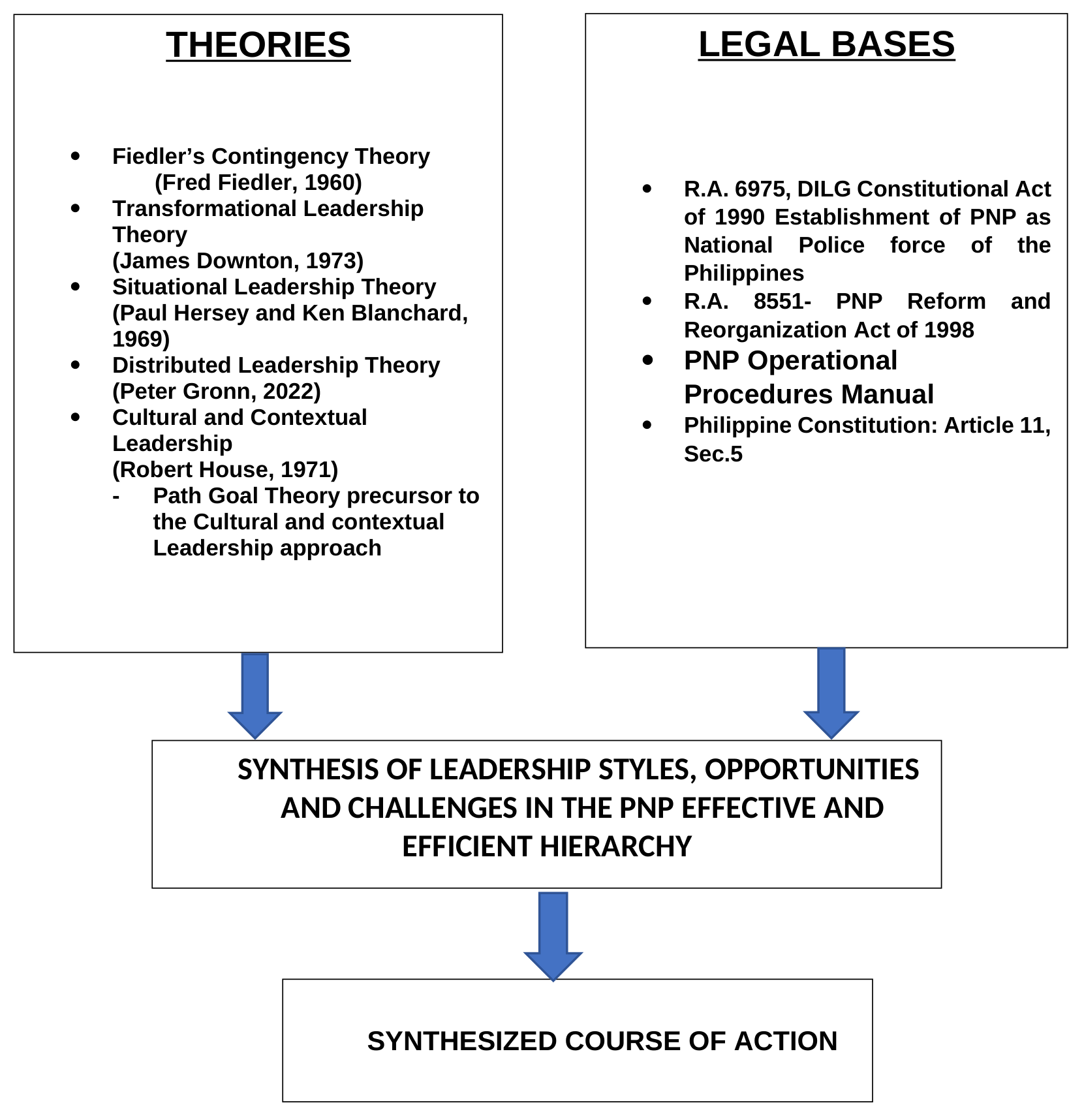
However, some few theories mentioned herein were also very applicable to this study, like:
Transformational Leadership Theory which started with James V. Downton in 1973 and was expanded by James Burns in 1978. In 1985, researcher Bernard M. Bass further expanded the concept to include ways for measuring the success of Transformational Leadership. It focuses on leaders who inspire and motivate followers to achieve their best through intellectual stimulation, individualized consideration, inspirational motivation, and idealized influence. Contextualizing leadership styles within this framework could involve examining how PNP leaders inspire and empower their peers to execute leadership in times of needs.
Thus, based on the theory when leaders and members diversify their leadership and management styles, it suggests that they are competent enough to abide by the prevailing situations and resolve the latter towards effective and efficient leadership and management.
Situational Leadership Theory, was developed by Ken Blanchard and Paul Hersey in 1969. It suggests that effective leadership is contingent upon the readiness or maturity of followers. In the context of PNP leadership styles, this theory could be used to explore how leaders adapt their approach, based on the specific needs and characteristics of their fellow officers and men. The members of the police force shall take appropriate action based on the current situation. If members of the organization have background knowledge on the given task, then definitely they will perform well and produce a very good outcome that will lead to good performance.
Distributed Leadership Theory, one of the most well-known proponents of Distributed Leadership is Spillane (a Professor at Northwestern University), has said that for this tactic to be effective, “multiple individuals, with or without leadership positions, should take up leadership responsibilities”. This theory emphasizes the importance of leadership being distributed throughout an organization rather than being solely the responsibility of formal leaders. Contextualizing operational leadership styles within this framework could involve investigating how various members of the PNP contribute to military leadership within their organization.
Cultural Theory or Cultural Leadership articulates a vision for the way things are done in an organization. It creates core values, builds the actions around these values, and turns everything into a routine that is practiced by everyone within the organization.
Contextual Leadership Theory, on the other hand is about setting the leadership context up to promote engagement and performance within an organizational context. Given the emphasis on contextualizing leadership styles within the unique cultural and geographical context of the country, this theory highlights the importance of cultures context and community in leadership, such as indigenous leadership theories or cultural leadership theories could also be relevant.
By anchoring this study to one or more of these theoretical models, researcher can provide a theoretical framework for understanding and analyzing the leadership styles of the PNP members within the specified context.
This research also takes into consideration pertinent legal bases in which this study is anchored.
Republic Act No. 6975 or the Department of the Interior and Local Government Act of 1990, which established the Philippine National Police (PNP) as the national police force of the Philippines.
The Philippine National Police Operational Procedures Manual, which provides guidelines for law enforcers on how to carry out their duties effectively and within the bounds of the law.
Republic Act No. 8551 or the Philippine National Police Reform and Reorganization Act of 1998, which reorganized the PNP and laid down the functions and responsibilities of law enforcers in the country.
Philippine Constitution: Article 11, Sec.5, created the independent Office of the Ombudsman, composed of the Ombudsman to be known as “Tanod bayan”, one overall Deputy and at least one Deputy each for Luzon, Visayas, and Mindanao. A separate Deputy for the military establishment may likewise be appointed.
The theories, concepts and legal bases presented here provide directions for the present study.
2The problem
2.1Statement of the problem
This research determined the leadership styles, opportunities and challenges in the efficient and effective administration in the PNP among the select Municipal Police Stations in the Province of Rizal at CALABARZON Region, during Calendar Year 2023 towards Synthesized Course of Action.
This study sought to answer the following questions:
- 1. What is the demographic information of the respondent groups as to: 1.1 age; 1.2 gender; 1.3 highest educational attainment; 1.4 years in service; 1.5 rank; and 1.6 relevant trainings and seminars attended?
- 2. What is the status of leadership styles demonstrated in the PNP sphere as to the following aspects: 2.1 authoritative; 2.2 democratic; 2.3 delegative/laissez-faire; and 2.4 bureaucratic?
- 3. What is the perception of respondent groups of the opportunities for effective and efficient administration in the PNP as regard to the following dimensions: 3.1 organizational culture; 3.2 bureaucratic process; 3.3 training and development; and 3.4 promotions?
- 4. What is the discernment of the respondent-groups of the challenges for effective and efficient administration in the PNP as regards the aforementioned dimensions?
- 5. Based on the findings, what Synthesized Course of Action for effective and efficient administration in the PNP can be designed?
2.2Significance of the study
The Philippine National Police Organization is the citadel of the country’s civilian protection from potential threats to their safety and security. Thus, this present undertaking will be beneficial to the following individuals, groups and entities:
Philippine National Police Organization – PNP organization which consist of the people who will serve and to protect the community. Findings of this study will enable them to create a more comprehensive strategic plan to maintain or create an effective and efficient implementation of programs and projects relative to the administration and management of law enforcement and human resource management towards its success and beneficial implications which threshold public interests.
- Philippine National Police (PNP) Leadership: The top leadership within the PNP would be the primary stakeholders as the research directly concerns leadership styles within the organization.
- PNP Personnel: All levels of the hierarchy within the PNP are stakeholders as they are directly impacted by leadership styles, opportunities and challenges.
- Municipal/City/Regional and Central Offices: Results of this study may serve as basis for the central offices or the national government in the creation of more appropriate and timely regulations in relation to leadership and management in the implementation of its projects and programs as well as rules in the sound administration and management of the organization which will supervise and measure the competence of newly-hired non-commissioned personnel towards sustainable development and progress.
- Government Representatives: Government officials and policymakers who oversee law enforcement in the Philippines would have a vested interest in the findings of this research.
- Community Members: The general public, particularly in the Philippines, are stakeholders as they rely on the PNP for law enforcement and security as there is a perception of trust in law enforcement.
- Civil Society Organizations: NGOs or civil society organizations working on governance, human rights, or policing issues might also have an interest in the study's findings.
- Media: Journalists and media outlets covering law enforcement and governance issues in the Philippines would likely follow developments related to leadership within the PNP.
- Academic and Research Community: Findings of this study may serve as scholarly basis for research to be conducted in the future in consonance with the relationship of leadership styles, administrative challenges and opportunities within the Philippine National Police organization. Scholars, researchers, and academic institutions focusing on leadership, law enforcement, and organizational behavior would find value in the insights provided by this research.
3Research methodology
The section focuses on the discussion of the research design that would be employed in the study, flow of the study, research environment of the study, the respondents of the investigation, the research instrument to be used, the data gathering procedures, statistical treatment and scoring procedure of the study.
3.1Research design
This present undertaking utilized a descriptive-correlational method to describe the leadership styles, administrative challenges and opportunities of commissioned and non-commissioned personnel in the Philippine National Police-CALABARZON region. Descriptive Correlational research design was employed as it perfectly qualify the description of leadership styles administrative challenges and opportunities of non-commissioned personnel. Also, it examined the relationship of the profile of the respondents, their leadership styles and acquired technical knowledge on project implementation practices among the offices in the provincial government of Rizal.
3.2Flow of the study
This study followed the systems model approach as input, process, and output as shown in Figure 2. Input shows the related information of respondent groups as to age, gender, highest educational attainment, number of years in service, rank/ position, relevant trainings and seminars attended. It also shows the Status of leadership style as demonstrated by the respondents, Perception of respondent -groups of the opportunities and challenges for effective and efficient administration in the PNP and output.
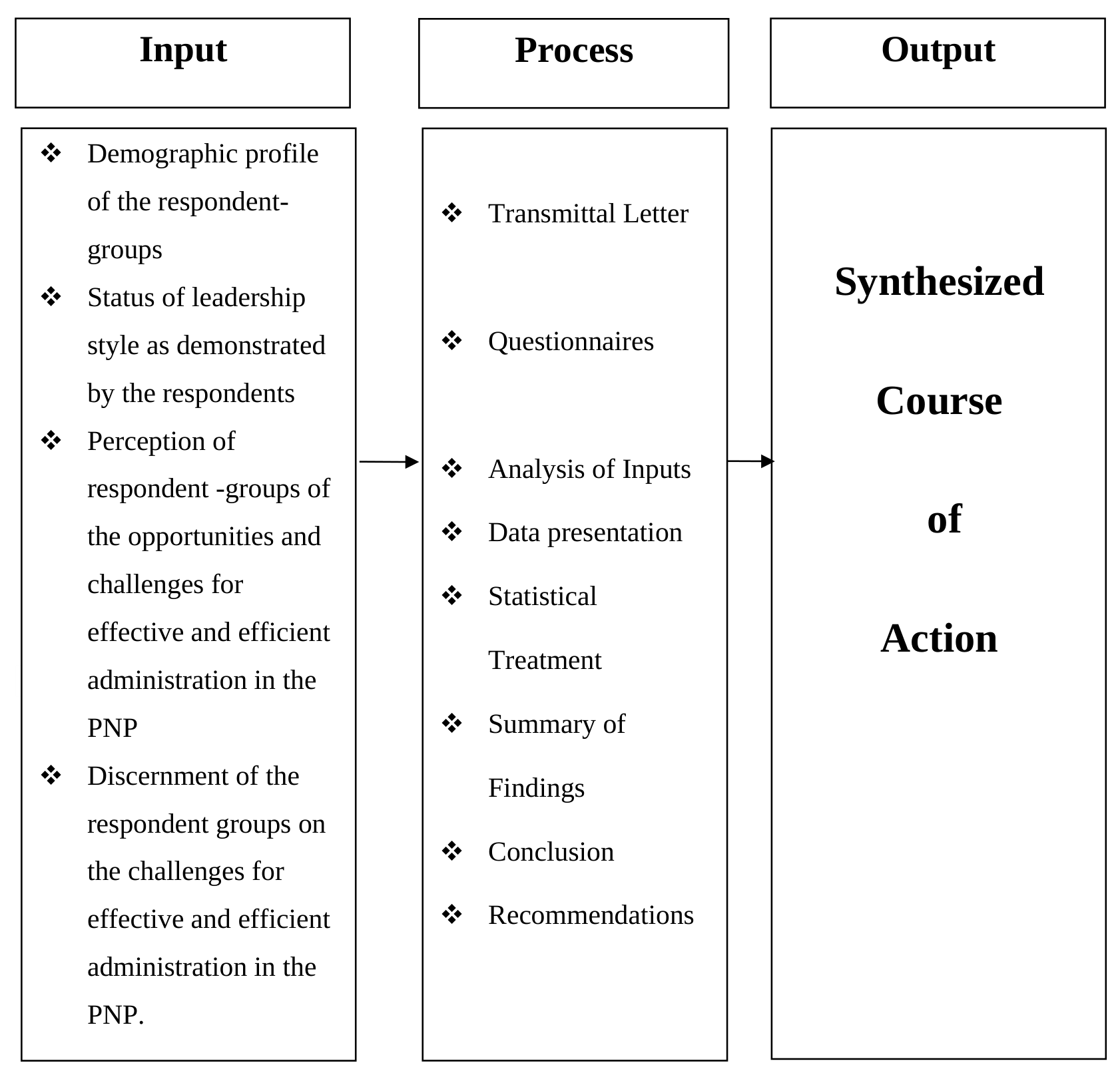
Perception of respondent -groups on the opportunities and challenges for effective and efficient administration in the PNP were discussed. Status of leadership style as demonstrated by the respondents were also taken into consideration. Finally, the synthesis of leadership styles, opportunities, and challenges within the organization's hierarchy was resolved
The process begins with the submission of the Transmittal Letter addressed to the Provincial Director of the Philippine National Police, Rizal PPO, asking permission to conduct the study. Once permission was granted, questionnaires were distributed to the respondents. Analysis of inputs through statistical analysis, treatment and interpretation of data and input of findings, conclusions and recommendations followed. Finally, the Synthesized Course of Action was crafted.
3.3Research environment
The study was conducted among the select PNP stations from the cities and municipalities in the CALABARZON Region specifically in the province of Rizal.
Rizal, officially the Province of Rizal is located in the Calabarzon region in Luzon. Its capital is the city of Antipolo. It is about 16 kilometers (9.9 mi) east of Manila. The province is named after José Rizal, one of the main national heroes of the Philippines. It is bordered by Metro Manila to the west, Bulacan to the north, Quezon to the east and Laguna to the southeast. The province also lies on the northern shores Laguna de Bay, the largest lake in the country. Rizal is a mountainous province perched on the western slopes of the southern portion of the Sierra Madre mountain range.
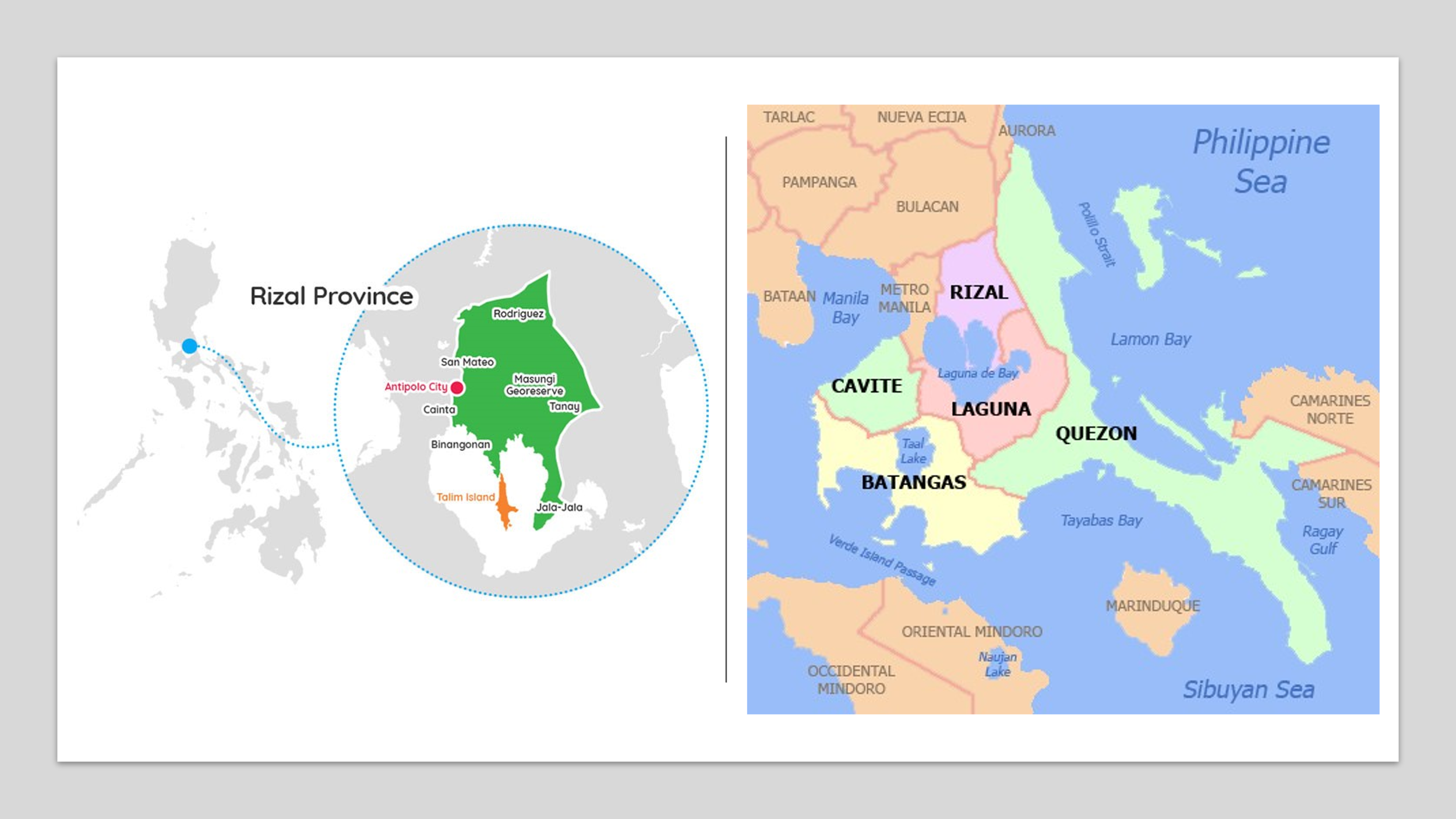
A study conducted by the National Statistics Coordination Board (NSCB), Rizal province came out to be the Philippines' least poor province with a poverty incidence rate of 3.4%, even lower than that of the National Capital Region or Metro Manila. On April 23, 2013, the National Statistics Coordination Board (NCSB) reported that Rizal, from being the least poor province in poverty incidence moved down to the 3rd Place, with Cavite taking over as the least province by 4.1% (compared to Rizal's 7.6%) and Laguna for 2nd with 6.3%.
Rizal has 13 municipalities and 1 city. The total number of barangays in the province is 189. Antipolo serves as the provincial capital since 2020, having been an administrative center since 2009 with the capitol located in the city. The province is a part of Greater Manila Area. It is the 5th largest province in the Philippines in terms of population. The province has a land area of 1,182.65 square kilometers or 456.62 square miles. Its population as determined by the 2020 Census was 3,330,143. This represented 20.56% of the total population of the CALABARZON region, 5.35% of the overall population of the Luzon Island group, or 3.05% of the entire population of the Philippines. Based on these figures, the population density is computed at 2,816 inhabitants per square kilometer or 7,293 inhabitants per square mile.
Antipolo, the province's capital city, is the center of trade and exchange, tourism, government, and economy. It is also a center of education and sports because of the availability of various educational and physical training facilities. Acclaimed of its scenic attractions, the city also produces agricultural products such as cashew nuts and rice cakes. Taytay, the province's center of garment and textile manufacturing, is also the town where the country's largest mall operator runs a store near the town center while, Cainta serves as the center of business-process outsourcing (BPO) businesses in the province, aside from being known for the presence of several shopping centers and delicacies such as bibingka or rice cakes.
The Philippine National Police was established to address the need for a centralized, professional, and civilian-led law enforcement agency. The PNP aimed to enhance national security, improve coordination, and strengthen community engagement through a civilian character, community-oriented policing, and an emphasis on professionalism and accountability. The laws that created and reformed the PNP, such as the 1987 Constitution, Republic Act 6975, and Republic Act 8551, served as legal foundations for its establishment, structuring, and vision.
3.4Respondents
Respondents of this study were the Commissioned and Non-commissioned officers and in the PNP organization within the CALABARZON region specifically in the province of Rizal. There were 70 respondents of the study. Further, complete enumeration was employed since it only focused in the provincial government of Rizal at CALABARZON, Region. Since this study used complete enumeration technique, sampling was no longer needed. The survey followed the principle of anonymity and willingness to share their information, hence no coercion of information was made in the data gathering.
| Municipal Police Stations | Police Commissioned Officers | Police Non-Commissioned Officers | Total | Percentage |
|---|---|---|---|---|
| Station 1 | 4 | 10 | 14 | 20 |
| Station 2 | 4 | 10 | 14 | 20 |
| Station 3 | 4 | 10 | 14 | 20 |
| Station 4 | 4 | 10 | 14 | 20 |
| Station 5 | 4 | 10 | 14 | 20 |
| Total | 20 | 50 | 70 | 100% |
3.5Research instrument
The research instrument used for this study, included survey questionnaires that were methodically developed and executed.
Questionnaire is a method of gathering information from respondents about attitudes, knowledge, beliefs and feelings. Self-constructed questionnaire was used in this study. The questionnaire was designed to gather information to answer research questions. The instrument which was utilized is survey-questionnaire. The questionnaires were designed by the researcher in two (3) similar segments pertaining to the profile of the respondents, leadership styles, administrative challenges and opportunities encountered by the respondents.
Part I, contained the profile information of the respondents in terms of age, gender, highest educational attainment, years in service and rank. Meanwhile, Part II, contained items relating to the leadership styles of the officials of the respondents in terms of authoritative aspect, democratic aspect and delegative aspect.
Part III contained items pertaining to the administrative challenges encountered by the respondents in terms of organizational culture, bureaucratic process, training and development and promotions. Similarly, part IV contained items with respect to the opportunities experienced by the respondents in terms of organizational culture, bureaucratic process, training and development and promotions.
3.6Data gathering procedure
The Transmittal Letter was submitted to the Provincial Director, Rizal PPO, requesting permission to conduct the study, this was needed by the researcher to get his consent and approval. After permission was granted, the researcher then asked for the list of PNP personnel as respondents of this study.
Survey questionnaire was administered to the 70 respondents after the approval of the letter which was sent to the office of the City/Municipality Chief of Police (COP) as received from the Human Resource Officer. The researcher gave printed copies of the survey-questionnaire among the respondents who would independently answer the questionnaire, which would be collected and sealed in an envelope for confidentiality purposes.
3.7Treatment of data
All pertinent data that were gathered, were compiled, tallied, and tabulated and were subjected to statistical treatment in order to answer the propose questions on this study. The statistical tool that was used were frequency determination, percentage computations, average weighted mean, standard deviation and ranking to analyze and interpret their responses as to the status of respondents’ demographic profile and the status of leadership styles demonstrated in the PNP sphere.
Percentage - to provide a clearer, reliable and objectival valid analysis and interpretation of the facts on the data gathered in this study, the percentage was used in treating statistically the problems of the study.
Weighted Mean – was utilized for respondent-groups perception on the effectiveness and efficiency leadership style of the administration in the PNP.
3.8Scoring procedures
To measure the responses of variables on the perception of the respondents of the study, the 4-point Likert scale is use to determined the status of the leadership styles demonstrated in the PNP sphere, and the perception of the respondent-groups on the opportunities for effective and efficient administration in the PNP CALABARZON Region in the Province of Rizal.
| Scale | Range | Descriptive Equivalent | Verbal Description |
|---|---|---|---|
| 4 | 3.26 - 4.00 | Strongly Agree (SA) | Complete agreement with the statement |
| 3 | 2.51 - 3.25 | Agree (A) | General agreement with the statement, but perhaps with some minor reservations |
| 2 | 1.76 - 2.50 | Less Agree (LA) | Partial agreement with the statement, but with significant reservations or qualifications |
| 1 | 1.00 - 1.76 | Disagree (DA) | Disagreement with the statement. |
3.9Ethical considerations
The participants of the study were members of the Philippine National Police. In order to safeguard their respective rights, the researcher designed a separate procedures in obtaining the data. With regards to the members of the PNP the researcher itself is a PNP member, who followed the chain of command by acquiring verbal referrals from the senior officers tasked to oversee the most personal and confidential affairs of the PNP. The researcher also discussed with the respondents on the methods of keeping the utmost confidentiality and secrecy of each individual participants of the this study to obtain a maximum confidence of the data gathered. This study was also designed to veer away risks (physical, emotional, religious and psychological) by providing the participants with the simplest questions the requires only answers of their experiences as far as policing works is concerned.
Being so, the participants would be resistant from any risks, thus no beneficial intervention needed in culminating the study. The researcher neither provided or promise a direct or indirect monetary considerations or material payments or incentives or stipend or any non-materials compensations to the participants. In so far, as the study of reference the researcher agreed with the respondents to treat extra ordinary cautions in lifting and extracting much literatures from the PNP doctrines promulgated by the Gen, Headquarters of the PNP which were marked as “Restricted” and “Highly Confidential” in a coded red enveloped, thus to be quoted with prudence.
3.10Definition of terms
To shed light on the terminologies used in this study, the following terms are conceptually and operationally defined:
Authoritative Aspect. This refers to the power and influence held by those in leadership or management positions within an organization. It represents the authority and decision-making capabilities of the organization's governing bodies or executives.
Bureaucratic Process. This refers to the process describes the formal, hierarchical, and rule-based procedures and protocols that an organization follows to carry out its operations and decision-making. It involves a well-defined chain of command, standardized workflows, and a clear division of responsibilities.
Delegative /Laissez- faire Aspect. This refers to the distribution of authority and responsibilities from higher-level management to lower-level employees or teams. It involves the act of entrusting tasks, decision-making, and problem-solving to subordinates, fostering a sense of ownership and accountability.
Democratic Aspect. This refers to the level of participation, transparency, and shared decision-making among its members. It involves aspects such as employee representation, open communication channels, and the incorporation of diverse perspectives in the decision-making process
Discernment. Essentially, it is about seeing beyond the surface and making informed choices base on a deep understanding of the situation. It is an ability to make wise decision and insightful judgement, especially in situations that are complex or ambiguous. It involves a careful observation and analysis, paying attention to details considering the different perspectives in gathering related information. Utilizing your emotional intelligence and understanding your own emotions and those that are of others in using awareness as your guide in every decisions.
Leadership Styles. Refer to the different approaches and behaviors that leaders use to influence their team members and achieve organizational goals.
Non-Commissioned Personnel. These refer to the individuals who have recently been employed in an organization, typically in non-supervisory or non-managerial roles, such as entry-level positions or support staff. These individuals do not hold commissioned officer or leadership positions within the organizational hierarchy.
Organizational Culture. This refers to the shared beliefs, values, norms, and behaviors that characterize an organization and guide the actions and interactions of its members. It represents the unique personality and work environment of an organization.
Output. The amount of something produced by a person, machine or industry.
Philippine National Police Organization. This is national police force of the Philippines, responsible for law enforcement, public safety, and security throughout the country. As an organization, the PNP operates under the Department of the Interior and Local Government and is governed by specific laws, policies, and hierarchical structures.
Promotions. These refer to the process of advancing an employee to a higher-level position within an organization, often accompanied by increased responsibilities, authority, and compensation. Promotions are typically based on an employee's performance, skills, and potential to take on more challenging roles.
Synthesized Course of Action. Refers to the process of consolidating various strategies and plans into a cohesive and comprehensive action plan.
Training and Development. These encompass the various educational and learning activities undertaken by an organization to enhance the knowledge, skills, and capabilities of its employees. This can include formal training programs, workshops, mentorship initiatives, and opportunities for professional development. The goal of training and development is to improve employee performance, prepare them for advancement, and align their skills with the organization's needs.
4Presentation, data analysis and interpretation
This part presents, analyzes and interprets the data obtained. Discussed in this regard are the related information about the respondents, status of leadership style as demonstrated by the respondents and the perception of respondent-groups of the opportunities and challenges for effective and efficient administration in the PNP.
4.1Demographic profile of the respondents
4.1.1Age
| Age | PCO | PNCO | Total | Percentage |
|---|---|---|---|---|
| Above 41 yo | 2 | 10 | 12 | 17.1 |
| 36-40 yo | 4 | 15 | 19 | 27.1 |
| 31-35 yo | 6 | 12 | 18 | 25.7 |
| 26-30 yo | 6 | 10 | 16 | 23.0 |
| 21-25 yo | 2 | 3 | 5 | 7.1 |
| Total | 20 | 50 | 70 | 100 |
The table shows that the highest number of the respondents belongs to age bracket of 36-40 years old with an average of 19 respondents or 27.1 percent, followed by an average of 18 respondents or 25.7 percent which belongs to age bracket of 31-35 years old. Respondents who were 26-30 years old ranked third, followed by respondents whose age bracket belongs to 41 years old and above with a total of 12 respondents or 17.1 percent. Lastly were on the age bracket of 18-25 years old or 7.1 percent.
Based on the above data, it is implied that most of the respondents who eagerly answered the survey questionnaires were coming from middle age respondents and dominated by the Police Non- Commissioned Officers. Followed by the younger groups of PCOs and PNCOs. These young gentlemen and ladies in uniform have been in the service for quite some time as their experiences and ranks goes with their age most of the time. Balancing the mix of younger and more experienced officers is crucial for effective leadership and operational efficiency in the PNP. Experienced officers with longer years of service can provide valuable institutional knowledge and mentorship to younger colleagues (Schafer, 2010).
4.1.2Gender
| Gender | f PCO | f PNCO | Total | Percentage |
|---|---|---|---|---|
| Male | 16 | 39 | 55 | 78.6 |
| Female | 4 | 11 | 15 | 21.4 |
| Total | 20 | 50 | 70 | 100 |
The data shows that the respondents were dominated by male police officers with 55 respondents or 78.6 percent and only 15 respondents or 21.4 percent were female.
Historically the PNP has been a male-dominated organization, with women comprising only about 10-15% of the total police force (Silagan, 2017). Research suggests that increasing the representation of women in policing can improve community relations, reduce use of force incidents, and enhance the overall effectiveness of law enforcement (Natarajan, 2008). Efforts to promote gender equality and increase the recruitment and retention of female police officers in the PNP are ongoing, but progress remain slow.
4.1.3Highest educational attainment
| Highest Educational Attainment | F PCO | f PNCO | TOTAL | Percentage |
|---|---|---|---|---|
| Master’s Degree Graduate | 3 | 3 | 4.3 | |
| MA Academic Units | 1 | 1 | 1.4 | |
| Bachelor’s degree | 16 | 50 | 66 | 94.3 |
| Total | 20 | 50 | 70 | 100 |
Bachelor’s degree holders dominated the respondents background at 66 or 94.3 percent while only 3 or 4.3 percent are Masters’ Degree holders and 1 or 1.4 percent are currently taking their Masters’ Degree. The PNP requires a minimum of a bachelor's degree for entry-level positions, with additional educational requirements of Masters degree in any courses they had graduated for higher ranks. Higher levels of education among police officers have been linked to better problem-solving skills, critical thinking, and adaptability to changing circumstances (Paoline and Terrill, 2007). Concerns have been raised about academic training and the practical skills needed for effective policing the pursuit of higher levels of education has been a personal preference and on individual circumstances.
4.1.4Number of years in service
| Years in service | f PCO | f PNCO | TOTAL | Percentage |
|---|---|---|---|---|
| 21 years and above | 10 | 2 | 12 | 17.1 |
| 16 – 20 | 7 | 2 | 9 | 13.0 |
| 11 – 15 | 18 | 18 | 25.7 | |
| 06 – 10 | 10 | 10 | 14.2 | |
| Below 5 years | 3 | 18 | 21 | 30 |
| Total | 20 | 50 | 70 | 100 |
The data manifested the greatest number of respondents falls below five years of service represented by 21 or 30 percent of the respondents, followed by 11-15 years of service represented by 18 or 25.71 percent.
Most number of respondents are Non-commissioned Officers and are new to the Philippine National Police Organization. Studies have shown that younger police officers tend to be more physically fit, energetic, and adaptable to new technologies and strategies (Zhao et al., 2015), the very reason that yearly recruitment activities happen.
4.1.5Rank/position
| Rank/ position | F PCO | F PNCO | TOTAL | Percentage |
|---|---|---|---|---|
| P/ Colonel | ||||
| PLT/ Colonel | 2 | 2 | 2.9 | |
| P/ Major | 2 | 2 | 2.9 | |
| P/ Captain | 8 | 8 | 11.4 | |
| P/ Lieutenant | 8 | 8 | 11.4 | |
| P/ Executive Master Sergeant | 2 | 2 | 2.9 | |
| P/ Chief Master Sergeant | 4 | 4 | 5.7 | |
| P/ Senior Master Sergeant | 1 | 1 | 1.4 | |
| P/ Master Sergeant | 5 | 5 | 7.1 | |
| P/ Staff Sergeant | 7 | 7 | 10.0 | |
| P/ Corporal | 11 | 11 | 15.7 | |
| Patrolman/ Patrolwoman | 20 | 20 | 28.6 | |
| Total | 20 | 50 | 70 | 100 |
Every Police Station be it Municipal or City police Stations the number of PNCO is always higher that the PCO, as such on the case of this table manifestation.
The table presented 20 or 28.6 percent are Patrolman/ Patrolwoman, followed by 11 or 15.7 percent for Police Corporal both generally are entry level positions. Majority of respondents in studies related to the Philippine National Police (PNP) consist of younger staff who hold lower or entry-level positions within the organization (Cruz and Dela Cruz 2019). The data revealed that approximately 60% of the surveyed participants fell into this category. Therefore, it revealed that the younger generations in the police service were mostly active and participative in every aspects of police service and they are willing to do it with a good and most precise leader.
4.1.6Trainings/seminars attended
| Trainings/ Seminars attended | f |
|---|---|
| Police Officers Candidate course | 3 |
| Police Senior Leadership Course | 5 |
| Police Junior Leadership Course | 12 |
| Criminal Investigation Course | 6 |
| Conduct of Illegal Drugs Refresher Seminar | 1 |
| Operation Officer management Course | 1 |
| Constructions on Health safety program | 1 |
| Public Safety Basic Officers Course | 4 |
| Civil Engineering; Breaking grounds, Building the world | 2 |
| PS Officers Basic Recruit Course | 19 |
| PS Officers Advance Course | 2 |
| Investigation Officers Basic Course Intelligence Collection Seminar | 2 |
| Human Resource Management course | 2 |
| Special Weapons and Tactics Training | 2 |
| Public Safety Basic Officers Course | 5 |
| Police first Responders course | 1 |
| Basic Intelligence Operations course | 2 |
| Special Counter Insurgency Operation Unit Training | 1 |
| Internal Security Operation Course | 2 |
The data presented a combined training and seminars for PCO and PNCO, as perceived from the table the Police Officers Basic Recruit Course was highly participated with 19 participants followed by Junior Leadership training course with 12 participants.
Trainings and leadership seminar courses play a crucial role in the development and effectiveness of police officers in the Philippine National Police (PNP). Here are some specific points highlighting their significance:
- Professional Development: Continuous training ensures that police officers are equipped with the necessary knowledge and skills to perform their duties effectively, improving their competency in handling various situations, from routine patrols to complex investigations.
- Enhanced Skills: Seminars/ Leadership seminars help in cultivating leadership qualities among officers, enabling them to make sound decisions, manage teams effectively, and inspire others to perform at their best. Such skills are essential in maintaining order, fostering community relations, and promoting a culture of integrity within the police force.
- Adaptability and Resilience: Training programs provide officers with the tools to adapt to evolving threats and challenges in law enforcement. This includes advancements in technology, changes in legislation, and new crime trends, ensuring that officers are well-prepared to address emerging issues effectively.
- Ethics and Integrity: Leadership seminars often focus on values such as ethics, integrity, and accountability. By instilling these principles in police officers, the PNP can work towards building trust within the community, reducing corruption, and upholding the rule of law.
- Officer Wellness: Training programs that include elements of mental health awareness, stress management, and resilience training can help promote the well-being of police officers. This is crucial in a high-stress profession like law enforcement and can contribute to reducing burnout and improving overall job satisfaction.
- Community Relations: Leadership seminars can emphasize the importance of community-oriented policing, fostering better relationships between the police force and the communities they serve. Strong community relations lead to increased cooperation, better crime-solving outcomes, and improved public perception of law enforcement.
- Research and Studies: Several studies have highlighted the importance of ongoing training and leadership development in law enforcement. Cherney et al. (2013) demonstrated how leadership training positively influenced police officers' leadership styles and performance (The Impact of Leadership Training on Police Officers' Leadership Styles).
- Effectiveness and Efficiency: Well-trained and empowered police officers are more effective in preventing crime, maintaining public order, and responding to emergencies. Investing in training and leadership development can ultimately lead to a more efficient and responsive police force.
Training and leadership seminar courses are essential for the Philippine National Police to enhance the skills, professionalism, integrity and service to people.
4.2Status of leadership style as demonstrated by the respondents
BY THE RESPONDENTS
4.2.1Authoritative aspects
| Authoritative aspects | PCOs | PNCOs | AWM | DE |
|---|---|---|---|---|
| always retain the final decision making authority within my department or team. | 3.22 | 3.12 | 3.17 | A |
| always try to include one or more subordinates in determining what to do and how to do it. However, the leader maintain the final decision making authority. | 2.96 | 3.08 | 3.02 | A |
| commands whenever a major decision has to be made | 1.91 | 3.92 | 2.92 | A |
| do not consider suggestions made by his subordinates | 1.65 | 1.12 | 1.41 | DA |
| asks for employee ideas and input into upcoming plans and projects. | 3.83 | 2.43 | 3.13 | A |
| tells us what has to be done and how to do it | 3.10 | 3.15 | 3.12 | A |
| Total | 2.77 | 2.80 | 2.79 | A |
Legend: 4.00-3.26 – Strongly Agree (SA); 3.25-2.51 – Agree (A); 2.50-1.76 – Less Agree (LA); 1.75-1.00 – Disagree (DA). AWM = average weighted mean; DE = descriptive equivalent; PCO = police commissioned officers; PNCO = police non-commissioned officers.
Table 9 showed, the average mean of 2.79 with a descriptive equivalent of A (Agree) suggests that there is a general recognition of the need for clarity in command structures and the importance of authoritative guidance.
An authoritative leadership style within the PNP is characterized by clear hierarchies, direct orders, and a top-down decision-making approach. In a law enforcement setting like the PNP, this style may be essential for maintaining discipline and responding swiftly to crises.
4.2.2Democratic aspects
| Democratic Aspects | PCOs | PNCOs | AWM | DE |
|---|---|---|---|---|
| knows more about their jobs than me, so I allow them to carry out the decisions to do their job | 1.61 | 4.06 | 2.84 | A |
| allows us to set priorities with my guidance | 2.90 | 2.65 | 2.78 | A |
| closely monitors us to ensure they are performing correctly | 2.90 | 2.65 | 2.78 | A |
| when there are differences in role expectations, he works with us to resolve the differences | 3.13 | 3.62 | 3.38 | SA |
| encourages us to know that each of us has the power of leadership position holds over another | 3.36 | 3.25 | 3.31 | SA |
| likes the power that his leadership position helps us | 2.80 | 2.82 | 2.81 | A |
| Total | 2.78 | 3.18 | 2.98 | A |
Legend: 4.00-3.26 – Strongly Agree (SA); 3.25-2.51 – Agree (A); 2.50-1.76 – Less Agree (LA); 1.75-1.00 – Disagree (DA). AWM = average weighted mean; DE = descriptive equivalent; PCO = police commissioned officers; PNCO = police non-commissioned officers.
Table 10 revealed an average mean of 2.98 with a descriptive equivalent A (Agree), indicating there is room for improvement in terms of inclusivity and participatory decision-making within the PNP leadership ranks.
A democratic leadership style involves shared decision-making, open communication, and a participatory approach to leadership. This style fosters collaboration and can lead to higher morale and job satisfaction among officers.
4.2.3Delegative or laissez-faire aspects
| Delegative or Laissez-faire Aspects | PCOs | PNCOs | AWM | DE |
|---|---|---|---|---|
| 1. gives plenty of space for creative ideas to emerge and be explored | 2.74 | 1.85 | 2.30 | LA |
| 2.enables us to do efficient undertaking for individual learning | 2.74 | 3.17 | 2.96 | A |
| 3.empowers our mind and skills in the right circumstances | 2.88 | 1.83 | 2.35 | LA |
| 4.allows to be more objective and functional as to comply with the task given to them | 3.10 | 3.20 | 3.15 | A |
| 5.fills any leadership and our relationship gap in order to facilitate and operate formal attainment of our duties and responsibilities | 2.74 | 3.84 | 3.29 | SA |
| 6.allows us to change overtime and fulfill their roles as delegated so as to successfully perform our mandate | 2.45 | 2.65 | 2.55 | SA |
| Total | 2.76 | 2.75 | 2.76 | A |
Legend: 4.00-3.26 – Strongly Agree (SA); 3.25-2.51 – Agree (A); 2.50-1.76 – Less Agree (LA); 1.75-1.00 – Disagree (DA). AWM = average weighted mean; DE = descriptive equivalent; PCO = police commissioned officers; PNCO = police non-commissioned officers.
The table showed an average mean of 2.76 with a descriptive equivalent of A (Agree), revealing a balance between autonomy and centralized control within the PNP, allowing for some level of discretion among personnel while maintaining overall organizational coherence.
Delegative leadership involves entrusting subordinates with decision-making authority. This style can promote autonomy and professional development among officers but may require strong oversight to prevent mismanagement.
4.2.4Bureaucratic aspects
| Bureaucratic Aspects | PCOs | PNCOs | AWM | DE |
|---|---|---|---|---|
| flexibility and adaptability are often restricted by the rigid rules, regulations and procedures in the field of work | 3.57 | 2.50 | 3.03 | A |
| excessive paper works and red tape consume much time,thus, office works and administrative task do not directly contribute to the efficiency and effectiveness of the organization. |
1.84 | 3.49 | 2.66 | A |
| communication barriers and siloed departments, can be felt how effective the flow of communication and information within and across different departments. |
2.27 | 3.95 | 3.11 | A |
| resistance to change and innovation, the receptiveness of personnel to organization in terms of new ideas and changes in procedures are followed immediately. |
2.27 | 1.31 | 1.80 | LA |
| 5. transparency and accountability, decision making procedures and performance evaluation in PNP organization is transparent and accountable. |
3.68 | 2.63 | 3.15 | A |
| 6.personnel are empowered and let their initiative flows smoothly, thus, the autonomy and decision making power felt whatever the role of the worker in the organization. |
3.03 | 2.76 | 2.90 | A |
| Total | 2.78 | 2.77 | 2.76 | A |
Legend: 4.00-3.26 – Strongly Agree (SA); 3.25-2.51 – Agree (A); 2.50-1.76 – Less Agree (LA); 1.75-1.00 – Disagree (DA). AWM = average weighted mean; DE = descriptive equivalent; PCO = police commissioned officers; PNCO = police non-commissioned officers.
Table 12 revealed an average mean of 2.76 with a descriptive equivalent of A (Agree), indicated a significant emphasis on organizational protocols and standard operating procedures within the PNP, highlighting a commitment to maintaining order and efficiency. Bureaucratic leadership relies on adherence to rules, procedures, and established norms. In a paramilitary organization like the PNP, bureaucratic elements are often necessary for ensuring consistency and accountability in operations.
4.3Opportunities for effective and efficient administration in the PNP as perceived by the respondents
4.3.1Organizational culture
| Organizational Culture | PCOs | PNCOs | AWM | DE |
|---|---|---|---|---|
| 1.find it difficult to efficiently perform my duties since there are multiple and overlapping responsibilities | 2.98 | 2.77 | 2.87 | A |
| 2.find it difficult to understand complex administrative orders before I perform such | 3.55 | 2.53 | 3.04 | A |
| 3.find it difficult to navigate the entire PNP organizational system | 3.08 | 3.05 | 3.06 | A |
| 4.find it difficult to select communication means when conveying critical information to my officials | 3.40 | 2.30 | 2.85 | A |
| find it difficult to harmonize good rapport with other senior members of the organization | 1.62 | 2.91 | 2.26 | LA |
| find it difficult to convey my own strategic plan and actions in fulfilling my duties and responsibilities | 2.04 | 3.10 | 2.57 | A |
| Total | 2.78 | 2.77 | 2.80 | A |
Legend: 4.00-3.26 – Strongly Agree (SA); 3.25-2.51 – Agree (A); 2.50-1.76 – Less Agree (LA); 1.75-1.00 – Disagree (DA). AWM = average weighted mean; DE = descriptive equivalent; PCO = police commissioned officers; PNCO = police non-commissioned officers.
The table showed an average mean of 2.80 with a descriptive equivalent A (Agree), in which respondents rated the current organizational culture within the PNP as generally positive but identified room for improvement. The culture was perceived as hierarchical, emphasizing respect for rank and a sense of discipline. However, some respondents pointed out that this hierarchical structure often leads to communication barriers and hinders innovation and creativity within the organization. A positive and conducive culture fosters morale, productivity, and a sense of belonging among the personnel. Studies such as "Organizational Culture and Police Misconduct" by Paoline et al. (2000) have suggested that a strong ethical culture can significantly reduce instances of misconduct and enhance organizational performance.
4.3.2Bureaucratic process
| Bureaucratic Process | PCOs | PNCOs | AWM | DE |
|---|---|---|---|---|
| find it difficult to access essential resources and information which are overly complex and time-consuming | 2.38 | 3.01 | 2.69 | A |
| face significant delays and obstacles when trying to complete basic administrative tasks due to organization rigid requirements | 2.70 | 2.65 | 2.67 | A |
| find it difficult to understand and navigate organization’s policies, protocols and approval processes | 3.35 | 2.70 | 3.02 | A |
| feel that the heavy documentation requirements and paperwork required are burdensome and hinder the actual productivity as a police officer. | 2.70 | 2.78 | 2.74 | A |
| fell that there is less sufficient support or guidance for the newly-hired personnel which leaves itself to navigate the system on their own | 2.81 | 2.96 | 2.88 | A |
| see that the organization’s bureaucratic culture being resistant to change and unwilling to streamline its administrative procedure | 2.70 | 2.56 | 2.63 | A |
| Total | 2.81 | 2.80 | 2.81 | A |
Legend: 4.00-3.26 – Strongly Agree (SA); 3.25-2.51 – Agree (A); 2.50-1.76 – Less Agree (LA); 1.75-1.00 – Disagree (DA). AWM = average weighted mean; DE = descriptive equivalent; PCO = police commissioned officers; PNCO = police non-commissioned officers.
Respondents identified bureaucratic processes within the PNP as both a strength and a challenge, showing an average mean of 2.81 with a descriptive equivalent of A (Agree). While these processes help maintain order and consistency, they were also seen as bureaucratic red tape that can slow down decision-making and hinder operational efficiency. Bureaucratic processes within the Philippine National Police can sometimes impede agility and decision-making. However, effective streamlining and optimization of bureaucratic procedures can enhance efficiency without compromising organizational integrity. Research such as "Bureaucracy and Modern Organization" by Max Weber provides insights into how bureaucratic structures can be modified to promote efficiency and accountability.
4.3.3Training and development
| Trainings and Development | PCOs | PNCOs | AWM | DE |
|---|---|---|---|---|
| find that training and training programs are inadequate to newly-hired personnel because of the overlapping demands to roles to perform and responsibilities to undertake. | 2.59 | 3.02 | 2.80 | A |
| find that trainings received do not address the specific challenges faced in day-to-day work within the organization | 2.38 | 3.16 | 2.77 | A |
| find that there is less or no sufficient resources allocated to dedicated newly-hired personnel to ensure effective training and development | 3.10 | 2.55 | 2.82 | A |
| find that the newly hired personnel possess lack of confidence and abilities due to the perceived gaps in the organization’s training and development initiatives | 2.69 | 2.21 | 2.62 | A |
| find that training and development do not prioritize the continuous learning and professional growth of newly-hired personnel instead these just subjected to experiential learning or on the job training. | 3.00 | 2.88 | 2.94 | A |
| find that training and development programs is being disconnected from the practical realities and evolving needs of the office. | 3.93 | 2.82 | 3.37 | SA |
| TOTAL | 2.94 | 2.90 | 2.87 | A |
Legend: 4.00-3.26 – Strongly Agree (SA); 3.25-2.51 – Agree (A); 2.50-1.76 – Less Agree (LA); 1.75-1.00 – Disagree (DA). AWM = average weighted mean; DE = descriptive equivalent; PCO = police commissioned officers; PNCO = police non-commissioned officers.
Training and development opportunities within the PNP were rated high by respondents with an average mean of 2.87 and a descriptive equivalent of A (Agree). Highlighting the organization's commitment to enhancing the skills and capabilities of its personnel. However, some respondents expressed a desire for more specialized training programs tailored to specific roles and responsibilities within the force. Investing in training and development programs is essential for equipping PNP personnel with the necessary skills and knowledge to perform their duties effectively. Studies like "The Impact of Training and Development on Employee Performance" by Acinas (2019) emphasize the positive correlation between training initiatives and employee performance.
4.3.4Promotions
| Promotions | PCOs | PNCOs | AWM | DE |
|---|---|---|---|---|
| find that hard work, dedication and contributions may not be fully recognized as core considerations for my future promotions | 1.74 | 3.15 | 2.44 | LA |
| find that policies and practices lack transparency making them unclear as what criteria and process are used | 2.49 | 3.37 | 2.93 | A |
| 3. find that my relatively short tenure within the organization is significant barrier for my chances of receiving promotion | 2.86 | 2.64 | 2.75 | A |
| 4.find that there is less well-defined system for evaluating and rewarding performance | 3.48 | 2.36 | 2.92 | A |
| 5.find it uncertain about the availability of promotional opportunities and the specific pathways for career advancement | 3.08 | 2.60 | 2.84 | A |
| 6.find that the organization offers less sufficient incentives for the professional development and upward mobility | 3.10 | 2.53 | 2.81 | A |
| Total | 2.79 | 2.78 | 2.78 | A |
Legend: 4.00-3.26 – Strongly Agree (SA); 3.25-2.51 – Agree (A); 2.50-1.76 – Less Agree (LA); 1.75-1.00 – Disagree (DA). AWM = average weighted mean; DE = descriptive equivalent; PCO = police commissioned officers; PNCO = police non-commissioned officers.
The Table showed an average mean of 2.78 with a descriptive equivalent of A (Agree) and suggested that there is a considerable level of satisfaction among PNP officers with the promotion process. The perceived transparency and merit-based nature of promotions are crucial for maintaining morale and motivation within the organization. However, the study also highlights areas where improvements could be made to further enhance the promotion system within the PNP. The promotion process within the Philippine National Police should be transparent, merit-based, and aligned with organizational objectives. Research studies such as "Promotion Mechanisms in Organizational Hierarchies" by Lazear (2014) highlight the importance of fair promotion practices in maintaining employee motivation and organizational effectiveness.
4.4Summary of the opportunities for effective and efficient administration in the PNP according to rank
TO RANK
| Indicators | AWM | Rank | Descriptive Equivalent |
|---|---|---|---|
| Promotions | 2.78 | 4 th | Agree |
| Organizational culture | 2.80 | 3 rd | Agree |
| Bureaucratic process | 2.81 | 2 nd | Agree |
| Training and development | 2.87 | 1 st | Agree |
The Table highlight opportunities for improvement based on a survey with respondents ranking these aspects with a second to highest rating with a descriptive equivalent of A (Agree). Efficient and effective administration within the Philippine National Police (PNP) plays a critical role in maintaining law and order, ensuring public safety, and upholding the rule of law. This discussion focuses on four key areas, Organizational Culture, Bureaucratic Process, Trainings and Development, and Promotions within the PNP. This table also presents the four most important opportunities effective and efficient administration in the PNP arranged according from lowest to highest. These were identified as promotions rank 1st from the lowest with an average weighted mean of 2.78, next 2nd was the organizational culture with awm 2.80, 3rd was on the bureaucratic process and 4rth was on training and development with an awm of 2.87.
Although, it can be gleaned that these were all rated with a descriptive title of “Agree” but they vary according to the rating and ranking. And it cannot be undetermined that these still need to sustained and to be able to perfectly improved something in the best version of hard work beyond the expectations of the clientele and the administration. Therefore, it implies that the PNP hierarchy must be able to decipher, coordinate the administrative and operational tasks, manage personnel record, support the needs of the community. Enhance policing system, uphold and promotes collaborative reform in the organization by addressing the needs of personnel though promotion, utilizing technology to curtail bureaucracy, and promoting better governance through training and seminars. With an adaptable police organizational structure these will enables the PNP to synthesizes a course of action that is most fitted to the organization on this present time.
4.5Status of leadership style according to rank of priority
| Indicators | AWM | Descriptive Equivalent | Rank |
|---|---|---|---|
| Authoritative Aspects | |||
| Do not consider suggestions made by subordinates |
1.41 | Disagree | 1 |
| Bureaucratic Aspects | |||
| Resistance to change and innovation. The perspective of personnel to organization in terms of new ideas and changes in procedures are followed immediately. | 1.80 | Less Agree | 2 |
| Organizational Culture | |||
| Find it difficult to harmonized good rapport With other senior members of the organization |
2.26 | Less Agree | 3 |
| Delegative or Laissiz- faire Aspects | |||
| Give plenty of space for creative ideas to emerge and be explored. | 2.30 | Less Agree | 4 |
| Empower our mind and skills in the right circumstances | 2.35 | Less Agree | 5 |
| Promotions | |||
| Find that hardwork, dedication and contributions may not be fully recognized as core considerations for future positions. | 2.44 | Less Agree | 6 |
| Total | 2.09 | Less Agree |
Legend: 4.00-3.26 – Strongly Agree (SA); 3.25-2.51 – Agree (A); 2.50-1.76 – Less Agree (LA); 1.75-1.00 – Disagree (DA). AWM = average weighted mean; DE = descriptive equivalent; PCO = police commissioned officers; PNCO = police non-commissioned officers.
In this study, the status of leadership styles as demonstrated by the respondents was evaluated, with a focus on aspects including Authoritative Aspects, Bureaucratic Aspects, Organizational Culture, Delegative Aspect, and Promotions. The findings indicate that these leadership styles received a second-to-last rating in terms of needing improvement according to the feedback provided by the respondents with an average mean at 2.09 and with a descriptive equivalent of LA (Less Agree).
Authoritative leadership is characterized by a strong leader who makes decisions independently and expects compliance from subordinates. The respondents' feedback suggests that there is a need for improvement in this area. This could imply a desire for leaders to be more open to input from team members or to adopt a more collaborative decision-making approach. Studies have shown that an overly authoritative leadership style can lead to reduced employee morale and engagement (Barbuto and Story, 2016).
Bureaucratic leadership emphasizes following established procedures and rules strictly. The respondents' feedback highlights the need for improvement in this aspect of leadership. While bureaucracy can provide structure and consistency, an over-reliance on bureaucratic processes can stifle creativity and innovation within an organization. Research suggests that bureaucratic leadership can hinder adaptability and agility in a fast-paced business environment (Hales, 2015).
Organizational culture plays a crucial role in shaping leadership styles and employee behavior. The feedback suggests that respondents feel there is room for improvement in the organizational culture within the context of leadership. A positive organizational culture that promotes trust, collaboration, and a shared vision can enhance leadership effectiveness and overall organizational performance (Schein, 2010).
Delegative leadership involves granting decision-making authority to subordinates. The respondents' feedback indicates a need for improvement in this leadership aspect. Delegative leadership can empower employees, promote creativity, and foster a sense of ownership among team members. However, excessive delegation without proper guidance or support can lead to confusion and inefficiency within the workforce (CMI, 2020).
This implied that promotions within an organization are essential for recognizing and rewarding employee performance and potential. The respondents' feedback signals that improvements are needed in this area. Transparent promotion processes based on merit and fairness are crucial for maintaining employee motivation and commitment. Studies have shown that perceived unfairness in promotion decisions can lead to dissatisfaction and disengagement at the workplace. They underscored the importance of fair and transparent criteria for promotions to prevent favoritism or nepotism.
Further, Harmonizing personnel within the PNP organization requires a multifaceted approach that takes into account the challenges specific to law enforcement. It necessitates a commitment to fostering inclusive ethical, supportive organizational culture. By promoting open communications, valuing diversity, enhancing training and investing the well-being of personnel, the PNP can work toward a more cohesive and effective force that serves its community with integrity and professionalism.
Recognizing hard work and dedication to duty as core considerations for future positions very essential in maintaining a motivated, engaged and productive workforce. Failure to do so can result in a cascade of negative impacts that not only affect individual employees but also harm the organization’s overall effectiveness and reputation. It is vital for leaders to implement fair recognition and development practices to cultivate a culture of respect, appreciation and continuous growth.
4.6Discernment of the PNP regarding the challenges for effective and efficient administration
| Indicators | Challenges | Strategies |
|---|---|---|
| Leadership | Cultivating leaders who inspire and motivate their subordinates towards achieving common goals can be difficult, especially in a hierarchial and bureaucratic organization like the PNP. | Implementing leadership development programs must focused on emotional intelligence, visionary thinking and inclusive decision making. It can help develop transformation leaders within the PNP organization. |
| Organizational Culture | Shifting from a rigid, rule based culture to one that vales adaptability and through consistent communications and behavioral modelling by leaders. | Promote culture of continuous improvement, transparency and accountability through consistent communications and behavioral modelling by leaders. |
| Training and Development | Regular updates to training programs to keep up with modern policing techniques and technologies can strain resources. | Establish partnership with academic institutions, international law enforcement agencies, and private sector entities to provide ongoing training and professional development opportunities |
| Skill diversification challenge , ensuring that training programs covers a wide range of skills, from tactical proficiency to cybercrime investigation. | Implement modular training systems that allow officers to specialize while maintaining core competencies in fundamental police work. | |
| Promotions | Addressing the allegations of favoritism, nepotism, or corruption in the promotion process to endure deserving officers and men to advance in the next higher ranks. | Create a clear, transparent criteria for promotions that are performance based. Skills, integrity and potential leadership ability. Regular audits and reviews on the promotion process can help maintain fairness and credibility. |
| Offering a clear, achievable career pathways to motivate officers and reduce turnover. | Develop structured career pathways that include milestones for training, field experience, and leadership opportunities. This can help officers see a clear progression path and understand what is required for career advancement. |
The Philippine National Police (PNP) served as the primary law enforcement agency in the Philippines. To ensure efficient and effective administration, the PNP must navigate various challenges in areas such as leadership, organizational culture, training and development, and promotions. There are challenges faced by the PNP in these key areas and explore potential strategies to address them.
Smooth transitions between leaders are crucial for organizational stability, but challenges may arise due to abrupt turnovers or lack of continuity. Establishing well-defined succession plans and leadership development programs to ensure a seamless transition.
Leaders in the PNP demonstrate high ethical standards amidst pressures and temptations by providing continuous ethics training and implementing mechanisms for reporting unethical behavior. Striking a balance between empowering subordinates while holding them accountable for their actions can be challenging. Fostering open communication channels between leadership and subordinates to ensure shared understanding and accountability.
5Summary of findings, conclusions and recommendations
5.1Summary of findings
Majority of the respondents belonged to 24 or 34.28 percent who are above 41 years of age, followed by 20 or 28.57 percent belonged to 26-30 years of age and then proceeded by 15 or 21.42 percent who are between 36-40 years old and consequently followed by 7 or 10 percent at the age of 31-35 years old and lastly only 4 or 5.71 percent falls between 18-25 years old. Balancing the mix of younger and more experienced officers is crucial for effective leadership and operational efficiency in the PNP. There is a dominance by male police officers with 55 or 78.57 percent and only 15 or 21.42 percent are female, this pertains to the Gender affiliation of a male dominated organization. Efforts to promote gender equality and increase the recruitment and retention of female police officers in the PNP are ongoing, but progress remains slow.
Generally, all the respondents have Bachelor’s degree, although at 66 or 94.28 percent shows it, the remaining number of respondents are taking their Masters’ degree or have graduated from it. A great number of respondents falls below five years of service represented by 21 or 30 percent of the respondents, followed by 11-15 years of service represented by 18 or 25.71 percent. Most respondents are Non-commissioned Officers and are new to the Philippine National Police Organization.
Every Police Station be it Municipal or City Police Stations, the number of PNCO is always higher than that of the PCO. Majority of respondents in studies related to the Philippine National Police (PNP) consist of younger staff who hold lower or entry-level positions within the organization and approximately 60% of the surveyed participants fell into this category.
Training and seminars always involved both the PCO and PNCO, Basic Trainings and leadership seminar courses play a crucial role in the development and effectiveness of police officers in the Philippine National Police (PNP) as they are essential to enhance the skills, professionalism, integrity and services rendered to people. The study highlighted opportunities for improvement based on a survey with respondents ranking these aspects with a second to highest rating with a descriptive equivalent of A (Agree). Efficient and effective administration within the Philippine National Police (PNP) plays a critical role in maintaining law and order, ensuring public safety, and upholding the rule of law. This discussion focuses on four key areas, Organizational Culture, Bureaucratic Process, Trainings and Development, and Promotions within the PNP.
The status of leadership styles as demonstrated by the respondents were evaluated, with a focus on aspects including Authoritative Aspects, Bureaucratic Aspects, Organizational Culture, Delegative Aspect, and Promotions. The findings indicate that these leadership styles received a second-to-last rating in terms of needing improvement according to the feedback provided by the respondents with an average mean at 2.09 and with a descriptive equivalent of LA (Less Agree). Striking a balance between empowering subordinates while holding them accountable for their actions can be challenging. Fostering open communication channels between leadership and subordinates to ensure shared understanding and accountability as well as regularly reviewing and optimizing bureaucratic processes to increase efficiency.
5.2Conclusions
In order to shed light on the critical role of leadership in the Philippine National Police and provide a roadmap for enhancing leadership practices, seizing opportunities, and addressing challenges and foster effective leadership, the PNP can strengthen its organizational structure, thereby improving its capacity to serve and protect the Filipino people effectively. The research on the synthesis of leadership styles, opportunities, and challenges in the Philippine National Police (PNP), effective and efficient hierarchy has several significant implications and involves various stakeholders, strategies and comprehensive plans. This study investigates the diverse leadership styles utilized within the PNP and analyzes the opportunities and challenges associated with fostering an effective and efficient hierarchical structure within the organization. This research aims to provide insights into enhancing leadership practices, optimizing organizational performance, and addressing key issues faced by the PNP.
5.3Recommendations
Based on the findings and conclusions arrived in this study, it is hereby recommended that the output of the study, Synthesized Course of Action be adopted.
References
- [1]Balbuena A, Stanislaus JP, Balaccua MS (2020). Application of Leadership Theories in Analyzing the Effects of Leadership Styles on Productivity in Philippine Higher Education Institutions . The International Encyclopedia of Higher Education Systems and Institutions, 1976–1983. https://doi.org/10.1007/978-94-017-8905-9_537
- [2]Clement Akpan R (2018). Roles of perceived leadership styles and rewards in the practice of Total Quality Management. Leadership & Organization Development Journal, 25(1), 24–40. https://doi.org/10.1108/01437730410512750
- [3]Daniel RM, Ugochuku RV (2020). Influence of Project Managers Leadership Style on Project Implementation. Project Management Journal, 38(1), 123–123. https://doi.org/10.1177/875697280703800112
- [4]Garstka C (2016). The role of the Principal's leadership style in the implementation of ICT policy. British Journal of Educational Technology, 42(2), 311–326. https://doi.org/10.1111/j.1467-8535.2009.01014.x
- [5]Grant KP, Baumgardner CR, Shane GS (2017). The perceived importance of technical competence to project managers in the Defense Acquisition Community. IEEE Transactions on Engineering Management, 44(1), 12–19. https://doi.org/10.1109/17.552804
- [6]Handzic MU (2011). Integrated Socio‐Technical Knowledge Management Model: An empirical evaluation. Journal of Knowledge Management, 15(2), 198–211. https://doi.org/10.1108/13673271111119655
- [7]Henkel T, Marion J, Bourdeau D (2019). Project manager leadership behavior: Task-oriented versus relationship-oriented. Journal of Leadership Education, 18(2). https://doi.org/10.12806/v18/i2/r8
- [8]Hysong SJ (2018). The role of technical skill in perceptions of managerial performance. Journal of Management Development, 27(3), 275–290. https://doi.org/10.1108/02621710810858605
- [9]Irawan D, Mochtar I, Utomo C (2019). The actualization of leadership models adopted by field implementers that influencing the contractor employees' motivation and performance. Journal of Applied Engineering Science, 17(4), 555–566. https://doi.org/10.5937/jaes17-21908
- [10]Linfield DC, Jones AH (2016). Leadership and Local Government Effectiveness: A Framework for Analysis. Korean Journal of Local Government & Administration Studies, 29(1), 199–222. https://doi.org/10.18398/kjlgas.2015.29.1.199
- [11]Magallanes VM, Dioso DP (2020). Leadership style practices of principals and organizational commitment profile of employees of Dioceasan Catholic schools. Philippine Social Science Journal, 3(2), 39–40. https://doi.org/10.52006/main.v3i2.156
- [12]Muthike J (2018). Influence of Leadership Styles on Timely Completion of Road Construction Projects. International Journal of Innovative Research and Development, 9(2). https://doi.org/10.24940/ijird/2020/v9/i2/feb20034
- [13]Nauman S (2018). Patterns of empowerment and leadership style in Project Environment. Human Resource Management International Digest, 19(2). https://doi.org/10.1108/hrmid.2011.04419bad.009
- [14]Renzi TM (2020). The effect of leadership styles on project implementation. Open Journal of Leadership, 09(04), 198–213. https://doi.org/10.4236/ojl.2020.94012
- [15]Sajeva MM (2018). The Analysis of Key Elements of Socio-Technical Knowledge Management System. Socio-Technical Knowledge Management, 84–95. https://doi.org/10.4018/978-1-59904-549-8.ch007
- [16]Turner JR, Müller R (2016). The project manager's leadership style as a success factor on projects: A literature review. Project Management Journal, 36(2), 49–61. https://doi.org/10.1177/875697280503600206
- [17]Viernes MZ, Binuya CP, Lanorio MS, Pedro AB (2018). The perceived leadership styles of Division Chiefs and Department heads of the Local Government Unit of Cabanatuan City in the Philippines. OALib, 05(08), 1–13. https://doi.org/10.4236/oalib.1104763
- [18]Wadud S (2019). Organizational Management Style in the Philippines and Project Implementation Practices. Nonprofit Management and Leadership, 24(1), 23–42. https://doi.org/10.1002/nml.21078
- [19]Wang E, Chou HW, Jiang J (2018). The impacts of charismatic leadership style on team cohesiveness and overall performance during ERP implementation. International Journal of Project Management, 23(3), 173–180. https://doi.org/10.1016/j.ijproman.2004.09.003
- [20]Young DS (2016). The Relative Importance of Technical and Interpersonal Skills For New Information Systems Personnel. Issues In Information Systems, 3(4).