Information Technology Web Application Development
Startup Team Connect: A Web Platform for Skill-Based Startup and Project Team Formation
Department of Computer Science and Engineering, Hyderabad Institute of Technology and Management, Hyderabad, Telangana, India
Published November 2026
Abstract
Startup Team Connect is a web-based platform designed to help students, innovators, and startup founders find suitable people to work with on their project or startup ideas. Sometimes a student or founder may have a good idea but may not have all the skills needed to develop it, so finding the right teammates can be difficult. This platform provides a common place where users can create their profiles by adding their skills, interests, experience, and the areas in which they are interested in contributing. Founders can also post their startup or project ideas and mention the roles and skills they are looking for in their team. Other users can browse the available projects, search for opportunities based on their skills and interests, and send collaboration requests to join a suitable project. The main purpose of the platform is to make the process of finding teammates easier, faster, and more organized instead of depending only on friends or contacting people individually. It can be useful for students working on academic projects, hackathons, innovation activities, and early-stage startup ideas where teamwork and different skills are important. The current project mainly focuses on the basic process of creating user profiles, posting startup or project ideas, searching for suitable opportunities, sending applications or collaboration requests, and forming teams. In the future, the platform can be improved by adding features such as AI-based team recommendations, skill verification, mentor connections, and links to startup support services. Overall, Startup Team Connect aims to provide a simple and useful platform that connects people with suitable teammates based on their skills, interests, and project requirements.
Keywords: Startup Team Connect; startup teams; student collaboration; skill-based search; project matching; entrepreneurship; team formation; innovation
1Introduction
A good project idea usually needs people with different skills to turn it into a useful product. A team may need developers, designers, business members, marketing members, or people who have knowledge in a particular field. One person may not be able to handle all these areas, so finding the right people becomes an important part of starting a project.
Students take part in academic projects, hackathons, innovation contests, and startup activities throughout their studies. In many cases, teams are formed mainly from friends or people students already know. Because of this, a person with the required skills may be interested in a project but may not get a chance to find or contact the project owner.
General social and professional networking websites can help people connect, but they are not always focused on forming a team for a specific project. Users may have to go through many profiles and manually decide whether someone's skills and interests match what their project needs.
Startup Team Connect provides one common platform where project owners and potential team members can find each other. A founder can share an idea, mention the required skills, and receive collaboration requests, while users can search for projects that match their interests and abilities. This makes the initial team-finding process simpler.
The platform can be improved in future by considering more details such as experience, availability, preferred roles, and project interests. AI-based recommendations and mentor connections can also be added later. These are future possibilities and are not treated as features already available in the current version.
2Problem statement
Students and aspiring entrepreneurs may have good project or startup ideas but may not have people with all the skills needed to complete them. For example, someone may be able to develop the software but may need help with design, marketing, finance, or communication. Finding people whose skills match these needs can take time, especially when there is no single place to search for them.
Existing networking platforms are useful for connecting people, but they do not always provide a simple process specially focused on startup and project team formation. Users may have to search through profiles, contact people separately, and decide manually whether their skills fit the project. This shows the need for a platform that connects project requirements with people who are interested in contributing.
The platform is intended to let users:
- Create a profile with their skills, interests, and experience
- Post a startup or project idea
- Mention the roles and skills required for a project or startup
- Search for people who can fill the required project roles
- Find and join projects or startups based on their interests
- Send and accept collaboration requests
- Create and manage a startup or project team
Startup Team Connect brings profiles, project posts, search, and collaboration requests together in one web application so that users can manage the early team-formation process in one place.
3Objectives
The main objectives of Startup Team Connect are to:
- To provide one common platform for forming startup and project teams.
- To allow users to create profiles with their skills, interests, and experience.
- To allow founders and users to publish startup and project ideas.
- To help users find teammates based on the skills needed for a project.
- To provide simple search and filtering options for finding suitable collaborators.
- To allow users to send and receive collaboration requests.
- To encourage students and young innovators to participate in startup and project activities.
- To make it easier to form teams with people from different skill areas.
- To encourage collaboration, innovation, and entrepreneurship.
- To provide a base for adding AI-based team recommendations in future versions.
4Research gap
Many existing platforms mainly focus on professional networking, social interaction, employment, or general project collaboration. These platforms are useful, but students or founders who want to form a project team may still have to search manually for people with the right skills and interests.
Finding a suitable teammate is not only about checking one skill. A project owner may also need to look at interests, experience, preferred role, and the actual requirements of the project. On general networking platforms, this comparison is usually done manually by the user.
Another gap is that project creators and potential collaborators need to be part of the same system. A founder should be able to clearly explain what the project needs, while another user should be able to show their skills and interests and request to join the project.
Startup Team Connect brings these activities together through:
- Skill-based user profiles.
- Startup and project posts.
- Required roles and skills.
- Search and filtering options.
- Finding suitable team members.
- Collaboration requests.
- Team formation.
The project mainly focuses on the early stage of project development, where people need to find suitable teammates and organize a team around a common idea.
5Literature review
5.1Team formation processes in new ventures (2018)
Held et al. (2018) studied how teams are formed in new ventures. Their work explains why selecting people who can contribute to a venture is important and how team members become involved during development. This is related to Startup Team Connect because the platform also aims to help founders and project owners find suitable people for their teams. The original publication should be checked before using the reference in a final submission.
5.2Online team formation in social networks (2012)
Anagnostopoulos et al. (2012) studied online team formation in social networks and looked at how algorithms can help select groups of people for different tasks. This work gives useful background for understanding team composition and skills. However, the current Startup Team Connect project should not be described as using the same algorithm unless it has actually been implemented.
5.3Understanding matchmakers’ experiences in assembling innovation teams (2021)
Koivunen et al. (2021) studied the process of bringing together people from different backgrounds to form innovation teams. Their work shows that creating multidisciplinary teams can be challenging. This is connected to Startup Team Connect because the platform aims to make it easier for students and founders to find collaborators with different skills.
5.4SkillRec: a data-driven approach to job skill recommendation for career insights (2023)
Ong and Lim (2023) described SkillRec, a data-driven method related to recommending skills using job information. Although their work is focused on career insights, the use of skill-related information can be useful when thinking about future teammate discovery. The current Startup Team Connect prototype does not claim to use the SkillRec method.
5.5A graph neural network-based teammate recommendation model (2024)
Zhang et al. (2024) presented a graph neural network-based approach for recommending teammates in knowledge-intensive crowdsourcing. This work gives an idea of how future systems could use relationships and collaboration preferences while suggesting teammates. For Startup Team Connect, this can be considered a possible future direction and is not a feature claimed for the current prototype.
5.6Cloud-based collaborative platform for startup idea management (2026)
Krishna and Reddy (2026) are included in the original draft for work related to a cloud-based collaborative platform for startup idea management. This topic is related to the purpose of Startup Team Connect because both involve managing startup ideas and collaboration. The publication details should be verified before the reference is used in the final paper.
6Proposed system flow
Startup Team Connect is designed as a web application where users can find projects and possible teammates based on their skills, interests, and project requirements.
The process starts with user registration and profile creation. A profile can contain skills, interests, experience, and the areas in which the user would like to work or contribute.
A founder can post a startup or project idea and mention the roles and skills required. Other users can view the available projects and send a collaboration request when they are interested.
Search and filtering help users find suitable people or projects more easily. The founder can check the applicant's profile and decide whether to accept or reject the request.
6.1Main system flow
The main system flow is: User Registration → Profile Creation → Skills & Interests → Project/Startup Posting → Search → Collaboration Request → Request Approval → Team Formation.
In a future version, the system can compare project requirements with the information in user profiles and provide teammate suggestions. If an automated score is added, it should be explained clearly and should only support the founder's decision rather than being treated as proof of a person's actual skill.
7Major modules
- User Registration & Authentication: Provides login and account creation for users and founders.
- Profile Management: Allows users to update their skills, interests, resume, and experience.
- Startup Management: Allows founders to create startup or project posts and mention required skills.
- Skill-Based Matching: Helps users find projects or startups that need their skills.
- Application Management: Allows users to apply and founders to accept or reject requests.
- Compatibility Matching: Can be used to compare a user's profile with the needs of a startup or project.
- Duplicate Detection: Helps identify project or startup titles that may be similar.
- Team Collaboration: Provides a place for team members to communicate, share notes, and work together.
- Notifications: Gives updates about applications and team activities.
- Admin Management: Helps manage users, projects, startups, and platform activities.
8Methodology
- 1. Problem identification and research
- 2. Requirement analysis
- 3. System design
- 4. Database and backend development
- 5. Frontend development
- 6. Security implementation
- 7. Testing and debugging
- 8. Deployment and documentation
9Security and privacy considerations
The application stores account details, user profiles, and project information, so this information needs to be protected and handled carefully.
Security measures to consider include:
- Secure authentication.
- Password protection.
- Role-based access control.
- Secure database operations.
- Session management.
- Protection from unauthorized access.
- User reporting and blocking options.
Users should have control over which profile details are visible to other people. Sensitive information should not be shared unnecessarily, and team information should only be available to authorized members.
10Expected outcomes
The prototype is expected to support the following outcomes:
- A single platform for startup and project team formation.
- Simple creation of skill-based user profiles.
- A place to publish startup and project ideas.
- Easier discovery of suitable teammates.
- Search for projects and users based on skills and interests.
- A simple collaboration request process.
- More organized team formation.
- More opportunities for students to participate in innovation and startup activities.
11Results
The Startup Team Connect prototype demonstrates the basic steps involved in creating and organizing a project team through a web application.
Users can register, complete their profiles, and explore available startup or project ideas. Founders can also create new projects and explain the type of help or skills they need.
When a project is published, the founder can mention the required roles and skills. Other users can search for projects they are interested in and send collaboration requests.
The founder can review the applicant's profile and either accept or reject the request. When the request is accepted, the user can become part of the project team.
Together, these functions show how one platform can support project discovery, applications, and team formation. The prototype provides a starting point for this process, and its usefulness depends on clear project information, accurate user profiles, and proper access control.
The login page contains email and password fields along with options for users and founders to sign in or create an account. These are the main visible parts of the login interface, while the actual security of the system should be checked through proper testing.
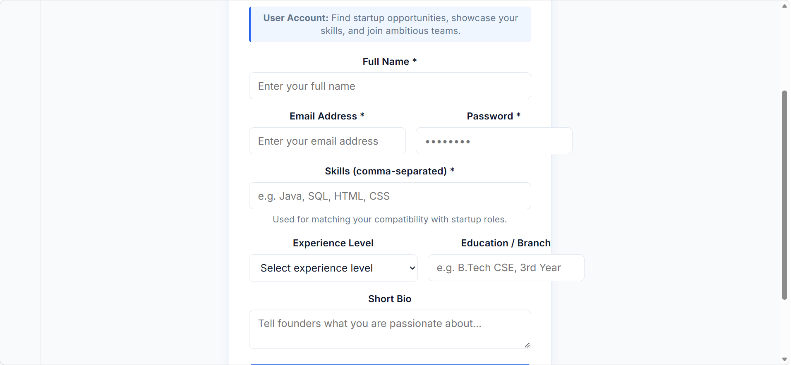
The user registration page collects details such as name, email, password, skills, experience level, education or branch, and a short bio. These details help users describe their background and interests while looking for project opportunities (Figure 1).
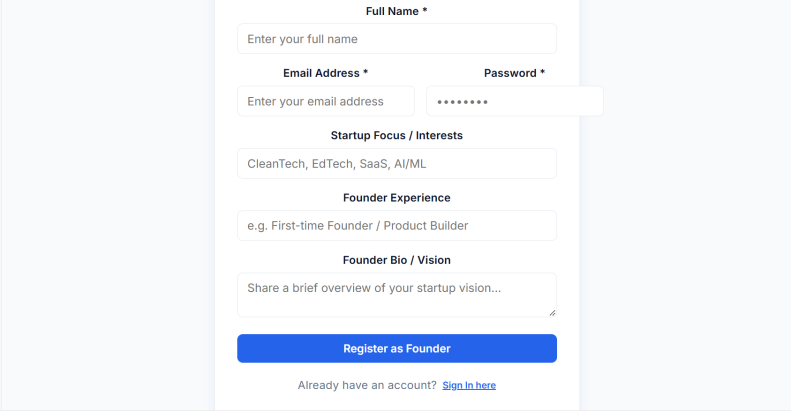
The founder registration page collects account information along with details about the founder's startup interests, experience, and vision. This form is used to create a founder account for posting and managing startup ideas (Figure 2).
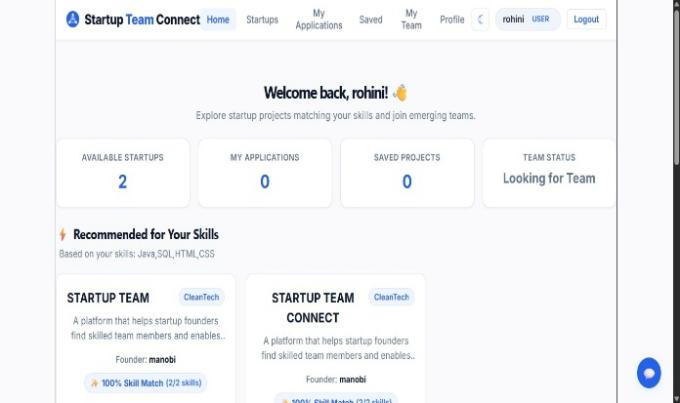
The user dashboard brings project discovery and personal activity into one place. Users can view projects, apply to opportunities, save projects, and check their team status based on the available features (Figure 3).
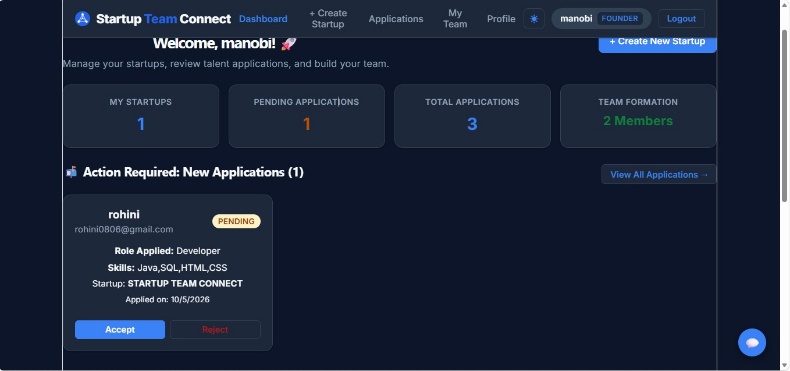
The founder dashboard helps founders manage startup posts and collaboration requests. It shows project information and provides options for reviewing applicants and accepting or rejecting requests (Figure 4).
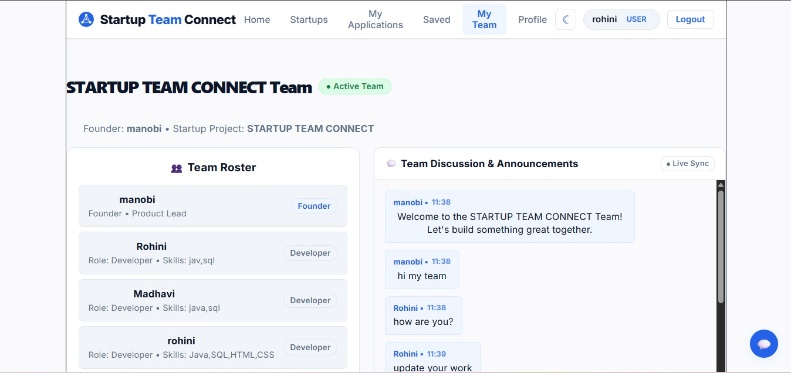
The My Team page shows the current team members along with their roles and skills. A discussion or announcements area gives team members a place to share updates and communicate about the project (Figure 5).
12Discussion
Startup Team Connect focuses on a common problem at the beginning of a project: finding people who are interested in the same idea and who can provide the skills needed to work on it.
Instead of depending only on personal contacts, users can search for projects and possible collaborators using skills and project requirements. This gives the search a clearer purpose than general networking alone.
The platform supports both sides of the collaboration. A founder can publish an idea and look for teammates, while a user can explore projects and request to join one that matches their interests.
The usefulness of the results depends on the information users provide and how well the system compares profiles with project requirements. In future, the platform can also consider skill level, experience, availability, preferred role, and project category to make suggestions more useful.
13Future scope
Possible extensions for later versions include:
- AI-based teammate recommendation.
- Intelligent compatibility scoring.
- GitHub and portfolio integration.
- Resume integration.
- Skill verification and badges.
- Mentor and expert connection.
- Hackathon integration.
- Real-time chat and video meetings.
- Mobile application.
- Team performance analytics.
- Multilingual support.
A future recommendation feature could compare the skills required by a project with the skills listed in user profiles. The system should give a simple reason for each suggestion so that founders can understand it and make the final decision.
14Conclusion
Startup Team Connect is a web-based prototype created to help students, innovators, and aspiring entrepreneurs find teammates for their projects and startup ideas.
The platform brings user profiles, project posts, search, collaboration requests, and team formation together in one place. This can make it easier for users to find people whose skills and interests match the needs of a project.
The current work also gives a base for future improvements such as skill verification, mentor connections, better profile information, and automated teammate recommendations. These are future possibilities and should be kept separate from the features already available in the prototype.
Overall, Startup Team Connect aims to make finding project teammates more organized and focused. The usefulness of the platform will depend on reliable user information, useful search results, clear collaboration steps, and continued testing and improvement.
References
- [1]Anagnostopoulos A, Becchetti L, Castillo C, Gionis A, Leonardi S (2012). Online team formation in social networks. In: Proceedings of the 21st International Conference on World Wide Web; 2012.
- [2]Held J, Herrmann AM, van Mossel A (2018). Team formation processes in new ventures. Small Business Economics.
- [3]Koivunen N, Olshannikova E, Olsson T (2021). Understanding matchmakers’ experiences in assembling innovation teams. Computer Supported Cooperative Work.
- [4]Krishna, Reddy (2026). Cloud-based collaborative platform for startup idea management.
- [5]Ong CY, Lim EP (2023). SkillRec: a data-driven approach to job skill recommendation for career insights.
- [6]Zhang et al. (2024). A graph neural network-based teammate recommendation model for knowledge-intensive crowdsourcing.