Supply Chain Efficiency
Developing an Integrated Procure-to-Pay and Source-to-Contract Digital Framework for Construction Supply Chain Efficiency in Saudi Arabia
Published November 2026
Abstract
Procurement in construction in Saudi Arabia is a highly fragmented process operating across project organisations, specialist contractors and a wide range of dispersed suppliers. This fragmentation means that there is a significant disconnect between the strategic sourcing decisions and the actual transactions that take place in the delivery and payment of materials, equipment and services. This review proposes an integrated digital framework that links Source-to-Contract (S2C) with Procure-to-Pay (P2P), with construction-specific evidence, contractual authority and supplier involvement being the key design constraints. The framework is the result of a structured integrative review of 30 journal papers from the period 2020 to 2025, which were analysed thematically with respect to e-procurement, construction supply chains, information interoperability, payment governance and digital adoption. The review identifies five recurring integration failures: inconsistent master data, separation of contract and operational records, poor linkage of physical progress, fragmented exception handling and uneven levels of organisational readiness. The proposed framework addresses these through the use of a governed supplier and contract register, project coded requisition controls, evidence linked receipt and valuation, invoice reconciliation and an auditable analytics layer. It clearly distinguishes between deterministic control rules and optional advanced technologies (including model based quantity extraction and distributed verification). Performance is assessed in terms of traceability, procurement lead time, first pass match, payment predictability, supplier access and disruption response rather than on the basis of any assumed cost savings. The contribution is a process to data architecture and a staged implementation methodology which is appropriate for Saudi construction programmes, with the boundaries of the approach being clearly defined by procurement regulations, contract provisions and information quality. As the framework is based on a review of the published literature rather than on a live implementation it provides a set of testable design propositions rather than any unproven operational results.
Keywords: procure-to-pay; source-to-contract; construction procurement; digital supply chain; e-procurement; Saudi Arabia
1Introduction
Saudi Arabia's investment in infrastructure, industrial facilities and large scale urban development means that procurement coordination is a governance issue rather than simply an administrative one. A construction project will generate a huge number of purchase orders, variations and associated delivery instructions, site confirmations, financial obligations and supplier payments. The various parties that are creating these records are using different systems and are reporting up through different chains of approval. The information gaps that result mean that it is not always clear whether a purchase is in fact contractually allowed, whether a variation has been approved or whether an invoice is in fact for work that has actually been performed. Dispersed information, delayed material flows and poor coordination are all factors identified in the literature on construction supply chains as contributing to project uncertainty [1, 2]. The conclusion is that a digital interface which simply accelerates the processing of purchase orders without resolving the issue of contractual continuity may just be a system which is processing a series of inconsistent decisions more quickly.
Two procurement areas need to be separated out before they can be brought together. Source-to-Contract (S2C) covers the journey from requirement definition through to market engagement, qualification, tender evaluation, negotiation and award of contract. Procure-to-Pay (P2P) is the operationalisation of those commitments via requisitions, purchase orders, receipts, invoice matching and payment. The separation is a functional one rather than a fundamental one. Sourcing requires flexibility and judgement whereas the actual transactional execution requires a degree of control that can be repeated. The construction environment actually amplifies this tension with the nature of the work (sub-contracting, long lead items, measured quantities, retention, approved variations etc) which is very different to the purchase of a standard catalogue item. Reviews of e-procurement have highlighted that isolated digital tools can in fact leave the institutional and trust barriers quite intact [5]. The issue of integration is therefore really about which information and authorities need to cross the boundary and who is accountable when they do.
The literature is full of promising but incomplete solutions. The papers on digital construction procurement describe all sorts of technology for document exchange, supplier selection, information sharing and payment automation [7]. The problem with a technology focused approach is that it can miss the point of the operational reality of delivery tickets, measurement certificates, variations that are in dispute and the issue of liquidity. The same can be said of interoperable BIM which may produce reliable quantities without in any way resolving the question of who can approve commercial variations. There is evidence from Saudi Arabia that there is a capability gap in this respect as the respondents in the construction sector were broadly unaware of blockchain despite recognising its potential for traceability [8]. The adoption model therefore needs to start with the records, processes and incentives that are actually achievable rather than assume that all the participants in the supply chain can go live on a platform at the same time.
The purpose of this paper is to develop and critically justify an integrated S2C-P2P digital framework which will improve the efficiency of the construction supply chain via the continuity of commercial decisions, verifiable execution and accountable payment in Saudi Arabia. The analysis is guided by four objectives: to identify the process discontinuities that have been reported in the literature; to define the interoperable data objects and decision rights which link contract to payment; to design a staged control architecture which is responsive to the nature of construction and to the local institutional context; and to propose a set of tests which can be used to measure the operational value and the level of implementation risk. The research question is: how can the two procurement cycles be joined without compromising project level flexibility, supplier fairness or the evidential requirements of the construction contract? The paper presents a conceptual design only and does not make any claim as to the operational value of the platform in any Saudi projects.
2Review design and analytical method
We chose a structured integrative literature review as the approach as the research question is one that brings together operational process design, information systems and construction contract administration. The evidence base for these areas is extremely diverse in terms of methodology with studies ranging from surveys to conceptual models to simulation to case studies to systematic literature reviews. There is no basis for statistical aggregation as the studies do not yield comparable outcomes. The present study therefore employs thematic synthesis to distil the research findings into architectural requirements and falsifiable performance propositions. The 30 papers that are cited were located via targeted searches of journal and academic databases using combinations of the following terms: construction procurement, e-procurement, sourcing, payment, supply chain integration, BIM, data governance, Saudi Arabia and smart contracts. The search was limited to publications from 2020 to 2025 and all bibliographic details were cross checked against the DOI linked records.
Eligibility required a peer-reviewed journal publication within the date range and a direct contribution to at least one of the design issues: sourcing and supplier qualification; construction logistics; information integration; contracting and payment; implementation capability; or resilience and evaluation. Priority was given to research with clear methodology, verifiable publication details and a demonstrable link to project based procurement. Research on consumer purchase behaviour or which simply provided vendor claims without any supporting evidence was not included. A very small number of cross industry resilience papers were included only where the implications could be explained without treating them as evidence of Saudi construction. The corpus is targeted rather than comprehensive and database wide record counts, formal quality scores and coverage statements are not reported as they could not be reproduced for this paper.
Each publication was assessed against an extraction matrix which captured the setting, the methodological approach, the procurement stage, the data dependencies, the reported mechanisms and the limitations. The evidence was then evaluated at three analytical levels: commercial governance, transaction execution and cross organisational information exchange. An assertion was deemed convergent where studies employing different methodologies arrived at the same conclusion (e.g. the importance of information visibility); a claim was considered conditional where it was dependent on experimental prototypes or proposed technical designs. Contradictions were not smoothed over but were explicitly recorded. For instance, automated payments may improve timeliness but will also create disputes as to what constitutes valid evidence of completion. The proposed framework was then developed by converting these divergences into decision rules, required records and exception pathways and then checking that each of the elements in the framework served one or more of the stated objectives.
The synthesis employs four quality controls. Firstly, a paper describing technical feasibility is not in itself evidence of actual adoption or of net savings. Secondly, where there is local Saudi evidence it is discussed in the context of the Saudi case; international evidence is presented as a hypothesis which may be transferable. Thirdly, compliance is treated as a design requirement which must be verified on a project by project basis via appropriate legal means rather than as a statement that some one generic workflow will be compliant with all procurement regimes. Finally the diagrams are conceptual representations created for the purpose of this review and do not represent actual performance. These controls ensure the framework is auditable whilst recognising that prospective validation is still required. The framework enables analytical generalisation about mechanisms and design dependencies but not about actual project outcomes.
3Evidence synthesis
3.1Sourcing governance and supplier integration
Digital sourcing is frequently touted as a way of getting faster tenders, accessing a wider market and enabling a more consistent evaluation. Its real value in construction is in the creation of commercially viable commitments prior to work commencing. The selection model is designed to separate price from capability, quality, sustainability, relationship performance and delivery reliability [10]. A low tender price is of very limited value if the supplier's capacity is not in fact capable of delivering the critical construction sequence. Supplier qualification therefore requires structured evidence of technical capability, financial strength, compliance with safety requirements and delivery capacity in the relevant geography. The criteria for award must be preserved along with the adjudication and authorisation. That evidence must be available to the operational purchaser when they go on to make their own supplier selection, rather than simply being archived as a separate piece of tender documentation.
Supplier integration goes way beyond just electronic invitations and online bidding. A review of the supplier relationship highlights qualification, sharing of information, joint problem solving, contractual co-ordination and post award evaluation as all being complementary mechanisms [12]. A global survey also found that technology usability, financial capacity, security issues and the institutional context all play a part in the adoption of e-procurement [13]. This clearly suggests that the notion of a central portal being able to integrate a range of disparate subcontracting relationships is a fallacy. Procurement maturity is in part a function of the quality of the relationships between the client, the main contractor, the specialist subcontractor, the manufacturer and the logistics provider. The practical upshot of this is that you will have different supplier onboarding processes, different documentation requirements and accessible routes for confirming or challenging transactions.
Sustainable procurement brings in another alignment issue. The environmental specs are generally established during the pre-contract design phase, the actual material substitution and shipment decisions are made at the time of execution. If those decisions are being made in separate systems then the sustainability clauses cannot be verified against the actual goods that are purchased. A review of the integration of electronic and sustainable procurement shows that digitalisation strategies need complementary governance rather than parallel initiatives [3]. Within the proposed framework the technical specs, approved equivalents, supplier certifications and the contractual environmental obligations all become reference data for the purchase order and the receiving process. That's a more robust position to be in than to assign some unverifiable sustainability score to every transaction or to assert that electronic procurement in itself leads to a reduction in environmental impact.
3.2Transaction controls and the payment evidence problem
The 'operational' P2P cycle is typically described as a straight line from requisition through to order, receipt, invoice and payment. Construction of course throws that model into disarray. Materials can arrive in partial loads; equipment hire is on a time basis; specialist works are certified against actual progress; and payments to sub-contractors can be contingent on retention, advance recovery or contractual notices. A PO may therefore be a call-off against a rate agreement, a defined work package or a controlled variation rather than an independent PO. The nature of the transaction is what determines the appropriate matching rule. Three way matching is perfectly appropriate for goods but if you apply it in a mechanical way to work certificates you can end up with false exceptions and in the worst case scenario you can actually approve a liability without any performance evidence at all.
Payment research makes the governance trade-off explicit. Das et al. put forward the idea of secure interim payment mechanisms, while Hamledari and Fischer show how reality capture evidence can be used to drive the logic of payment under contract [15]. Related conceptual and empirical work suggests that smart contracts can be used to deliver transparency and deal with late or disputed payments where the milestones and the authorisations to validate are clearly defined [17]. The value of this is in the verifiability of the conditions, not in the notion that construction disputes go away when the code runs. Quality rejection, disputed quantities, unforeseen ground conditions and claims for prolongation are all issues of contract interpretation. The digital workflow therefore should allow a certified amount to go forward whilst still permitting legitimate dispute over other amounts.
Recent work has gone on to extend automation into claim management and milestone verification [18]. These are compelling as proofs of process traceability, but their real value in terms of generalisability will be dependent upon independent evidence collection, appropriate authority and viable correction processes. A digital signature from an unauthorised individual is no more commercially valid than a paper signature. Supplier payment speed is not simply a function of how long it takes to process an invoice. It is also a function of the terms of the contract, the retention rules, treasury approvals and cash availability. The framework therefore distinguishes between invoice processing efficiency and contractual payment timeliness. Both of these need to be measured and neither can be used as a substitute for the other.
3.3Interoperability, material identity and data quality
Interoperability issues occur when two apparently identical things are in fact different in different projects. A supplier can have multiple legal entities; one material specification can have multiple local descriptions; the same package can be coded in different ways by estimating, procurement and finance. Research into BIM and procurement decision support has shown that common information structures can link quantities to commercial decisions, but only if the classifications and the responsibilities are defined [19]. A model element or material take-off should not in itself result in a binding order. Revision status, authorised design baseline, waste allowances and delivery schedules all need to be independently validated. The reliable integration unit is therefore a governed transaction which is linked to design and contract evidence, not a raw geometry export.
Research into modular construction demonstrates the utility of shared records in tracking components through the production and delivery process [20]. A construction supply chain data model goes on to demonstrate the complexity of maintaining information continuity in the face of changing custodians and lifecycle handovers [21]. This underpins the need for persistent identifiers for project, work package, supplier, contract, item, location and approval event. The records need to be able to persist across application boundaries even as the applications themselves change. Equally important is version control: a purchase order issued on the basis of superseded quantities must be flagged prior to the supplier incurring any cost. Data sharing should be such that it only reveals the information required for the role of the recipient.
Big data research indicates that analytics can assist in risk detection and supply chain coordination, but the extent to which this can be achieved is dependent on governance and capability. Elkliny et al. identify a number of barriers to implementation which they categorise as relating to data quality, technology, organisational capability, regulation and finance [22]. A construction risk review makes a similar point in that it suggests that better monitoring is only possible with well defined risks and with information flowing between the various firms [23]. The upshot is that predictive dashboards should be positioned downstream of a reliable transactional record. A very sophisticated model trained on bad data (e.g. inconsistent order dates, missing receipt certificates) can produce very accurate looking forecasts which are in fact of very poor quality. The review underlines the need for disciplined data stewardship prior to any significant move towards algorithmic automation, particularly where the various participating firms are of very different digital maturity.
3.4Saudi implementation conditions and resilience
Saudi construction is characterised by very large projects, deep levels of subcontracting, geographic dispersion and a requirement for institutional approvals. The literature does not point to a single maturity profile across the sector. Evidence from the national concrete supply chain indicates there has been very little practical exposure to blockchain despite there being some interest in more transparent coordination [8]. A separate study looking at BIM adoption in the Saudi construction sector highlights the significance of the capabilities of the industry and the drivers for adoption [24]. Taken together these findings support a phased approach, supplier access via alternative means and appropriate contractual alignment. They do not in any way establish the performance of any one procurement platform. Applicability will need to be tested on a case by case basis for government projects, private developments, industrial clients and smaller subcontractors as their procurement authorisations and data requirements may be very different.
Resilience is about more than just visibility. Procurement delays, transport risk and poor resource planning across the supply chain can all compound across the various participants in a project [26]. Cross industry simulation has shown that information sharing can help with recovery, though the degree of success will be dependent on the length of the disruption and the physical network [27]. In one Saudi project the practical value of the linked S2C and P2P records was in enabling the identification of exposed suppliers, outstanding call-offs, approved alternatives and materials committed to the affected sites. Digital systems won't create the replacement inventory but they will reduce the time taken to establish the exposure and authorise a proportionate response.
4The integrated digital framework
4.1Architecture and continuity principles
Figure 1 is a layered architecture with S2C and P2P sharing the same governed commercial layer. The first layer contains supplier identities, qualification status, category codes, project and work package numbers, approved specifications, budgets and approval delegations. The second layer holds the tender results, the executed contracts, the rates, the milestones, the schedules, the variations and the controlled amendments. The third layer provides the operational functions of requisition, order, delivery, inspection, certification and invoicing. Underneath that is an event and integration layer which feeds the status of the various activities into the project controls, the accounting and the document systems. There is also a separate assurance layer which provides the audit trails and the exception queues. The layers define the responsibilities, they do not in any way imply that you have to buy a single, monolithic piece of software.
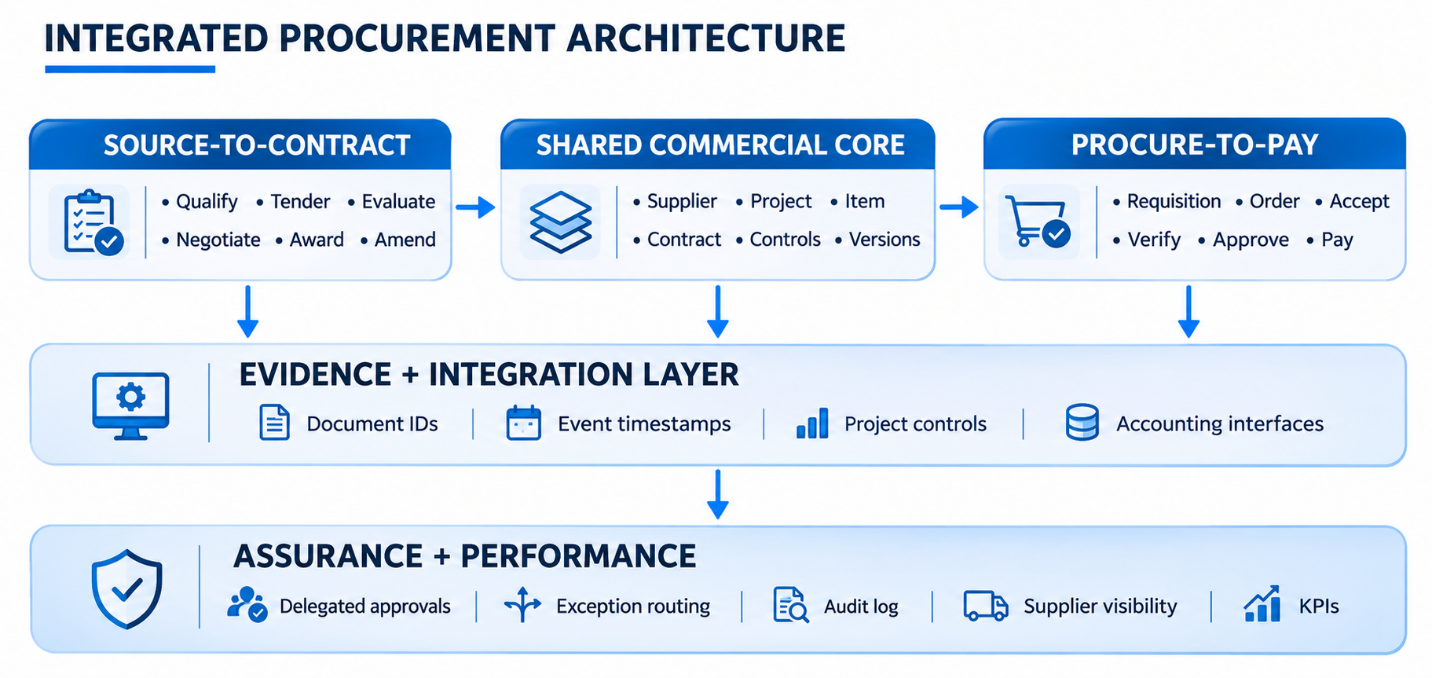
The key design principle is continuity of evidence. Every approved requisition must reference the relevant contract or an approved route for non-contracted procurements. Every order will record the relevant prices, quantities, tax treatment, delivery terms and the approval version. Every receipt or certificate will identify the goods or services accepted, by whom, when, where and under what inspection criteria. Every invoice will reference the payable event and will show the difference from the commercial baseline. This creates a chain of evidence which prevents silent changes from occurring between the tendered promise and the actual payment. It also enables you to determine whether a variance is due to supplier performance, design change, coding error, unauthorised purchase or disputed certification.
Governance has to be structured around decision rights. The category manager sets the sourcing rules. The project manager confirms the scope and sequencing. The engineer certifies technical acceptability. The quantity surveyor or commercial admin assesses the measured work. Finance validates the tax and accounting treatment. Treasury then releases the authorised payment. In a small organisation a number of these roles could be held by one individual, but incompatible approvals must still be segregated. You shouldn't have a single workflow whereby the requestor can create a supplier, change the supplier's bank details, approve the receipt and authorise payment without some independent review. That's a design requirement rather than a reflection of any particular Saudi law (which would of course have to be checked for the organisation and contract in question).
4.2Source-to-Contract process and commercial baseline
An integrated S2C cycle starts with a requirement that is in line with the approved project scope and procurement programme. The requirement will contain a work package classification, baseline budget, estimated times and technical acceptance criteria. Market engagement then leads to a verifiable pool of eligible suppliers with the qualification records identifying which suppliers are to be excluded (mandatory) and which are to be given preference (scored). The bid evaluation will preserve the weighted criteria, the clarifications and the conflict of interest declarations. The contract record will contain the schedule of rates items, the variation mechanisms, the payment terms, the retention, the guarantees, the delivery obligations and the dispute resolution mechanism. The level of detail is important in that if the award metadata is incomplete then the downstream users will have to re-interpret the commercial terms every time a transaction is raised.
Source decisions should be reviewed if the project evidence changes. A late design change may mean the material that was originally selected is no longer available. Delivery performance may mean a contingency supplier is required. Aggregated call-offs may well cross the approval thresholds. In such cases you would be looking at a versioned amendment rather than deletion of the prior baseline. The framework treats contract amendments as a controlled event which only propagates to the open orders and the affected invoices once it has been authorised. Supplier records are centrally governed to the point where duplicates can be detected, but are flexible enough to accommodate local licensing, branch arrangements and project specific qualification. Strong oversight doesn't necessarily mean that a central procurement team is going to be making all the site level purchase decisions. Delegations will define what can be decided at the site level within the parameters of the delegation.
4.3Procure-to-Pay execution and exceptions
P2P kicks off when a project coded requisition passes the checks for contractual availability, level of commitment, need for delivery and approval authority. A compliant catalogue or rate based order can be generated automatically in that case; a non-standard request would go down the appropriate exception route. The receiving stage is where you determine whether it's a physical delivery or a commercial acceptance. For a manufactured component you might have serial numbers, inspection reports and a delivery to location. For a service sub-contractor you'd have the relevant object as an engineer approved progress certificate. The system will record rejected or quarantined goods without that being treated as acceptance of the goods having arrived. That distinction is absolutely critical to stop you paying too early and to stop you having the inventory incorrectly reported.
Invoice validation is by transaction type. For goods it's PO, receipt and invoice comparison (with transparent tolerances). For time-based services we need authorised time records; for measured works we need certified quantities and the applicable contractual rates; for milestone services we need documentary evidence of completion. Exceptions are categorised rather than just thrown into a generic 'fail' queue. The various exception types (quantity variance, price variance, tax error, missing certificate, duplicate invoice, changed bank details, disputed variation) all have different owners. The process should be able to support partial acceptance and undisputed payment where the contract allows, whilst maintaining a full record of the amount and reason for any amount withheld. The rules must be explainable, overrideable by the appropriate authority and recoverable in the event of a system failure. Figure 2 shows this.
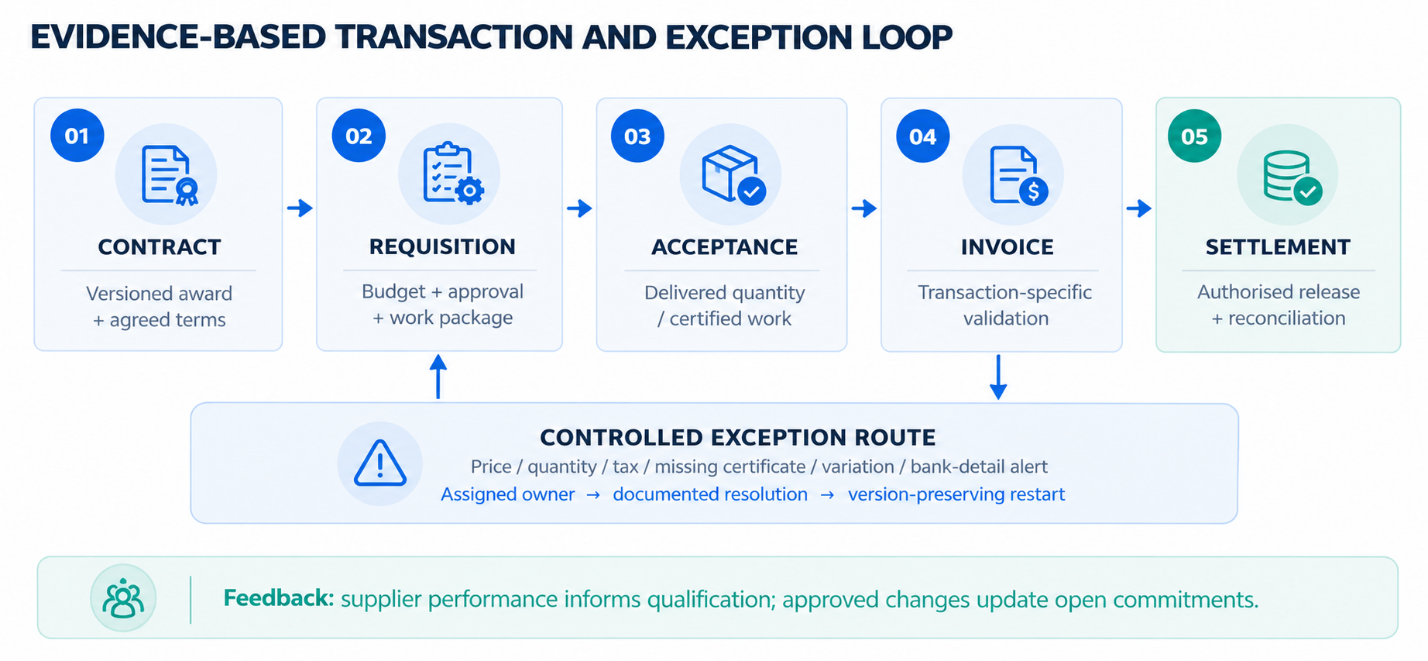
The last P2P step is payment reconciliation rather than simply passing an instruction on to the bank. Finance will check that the invoice has an authorised liability, treasury will check the payment status and the accounting system will record the settlement or rejection against the correct supplier entity. Suppliers should be able to see a clear progression from receipt through to validation, approval and settlement with reasons for any exceptions. Internal users need the same definitions in order to avoid one team reporting an invoice as approved and another team reporting it as not yet approved. Standardised event timestamps will allow you to separate out supplier submission delay, inspection delay, approval delay and the contractual payment period. That enables you to have operational accountability without disguising your cash flow decisions as system defects.
4.4Data model, security and technology options
A minimum viable data model consists of eight interlinked entities: supplier, project, work package, specification, contract, order, acceptance event and payable document. Each entity has a unique identifier and immutable event histories which record what changed, who changed it and on what evidence. Master data stewards are responsible for resolving duplicate suppliers and conflicting item codes, with the project teams remaining responsible for the technical attributes. Interface controls will check for required fields, prevent orphaned records and route any rejected messages for correction. The information model must be able to support subcontract hierarchies, multiple currencies where appropriate, tax categories and controlled confidentiality. An API is only of value if common definitions, error handling and ownership have already been agreed.
Advanced tools are only of selective use. BIM can assist with quantity consistency but the design model data will still need to go through commercial and revision checks prior to procurement. Computer vision, mobile scanning or sensor feeds can all assist with receipt verification but none of them should be allowed to replace competent technical inspection. Distributed records can be useful in terms of enhancing cross party traceability where no one party is trusted to maintain the sole ledger; they do however introduce a whole host of governance, privacy and integration issues. Reviews of blockchain and smart contract applications are consistently highlighted as having both promise and significant institutional barriers [28, 29, 30]. The baseline recommendation is therefore to start with reliable identifiers, signed evidence, access controls and interoperable records before considering the use of decentralised automation as a legitimate enhancement.
5Implementation roadmap and performance evaluation
Implementation should be by transaction risk and readiness rather than by a drive to turn on everything at the same time across every project. The pre-implementation phase will map out the existing approvals, contractual variations, chart of accounts structures and supplier IDS and will also establish information ownership and security responsibilities. A pilot will then select one material category with fairly stable specs, a small number of suppliers and clear delivery evidence. This allows you to test data reconciliation, electronic acknowledgement and basic invoice matching without having to put any complex claims administration on an immature system. The next stage will be to add in subcontract progress certification and variations and then move on to broader integrations and bounded analytics. There should be clear acceptance gates at each stage for auditability, training and recovery capability.
Table 1 takes the evidence synthesis and turns it into design controls. Table 2 then defines the measures by which you will assess whether those controls actually result in improved execution. The metrics have to be defined prior to go-live and will be based on actual observed baseline records rather than any vendor's optimistic demonstration. The recommended metrics are median requisition to order duration, the % of orders linked to a valid contract version, first pass invoice match by transaction type, days in each exception category, certified to paid interval and the % of suppliers able to acknowledge the transaction. Other metrics of interest are the number of duplicate supplier records, the number of unresolved changes to payment instructions, the number of late material deliveries and recovery time following a disrupted shipment. The baseline will need to be broken down by project size and type so that a high volume commodity type doesn't mask a failure in the more complex subcontract payment administration.
| Integration failure | Required digital linkage | Accountable control | Exception pathway |
|---|---|---|---|
| Supplier duplication | Legal entity ID, qualification and bank-change record | Supplier data steward | Escalate conflicting identity before order |
| Award-to-order drift | Contract version, rates, work package and approval | Commercial manager | Block or request approved amendment |
| Unverified execution | Delivery inspection or progress certificate tied to order | Site engineer / certifier | Hold disputed quantity with documented reason |
| Invoice mismatch | Line-level price, quantity, tax and accepted value | Accounts payable | Route variance to named owner; retain audit |
| Fragmented supplier access | Shared acknowledgement and payment-status events | Supplier relationship lead | Provide accessible alternative submission channel |
| Delayed disruption response | Open commitments, site demand and approved alternatives | Project procurement lead | Trigger coordinated supplier contingency |
| Indicator | Operational definition | Interpretive caution |
|---|---|---|
| Contract linkage coverage | Orders referencing a current approved contract version / all applicable orders | Distinguish valid spot purchases |
| Requisition-to-order time | Median hours from complete request to authorised order | Segment urgent and routine work |
| First-pass invoice match | Invoices accepted without manual correction / invoices submitted | Report separately for goods and measured work |
| Exception age | Median elapsed days within each unresolved variance category | Do not hide contested contractual claims |
| Certified-to-paid interval | Days from accepted payable evidence to cleared settlement | Separate agreed credit terms |
| Supplier participation | Eligible suppliers completing acknowledgements electronically / eligible suppliers | Include small supplier accessibility |
| Disruption visibility | Time needed to identify exposed orders and alternative capacity | Assess alongside actual recovery |
Evaluation should be a mixture of system logs, sampled commercial files and stakeholder interviews. A log may show a receipt has been approved but you need to look at the file to determine whether the certification actually met the contractual criteria. Supplier interviews can tell you whether a seemingly faster client process has simply moved the admin or the financial risk elsewhere. A before and after pilot comparison should be as rigorous as possible in terms of procurement category, contract value, project phase and any unusual delivery issues. Where possible a matched comparison between parallel sites should be used. Any claims of cost saving, labour efficiency or sustainability benefit should only be made once the benefit has been measured (including the cost of software configuration, training, maintenance and supplier adoption).
Implementation governance must also cover cybersecurity, data minimisation and business continuity. Supplier banking changes, privileged overrides and integration failures all warrant greater monitoring as the financial impact of such events can be far greater than the typical price difference. The contracts should set out the evidential value of electronic acknowledgements and the process for rectifying any erroneous records. Data ownership, data retention and data access rights need to be checked against the relevant Saudi and contractual requirements prior to go-live. Resilience arrangements should include offline capture of site receipts, controlled retrospective sync, regular backup and a fully tested manual fallback for urgent purchases. Digitisation increases your reliance on technology and it should not in any way remove the organisation's ability to procure safely should a network service fail.
6Discussion: Contributions, limitations and research agenda
The synthesis is that construction procurement efficiency is generated at the interface between commercial authority and actual physical execution. Digitised tendering won't fix the problem of disputed receipt quantities and faster invoice routing won't fix the issue of unauthorised variation. The real contribution of the framework is the creation of a common evidential spine which links award, order, acceptance and payment whilst maintaining the separation of responsibilities across the process. That's a significant extension of the generic electronic procurement literature which tends to focus on the technology. It specifically identifies the contract version, work package and acceptance objects that are required in the project based context. It also moves away from technological determinism in that the use of advanced verification is an option on top of a working governance system rather than the necessary pre-requisite for integration.
Two issues remain in the research to date. The first is the tension between the need for greater traceability and the legitimate need for commercial confidentiality. A tier two supplier may be in a position where they need to confirm a delivery has been made without having access to the upstream margins or the competing bids. Role based disclosure and purpose limited data sharing will need to be tested in practice. The second is the tension between the need for automation to have clear decision rules and the reality of construction contracts which will often have clauses which are interpretive in nature and work scopes which will be changing. In those situations the optimal digital outcome may simply be to get the disagreement identified and escalated more quickly than to have it automatically settled. Research into the automation of contractual payments has demonstrated the technical feasibility of such systems but has not established their general enforceability, particularly across a range of different contract forms and regulatory regimes [17, 18]. Human decision rights therefore need to be visible within the digital control architecture.
The review has significant caveats. The 30 studies were selected via a transparent, topic driven integrative process but do not constitute a truly exhaustive global evidence base. The quality and relevance of the studies varies considerably and a large amount of the construction technology literature consists of models and pilots rather than actual operational results. The Saudi specific evidence is considerably more limited than the international evidence and the framework itself was not field tested. As such no quantifiable improvement, no % saving and no legal compliance outcome can be legitimately claimed as a result of the proposal. The diagrams are of a normative design and not of an actual installed enterprise system. All of these limitations are very clearly stated so that future work can disentangle the effect of process integration from the effect of wider organisational change.
Future work should validate the framework across a range of Saudi project scenarios, comparing the performance of the large developers with that of the specialist subcontractors and public sector with private sector contracting. A longitudinal study would be required to capture the transaction history both before and after implementation, to assess the impact on supplier admin burden and to determine whether the improved contract linkage actually results in fewer disputes (rather than just a reclassification of them). The study should also look at how the model derived quantities are reconciled with the certified progress, how suppliers challenge the digital records of progress which are inaccurate, and how the project teams deal with approved variations when under schedule pressure. Complementary research could look at the data sharing arrangements between the contractor and the supplier, the economics of digital participation for the smaller supplier and the circumstances in which decentralised verification is preferable to the traditional secure audit log.
7Conclusion
This is a construction specific approach to integrating Source-to-Contract and Procure-to-Pay in Saudi Arabia. The evidence suggests that procurement fragmentation is not caused by the lack of software per se but by the discontinuities in the commercial record (award, receipt, payment), approval authority, physical verification and supplier communication. The proposed approach addresses all of these through a framework of governed master data, versioned contracts, project coded orders, evidence linked acceptance and explainable invoice exceptions. Payment transparency and supplier involvement are treated as outcomes to be designed for rather than as a natural result of automation. A staged road map with appropriate and differentiated performance measures provides a basis for practical testing without any claims of unobserved benefits. The most compelling argument for the approach is that reliable continuity between what was awarded, what was received and what was paid can lead to better decision making whilst still allowing for the necessary professional judgement. Its ultimate value will be determined by empirical validation and the appropriate application of controls within the actual contractual and institutional context of Saudi construction projects.
References
- [1]Liao L, Yang C, Quan L. Construction supply chain management: A systematic literature review and future development. Journal of Cleaner Production. 2023;382:135230. https://doi.org/10.1016/j.jclepro.2022.135230
- [2]Singh N, Ashish DK, Dixit A. Construction supply chain: A systematic literature review with bibliometric analysis. Journal of Global Operations and Strategic Sourcing. 2025;18(3):471–497. https://doi.org/10.1108/JGOSS-04-2023-0032
- [3]Yu ATW, Yevu SK, Nani G. Towards an integration framework for promoting electronic procurement and sustainable procurement in the construction industry: A systematic literature review. Journal of Cleaner Production. 2020;250:119493. https://doi.org/10.1016/j.jclepro.2019.119493
- [4]Yevu SK, Yu ATW, Darko A. Barriers to electronic procurement adoption in the construction industry: A systematic review and interrelationships. International Journal of Construction Management. 2023;23(6):964–978. https://doi.org/10.1080/15623599.2021.1946900
- [5]Gurgun AP, Kunkcu H, Koc K, Arditi D, Atabay S. Challenges in the integration of e-procurement procedures into construction supply chains. Buildings. 2024;14(3):605. https://doi.org/10.3390/buildings14030605
- [6]Yevu SK, Yu ATW, Darko A. Digitalization of construction supply chain and procurement in the built environment: Emerging technologies and opportunities for sustainable processes. Journal of Cleaner Production. 2021;322:129093. https://doi.org/10.1016/j.jclepro.2021.129093
- [7]Chan APC, Owusu EK. Evolution of electronic procurement: Contemporary review of adoption and implementation strategies. Buildings. 2022;12(2):198. https://doi.org/10.3390/buildings12020198
- [8]Al Azmi N, Sweis G, Sweis R, Sammour F. Exploring implementation of blockchain for the supply chain resilience and sustainability of the construction industry in Saudi Arabia. Sustainability. 2022;14(11):6427. https://doi.org/10.3390/su14116427
- [9]Zhao N, Ying FJ, Tookey J. Construction procurement selection criteria: A review and research agenda. Sustainability. 2022;14(22):15242. https://doi.org/10.3390/su142215242
- [10]Babaeian Jelodar M, Wilkinson S, Kalatehjari R, Zou Y. Designing for construction procurement: An integrated decision support system for building information modelling. Built Environment Project and Asset Management. 2022;12(1):111–127. https://doi.org/10.1108/BEPAM-07-2020-0132
- [11]Ben Mahmoud B, Lehoux N, Blanchet P. Integration mechanisms for material suppliers in the construction supply chain: A systematic literature review. Construction Management and Economics. 2024;42(1):70–107. https://doi.org/10.1080/01446193.2023.2239381
- [12]Donyavi S, Flanagan R, Assadi-Langroudi A, Parisi L. Understanding the complexity of materials procurement in construction projects to build a conceptual framework influencing supply chain management of MSMEs. International Journal of Construction Management. 2024;24(2):177–186. https://doi.org/10.1080/15623599.2023.2267862
- [13]Yevu SK, Yu ATW, Nani G, Darko A, Tetteh MO. Electronic procurement systems adoption in construction procurement: A global survey on the barriers and strategies from the developed and developing economies. Journal of Construction Engineering and Management. 2022;148(1):04021186. https://doi.org/10.1061/(ASCE)CO.1943-7862.0002213
- [14]Das M, Luo H, Cheng JCP. Securing interim payments in construction projects through a blockchain-based framework. Automation in Construction. 2020;118:103284. https://doi.org/10.1016/j.autcon.2020.103284
- [15]Hamledari H, Fischer M. Construction payment automation using blockchain-enabled smart contracts and robotic reality capture technologies. Automation in Construction. 2021;132:103926. https://doi.org/10.1016/j.autcon.2021.103926
- [16]Nanayakkara S, Perera S, Senaratne S, Weerasuriya GT, Bandara HMND. Blockchain and smart contracts: A solution for payment issues in construction supply chains. Informatics. 2021;8(2):36. https://doi.org/10.3390/informatics8020036
- [17]Sigalov K, Ye X, König M, Hagedorn P, Blum F, Severin B, et al. Automated payment and contract management in the construction industry by integrating building information modeling and blockchain-based smart contracts. Applied Sciences. 2021;11(16):7653. https://doi.org/10.3390/app11167653
- [18]Li J, Mao L, Cao J. Process model for claim and payment management in a construction supply chain based on smart contracts. Journal of Construction Engineering and Management. 2025;151(11):04025172. https://doi.org/10.1061/JCEMD4.COENG-16292
- [19]Pino Álvarez TE, Barkokebas B, Prieto Ibáñez AJ, Bastos Costa D. BIM and procurement data integration in industrialized construction using artificial intelligence. Revista Ingeniería de Construcción. 2024;39(3). https://doi.org/10.7764/RIC.00113.21
- [20]Li X, Lu W, Xue F, Wu L, Zhao R, Lou J, et al. Blockchain-enabled IoT-BIM platform for supply chain management in modular construction. Journal of Construction Engineering and Management. 2022;148(2):04021195. https://doi.org/10.1061/(ASCE)CO.1943-7862.0002229
- [21]Hijazi AA, Perera S, Calheiros RN, Alashwal A. A data model for integrating BIM and blockchain to enable a single source of truth for the construction supply chain data delivery. Engineering, Construction and Architectural Management. 2023;30(10):4645–4664. https://doi.org/10.1108/ECAM-03-2022-0209
- [22]Elkliny A, Mahmoudi A, Deng X. Big data-driven implementation in international construction supply chain management: Framework development, future directions, and barriers. Buildings. 2025;15(13):2167. https://doi.org/10.3390/buildings15132167
- [23]Baghalzadeh Shishehgarkhaneh M, Moehler RC, Fang Y, Aboutorab H, Hijazi AA. Construction supply chain risk management. Automation in Construction. 2024;162:105396. https://doi.org/10.1016/j.autcon.2024.105396
- [24]Iqbal M, Ullah I, Abdou H, Alzara M, Yosri AM. Blueprint for progress: Understanding the driving forces of BIM adoption in Kingdom of Saudi Arabia (KSA) construction industry. PLOS ONE. 2025;20:e0313135. https://doi.org/10.1371/journal.pone.0313135
- [25]Badkoubeh M, Ghannadpour SF. Designing a construction supply chain model using backup supplier aiming at optimizing resiliency against disruption. Journal of Civil Engineering and Management. 2024;30. https://doi.org/10.3846/jcem.2024.21450
- [26]Awaad S, Mansour DM, Mahdi I, Abdelrasheed I. Impact of material supply chain on the productivity optimization for the construction of roads projects. Scientific Reports. 2024;14:3294. https://doi.org/10.1038/s41598-024-53660-6
- [27]Lohmer J, Bugert N, Lasch R. Analysis of resilience strategies and ripple effect in blockchain-coordinated supply chains: An agent-based simulation study. International Journal of Production Economics. 2020;228:107882. https://doi.org/10.1016/j.ijpe.2020.107882
- [28]Tezel A, Papadonikolaki E, Yitmen I, Hilletofth P. Preparing construction supply chains for blockchain technology: An investigation of its potential and future directions. Frontiers of Engineering Management. 2020;7(4):547–563. https://doi.org/10.1007/s42524-020-0110-8
- [29]Ye X, Zeng N, König M. Systematic literature review on smart contracts in the construction industry: Potentials, benefits, and challenges. Frontiers of Engineering Management. 2022;9:196–213. https://doi.org/10.1007/s42524-022-0188-2
- [30]Heydari M, Shojaei A. Blockchain applications in the construction supply chain. Automation in Construction. 2025;171:105998. https://doi.org/10.1016/j.autcon.2025.105998