Enhancing Infrastructure Resilience
Enhancing Infrastructure Resilience Through Integrated Health, Safety and Environmental Risk Management in Saudi Arabia’s Industrial Projects
Published November 2026
Abstract
Industrial infrastructure in Saudi Arabia is undergoing expansion and renewal with the environment being as much a factor as the infrastructure itself with exposure to extreme heat, flash flooding, complex supply chains and highly interdependent utility services. Traditional HSE (health, safety and environment) arrangements will only go some way towards reducing the number of discrete incidents and will not in any way guarantee the continued function of the essential infrastructure in the face of a compound disruption. This is a critical integrative review of how occupational health, process safety, environmental protection and asset resilience can be managed as one decision system across the industrial project lifecycle. A total of 30 peer reviewed papers published between 2020 and 2025 were purposefully selected for this study, including three which were specifically Saudi focused. These were subjected to a thematic analysis looking at hazard pathways, institutional controls, operational dependencies and recovery capabilities. The synthesis of the findings identifies five persistent disconnects: compliance at the project level versus continuity at the network level; metrics of occupational injury versus metrics of major accident precursors; environmental assessment versus operational safeguards; information gathering versus accountable decisions; and controls in the construction phase versus controls for long term adaptation. In response to these disconnects the paper proposes an integrated resilience governance model which links critical function mapping, dynamic HSE risk assessment, protective barriers, cross operator coordination and performance based learning. Indicators are specified to support the model but are not presented as validated field thresholds. The contribution of this work is a testable management architecture rather than a claim of any measured national performance. It provides a framework which could be used by owners, regulators and delivery partners to help prioritise the interventions that will jointly protect workers, communities, the environment and the continued function of the key services.
Keywords: infrastructure resilience; health, safety and environment (HSE); risk management; industrial projects; Saudi Arabia
1Introduction
Industrial projects in SA are increasingly significant not just for their capital intensity but for the fact that their outputs are contingent upon a range of other critical systems. A refinery for example is dependent on power, cooling water, transport links, telecommunications and a range of specialist contractors. A failure in any one of those services can have a knock-on effect right across the production process, impact worker safety and affect the surrounding communities. You can't therefore assume that the resilience of the infrastructure is going to be a function of the resilience of any one individual piece of infrastructure. It's about whether the system as a whole can anticipate a disturbance, contain the losses that it does suffer, maintain the essential functions and then recover to an acceptable level. The Najran infrastructure assessment by Alyami et al. [1] is very much focused on robustness, redundancy and flexibility. The Saudi climate preparedness review by Mani and Goniewicz [2] is equally pertinent in that it's all about the interaction between water scarcity, weather exposure and adaptive governance. There's a very good local rationale emerging from both of these papers but neither of them really answers the question of how the day to day HSE decisions in the industrial environment should be linked to the continuity of the system.
There's also the problem of institutional ownership of the risk. The construction supervisors will be looking at lifting, excavation and work permits. The process engineers will be looking at containment and the protective instrumentation. The environmental people will be looking at emissions, wastewater and the receptors. The business continuity people will be looking at the potential for service interruption. Each of these groups will have their own data, their own incentives and their own escalation paths. If their assessments are siloed then a risk can end up being 'between the cracks'. A drainage failure may initially be a civil engineering issue but the ingress of water can then disable electrical switchgear, lead to an unsafe shutdown, block emergency access and result in contaminated run-off. Research into disaster reduction in Saudi Arabia identifies robustness, early warning and emergency response as three inter-related priorities [3]. A review of the various critical infrastructure frameworks also finds that resilience is inherently multi-dimensional and cannot be captured in a single engineering score [4].
This paper sets out the question of under what governance circumstances can an integrated HSE risk management approach enhance the resilience of Saudi Arabia's industrial infrastructure to disruption (i.e. the ability to resist, absorb, adapt and recover from disruption). It seeks to develop a context specific, evidence based explanation of the relationship between HSE control effectiveness and infrastructure resilience. The aims are to separate out infrastructure resilience from the concept of routine compliance; to examine the interplay of occupational, technological and environmental hazard pathways; to assess the relative strengths and weaknesses of the current range of governance and analytical tools; and to produce an implementable framework complete with auditable indicators and clear research propositions. This is very much a different exercise from a simple descriptive account of the nation's disaster policies. The unit of analysis is the industrial project and its dependencies throughout the lifecycle (design, construction, commissioning, operation and modification).
The contribution is intentionally analytical rather than empirical. There has been no questionnaire completed, no site inspections carried out and no operational data collected as part of this review. It does not therefore go on to estimate accident frequencies, calculate any national resilience scores or rank individual Saudi facilities. It simply brings together the evidence which would normally be scattered across the fields of construction safety, process systems, environmental law and infrastructure modelling. That said it is an important distinction for the purposes of publishable work. Any propositions derived from such a disparate body of literature should be presented as propositions until they have been tested against actual operational outcomes.
2Conceptual foundations
Resilience and risk management have very similar aims but very different starting points. Risk assessment typically looks at the likelihood, severity and existing controls around a set of defined adverse events. Resilience also looks at unfamiliar combinations, functional dependencies and the ability to reorganise when the barriers you've assumed to be there are in fact not sufficient. Imani and Hajializadeh [5] and Sun et al. [6] illustrate the impact of interconnections on the spread of disturbance. Dasuni et al. [7] go on to distinguish between one-way dependence and two-way (reciprocal) interdependence which has very real practical implications. An industrial water supply may well be dependent on electricity even if the reverse dependency is effectively zero. Explicitly mapping both directions avoids the trap of making assumptions about alternatives and recovery sequences.
A further distinction is between personal safety and process safety. It's all very well to be reducing slips, minor injuries and procedural non-conformities but that doesn't prove that you're in any way controlling the risk of a catastrophic loss of containment. Resilience engineering reviews identify anticipation, learning, awareness and adaptive flexibility as the relevant organisational capabilities [8]. For the Saudi construction context Mosly [9] identifies a number of interrelated factors which influence safety performance rather than any one single thing on a checklist; Choudhry et al. [10] identify management commitment, worker involvement and training as key proactive elements. Their findings are consistent with the need for integration, albeit they are all focused on construction activities rather than the hazards of an operating chemical installation which may be more likely to be the result of low frequency, high consequence technical failures.
Integrated HSE risk management in this context is a co-ordinated decision making process which looks at the risks to people, assets, ecological receptors and essential services using common dependency information, with clearly defined risk ownership and independently verified controls. Resilience is defined as four interlinked capabilities: the ability to anticipate prior to disruption, the ability to absorb without incurring disproportionate service loss, the ability to adapt as the situation evolves and the ability to recover in such a way as to reduce future vulnerability. Integration does not mean that every individual judgement is folded into a single score. OELs, major accident barriers, ecological thresholds and service restoration targets are all distinct things. It is the governance that must make the trade-offs between them transparent rather than hide them away in some composite index.
A real-world integration issue is the assessment of competing objectives. Wuni [22] shows how sustainable construction introduces risk dimensions which go well beyond the normal cost and time parameters. Almashhour et al. [23] are advocating a shift to an adaptive, sustainability based form of risk management and their work provides useful organising principles. The problem with such an approach is that aggregation can hide non-compensable safety requirements. A lower environmental impact should in no way be treated as an arithmetic offset to an unacceptable fatality scenario and faster restoration should not be used as an excuse for uncontrolled pollution. The decision matrix therefore has to be set up to clearly distinguish between mandatory acceptance criteria and negotiable performance preferences.
3Review design and analytical method
A critical integrative review was chosen as the design as the central question is one of linking together quite disparate bodies of research (in terms of methodology, sector and definition). It enables a comparative conceptual approach and the development of a framework but it does not in any way permit the statistical pooling of the estimates. The documentary basis was three of the supplied papers on Saudi critical infrastructure, climate preparedness and disaster risk reduction [1–3]. Further journal papers from 2020 to 2025 were located via targeted title and topic searches and DOI searches, with the search criteria being infrastructure interdependency, resilience engineering, construction occupational safety, process hazards, environmental assessment, climate exposure and digital monitoring. The resulting 30 reference corpus was assembled purposefully to ensure adequate conceptual coverage and should not be taken as a comprehensive database census.
Eligibility required a peer-reviewed journal article with a publication date between 2020 and 2025, a persistent DOI and a material contribution to at least one of the review domains. Saudi evidence was given priority for institutional and exposure claims. International studies were included where they made a contribution to a transferable mechanism (e.g. modelling cascading failures, selecting leading safety indicators). Articles without a verifiable publication record, opinion pieces which made no analytical contribution and material outside the date window were excluded from the bibliography. The DOI/title correspondence was checked via publisher, journal, scholarly repository or bibliographic records. This is a bibliographic validation exercise and is not a guarantee that every full text or every indexed metadata field has been independently checked.
Each article was parsed through a structured extraction framework: research setting; study design; hazard or dependency in question; the primary HSE or resilience construct; the practical intervention; and the boundaries of inference. The findings were then inductively grouped into five themes: institutional coordination, occupational and process hazards, climate and ecological exposure, network interdependency and adaptive information systems. The relationships between the themes were then assessed via a cause-control-service continuity logic. In this instance the logic was to ask whether the intervention in question altered hazard exposure, barrier integrity, the propagation of disturbance or the capacity for restoration and whether the evidence underpinning the claim was causal, associative or merely a plausible mechanism.
The appraisal focused on methodological fit rather than any sort of synthetic numerical quality score. Survey studies were assessed on the extent to which they reported perceptions as opposed to actual safety performance; reviews were looked at in terms of the scope of the evidence and the extent to which the evidence could be interpreted; modelling studies were assessed on the basis of their assumptions regarding network topology and data access; and the national studies were assessed for their level of transferability to the industrial setting. Where there were divergent findings these were left as such, with no attempt to force them into a single conclusion. Table 1 sets out the evidence and the implications. The process is very clear about its limitations: there was no duplicate independent screening, no comprehensive export of subscription database records and no reproducible record flow count. Accordingly there is no claim to have carried out a fully systematic review or to have quantified publication bias.
| Review domain | Sources | Supported contribution | Important qualification |
|---|---|---|---|
| Saudi infrastructure and preparedness | [1–3,14] | Spatial hazards, service networks, and response arrangements | Local context is heterogeneous; broad disaster findings do not demonstrate project HSE implementation. |
| Construction safety and project controls | [9–13,27] | Safety management, contractor interfaces, delivery and material risks | Cross-sectional perceptions and project metrics are not direct continuity outcomes. |
| Process and organisational resilience | [8,17–21,29] | Adaptive capacity, leading indicators, protective barriers and risk responses | Conceptual and multicriteria studies require observed barrier-performance validation. |
| Environment and climate exposure | [2,14–16,22,28] | Heat, flooding, assessment obligations and material impacts | Site pathways and environmental receptor thresholds are location specific. |
| Dependencies and digital assurance | [4–7,24,25,30] | Network coupling, functional performance and real-time decision support | Model outputs depend on quality of topology, governance and operational data. |
| Sustainable governance integration | [12,16,22,23,26] | Regulatory allocation, multidimensional risk and organisational capabilities | Sector transfer cannot be assumed without contextual design and evaluation. |
4Evidence synthesis
4.1Governance fragmentation and project interfaces
The project studies from Saudi Arabia suggest that risk allocation and management capability have an impact on performance which extends far beyond the actual execution of the work. Alshri et al. [11] identify financing, change orders and planning deficiencies as key drivers of delay and cost escalation. Rehman et al. [12] look at the impact of the legal and regulatory environment on construction risk management and Al-Gahtani et al. [13] demonstrate that the threats to a pipeline project can be specification errors, poor material quality, supplier behaviour and inadequate risk monitoring. These are outcomes related to the project rather than any indication of physical resilience. The significance of these findings is considerable in that schedule compression, contractual uncertainty and inconsistent QA may all result in the erosion of the resources required to maintain the critical barriers. The starting point for integration is therefore the client's governance of the interfaces, in particular the authority to resolve any conflict between commercial milestones and unacceptable residual risk.
A good arrangement has a named owner for each high consequence scenario and a separate owner for each external dependency which has the potential to defeat its controls. The project risk register needs to show how a failure in one package impacts the exposure in another (e.g. temporary drainage adjacent to a substation, hot work and fuel transfer happening at the same time, lifting over a live service corridor). Interface reviews are required at design freeze, contractor mobilisation, commissioning and any substantive change. That's much more precise than just asking for better communication. Decisions need to be based on documented assumptions, be subject to cross-disciplinary challenge, have a clear formal escalation path and there needs to be evidence that the agreed protections have been put in place and are in fact working.
4.2Occupational health and major-accident prevention
Saudi construction case studies illustrate why proactive management is so important. Choudhry et al. [10] identify two clusters of safety management practices, Mosly [9] identifies a number of factors which influence the outcome. Neither of these results should be read as a universal causal model for all facilities. A useful synthesis is that safety culture provides the organisational context for control, whereas engineered barriers provide the scenario specific defence. The process industry literature makes this distinction very clear: Bento et al. [17] note that resilience is often mentioned without any reference to the actual mechanisms of adaptation, and Qureshi et al. [18] advocate for risk governance which goes beyond the individual asset level assessment. Chen et al. [19] have documented the growing body of work on process system resilience, but conceptual development in itself will not necessarily lead to effective barriers.
For significant accident hazards an integrated regime should link bow-tie scenarios, hazardous area classifications, inspection results, impairment permits and emergency response capability. A closure rate for corrective actions is only of value if it is linked to severity and subject to independent verification. Safety observation figures can simply go up as a result of improved reporting. Bayramova et al. [20] identify a number of different constructs of leading indicators and a later review [21] highlights the continuing conceptual confusion. As such organisations should for each indicator define the precise causal mechanism, data source, decision threshold, responsible role and the action to be taken if the signal is deteriorating. Examples would be overdue proof tests of protective systems, unresolved critical lifting plan deviations and the proportion of emergency routes maintained during construction variations.
Occupational health requires equal status. Heat, dust and fatigue all have the potential to impair judgement, equipment use and emergency performance prior to any acute injury occurring. Hamed et al. [15] have shown how the importance of regional heat exposure is increasing under the new climate conditions. Exposure based controls therefore need to take into account work intensity, humidity, radiant heat, rest facilities, acclimatisation and the protection of the sub-contractor. A single outdoor work rule cannot replace the need for task specific assessments, particularly where workers are using impermeable protective clothing or working in poorly ventilated enclosures. These are the very reasons why heat related precursors should be monitored in the same way as process safety and not treated as a separate welfare issue.
4.3Environmental exposure and compound hazards
Industrial infrastructure interacts with hydrology, ambient temperature, emissions pathways and ecological receptors. Mani and Goniewicz [2] identify the water related and climatic adaptation pressures in Saudi Arabia; Masoud et al. [14] show the utility of terrain and hydrological modelling in the assessment of flash floods in Jazan. The site specific relevance of such work still has to be established as a regional flood map is not in itself a validated drainage capacity or a tested isolation strategy for hazardous inventories. Environmental hazards can become safety hazards via inundated power supplies, contaminated firewater and loss of access. Conversely a protective intervention can turn an environmental hazard into a safety hazard if the runoff paths, waste handling and discharge controls are not all considered in tandem.
Environmental impact assessment should also link the conditions for approval to lifetime operating assurance. Alomari and Heffron [16] look at the regulatory regime and actual practice of environmental assessment in Saudi Arabia and identify a governance issue which is frequently divorced from the occupational and asset risk registers. The integration of the two would see significant impact pathways linked to specific design requirements, monitoring locations, response procedures and handover responsibilities. Mohammed et al. [28] point out that the choice of construction materials has significant emissions implications. Embodied impacts and operational resilience are not the same thing, yet both can influence the choice of cooling system, spare capacity, corrosion resistance and replacement strategies. The challenge is to compare the alternatives on the basis of safety, continuity and environmental performance and to record the uncertainty.
4.4Network dependency and continuity
Current Saudi research into infrastructure networks is all about robustness, redundancy and flexibility [1]. The wider literature on modelling demonstrates that the structure of the network will determine the form and scale of cascading failure [5-7]. A single backup generator may be of benefit in terms of local reliability but will not in any way provide resilience if both the primary and the backup system rely on the same fuel delivery route or if both have a control room in a flood-prone area. Industrial customers therefore need to go beyond the simple mapping of equipment and look at shared locations, shared supply contracts, shared data links, shared workforces and shared emergency access. The key question is which service must survive, for whom, for how long and under what combinations of failure.
A defensible service continuity analysis will identify the minimum safe operating functions, the maximum tolerable downtime, the dependencies, the feasible alternate modes and the time to restore. The testing should incorporate plausible common cause disturbances rather than just single component outages. Guo et al. [4] illustrate the range of resilience assessment dimensions and the need to explain the metrics you choose. A resilience score with no explanation of the assumptions behind it may in fact be a very poor indicator of risk. The preferred decision product is therefore a scenario specific account of the degraded functionality, the credible restoration pathways and the residual exposure to workers, the community and receptors, backed up by evidence from the exercises or from actual interventions.
4.5Digitalisation and organisational learning
Real time sensors, integrated maintenance systems and digital twins provide the opportunity to detect deterioration and to rehearse response options. Broo and Schooling [30] look at both the potential and the practical problems with infrastructure digital twins, Omrany et al. [24] survey the applications in resilient urban environments and Geng et al. [25] propose a system level approach to life cycle risk in bridge networks. Their applications should not be taken as evidence that digital twin deployments in industry lead to better outcomes. Data integration can introduce cyber dependencies, false alarms, black box models and liability issues. The governance question is whether a trusted signal can get to someone with the authority to act before a critical function is lost.
Digital systems are at their most defensible when every element on the dashboard is linked to a decision pathway. A pump vibration reading that is out of the normal range should trigger inspection criteria, define an acceptable operating envelope and identify who has the authority to suspend work. The model parameters have to be updated following any maintenance work and be validated against known failures. A human operator must have access to the key procedures in the event of a network failure. The architecture that results uses the digital intelligence as evidence of an accountable action rather than treating the purchase of software as a substitute for sound engineering judgement.
The transferability of the organisational resilience findings also needs to be examined. There is evidence from the Saudi healthcare associates study on occupational safety, staff resilience and engagement with organisational resilience [26], but the relationships derived from hospital administrators are not necessarily going to be applicable to industrial process barriers. Similarly, Baghdadi's assessment of the hazards associated with tunnel construction [27] highlights the importance of a context specific exposure analysis; the confined space and ventilation hazards in a tunnel are very different from those in a desalination plant or a petrochemical plant. This again serves to reinforce the general methodological point that the integration architecture can be shared across sectors but the hazard models, the PPE and the verification procedures have to be specific to the task.
5An integrated HSE–resilience governance framework
The proposed framework comprises five interlocking functions (see Figure 1). The first is the asset owner defining the core services and mapping the dependencies across facilities, contractors and external operators. The second is an integrated assessment which takes the occupational, process, environmental and climate hazards and turns them into shared scenarios, all the while retaining the relevant domain specific criteria. The third function is the design of the preventative and mitigative barriers, their verification and protection against unauthorised impairment. The fourth is operational coordination which defines the decision rights for abnormal conditions, the emergency support and the alternative service provision. The fifth is the learning function which links the leading indicators, the drills, the incidents and the restoration evidence back to the design standards and the investment priorities. This is a conceptual framework, not a validated scoring tool.
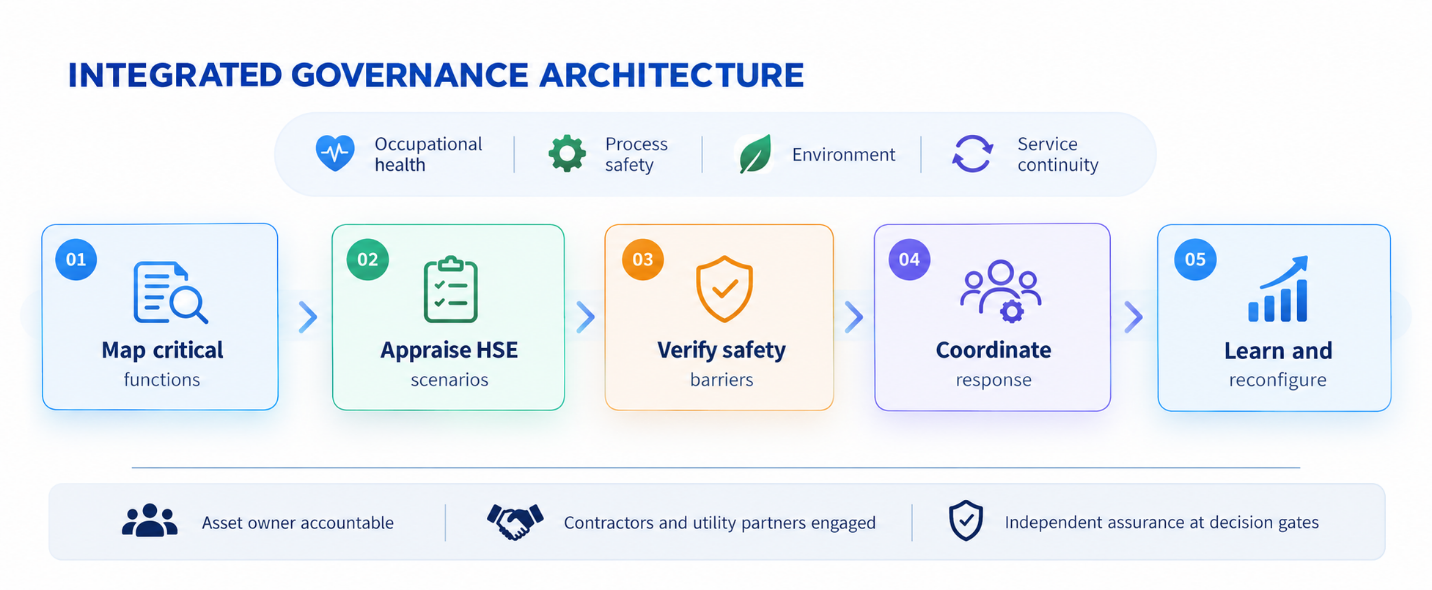
The framework is intentionally rooted in governance gates rather than departments. At the concept selection stage the owner should be demanding that location, utility dependencies and emergency escape routes have all been considered as part of the same analysis. At design approval the test is whether the severe scenarios and environmental receptors can be shown to be addressed by engineered safeguards. Prior to commissioning the test is whether the critical barriers, operating envelopes and emergency interfaces have all been independently challenged. During operation there should be periodic reviews of the impairments, workforce exposure, climate data and degraded service capacity. After a disruption the asset team should be able to explain not just why the components failed but why the safeguards, the information pathways and the recovery arrangements didn't contain the consequences.
Table 2 turns this architecture into a set of illustrative assurance indicators. The indicator set is deliberately a mixture of technical, human and organisational evidence and avoids the temptation to have a single percentage figure which is then claimed to be a measure of resilience. The selection of indicators will be hazard led (a pipeline, a desalination plant, a logistics hub and a petrochemical complex will all have different requirements in terms of their thresholds). Leading indicators also require measurement discipline. A reported proportion of closed findings for instance has very limited value unless the findings are classified by risk significance, recurrence is tested and closure is supported by field evidence [20,21]. In governance terms the key difference is between having a metric and actually changing a decision as a result of it.
| Control focus | Illustrative indicator (no prescribed target) | Responsible decision role | Review trigger |
|---|---|---|---|
| Critical-function coverage | Percentage of essential services with mapped common-cause dependencies | Asset owner / systems engineer | Mapping approval; major change |
| Barrier health | Risk-weighted overdue inspection, proof-testing and bypass exposure | Process safety / maintenance | Weekly; before restart |
| Workforce exposure | Heat and fatigue controls verified for high-exposure tasks and subcontractors | Occupational health / contractor | Shift; weather alert |
| Environmental containment | Verified status of runoff isolation, spill routes and discharge monitoring | Environmental lead | Rainfall warning; monthly |
| Interface readiness | Open high-consequence interface actions with independently accepted closure | Project director / HSE | Gate review; weekly |
| Alternative service capacity | Demonstrated survival of safe operating functions during common-cause tests | Operations / utility partners | Exercise; annual review |
| Recovery learning | Actionable lessons with tested changes to procedures, design or contracts | Resilience steering group | After event; quarterly |
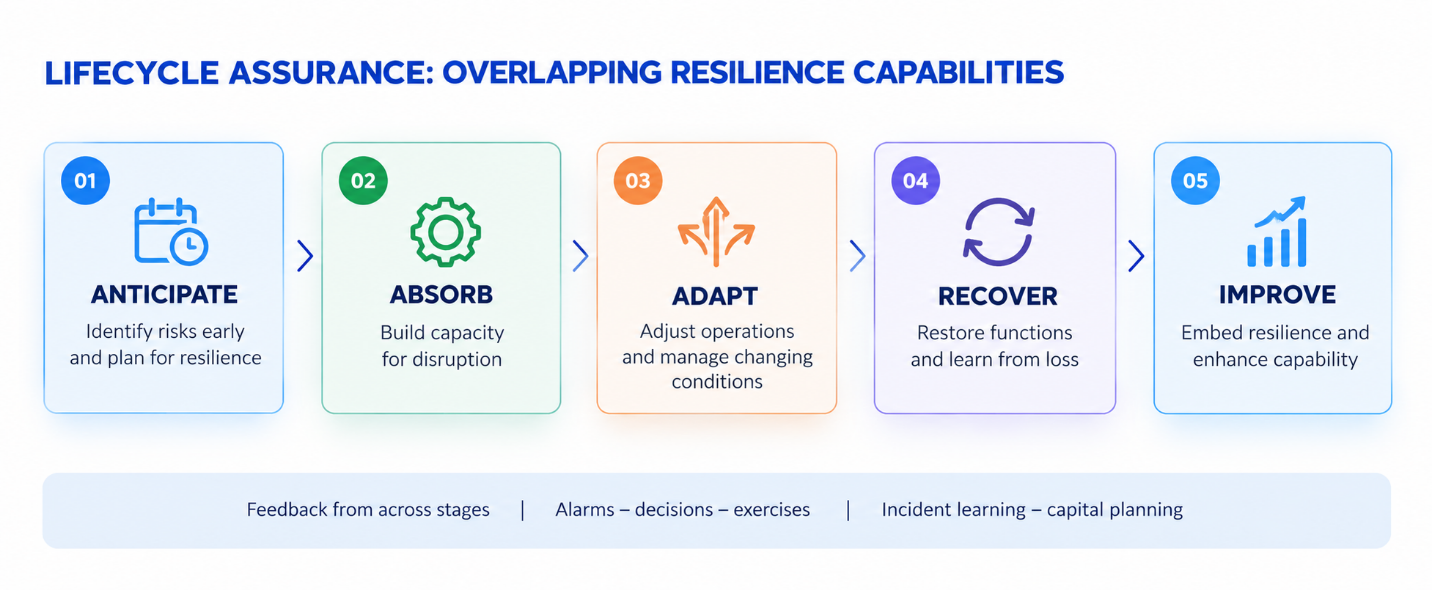
Figure 2 shows the recurring operational logic. Anticipation is about identifying the environmental and technological stressors; absorption is about the effectiveness of barriers and redundancy; adaptation is about staff authority and the existence of protected alternatives; recovery is about the need for rehearsed restoration and evidence capture; improvement is about updating the design and governance assumptions. The stages all overlap. A response decision may be one which maintains production but increases worker exposure, or one which speeds up drainage but releases the contaminated water. The framework therefore requires a clear cross-domain trade-off review to be undertaken at the point where a proposed resilience measure shifts risk to another stakeholder. The ability to explain, escalate and authorise those trade-offs is a fundamental element of integrated governance.
There's also the need to separate risk treatment from implementation evidence. Khalilzadeh et al. [29] look at responses to production stage oil and gas hazards using multi-criteria decision making. They provide a useful way of structuring the difficult decisions that are involved, but a preferred control on paper can easily be undermined if maintenance, worker competency or contractor incentives subsequently decline. The framework therefore requires three separate records: the technical rationale for the selection of a control, the documentation that it was installed and the operational evidence that it continues to perform under actual operating conditions. If these levels of evidence are not properly distinguished then you risk turning your risk register into a mere exercise in administrative closure.
6Discussion and implications
There's a persistent imbalance between the level of maturity of project level controls and the level of visibility we have of the cross-systemic consequences. Saudi construction research provides us with a good deal of information on safety practices, management factors and delivery risk [9–13]. Saudi research into disasters and climate provides us with information on hazards and the more general area of preparedness [1–3,14]. The international resilience literature provides us with the mechanisms for functional dependencies and adaptation [4–8,17–19]. These are all complementary pieces of work, but their co-existence doesn't in any way mean that we have an integrated governance model in operation at the industrial facility. The framework proposed here is precisely what is required to close that explanatory gap by specifying what information needs to cross organisational boundaries and what decisions need to be made as a result.
A second point is about the interpretation of resilience investment. Redundancy is only of value if the failure modes are sufficiently independent and the alternatives can be brought into play in time. Inspection spend is only worthwhile if it's able to detect degradation in the consequential barriers. Training is only of use if the people can make a judgement in the face of constraints. Environmental compliance is a resilience enabler to the extent that monitoring results actually have an impact on the operating boundaries and the recovery plans. This is a systems view which would reject both a very narrow definition of HSE excellence as being one of injury frequency and a very narrow definition of infrastructure robustness as being purely technological. It would also suggest that procurement and contract management are as much part of the picture as engineering design, since the various parties will often be in control of different parts of one risk pathway.
For the Saudi industrial client the priority is to get ownership of the cross boundary situation prior to the project getting into accelerated construction or complex commissioning. The owner needs to have common hazard language, needs to formally resolve the assumptions between design and the contractor, needs to test the continuity of the functions and needs to have protected routes for the escalation of any adverse evidence. Regulators and the sector bodies could be encouraged to have a similar approach to the reporting of critical barrier impairment, significant environmental release and restoration capability without necessarily having to mix those together. The challenge is as much geographical as it is institutional. The coastal exposure, the mountainous flood catchments, the arid inland heat and the remote logistics all require different engineering solutions rather than a one size fits all national approach.
Emergency preparedness is the perfect example of the value of maintaining that distinction. The Saudi disaster risk review [3] highlights infrastructure, public awareness and response capability. Flash flood modelling [14] can be used to help with spatial prioritisation. Neither of those however will tell you whether a night shift industrial team can isolate the systems and get in touch with the local utility. Field exercises should therefore be used to test the critical assumptions across the organisation. These would include loss of the primary telecoms, inaccessible entrances, conflicting shutdown requests and the unavailability of spares. The observed performance will then be used to update the dependency maps and the investment priorities. The objective is not to produce more documentation but to have fewer assumptions that are untested at the point when you actually need to act.
Integration is only considered operational when the assurance process is looking at the relationships between decisions rather than simply ticking off the number of documents that have been completed. Prior to an industrial project being commissioned the owner should ask themselves which of the protective functions are reliant on the same electrical feeder, the same drainage channel, the same communications platform or the same specialist maintenance team. That question completely changes the nature of the design review. The review participants now have to be able to demonstrate that their proposed alternative will survive the disturbance for which it was designed. Joint exercises should also identify who has the authority to carry out load shedding, to suspend hazardous work, to request assistance from outside the site and to declare that a system which has been disrupted is safe to re-start. Acknowledgements of communication cannot in any way take the place of executable commitments, particularly where the external provider does not have control of the facility in question. The evidence of the process should be a chain from the hazard assumption through to the engineered response, field verification and decision ownership. That chain of evidence enables the reviewers to question the adequacy of the design without treating every un-resolved observation as being of equal importance. It also protects the workers and emergency responders from receiving conflicting instructions as the situation rapidly evolves. The measure of governance maturity is whether the consequential warnings are in fact changing the way that work is done, the operating limits or the investment decisions before the disruption has become prolonged harm.
Implementation will of course be dependent on good information and good incentives. If the contract rewards the completion of the schedule but leaves the shared infrastructure vulnerabilities outside the formal scope of either party then neither a very sophisticated software package nor any number of additional inspections are going to close that gap. The procurement requirements therefore need to set out the critical information exchanges, the acceptance tests, the temporary works obligations and the arrangements for the transfer of live risk from the constructor to the operator. Monitoring systems need stable denominators, independent verification and clear procedures for dealing with missing data. A reduction in the number of incidents may simply be a reflection of a change in the way incidents are reported; an increase in the number of near misses may be an indication of a more engaged workforce. The auditor will need to look at the mechanisms behind the indicators and be able to separate the significance of the risk from the administrative closure of the issue. The same applies to environmental surveillance with sampling results needing to be linked to enforceable operating conditions and emergency controls. Following a near miss or a service interruption the lessons learned should lead to tangible changes in the technical standards, the maintenance plans, the contracts or the exercises. The ultimate test is not whether recommendations have been issued but whether the revised controls actually work under representative demand (including extreme weather, staff unavailability and loss of normal comms) and the continuing availability of genuinely independent protection against escalation.
7Research priorities, boundaries and conclusion
Three research propositions emerge. Firstly, industrial projects which have jointly maintained dependency maps and cross-functional risk ownership should see a reduction in the number of unrecognised pathways from local disturbance to service failure. Secondly, independently verified, scenario specific leading indicators should be a more meaningful predictor of material control degradation than either aggregate observation or incident count. Thirdly, commissioning exercises which incorporate environmental impacts and external utility failure should reveal restoration constraints which would be missed by equipment only commissioning. Each of these is a falsifiable proposition which could be tested in a prospective multi-site study via process tracing of decisions and a comparison of the recovery times that are tested against the actual recovery times that occur. The study would need to control for facility complexity, reporting culture and exposure differences rather than simply ascribing all of the variation in performance to integration.
The review has significant caveats. The 30 studies form a purposive, DOI-traceable evidence set rather than a truly comprehensive systematic sample and publication selection is likely to have resulted in a bias towards more accessible English language accounts. Much of the Saudi project evidence is cross-sectional and the infrastructure and digital modelling literature varies considerably in terms of validation maturity. No site data were collected to validate the proposed architecture or to calibrate the thresholds. DOI correspondence is only evidence of bibliographic traceability and is not in any way a plagiarism check, a guarantee of indexing by a publisher or proof of reproducibility. The limitations in terms of the strength of causal inference are real but the value of an explicitly testable synthesis is not in any way diminished.
Infrastructure resilience in the Saudi industrial projects is about far more than just meeting the requirements of occupational health & safety, process and environment in parallel. It's about having a governance structure that links the hazard pathways to the critical functions, assigns ownership across the technical and contractual interfaces, verifies the protective barriers, maintains the adaptive capacity and learns from service recovery. The literature that we've reviewed supports the individual elements of this argument but it's clear that the effectiveness of the combination has not been sufficiently tested. The practical value of this is in providing a structured basis for design reviews, operational assurance and for future empirical work. Its ultimate value will be judged by whether the integrated decisions that are made actually prevent a hazard from becoming a prolonged harm to people, to essential services and to the environment.
References
- [1]Alyami SH, Abd El Aal AK, Alqahtany A, et al. Developing a holistic resilience framework for critical infrastructure networks of buildings and communities in Saudi Arabia. Buildings. 2023;13:179. https://doi.org/10.3390/buildings13010179
- [2]Mani ZA, Goniewicz K. Adapting disaster preparedness strategies to changing climate patterns in Saudi Arabia: A rapid review. Sustainability. 2023;15:14279. https://doi.org/10.3390/su151914279
- [3]Al-Wathinani AM, Barten DG, Borowska-Stefańska M, et al. Driving sustainable disaster risk reduction: A rapid review of the policies and strategies in Saudi Arabia. Sustainability. 2023;15:10976. https://doi.org/10.3390/su151410976
- [4]Guo D, Shan M, Owusu EK. Resilience assessment frameworks of critical infrastructures: State-of-the-art review. Buildings. 2021;11:464. https://doi.org/10.3390/buildings11100464
- [5]Imani M, Hajializadeh D. A resilience assessment framework for critical infrastructure networks' interdependencies. Water Science and Technology. 2020;81:1420–1431. https://doi.org/10.2166/wst.2019.367
- [6]Sun W, Bocchini P, Davison BD. Overview of interdependency models of critical infrastructure for resilience assessment. Natural Hazards Review. 2022;23(1). https://doi.org/10.1061/(ASCE)NH.1527-6996.0000535
- [7]Dasuni KAL, Palliyaguru R, Amaratunga D, Liyanawatta TN. Redefining dependencies/interdependencies of critical infrastructure: A systematic review of the existing knowledgebase. Sustainable and Resilient Infrastructure. 2025;10(2):202–222. https://doi.org/10.1080/23789689.2024.2403885
- [8]Ranasinghe U, Jefferies M, Davis P, Pillay M. Resilience engineering indicators and safety management: A systematic review. Safety and Health at Work. 2020;11(2):127–135. https://doi.org/10.1016/j.shaw.2020.03.009
- [9]Mosly I. Factors influencing safety performance in the construction industry of Saudi Arabia: An exploratory factor analysis. International Journal of Occupational Safety and Ergonomics. 2022;28(2):901–908. https://doi.org/10.1080/10803548.2020.1838774
- [10]Choudhry RM, Zafar I, Almatawa MS. Proactive approach to measure safety management on building projects in Saudi Arabia. Advances in Civil Engineering. 2023;2023:6306157. https://doi.org/10.1155/2023/6306157
- [11]Alshihri S, Al-Gahtani K, Almohsen A. Risk factors that lead to time and cost overruns of building projects in Saudi Arabia. Buildings. 2022;12:902. https://doi.org/10.3390/buildings12070902
- [12]Rehman MA, Ishak MSB, Adeleke AQ. The moderating effects of statutory laws and regulations of risk factors and management in the Kingdom of Saudi Arabia construction industries. Business, Management and Economics Engineering. 2024;22(1):53–76. https://doi.org/10.3846/bmee.2024.19883
- [13]Al-Gahtani K, Shafaay M, Ahmed O, et al. Risk factors for time and cost overruns of pipeline projects in Saudi Arabia. Advances in Civil Engineering. 2023;2023:9497451. https://doi.org/10.1155/2023/9497451
- [14]Masoud MHZ, Basahi JM, Alqarawy A, et al. Flash flood prediction in Southwest Saudi Arabia using GIS technique and surface water models. Applied Water Science. 2024;14:61. https://doi.org/10.1007/s13201-024-02117-2
- [15]Hamed MM, Al-Hasani AAJ, Nashwan MS, Sa'adi Z, Shahid S. Assessing the growing threat of heat stress in the North Africa and Arabian Peninsula region connected to climate change. Journal of Cleaner Production. 2024;447:141639. https://doi.org/10.1016/j.jclepro.2024.141639
- [16]Alomari MA, Heffron RJ. Environmental impact assessment: A Middle Eastern experience. Journal of Environmental Law. 2021;33(2):309–338. https://doi.org/10.1093/jel/eqab002
- [17]Bento F, Garotti L, Mercado MP. Organizational resilience in the oil and gas industry: A scoping review. Safety Science. 2021;133:105036. https://doi.org/10.1016/j.ssci.2020.105036
- [18]Qureshi MMR. Building proactive organizational resilience against the risk of major process safety incidents. Process Safety Progress. 2023;42(1):48–55. https://doi.org/10.1002/prs.12411
- [19]Chen C, Li J, Zhao Y, Goerlandt F, Reniers G, Liu Y. Resilience assessment and management: A review on contributions on process safety and environmental protection. Process Safety and Environmental Protection. 2023;170:1039–1051. https://doi.org/10.1016/j.psep.2022.12.072
- [20]Bayramova A, Edwards DJ, Roberts C, Rillie I. Constructs of leading indicators: A synthesis of safety literature. Journal of Safety Research. 2023;85:469–484. https://doi.org/10.1016/j.jsr.2023.04.015
- [21]Bayramova A, Edwards DJ, Roberts C, Rillie I. Unravelling the Gordian knot of leading indicators. Safety Science. 2024;177:106603. https://doi.org/10.1016/j.ssci.2024.106603
- [22]Wuni IY. Developing a multidimensional risk assessment model for sustainable construction projects. Engineering, Construction and Architectural Management. 2025;32(6):4155–4173. https://doi.org/10.1108/ECAM-11-2023-1201
- [23]Almashhour R, Al-Mhdawi MKS, Daghfous A, Qazi A, Ojiako U. Traditional to sustainable risk management in the construction industry: A systematic literature review. International Journal of Managing Projects in Business. 2025;18(3):528–565. https://doi.org/10.1108/IJMPB-01-2025-0021
- [24]Omrany H, Mehdipour A, Oteng D, Al-Obaidi KM. The uptake of urban digital twins in the built environment: A pathway to resilient and sustainable cities. Computational Urban Science. 2025;5:20. https://doi.org/10.1007/s43762-025-00177-x
- [25]Geng Z, Zhang C, Jiang Y, Pugliese D, Cheng M. Integrating multi-source data for life-cycle risk assessment of bridge networks: A system digital twin framework. Journal of Infrastructure Preservation and Resilience. 2025;6:9. https://doi.org/10.1186/s43065-025-00121-7
- [26]Qassim AA, Abedelrahim SS. Healthcare resilience in Saudi Arabia: The interplay of occupational safety, staff engagement, and resilience. International Journal of Environmental Research and Public Health. 2024;21(11):1428. https://doi.org/10.3390/ijerph21111428
- [27]Baghdadi A. Evaluation of safety management during tunnels construction in Saudi Arabia. International Journal of Engineering Technologies and Management Research. 2024;11(4). https://doi.org/10.29121/ijetmr.v11.i4.2024.1449
- [28]Mohammed A, AlSufyani A, Ghaithan A, Alshibani A. Dynamic material flow analysis of construction materials in Saudi Arabia: Strategies for sustainability of residential buildings. Building and Environment. 2024;265:111972. https://doi.org/10.1016/j.buildenv.2024.111972
- [29]Khalilzadeh M, Banihashemi SA, Heidari A, Orazani SMH, Taebi P. Risk management in the production phase of oil and gas projects: Evaluating risk responses and their impact on safety and damage reduction. Discover Civil Engineering. 2025;2:91. https://doi.org/10.1007/s44290-025-00250-8
- [30]Broo DG, Schooling J. Digital twins in infrastructure: Definitions, current practices, challenges and strategies. International Journal of Construction Management. 2023;23(7):1254–1263. https://doi.org/10.1080/15623599.2021.1966980