Economic Model
Optimizing Business-to-Business Commercial Vehicle Leasing Contracts in Saudi Arabia: An Economic Model for Pricing, Risk and Long-Term Profitability
Published November 2026
Abstract
Commercial vehicle leasing is an arrangement whereby capital expenditure, asset management and certain operating risks are passed from the lessor to the business customer. In the Saudi context this is occurring at the same time as the growth of logistics activity, the diversification of transport demand and the increasing use of data in fleet management. A competitive rental quote is not necessarily a viable contract as the quoted payment will need to cover capital, maintenance, financing, expected credit losses and residual value exposure as well as allow for a degree of contractual flexibility. This paper reviews 30 publications (all with a DOI) from 2020 to 2025 and develops an integrated, risk-adjusted framework for business to business leasing decisions. The review is structured thematically around vehicle depreciation, customer credit, utilisation volatility, lifecycle cost, contract design and fleet renewal. The model proposed combines DCF, probability weighted loss, scenario analysis and contractual risk allocation. The illustrative calculations are of the decision process rather than actual estimates for the Saudi market. The findings suggest that pricing discipline is less about any one risk premium and more about the integration of the operational information, the enforceability of the service obligations, the return conditions and the renewal options. The paper's contribution is a transparent decision architecture through which both lessors and lessees can assess the profitability, affordability and service resilience of a leasing arrangement without having to assume that the future resale value or future utilisation will be guaranteed.
Keywords: commercial vehicle leasing; lease pricing; residual value risk; credit risk; discounted cash flow; Saudi Arabia
1Introduction
Commercial vehicles are productive capital goods rather than just transport assets. Their value is derived from the service they provide over time, and that value is dependent upon availability, the right vehicle being used, the nature of the finance and the customer's ability to meet their long term obligations. In a business to business lease the lessor will either buy or finance the asset and will recover their investment through the agreed periodic payments and any proceeds from disposal. The lessee will have the use of the vehicle and may well still have some of the ownership burdens with the supplier. The apparent simplicity of a monthly rental is in fact a very complex allocation of depreciation, downtime, credit, maintenance and market risk. Research into the pricing of automotive leases has shown that the expected residual value and the choice of rent/deposit combination are both of significant importance to the lessor's return [1,2]. Asset specific credit analysis is also something which requires a different approach to that of the standard consumer lending process [3,4].
Saudi Arabia is a relevant case as vehicle fleets underpin road freight, last mile, construction, food distribution and industrial projects. The national logistics transformation agenda recognises the importance of commercial fleet productivity but does not imply that all operators have the same cost structure. Saudi evidence has shown there are differences in the logistics business models, there are implementation constraints and the value of digital coordination [6–10]. Transport planning research has also highlighted the interplay between technology, investment capacity and institutional arrangements [29]. These findings support a leasing model which would allow for variation in vehicle class, route, customer sector and service level obligations. A single markup on acquisition cost would mask these differences and could in fact encourage bidding which is essentially about fleet size rather than value.
The fundamental issue is the disconnect between the practice of quoting and the economics of the lifecycle. Price quotes tend to focus on the obvious rental cost, with losses potentially arising later in the form of excessive mileage, faster than anticipated wear and tear, late payments, uninsured damage or a poor resale market. A fleet that is used heavily may still end up with poor economic returns if the actual mileage exceeds the assumptions upon which the maintenance budget was based. On the other hand, a fleet that is under-used can see its value to the lessee depressed while the lessor's capital remains locked in. The paper looks at the contract as a co-managed economic system rather than a static finance exercise.
The study is about building an analytically coherent review-based framework for the assessment of sustainable B2B commercial vehicle leasing contracts in Saudi Arabia. The aims are to collate the current evidence on lifecycle cost and asset valuation; to separate out the credit, operational and residual value exposures; to define a clear risk-adjusted rental floor and to identify the contractual clauses that will enable fair adaptation over the life of the lease. The central question is how pricing and contract governance can be combined in such a way as to protect the lessor's risk-adjusted profitability and at the same time maintain the lessee's operational performance. It's a discussion of a conceptual model rather than a claim to have arrived at any estimate of the current level of profitability in the Saudi leasing industry.
2Review design and analytical method
An integrative, systematic literature review was chosen as the research methodology as the research question cuts across finance, operations research, transport economics and contract management. The aim is explanatory synthesis and model development rather than statistical pooling of comparable effect sizes. The review boundaries are set at all academic work published between January 2020 and December 2025. The candidate papers were identified via the publisher and academic indexing sites through a combination of the key terms: leasing, vehicle residual value, credit risk, fleet optimisation, lifecycle cost, transport contracts, commercial vehicles, logistics and Saudi Arabia. Each bibliographic record was checked for a publisher associated DOI and for relevance to at least one of the model elements. The thirty papers that make up the final analytical set are reported on individually in the references.
The review process went through four analytical phases. The first was to categorise the documents by the economic decision they were making: asset valuation, counterparty assessment, operating cost forecasting, commercial pricing, capacity deployment or institutional context. The second phase was to separate the claims actually made in the literature from the assumptions that were specifically put forward in the model. The third was to assess the evidence for complementarity and tension; a finding derived for passenger cars or European electric vans was not automatically deemed to be relevant to the case of Saudi heavy duty trucks. The fourth stage was to convert the linked arguments into a set of parameters, equations, decision rules and contractual controls. Table 1 contains the thematic synthesis. The process is replicable at the level of the stated search concepts and inclusion criteria but is not presented as a complete and exhaustive catalogue of all relevant papers.
The unit of analysis is a vehicle-contract pair within a fleet portfolio. The profit constraint is viewed from the lessor's cash flow perspective and service reliability, cost predictability and flexibility are assessed from the lessee's point of view. The model is deterministic at the accounting level and is explicitly scenario based where the observations are uncertain. It deliberately does not calibrate Saudi default probabilities, resale curves, regulatory charges or vehicle prices without the benefit of auditable local data. Its value is in establishing what needs to be measured prior to any such calibration being able to be taken as credible. There are no human participants, no field interviews and no claimed primary observations in this review.
| Evidence stream | Core insight | Model requirement | Sources |
|---|---|---|---|
| Asset value and exit | Depreciation and resale forecasts are asymmetric | Scenario-specific net residual value; end-of-term condition evidence | [1,2,5] |
| Counterparty risk | Probability of default differs by client and asset | Collection factor, exposure, recoverability, credit review | [3,4,21–23,28] |
| Operational expenditure | Wear and maintenance depend on actual usage | Kilometre-linked budgets, availability and service response | [19,20,30] |
| Network and allocation | Fleet size, coordination and matching alter productivity | Capacity bands, vehicle equivalence, relocation rights | [14,15,17,18,25,27] |
| Commercial market | Contract commitment trades flexibility for certainty | Transparent indexation, term, service and return clauses | [6,16,24] |
| Saudi implementation | Logistics digitisation creates data and governance needs | Local cost calibration, regulatory mapping, data stewardship | [7–10,29] |
| Lifecycle technology | Propulsion choice and replacement change cash-flow profiles | Comparable TCO, infrastructure and policy scenarios | [11–13,26] |
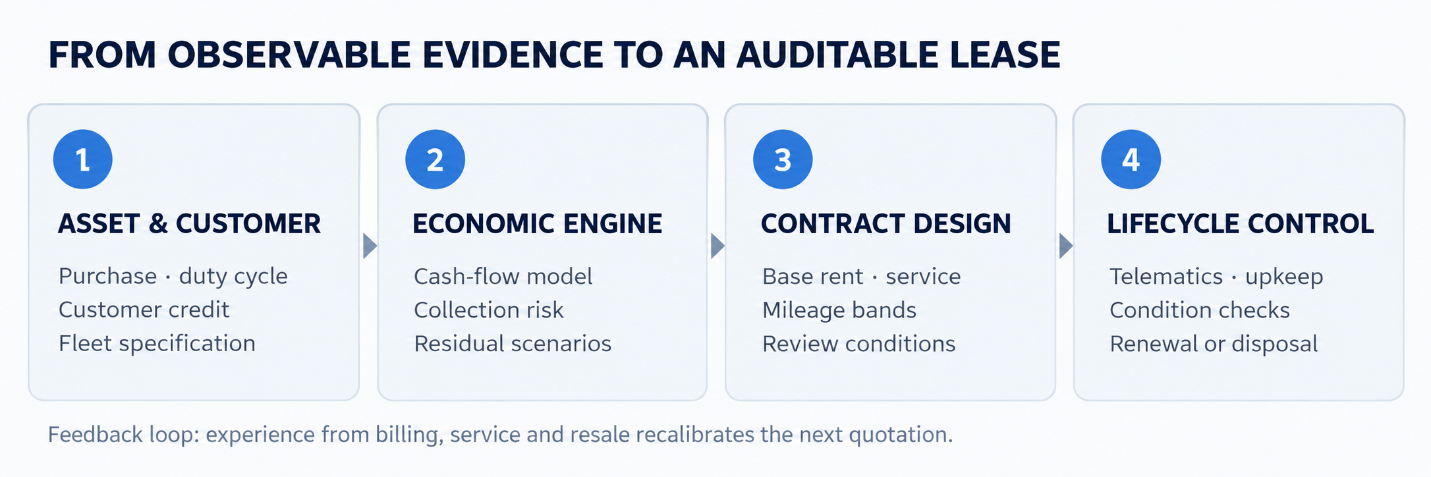
3Economic foundations of lease pricing
For any given asset an economically defensible rental must be one which recovers the acquisition outflow after allowance has been made for the discounted value of the contractual inflows, the expected disposal proceeds and the cash expenses. Depreciation in itself is not a cash outflow but the gap between the acquisition price and the final net disposal proceeds is of course economically critical. The literature on residual value prediction for vehicles is well established and demonstrates that errors in prediction can have an impact on both customer competitiveness and lender exposure [1,5]. Ko [2] takes this a step further by applying the concept of asymmetry to the residual value outcomes in an option pricing context. The upshot of all this is that a lessor should not be setting their rent on the basis of a single optimistic resale figure. Adverse and severe resale scenarios must be incorporated even if the accounting rules permit the use of a single point estimate.
The discount rate and the financing costs need to be treated with care. Discounting the operating cash flows at an appropriate risk-adjusted hurdle rate takes into account the timing of the cash flows and the opportunity cost of capital. If you're discounting the same unlevered cash flows and separately deducting interest expense then you're effectively double counting the financing cost. The enterprise valuation approach discounts the unlevered cash flows, the equity approach deducts the debt service and discounts the equity distributions. The proposed pricing equation is consistently using the unlevered convention. Any recovery of financing fees is only isolated as a separate item if it is in fact an additional contractual item rather than a second cost of the same funds. The rate should be consistent with the nominal currency of the forecast and the allocation of risk.
Commercial customers will compare lease rentals with ownership, with hire purchase and with other capacity arrangements. The benchmark they use is a service adjusted total cost of mobility rather than simply a vehicle purchase quote. Studies of light commercial vehicle ownership have shown that purchase incentives, vehicle size and local running costs can in fact reverse the comparison between the various propulsion technologies [11–13]. The studies may be from other markets but the methodology is clearly transferable: you compare the full service equivalent cash flows under the same utilisation and availability assumptions. A lease which includes maintenance, replacement vehicles and data services is not directly comparable to a lease which provides only the physical asset. Pricing is much more transparent when those individual components are all laid out separately prior to negotiation.
4Risk decomposition and interdependence
Credit risk starts with the probability of the lessee defaulting on payment and runs through to exposure at default and recoverability. There is evidence from leasing contract prediction work that asset variables can be of value in improving discrimination when used in conjunction with borrower characteristics [4]. Chang and others [3] have shown the value of bespoke credit modelling in the context of vehicle leasing, and there is a good deal of work on small business credit which demonstrates both the strengths and the governance issues associated with a data-driven approach [21–23,28]. For B2B contracts the assessment of concentration of revenue in one customer, the timing of receivables, sectoral cyclicity, the quality of the guarantee and the recoverable value of the vehicle should all be considered together. A counterparty which is financially sound may still be operationally reliant on a cyclical project and a secured exposure may still involve the cost of retrieval and remarketing.
Residual value risk is distinct from default risk. It can occur even in the event of every invoice being paid as a result of market conditions, tech change, vehicle condition or mileage all having an impact on exit value. A default can exacerbate this risk by forcing a repossession or sale at a less favourable point on the depreciation curve. The risk should be priced in taking into account this dependence rather than simply summing up the worst case losses as if every one of the severe events were to occur in isolation. The same applies to contract excess mileage charges which are designed to discourage misuse. If the conditions for a dispute are not properly defined (i.e. the odometer evidence, the frequency of measurement and the definition of abnormal wear) then a counterparty dispute can arise. The relevant control in that situation is a traceable condition protocol which is in place prior to delivery.
Operating risk encompasses component failure, uncertain service intervals, accidents, insurance exclusions and the cost of a replacement vehicle. Markudova et al. [19] have demonstrated the feasibility of learning maintenance schedules from heterogeneous vehicle usage histories; Wang et al. [20] have developed a simulation based approach to maintenance optimisation under changing conditions. Telematics research has identified useful load state signals for heavy vehicles [30]. These are all developments which will help to identify the cost drivers that are observable but predictive accuracy is not the same as contractual enforceability. Sensor outages, inconsistent device fitting and disputes over data ownership could all in fact compromise the evidential basis for any adjustment. A good agreement will of course contain provisions as to what happens in the event that the primary measurements are not available and will provide a fair route for manual verification.
Market risk is the combination of interest rates, inflation, repair inputs, vehicle supply and residual values. Rather than simply apply an unrestricted index to the whole of the monthly rent, the indices should be matched to the underlying exposure and an adjustment boundary defined. So a repair parts index may well be relevant to a clearly defined maintenance element but would not be relevant to the fixed acquisition recovery which is already priced at the date of contract inception. Indexed clauses can be used to spread the risk but uncontrolled pass through is detrimental to the customer's budget certainty. The contract must strike a balance between commercial flexibility and the nature of a multi-year commitment. The importance of this distinction is particularly acute when a single procurement team is negotiating a fleet wide rate for vehicles which are in fact going to have very different duty cycles.
5Contract architecture and allocation of responsibilities
A lease is best thought of as a bundle of rights, operating services, risk bearing promises and end of term options. The basic structure will contain asset identification, term, agreed mileage, geography of operation, authorised use, preventive maintenance, tyres, insurance, telematics, substitute vehicles, incident notification and return standards. Each of those items will have an expected cost, an information requirement and a decision maker. Under a full service arrangement the supplier will have greater control over the quality of maintenance but will also be carrying more of the execution risk. Under a net lease the customer will be carrying more of the operating expenditure but may also have more control over their servicing. Neither arrangement is clearly the better one in all circumstances; the most efficient form will be the one that fits with your monitoring capability and the relative cost of managing each of the risks.
Evidence from Saudi last mile distribution shows that the business models in that market differ in their allocation rules, their compensation arrangements and their operational constraints [6]. Fleet relocation research likewise shows that capacity allocation and fleet structure are what determine the actual service outcomes [14]. The implication for B2B leasing is that availability should be defined in terms of the intended operation rather than some generic fleet average. A refrigerated distribution operator will be very much more concerned with the continuity of temperature control than a construction contractor who will be more concerned with toughness and the ability to get a replacement in quickly after a breakdown. A very narrow definition of availability which looks good on paper in terms of price can end up being a very expensive source of conflict if an excluded failure does in fact immobilise a business critical asset.
The deal proposed differentiates between fixed obligations and contingencies. There is a base monthly rent which covers capital recovery, the expected level of routine services and contract administration. There are then variable charges which are based on verifiable incremental mileage, exceptional damage and customer requested specification changes. Periodic reviews will be triggered by changes in vehicle allocation, persistent under utilisation or by reference to agreed external indices. Early termination charges will be based on the actual unrecovered economics (subject to mitigation and with a disclosed methodology) rather than an arbitrary % of future gross invoices. Table 2 sets out the eight clauses which embody the model in terms of contract governance. The aim is to achieve sufficient clarity for negotiation and for audit purposes, not to be a substitute for proper qualified Saudi legal advice.
| Provision | Recommended specification | Economic rationale |
|---|---|---|
| Asset and permitted use | Record exact specification, geography, load and sector | Controls maintenance exposure and insurance scope |
| Term and volume bands | Define commencement, minimum fleet and resizing window | Protects capital recovery while valuing flexibility |
| Mileage and excess wear | Agree bands, inspection standards and evidence method | Allocates usage-driven cost and disposal risk |
| Service-level commitment | Set availability definition, exclusions and repair response | Prices substitute-vehicle and downtime obligations |
| Payment and security | Specify timing, deposit treatment and default cure | Links receivables governance to expected credit loss |
| Indexation and reviews | Apply observable indices only to exposed cost elements | Distributes shocks without repricing fixed recovery |
| Termination and recovery | Disclose early-exit formula, mitigation and asset return | Limits disputes and avoids arbitrary future-rent penalties |
| Exit and renewal | Specify condition survey, disposal and renewal timetable | Makes residual-value assumptions operationally testable |
6Integrated economic model
Consider a contract for vehicle i over T monthly periods, where A = delivered acquisition and commissioning cost; Rt = invoiced monthly base rent; pt = probability of the customer remaining current; Ct = expected cash cost of maintenance, insurance, tracking, administration and replacement support; Lt = expected incremental default loss (not already captured in pt); and VT = net realisable residual proceeds at contract exit. With d being the monthly discount rate, the unlevered value is
That is a very compact expression which ensures that capital recovery, credit exposure and exit value do not get swallowed up in a single percentage markup. It also makes the treatment of tax and recoverable deposits very clear in that the deposits are liabilities until the contract is settled and cannot simply be treated as rental income.
When cash costs and collection probabilities are treated as stationary the required base rent can be isolated. With F the annuity factor, p the expected collected proportion and B the present value of the costs and expected losses (excluding capital), the zero-NPV floor is
A commercial target margin will require a positive NPV floor or an explicitly stated return on invested capital in excess of this floor. The calculation should be done across vehicle segments and customers. Using the portfolio average p and mileage for a high-risk individual agreement can mask the cross-subsidisation that management have never approved.
Expected losses require very careful operational definitions. A cash collection factor will reflect invoice shortfalls and a separate default loss provision will reflect the cost of repossession, recovery, dispute and remarketing. If you simply added in the unpaid rental in both of those you would be massively overstating the credit risk. Likewise the expected disposal value has to be net of the transport, inspection, refurbishment and selling costs. Insurance claims can only be included to the extent that they are actually covered by the policy, taking into account the deductibles and the claims process. For a portfolio the correlations can lead to a clustering of losses when macroeconomic pressure is simultaneously reducing the value of the customers and the value of the vehicles. The sensible approach is to do scenario testing and capital provisioning, not to have some undisclosed duplicate risk premium.
The lessee's corresponding decision problem is to minimise service equivalent cost subject to constraints on capacity, safety, delivery reliability and flexibility. A cheap vehicle that breaks down all the time is economically inferior if the cost of disruption is significant. Long term contracting can deliver some of the benefits of planning while at the same time reducing the customer's ability to shrink their fleet when projects come to an end. The model therefore allows for negotiated volume bands, relocation rights and vehicle substitution rights. The value of such flexibility is clearly economic and should be priced, though its value will be reduced if the operational and return conditions are too vague to allow it to be exercised. The preferred agreement is one which maximises joint efficiency and which provides a verifiable non-negative risk adjusted economic return to the lessor.
7Utilisation, service quality and fleet portfolio effects
Utilisation is often cited as a measure of asset productivity but in fact it has a number of different meanings (calendar availability, vehicle days deployed, productive trips, loaded km, distance travelled or earning hours). They are not interchangeable. Vehicle days is a measure of capacity utilisation. Loaded km is a better measure of transport output. Odometer miles are a good proxy for maintenance and depreciation. A lessee can have very high levels of deployment and yet be transporting very lightly loaded vehicles. A lessor can be earning a fixed monthly rental during periods of operation which are commercially inefficient. Performance dashboards should therefore have an income indicator alongside measures of workload, service and asset condition rather than simply stating that you're successful on the basis of a single percentage.
Analytical work on fleet sizing demonstrates how demand and delivery planning uncertainty will impact capacity decisions [15]. The efficiency of vehicle sharing systems is also a function of network scale and matching friction [25] (though of course a shared mobility finding cannot be simply transposed to the case of dedicated truck leases). Carrier collaboration research does suggest that there is potential benefit to be gained from co-operative use of vehicles and the sharing of those benefits across the participants [17,18,27]. That leads to the notion of portfolio optimisation opportunities: staggered procurement dates, interchangeable specifications, limited cross-customer redeployment and jointly negotiated maintenance capacity. The catch of course is that contractual permission, insurance scope, branding and vehicle compatibility all act to restrict the extent of substitution that is possible. The optimisation set must therefore incorporate these constraints rather than assume that all vehicles are fungible.
A decision on contract renewal should be based on a comparison of the present value of continuing to operate with the present value of disposal and replacement. The historical acquisition cost is irrelevant at the time of renewal. The relevant inputs are the current sale value, the anticipated cost of incremental repairs, the expected amount of downtime and the next period's demand. Fleet replacement modelling under conditions of policy and technology uncertainty supports this approach [26]. Vehicle electrification introduces a number of new factors into the normal comparison: charging access, energy contracts, payload issues and an uncertain resale value [24]. The model can incorporate all of these without necessarily concluding that electrification is the cheapest option for every Saudi duty cycle. The decision will be route specific, vehicle class specific and will depend on the credibility of the infrastructure.
8Pricing governance and procurement negotiation
A practical quote starts with a vehicle level cost sheet, goes through counterparty credit review and ends with an auditable term sheet. The sales team should not be negotiating below the risk adjusted rental floor without a proper documented justification (e.g. an enforceable volume guarantee, lower servicing cost or an independently approved strategic subsidy). Long term customer relationships may well reduce acquisition costs and provide better repayment data but relationship value does not remove the cost of capital. The model also discourages the indiscriminate application of deposit increases. Deposits can be a useful tool in limiting exposure and aligning incentives but if they are too high they can effectively exclude a number of sound customers and can also distort the comparison with other forms of finance.
Freight market research will tell you that there is a stability to contract volumes which is very different from the potentially higher (but more variable) returns available in the spot market [16]. This is relevant to leasing as committed fleet deployment can lead to a very stable stream of revenue but at the same time will severely limit the lessor's ability to re-deploy their assets in a market that is performing better. A fleet operator will have to work out the opportunity cost of granting exclusive, long term access to a scarce specialist vehicle. Likewise a corporate customer will want to have very clear rights in relation to project cancellation, geographical re-deployment and major specification change. The negotiation is therefore as much about the cost of the commitment as it is about the monthly invoice.
Tender evaluation should be split into the mandatory operational compliance, the lifecycle price and the change control elements. A quote which omits tyre replacement, emergency breakdown cover and delivery charges should not be ranked against an inclusive quote. For multi vehicle tenders the evaluation is improved if the bidders are all provided with the same mileage and downtime scenarios. The lessor should also have internal segregation between sales approval, credit review, residual value assumptions and fleet operations. Independent challenge to the assumptions is particularly important where an optimistic salvage value is being used to make an otherwise unappealing bid look profitable. The same governance applies whether you're dealing with a small supplier or a large national fleet.
9Saudi arabian application and institutional fit
The Saudi context brings its own set of implementation imperatives rather than a fundamentally different discounting profile. The transport networks are designed to link up the industrial clusters, the logistics parks and the widely dispersed delivery points. The commercial vehicles are operating in all sorts of climatic and road condition environments and across a wide range of service territories. There is clearly a body of Saudi logistics research which is focused on digitalisation, transparency and sustainability [7–10]. Almatar [29] goes on to point to planning capacity and institutional coordination as being key to the modernisation of the transport sector. That research underpins the view that data integration and compliance readiness are operational issues. It doesn't provide us with a one size fits all national schedule of insurance costs, depreciation or commercial leasing margins (those will have to come from the contracts and the market).
For local calibration the supplier will need to put together the purchase invoices, workshop costs, claim history, insurance policies, actual distance distributions, recovery costs, customer arrears and the actual disposal prices achieved. The data should be broken down by city or region, vehicle class, age, payload, refrigeration or other special equipment and primary customer sector. Historical prices will need to be adjusted for inflation and for changes in product specification. Where the sample is small scenario ranges and a degree of conservatism in judgement are better than any attempt at unsupported precision. An independent audit of the odometer readings and a properly documented end of term inspection process can make a huge difference to the validity of the residual value analysis.
Regulatory requirements should be checked at the time of contracting in respect of the vehicle's intended use and the parties' legal status. Registration, permitted activities, compulsory insurance, employment and transport sector obligations will vary by service category. These are purely due diligence items in the regulatory and commercial sense and should not be read as the review having established that all the relevant Saudi rules are in fact complied with. Vision 2030 is a relevant economic policy context in respect of logistics productivity, technological capability and diversification and should not be used as a basis to argue that a particular lease structure is in fact entitled to a concession or guarantee. The recommended response is an internal regulatory mapping exercise as part of the quotation checklist.
10Scenario analysis and decision interpretation
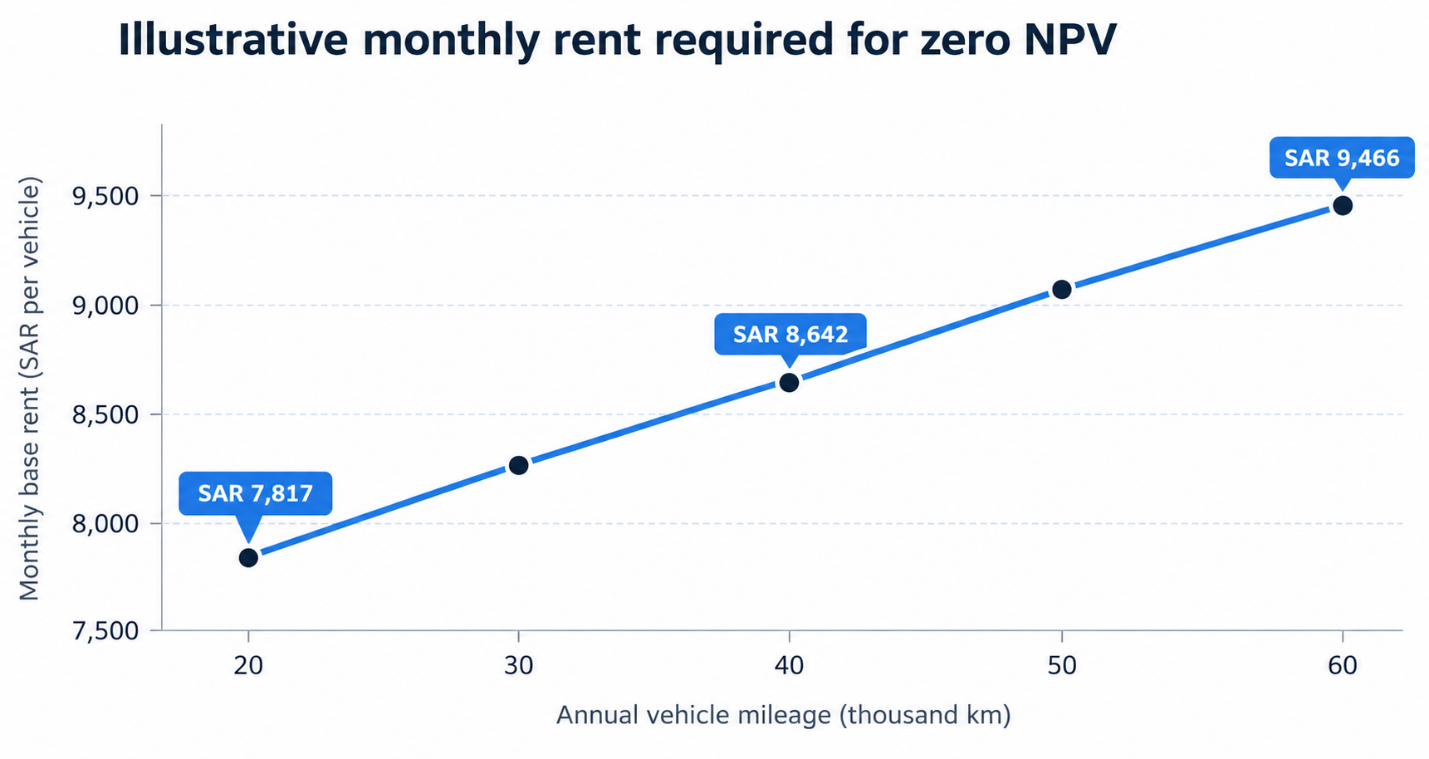
Here's a transparent example of how the framework works in terms of pricing, without any pretence of being market research. Take a single vehicle with an acquisition and commissioning cost of SAR 200,000, a 36 month lease, a very low hurdle rate of 10% per annum, fixed operating support of SAR 17,000 per year, an admin allowance of SAR 350 per month, a residual value of SAR 58,000 and a collection factor of 97%. Let the usage linked servicing cost be SAR 0.48 per km. These are all hypothetical teaching inputs, not actual Saudi figures or quotes. Finance is captured via discounting and is not subtracted again. The figure shows the implied monthly zero NPV rent for three different mileage scenarios, derived from the above assumptions.
The point of the example is to show the direction and size of the sensitivity within a fully specified accounting identity. As annual km increases the flat rental becomes less protective in the face of incremental wear not being charged to the user. A higher predicted residual value will reduce the initial rental required, but will expose the supplier to a greater shortfall later on. A worse collection factor will increase the rental required from the accounts that are expected to pay. The whole point of the exercise is to allow the operator to substitute in the actual portfolio estimates and thus provide a link between the contract approval and the annual performance review. It is not a statement that the rental shown is the optimal current market price.
Scenario governance should look at at least a base case, a combined deterioration case and an operationally favourable case. The adverse case should have the correlated elements of slower collections, increasing maintenance cost and lower disposal value. If you just vary each input in turn around an otherwise static base case you will tend to under-estimate the financial impact of deterioration occurring simultaneously. The other extreme is not to use an optimistic case to justify a fixed low rent without some evidence that the customer (or the lessor) can in fact achieve the required level of productivity improvement. For each significant driver you should record who the assumption owner is, how often it is updated and what the intervention threshold is.
11Discussion and theoretical contribution
The literature supports three interrelated views. Firstly, commercial leasing is a lifecycle investment decision where the uncertainty of asset value, customer behaviour and the operating service cannot be priced in any meaningful way in isolation. The literature on vehicle residual values and default probabilities provides us with a range of different analytical tools [1–5] but the point is that you can't take any one of those and use it as a substitute for a proper residual forecast or for a proper approval score. Secondly, vehicle operation is not external to lease profitability. Maintenance scheduling, telematics and fleet allocation all have an impact on the cost and condition of the asset which is embedded in the rental floor [14,15,19,20,30]. Thirdly, governance is what determines whether the useful analytics actually result in enforceable and fair outcomes. The model is of no use if the adjustment rights are not clearly defined or if the data on which a claim is based cannot be independently verified.
The synthesis also goes some way to dispelling the notion that risk-adjusted pricing has to equate to indiscriminately high pricing. With better segregation of cost drivers you can in fact offer lower quotes to customers and routes that are genuinely predictable, whilst still maintaining the appropriate risk protections for those that are harder to monitor. An agreement which is underpinned by verifiable mileage reporting, prompt payment and a sensible return arrangement could in fact merit a lower risk loading than an equivalent agreement which is opaque in terms of its vehicle characteristics. That said this is all perfectly compatible with the digital logistics capabilities that are emerging in Saudi Arabia [6–10] as long as the procurement and ops teams can get their hands on the right information. The technology improves the observability, it doesn't change the economics of a bad deal.
A second contribution is the explicit treatment of reciprocal flexibility. Lessor profits can be improved through greater utilisation, but the lessee's demand volatility will have legitimate requirements for flexibility. Rigid contracts can result in under-utilised vehicles, disputed termination fees and ultimately credit stress. Unlimited flexibility pushes all of the capacity risk back to the lessor. The appropriate solution is option-like rights: agreed quantity bands, substitution charges, notice periods and clear early exit calculations. Ko's residual value option approach [2] is in principle consistent with this contractual interpretation although the present paper does not claim to have valued such options empirically. Future work should value these rights using actual contract histories rather than assume a single flexibility premium.
12Research limitations and future directions
This is of course a very limited review given the dearth of publicly available Saudi B2B leasing contract level cash flow data. The evidence base is drawn from related areas of research including passenger vehicle finance, other countries' commercial fleets and joint freight. The mechanisms are informative but the quantitative impact may not be transferable across vehicle type, legal system or market structure. The selection of 30 recent DOI identifiable papers provides a reasonable basis for the synthesis rather than any claim that all relevant work has been captured. This is not a legal opinion, not a causal field study, not an econometric estimation and not a real world optimisation exercise. It is a decision framework which will need to be locally calibrated, not a validated forecasting engine.
Future research should link the anonymised lessee repayment records to maintenance events, odometer trajectories, asset inspection records and realised auction proceeds. Hierarchical models could be used to estimate class-specific residual value distributions whilst allowing for regional heterogeneity. Survival analysis could be used to improve the timing of default estimates and portfolio stress tests could be used to quantify the dependence between arrears and the resale market. A second research stream should be concerned with the behavioural effects of specific clauses via matched contract comparisons (e.g. does a capped mileage band reduce disputes without increasing the level of opportunistic wear?). A third research stream should assess whether data sharing provisions can improve the quality of maintenance planning whilst still respecting the commercial confidentiality of the data. All of the empirical extensions would of course require explicit consent, secure record linkage and a clearly defined counterfactual.
13Conclusion
Profitable commercial vehicle leasing is all about getting the pricing right in conjunction with the appropriate level of operational responsibility and the right contractual structure throughout the life of the asset. A lease that looks good on paper at the outset can end up being a poor performer if you don't account for maintenance, recovery costs and the uncertainty of disposal. Conversely a high rent can be equally unattractive to the right type of customer if you've double-counted the risks. The review sets out a coherent pricing floor, separates out the principal risk streams and maps each of those to the information that is available and the controls that can be negotiated. The key finding is of a methodological nature: a sensible contract looks at the customer, the vehicle, the utilisation profile and the end of term disposition as a package rather than treating depreciation and credit risk as two separate percentage add-ons.
For the Saudi lessee businesses the immediate managerial priority is not some sophisticated predictive system but rather disciplined information architecture. You need reliable cost histories, contract level profitability reporting, documented residual assumptions and standardised return inspection. You can then go on to do more sophisticated optimisation once the records are in place to support the estimation. For the business customer you want transparent service definitions, transparent condition standards and proportionate adjustment rights so that the risk of apparent savings becoming actual disruption is reduced. The result is a framework that can be used as the basis of a testable B2B agreement that will enable private investment to be made, that will support the quality of the logistics service and that will underpin commercial resilience through successive fleet renewal cycles. It's all very well in theory but it's only as useful as it is validated against actual results.
References
- [1]Zhu J, Zhao Y, He P. Understanding the impacts on automobile leasing firm loss in China: an analysis of vehicle residual value risk and lease price patterns. Journal of Corporate Accounting & Finance. 2025;36(2):42–54. https://doi.org/10.1002/jcaf.22755
- [2]Ko SB. Real option valuation using Weibull distribution: a new framework for depreciation risk management. Journal of Derivatives and Quantitative Studies. 2025;33(2):110–130. https://doi.org/10.1108/JDQS-10-2024-0041
- [3]Chang YC, Chang KH, Chen WT. Vehicle leasing credit risk assessment modeling by applying extended logistic regression. Journal of Intelligent & Fuzzy Systems. 2023;45(4). https://doi.org/10.3233/JIFS-231344
- [4]Kozina A, Kuźmiński Ł, Nadolny M, et al. The default of leasing contracts prediction using machine learning. Procedia Computer Science. 2023;225:424–433. https://doi.org/10.1016/j.procs.2023.10.027
- [5]Kim M, Choi J, Kim J, et al. Trustworthy residual vehicle value prediction for auto finance. Proceedings of the AAAI Conference on Artificial Intelligence. 2023;37(13). https://doi.org/10.1609/aaai.v37i13.26842
- [6]Alharbi A, Cantarelli C, Brint A. Crowd models for last mile delivery in an emerging economy. Sustainability. 2022;14(3):1401. https://doi.org/10.3390/su14031401
- [7]Alasmari T, Alzahrani A. Saudi Arabia’s shifts towards green and sustainable logistics: bibliometric and machine learning-based insights and forecasts. Journal of Cleaner Production. 2025;509:145577. https://doi.org/10.1016/j.jclepro.2025.145577
- [8]Mutambik I. Digital transformation as a driver of sustainability performance: a study from freight and logistics industry. Sustainability. 2024;16(10):4310. https://doi.org/10.3390/su16104310
- [9]Alattas MI. The impact of technology on logistics services in Saudi Arabia. Archives for Technical Sciences; 2024. https://doi.org/10.70102/afts.2024.1631.379
- [10]Alhujaili R, Albaqami M, Aboulola O, Khayyat M. E-government implementation’s impact on Saudi Vision 2030 to become an international logistic center. International Journal of Informatics and Communication Technology. 2023;12(2):180–187. https://doi.org/10.11591/ijict.v12i2.pp180-187
- [11]Gil Ribeiro C, Silveira S. The impact of financial incentives on the total cost of ownership of electric light commercial vehicles in EU countries. Transportation Research Part A: Policy and Practice. 2024;179:103936. https://doi.org/10.1016/j.tra.2023.103936
- [12]Sendek-Matysiak E, Pyza D, Łosiewicz Z, Lewicki W. Total cost of ownership of light commercial electrical vehicles in city logistics. Energies. 2022;15(22):8392. https://doi.org/10.3390/en15228392
- [13]Awan MA, Scorrano M. The cost competitiveness of electric refrigerated light commercial vehicles: a total cost of ownership approach. Future Transportation. 2025;5(1):10. https://doi.org/10.3390/futuretransp5010010
- [14]Favier JC, Ganguly S, Shalpegin T. Optimal fleet policy of rental vehicles with relocation: a simulation study. Journal of Advanced Transportation. 2024;2024:7764326. https://doi.org/10.1155/2024/7764326
- [15]Aghazadeh D, Ertogral K. A fix and optimize method based approximate dynamic programming approach for the strategic fleet sizing and delivery planning problem. Central European Journal of Operations Research. 2025;33:91–119. https://doi.org/10.1007/s10100-024-00911-6
- [16]Li M, Bolumole YA, Miller JW. Antecedents of spot and contract freight mix in the truckload sector. Transportation Journal. 2022;61(4):331–368. https://doi.org/10.5325/transportationj.61.4.0331
- [17]Asgharieh Ahari S, Bakir I, Roodbergen KJ. A new perspective on carrier collaboration: collaborative vehicle utilization. Transportation Research Part C: Emerging Technologies. 2024;163:104647. https://doi.org/10.1016/j.trc.2024.104647
- [18]Wang S, Sun W, Baldacci R, Elomri A. Exact solution of location–routing problems with heterogeneous fleet and weight-based carbon emissions. Transportation Research Part E: Logistics and Transportation Review. 2025;193:103862. https://doi.org/10.1016/j.tre.2024.103862
- [19]Markudova D, Mishra S, Cagliero L, et al. Preventive maintenance for heterogeneous industrial vehicles with incomplete usage data. Computers in Industry. 2021;130:103468. https://doi.org/10.1016/j.compind.2021.103468
- [20]Wang Y, Limmer S, Nguyen DV, et al. Optimizing the maintenance schedule for a vehicle fleet: a simulation-based case study. Engineering Optimization. 2022;54(7):1258–1271. https://doi.org/10.1080/0305215X.2021.1919888
- [21]Bone-Winkel GF, Reichenbach F. Improving credit risk assessment in P2P lending with explainable machine learning survival analysis. Digital Finance. 2024;6:501–542. https://doi.org/10.1007/s42521-024-00114-3
- [22]Hou L, Lu K, Bi G. Predicting the credit risk of small and medium-sized enterprises in supply chain finance using machine learning algorithms. Managerial and Decision Economics. 2024;45(4):2393–2414. https://doi.org/10.1002/mde.4130
- [23]Gu Z, Lv J, Wu B, Hu Z, Yu X. Credit risk assessment of small and micro enterprise based on machine learning. Heliyon. 2024;10(5):e27096. https://doi.org/10.1016/j.heliyon.2024.e27096
- [24]He K, Jia H, Mu Y, et al. Leasing business model for truck mobile charging stations: from the view of operators. IEEE Transactions on Transportation Electrification. 2025;11(4):8811–8823. https://doi.org/10.1109/TTE.2025.3557026
- [25]Urban L, Baur A, Soppert M, Steinhardt C. Scale matters: why the efficiency of free-floating vehicle sharing systems depends on the system’s scale. Transportation Research Part C: Emerging Technologies. 2025;178:105169. https://doi.org/10.1016/j.trc.2025.105169
- [26]Xiao L, Zhang J, Wang C, Han R. Optimal fleet replacement management under cap-and-trade system with government subsidy uncertainty. Multimodal Transportation. 2023;2(2):100077. https://doi.org/10.1016/j.multra.2023.100077
- [27]Padmanabhan B, Huynh N, Ferrell W, Badyal V. Evaluation of three collaboration and profit sharing methods for carriers in pickup-and-delivery problems. Multimodal Transportation. 2023;2(2):100066. https://doi.org/10.1016/j.multra.2022.100066
- [28]Suhadolnik N, Ueyama J, Da Silva S. Machine learning for enhanced credit risk assessment: an empirical approach. Journal of Risk and Financial Management. 2023;16(12):496. https://doi.org/10.3390/jrfm16120496
- [29]Almatar KM. Smart transportation planning and its challenges in the Kingdom of Saudi Arabia. Sustainable Futures. 2024;8:100238. https://doi.org/10.1016/j.sftr.2024.100238
- [30]von Glehn FR, Gonçalves BHP, Fagundes Neto MG, Fonseca JPS. Telematics and machine learning system for estimating the load condition of a heavy-duty vehicle. Procedia Computer Science. 2024;232:2616–2625. https://doi.org/10.1016/j.procs.2024.02.080