Android Application Development
TRANSFLOW: An Android-Based Application for Coordinating Cement Transportation
Department of Computer Science and Engineering, SGIPO Polytechnic
Published November 2026
Abstract
TRANSFLOW is a web-based application that simplifies coordinating transport of cement between dealers, drivers and transporters. Traditional cement transportation can cause issues with communication, delays in deliveries and issues with keeping track of orders. The system created will provide all cement transportation delivery functions in one place. Dealers will be able to create orders for cement with details like how much cement they need, where to pick up and where to deliver. New orders will be shown on the transporter's dashboard and on all drivers' dashboards. Drivers will then be able to see any available orders and accept or reject them. The transporter will have visibility of any orders throughout the day and also be able to manage the drivers. The driver responses will be recorded and the order status will be updated. Notification will be sent to dealers, transporters and receiver.
The delivery will have visibility of the status and location via GPS. Orders, vehicles, drivers and completed deliveries will be kept on file. The application will be developed using React. The server will be using Node.js and Express.js. The data will be stored using MySQL. Google Maps API and GPS/Geolocation will be used. This system will reduce manual coordination of orders and provide better information sharing. The application will also help keep orders and deliveries well organised. Having orders in one place will increase transparency between all three parties. The application will provide a realistic solution to cement logistics. Overall this application will help improve co-ordination, visibility and efficiency of transporting cement.
Keywords: TRANSFLOW; Cement Transportation; Delivery Coordination; Order Management; Driver Assignment; GPS Tracking; React; Node.js; Express.js; MySQL
1Introduction
Cement transportation is an important part of the construction industry as cement needs to be transported to the right place at the right time. Dealers rely on a good transport system so they can fulfill customer orders. There are many processes involved in transporting cement. This includes ordering, getting vehicles, co-ordination with drivers, tracking deliveries and confirming deliveries. If this is done manually it can become complex when there are multiple orders and drivers. Many systems will use phone calls, messages and manual records. This can cause confusion, issues with tracking orders, delays with updates and issues with knowing which drivers are available. Keeping track of delivery requests and completed deliveries can also become time consuming. Implementing a digital system will help with these issues.
TRANSFLOW: Cement Transportation and Delivery Coordination is a web-based application that will help organise cement transportation. The system will bring all three parties (dealers, drivers and transporters) together in one place. This will help simplify orders, improve communication and give visibility of the transportation. The dealers section will allow dealers to create orders for cement deliveries. They can add details like how much cement they need, where to pick up, where to deliver and further information. Once the order has been placed it will be stored in the database. The order will be shown on the transporter's dashboard and on all drivers' dashboards. This will allow drivers to see any delivery requests.
The drivers section will allow drivers to see any available orders. They will then be able to accept or reject the order. This will be recorded and the order details will be updated. As multiple drivers will view the order, only one driver can be assigned. This will prevent conflicts. Any orders that have been rejected will still be available for other drivers to consider. The transporters section will allow them to see any orders throughout the day. They will have full visibility of the orders, know the order status, driver responses and confirmed assignments. This means transporters will have visibility of the transportation. It also allows them to have a clear view of any pending, accepted, rejected, assigned and completed orders.
2Problem statement
Transporting cement plays a huge role in the construction industry as they need to transport the required amount of cement in a timely manner. Using traditional methods of communication can cause some issues for the dealers, drivers and transporters. They often use phone calls and text messages to communicate.
Dealers may struggle to place orders, assign drivers and find out the status of their orders. They’ll have to constantly ask the transporters if they’ve had a driver assigned or if the cement has been delivered.
Transporters may run into issues when there are multiple orders for delivery. Keeping track of orders, driver availability, assigning drivers and tracking the delivery status can take up a lot of time. If multiple drivers have responded to the same delivery request confusion can occur as there isn’t any system to assign drivers. Keeping multiple separate records can also cause issues when trying to find specific information.
Drivers may not get orders in a structured way. They’ll have to rely on phone calls or texts to get information regarding the order. This can make it hard to see what orders are available, what their availability is and get clear information on what deliveries they have.
A major issue is the lack of centralised order information. Information may be inconsistent when being passed between different communication channels. Not knowing when you’ve been updated or delays in getting important information can occur. Without a good system to track the delivery status (picked up, on the way, delivered) it can be difficult. Manually keeping track of past orders can add extra work.
The solution to this issue is TRANSFLOW: Cement Transportation and Delivery Coordination Application. This is a centralised mobile application that allows dealers to create orders for delivery. The orders include information such as how much cement they want, where they want it picked up from and where they want it delivered to. These orders will then appear on the transporter's and registered drivers' dashboards. Drivers will be able to accept or decline orders that are available to them. The system will also only assign one driver per order. Transporters will be able to manage their orders, driver information and allocation. Dealers will be notified when drivers have been assigned. Updates on delivery status will also be provided.
Overall the main issue with this scenario is the lack of coordination relating to cement deliveries due to the lack of connection and manual processes. The application will bring all parties together on one platform, improve communication, reduce confusion when assigning drivers and keep delivery records organised. This provides a basis for a more systematic, transparent and convenient way of transporting cement.
3Literature review
3.1Vehicle routing/capacity
Research has been done into vehicle routing and capacity. Cement Transportation [1] looks at allocating demand considering the limited number of vehicles. Lyu et al. [2] looks at creating a working time aware scheduling framework considering capacity constraints in urban logistics. Considering the number of vehicles and capacity is important. This is considered in TRANSFLOW when allocating orders. However, advanced route optimisation is not included.
3.2Driver/order allocation
Having an efficient system to allocate drivers/orders will help prevent duplication. [1] looks at allocating demand considering fleet resources. [2] looks at considering operational constraints. TRANSFLOW uses a first come first served method. Only unallocated orders will be allocated. Any pending requests will be closed to prevent duplication. This will be validated using the backend/database.
3.3Integrated logistics
Integrated logistics looks to provide information and efficient dispatching for transport. [3] looks at dynamic dispatching using real time information. [5] looks at the importance of digital technologies in supply chains. TRANSFLOW looks to provide visibility of orders, driver responses, vehicle allocation and delivery updates in a centralised mobile application. However, advanced dynamic transport is not included.
3.4Dispatch/weighing information
Accurate dispatch information is important to keep cement transportation reliable. [4] looks at using Machine Learning techniques to predict weighing variations. [1] looks at allocating demand considering available vehicles. TRANSFLOW tracks order details, driver information, vehicle allocation and delivery status. Weighbridge integration and predicting weighing using Machine Learning is not included.
3.5Mobile visibility/location/notifications
Using digital technologies and location will help with communication. [3] looks at integrating technology for dynamic dispatching. [5] looks at the importance of sharing digital information in supply chains. TRANSFLOW looks to use a mobile application. This helps manage orders, driver acceptances, visibility using GPS and delivery status. The location will be linked to any active orders and will be visible to authorised users.
3.6Overall literature review
Studies have been looked at and key factors have been discussed. These include limited fleet availability, vehicle scheduling, order allocation, weighing and information. These are generally considered individually. TRANSFLOW looks to bring dealers, drivers, vehicles and orders together in a centralised mobile application. The main contributions of this project are helping with vehicle availability, consistent order allocations, visibility, notifications and delivery. This provides a realistic solution to improve cement transport.
4Comparison table
Table 1 compares the current manual process of cement transportation with the proposed TRANSFLOW system.
| No. | Feature | Current System | TRANSFLOW System |
|---|---|---|---|
| 1 | Order Creation | Orders placed through calls or texts. | Dealers create orders with delivery details. |
| 2 | Order Information | Details entered manually. | Quantity, pickup, and delivery details stored digitally. |
| 3 | Order Request | Drivers contacted through calls or texts. | Drivers view available orders on their dashboard. |
| 4 | Driver Availability | Transporters check availability manually. | Drivers respond based on their availability. |
| 5 | Driver Allocation | Multiple replies may cause confusion. | Only one driver is assigned per order. |
| 6 | Order Confirmation | Dealers contact transporters for confirmation. | Dealers receive driver-allocation notifications. |
| 7 | Order Management | Orders and drivers managed manually. | Transporters manage orders and drivers through a dashboard. |
| 8 | Communication | Mainly calls and text messages. | Order details and notifications are centralized. |
| 9 | Delivery Updates | Updates shared manually. | Drivers update Pickup, In Transit, and Delivered status. |
| 10 | Vehicle Location | Location is not easily available. | Optional GPS tracking can show vehicle location. |
| 11 | Order History | Records maintained manually. | Order and delivery details stored digitally. |
| 12 | Information Access | Details may be scattered. | Information is accessible through the application. |
| 13 | Time Management | Repeated calls can waste time. | Structured order handling reduces repeated communication. |
| 14 | Error Reduction | Manual work may cause errors. | Digital records and controlled allocation help reduce errors. |
| 15 | Future Growth | Manual management becomes harder as orders increase. | Future updates can support more users and features. |
5Research gap
Table 2 summarises the problem or research gap addressed in each reviewed study and the corresponding TRANSFLOW approach.
| Reference | Problem / Research Gap | TRANSFLOW Approach |
|---|---|---|
| [1] Cement Transportation Limited-Fleet Modeling | Challenges in fleet allocation and meeting transportation demand. | Organizes cement orders and supports driver assignment. |
| [2] Courier Working Time Aware Scheduling | Driver working-time and vehicle-scheduling constraints. | Supports driver-based order coordination and acceptance. |
| [3] Dynamic Dispatching and Transport Optimization | Need for coordination under changing dispatch conditions. | Provides order-status updates and notifications. |
| [4] Predicting Weighing Deviations | Weighing deviations during cement dispatch. | Centralizes cement-order and dispatch-related information. |
| [5] Supply Chain Management and Physical Internet | Need for information sharing and supply-chain integration. | Enables mobile-based communication among dealers, drivers, and transporters. |
6Proposed work
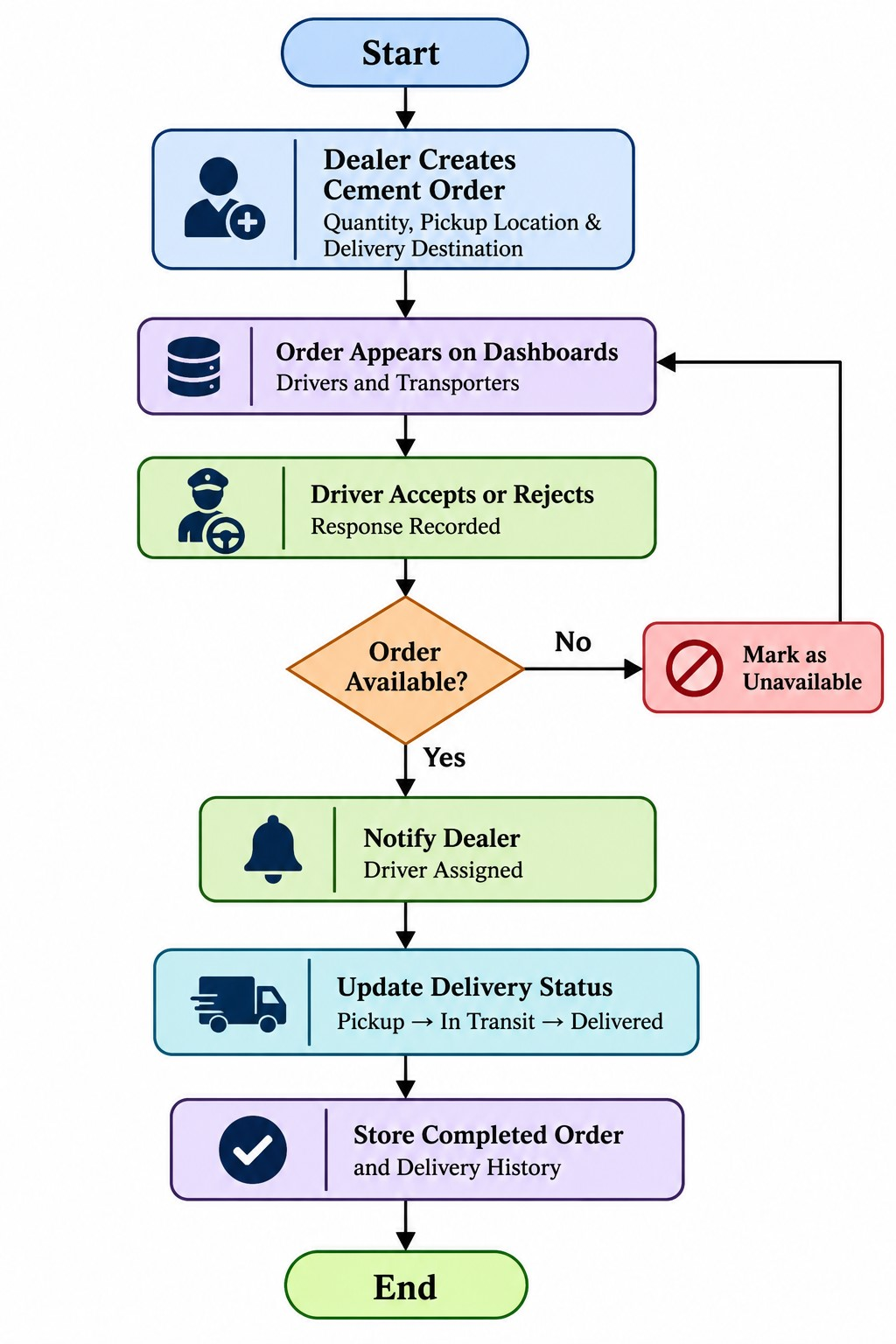
The TRANSFLOW application can be developed as an Android App using the Java language. The system will allow a good flow between dealers, drivers and transporters to allow an easy way to manage cement deliveries. The overall workflow of the application is shown in Figure 1.
6.1Create order
Orders can be created by a dealer. The dealer will add in information such as the amount of cement, pick up and drop off points, and any additional information they need to know about the delivery. Mandatory fields will be checked and once the dealer submits the order a unique order will be created.
6.2View order
The order will then be visible on the dashboards. Registered drivers will be able to view the orders available and understand what is needed for the order. Transporters will also be able to view all orders.
6.3Accept/reject orders
The driver will be able to accept or reject the order through the dashboard. This will be recorded and show which driver has responded. This will allow transporters to see which drivers have shown interest in the order.
6.4Assign driver
Once the driver has accepted the order the system will check that the order has not been assigned to another driver. If it has not been assigned then the driver will be confirmed. Only one driver will ever be assigned to an order. Any other requests for this order will be closed or set to unavailable. This will stop multiple drivers being assigned.
6.5Notification
Once the driver has been assigned, the dealer will receive a notification showing the driver's details. Transporters will also be able to see who has accepted and what the order status is. This keeps the users updated without having to constantly message/call.
6.6Update order status
As the driver arrives at the pickup location the order status can be set to ‘Pickup’. Once the cement has been picked up the order status will change to ‘In Transit’. Once the cement has been delivered, the driver can update the order to ‘Delivered’. The dealer and transporters will know how the delivery is progressing. All order details will be stored digitally.
6.7GPS
Including GPS in the application will link the driver's location updates to the delivery. This could help show where the vehicle is. However, the application must clearly show why the location is not available. This could be because there are no permissions, GPS switched off or a network issue. The delivery status should be easy to understand.
6.8Overview
The application will largely consist of the mobile application. There will be order and driver assignment logic. The main programming language will be Java. The backend, database, authentication, mapping and notifications will be decided upon.
6.9Secure orders & accurate assignment
Orders will be secure to ensure no two drivers get assigned to the same delivery. This will need to be managed through the backend or database. All order details and driver responses should be accurate to allow transporters to see how the order was assigned.
6.10Order history
Once an order has been completed all order details and delivery status will be stored. The dealer and transporters will be able to look back at previous delivery details. Having everything digitally will make it easier to look back at completed orders.
7Conclusion
This project intends to provide a more systematic, clear and convenient method for transporting and managing cement using a mobile application. It enables a unified platform for dealers, drivers and transporters to reduce constant manual communication between the parties and makes the overall ordering process easier to manage.
Dealers can request deliveries by entering the order details. Registered drivers can then see what orders are available and accept or decline the orders. Transporters can keep track of orders, manage driver responses and assign the orders. Once an order is accepted by a driver, the dealer will receive notification that they have been assigned to a driver. This keeps everyone informed and will reduce any confusion when assigning orders.
The application allows for a systematic method of keeping track of deliveries. The order can be updated to show if the order has been collected, in transit or delivered. Keeping a record of orders digitally and tracking the delivery history can make it easier to look back on previous orders. If GPS tracking is included this can help to keep track of vehicles.
Overall this application provides a practical solution to improving communication and coordination during the transportation of cement. It unifies all important parts of the delivery process in one place. However, its effectiveness can only be established once it has been implemented and tested and user feedback and performance data have been gathered.
In the future this application can be improved by including intelligent routing, better GPS tracking, estimated delivery times, delivery reports and performance tracking. With more security features, it can support more users which will increase the reliability. Overall this application has the potential to become a more complete and reliable solution for transporting cement.
8Future scope
The application can be improved in the future by adding extra features to improve the ease, safety, and efficiency of transporting cement. For example, the app can be tested using various drivers to see whether it can efficiently assign only one driver to an order. This can then be assessed by seeing how quickly notifications are sent, how quick the app works, how accurate the GPS is and the user experience.
More security can be added to protect the data being stored. This includes using secure storage and using roles to ensure dealers, drivers, and transporters can only see information that is relevant to them. The GPS can be improved to give more accurate information on deliveries and ensuring the location can only be seen by authorised users. Keeping the information up to date on how much capacity each vehicle has can help to choose the right vehicles for different cement orders.
Long term, adding features such as delivery reports, order history, estimated delivery times and supporting more users will make TRANSFLOW more useful. This can help to create a dependable and scalable application for managing cement transportation.
References
- [1]Mashhadi Bandani N, Naderi A, Akbarpour Shirzaei M. Cement transportation limited-fleet modeling and assigning to rated demands. Transport Problems. 2017;12(1):111–123. https://doi.org/10.20858/tp.2017.12.1.11
- [2]Lyu W, et al. Courier working time aware vehicle scheduling for efficient urban logistics [Internet]. IEEE; 2025. Available from: https://ieeexplore.ieee.org/document/11176971
- [3]Greenwood D, Dannegger C, Dorer K, Calisti M. Dynamic dispatching and transport optimization – real-world experience with perspectives on pervasive technology integration. In: Proceedings of the 42nd Hawaii International Conference on System Sciences (HICSS); 2009; Waikoloa, HI, USA. p. 1–9. https://doi.org/10.1109/HICSS.2009.168
- [4]Barros J, Cunha F, Martins C, Pedrosa P, Cortez PC. Predicting weighing deviations in the dispatch workflow process: A case study in a cement industry. IEEE Access. 2023;11:8119–8135. https://doi.org/10.1109/ACCESS.2022.3232299
- [5]Cortes-Murcia DL, Guerrero WJ, Montoya-Torres JR. Supply chain management, game-changing technologies, and physical internet: A systematic meta-review of literature. IEEE Access. 2022;10:61721–61743. https://doi.org/10.1109/ACCESS.2022.3181154