Electrical Engineering
Optimizing Medium- and Low-Voltage Electrical Distribution Systems for Sustainable Infrastructure Development in Saudi Arabia
Published November 2026
Abstract
Medium- and low-voltage (MV/LV) networks are fundamental to reliable and affordable infrastructure in Saudi Arabia. Their design must simultaneously address demand growth, harsh ambient conditions, power quality, safe fault clearance and integration of new distributed energy resources. This structured narrative review examines engineering strategies for optimising distribution architecture, transformer deployment, cable sizing, voltage regulation, protection coordination and digital monitoring. Peer-reviewed and institutional evidence is interpreted alongside the Saudi Electrical Code (SBC 401), international electrical-installation standards and the objectives of Saudi Vision 2030. The review develops a decision framework in which lifecycle cost, technical losses, service continuity and regulatory compliance are evaluated together rather than sequentially. Distinctions are drawn between the MV supply system and LV installation, between design constraints and optimisation objectives, and between simulated performance and measured outcomes. An illustrative comparison demonstrates the type of trade-offs that can arise when capital expenditure is balanced against losses and resilience; its indices are hypothetical and not field measurements. The synthesis indicates that early load characterisation, scenario-based network modelling, selective redundancy, correctly coordinated protection and meter-supported commissioning can improve the quality of investment decisions. Benefits depend strongly on project topology, climatic exposure, operational discipline and verified local parameters. A staged implementation roadmap is proposed for Saudi airports, industrial estates, healthcare buildings and mixed-use developments.
Keywords: medium-voltage distribution; low-voltage networks; electrical optimisation; technical losses; reliability; protection coordination; smart infrastructure; Saudi Arabia; Vision 2030
1Introduction
Electricity infrastructure underpins the safety, productivity and long-term sustainability of urban districts, industrial campuses, airports and public buildings. In Saudi Arabia, the development of new infrastructure creates a design challenge that cannot be reduced to selecting the cheapest transformer or shortest cable route. Electrical assets must carry changing loads through substantial service lives, withstand demanding environmental conditions and allow safe extension as occupancy and equipment requirements evolve. The Saudi Electrical Code defines essential expectations for electrical systems, including installation safety, distribution equipment, earthing, wiring and appropriate load identification (Saudi Building Code National Committee, 2024).
MV networks commonly distribute bulk power from utility or private substations to local transformers, while LV networks provide the final supply to building boards, motors, lighting, controls and increasingly electric-vehicle charging or distributed photovoltaic interfaces. Poor coordination between the two levels can cause avoidable losses, voltage drop, nuisance operations and excessive capital expenditure. A locally optimised LV feeder, for example, may merely transfer congestion to a poorly positioned transformer; equally, an oversized MV arrangement can impose unnecessary equipment and maintenance costs. Engineering optimisation therefore requires a system boundary broad enough to capture interactions between supply, conversion, distribution and demand.
Saudi Vision 2030 places energy diversification, infrastructure performance and resource efficiency among national development priorities. The national electricity strategy also envisages a growing contribution from renewable generation, making the management of voltage, protection settings and bidirectional flows increasingly significant (Kingdom of Saudi Arabia, 2025; International Energy Agency, 2026). The present review considers how distribution design can contribute to these objectives without presenting national policy targets as proof of project-level energy savings.
The aim is to synthesise practicable methods for improving MV/LV distribution systems in Saudi developments. The objectives are to identify recurrent network-design trade-offs; examine loss, voltage, fault and reliability assessment methods; construct an integrated optimisation framework; and formulate implementation priorities that connect engineering studies with construction delivery, commissioning and maintenance.
2Literature review
2.1Distribution architecture and spatial planning
Topology determines the available balance between cost, simplicity, sectionalisation and continuity. Radial arrangements are generally economical and straightforward to protect but can expose downstream loads to an upstream interruption. Open-ring MV configurations offer alternative restoration routes when appropriate switching facilities and spare capacity are available. Interconnected or meshed arrangements may enhance service continuity, yet introduce more complex fault-current and operational considerations. The selection cannot be made solely by counting feeders: geographical spread, service criticality, cable routes, spare capacity and operator procedures shape the preferred configuration.
The siting and number of MV/LV transformers have direct consequences for LV conductor length, feeder losses, switchgear footprint and future flexibility. Concentrating transformation can simplify maintenance while increasing the length of downstream feeders. Distributing smaller units nearer to load centres may reduce LV losses but add transformer no-load losses, civil works and maintenance interfaces. Appropriate studies compare complete system costs under representative daily and seasonal loading, rather than judging transformer efficiency only at rated load (IEC, 2011; ISO, 2017).
2.2Demand forecasting and diversity
Accurate design begins with transparent demand assumptions. Connected load is not equivalent to diversified maximum demand: lighting, cooling, vertical transportation, process equipment, data systems and standby loads have different coincidence profiles. Underestimating diversity can overload conductors; excessive conservatism can lead to unnecessarily large equipment and poor transformer loading. Designs should distinguish firm demand, intermittent loads, starting currents, critical loads and feasible future increments. For airports and industrial developments, phases of occupation and commissioning must be modelled separately.
Climate-sensitive load profiles deserve particular attention. High ambient temperature influences air-conditioning demand and can reduce cable ampacity or transformer thermal margin, depending on installation and equipment characteristics. Cable grouping, soil conditions, underground ducting and enclosure ventilation also affect permissible loading. These factors are engineering inputs, not generic correction factors that can be transferred unchanged between sites. The IEC wiring-system requirements emphasise selection and installation conditions, including cable sizing and voltage-drop considerations (IEC, 2024a).
2.3Technical losses and conductor sizing
Electrical losses have both immediate energy consequences and lifetime financial implications. Resistive conductor loss increases approximately with the square of current for a given resistance. A small reduction in feeder current can therefore be meaningful where loads remain high for long durations, but the monetary value depends on tariffs, load factors and operating hours. Increasing cable cross-sectional area reduces resistance while raising material, installation and termination costs. Optimisation must identify an economic conductor size that also satisfies thermal, short-circuit and voltage-drop constraints.
Transformer selection likewise involves a trade-off between no-load and load-dependent losses. Comparing alternative units solely by purchase price overlooks the time value of energy losses and the consequences of operating at low load for extended periods. Proper comparison requires manufacturer loss data, forecast utilisation, discount assumptions, replacement timing and expected service life. Where expansion is uncertain, modular transformer capacity or space provision can reduce the risk of paying for unused capacity.
2.4Voltage profile and power quality
Voltage at a remote LV load is affected by feeder impedance, current, power factor and upstream regulation. Excessive voltage drop can reduce equipment performance, while sustained overvoltage can stress connected devices. Power factor correction may reduce upstream reactive current when appropriately engineered; poorly selected compensation can interact with harmonic-producing equipment or create switching transients. Variable-speed drives, converters and electronic loads can generate harmonics that require dedicated assessment rather than reliance on average power factor values.
Power-quality evaluation should address unbalance, harmonics, dips, swells, interruptions and related phenomena using an explicitly defined measurement method. IEC 61000-4-30 specifies comparable measurement approaches for these parameters (IEC, 2025a). Network modelling must also capture emergency generator operation, transfer events and starting scenarios when these influence sensitive systems. The most effective mitigation may be load redistribution, improved circuit separation, filtering or revised equipment specification rather than blanket installation of compensation devices.
2.5Fault levels, protection and safety
Reliability is inseparable from the correct detection and isolation of faults. MV switchgear interrupting ratings, transformer impedance and LV short-circuit withstand capabilities must be checked against credible operating configurations. The IEC 60909 methodology provides a structured basis for short-circuit-current calculation, while IEC 60364-4-43 addresses protection against overcurrent in LV electrical installations (IEC, 2026; IEC, 2023a). A study is incomplete if it checks maximum fault current for equipment duty but ignores minimum fault current and the resulting protection operating time.
Selective coordination aims to disconnect the smallest practical part of the system without compromising safety. Settings must be evaluated for utility supply, generator supply, operating transfers and future network changes where relevant. Earthing design, fault-loop impedance, protective bonding and shock protection remain mandatory constraints. Any optimisation that reduces cost at the expense of permissible disconnection time, appropriate equipment ratings or safe access cannot be accepted as a feasible solution.
2.6Renewable generation and digital operations
Rooftop solar installations, energy storage, inverter-based equipment and managed EV chargers alter distribution-system behaviour. Load profiles may become bidirectional; fault contribution and voltage regulation may differ from those of conventional rotating machines. Interconnection studies should examine the point of common coupling, operating limits, power quality, islanding protection and coordination with the supply authority. IEEE 1547 provides internationally recognised guidance on distributed-energy-resource interconnection, although local Saudi utility and regulatory provisions take precedence for actual installations (IEEE, 2018).
Digital meters, supervisory control systems and condition-monitoring platforms can improve engineering decisions when their measurements are trusted and used operationally. Interval demand data support load-profile correction and transformer loading reviews; event records help investigate nuisance trips; thermal and status monitoring can inform preventive maintenance. Digitalisation is not itself an optimisation result: instrumentation requires defined accuracy, communication availability, cyber controls and a workflow for responding to anomalies.
3Research methodology
3.1Review design
This paper adopts a structured narrative and integrative review rather than a statistical meta-analysis. MV/LV design evidence combines installation codes, equipment standards, utility practices, simulation methods and project-level case studies with heterogeneous endpoints. The objective is to connect these evidence types into a reproducible decision framework, not to calculate pooled savings from incomparable projects. All project examples and performance indices used below are expressly illustrative.
3.2Sources and selection
Relevant material was identified from official Saudi Building Code and Vision 2030 publications, International Electrotechnical Commission and IEEE standards descriptions, the International Energy Agency and established power-engineering literature. Priority was given to contemporary regulations and standards with supporting foundational electrical-engineering methods where necessary. Search concepts included “medium-voltage distribution optimisation”, “low-voltage feeder sizing”, “loss minimisation”, “voltage drop”, “transformer placement”, “short-circuit coordination”, “power quality”, “distributed generation”, and “Saudi electrical code”.
Sources were retained when they informed at least one of five design domains: network architecture, energy efficiency, electrical safety, renewable integration or operational verification. Marketing statements without traceable methods, studies outside the relevant voltage-system boundary and numerical claims lacking context were not used as direct evidence of performance. National programmes were treated as policy context rather than demonstrations of specific network results.
3.3Analytical procedure
The review used thematic synthesis followed by engineering translation. First, each identified intervention was linked to its decision variables, such as cable size, transformer capacity, location, feeder topology, capacitor setting or protective-device selection. Second, constraints were classified as non-negotiable safety and compliance requirements or project-specific limits. Third, outcomes were grouped into capital cost, energy losses, reliability, voltage quality, maintainability and future adaptability. Finally, these relationships were arranged into a staged framework for feasibility assessment, modelling, procurement, commissioning and post-occupancy verification.
For a candidate design x, the conceptual multi-objective problem is to minimise discounted lifecycle cost and technical losses while controlling interruption risk, subject to thermal loading, acceptable voltage profile, equipment fault-duty and protection constraints. One possible scalar formulation is
where r is the chosen real discount rate and t indexes years. This is a decision-model expression, not a computed estimate for an actual Saudi site. Energy prices, incident costs and discount assumptions must be verified for each project.
3.4Reliability and limitations
Triangulation was sought between regulatory requirements, electrical standards and engineering logic. No private project data, utility load files or protection-study outputs were obtained; therefore, the paper cannot claim field-proven savings, improved SAIDI/SAIFI values or quantified carbon reductions. A formal database-screening count was not reconstructed. The methodology is suitable for conceptual synthesis and hypothesis formation, but a project-specific validation study would require documented demand records, calibrated network models and recorded outcomes.
4Results and discussion
4.1A sequential versus integrated design decision
A conventional project workflow often establishes a preliminary network configuration, sizes major equipment, obtains quotations and checks energy efficiency late in the design. This sequence can lock in transformer locations and cable routes before their financial and technical implications have been compared. An integrated process instead screens multiple feasible network configurations at concept stage, then repeats load-flow, fault and economic calculations after major design changes. Design teams can reject unsafe options early and compare remaining solutions under common demand scenarios.
The key finding of this synthesis is that there is no single universally optimal MV/LV arrangement. A design with low initial expenditure may have higher energy losses or vulnerability to single-point failures, whereas a resilience-oriented layout may justify greater capital investment for critical facilities. It is therefore useful to identify a set of feasible alternatives and document the decision rationale rather than rely on a single unexplained weighted score.
| Evaluation dimension | Minimum engineering test | Optimisation opportunity |
|---|---|---|
| Load and capacity | Peak, seasonal and staged demand; thermal ratings | Transformer utilisation and phased expansion |
| Voltage performance | Worst-case feeder voltage and power quality | Siting, conductor size, load balancing |
| Fault and protection | Maximum/minimum faults; discrimination | Selective isolation and equipment coordination |
| Losses and cost | Time-series copper and transformer losses | Lifecycle conductor and transformer selection |
| Continuity | Critical-load restoration and switching constraints | Sectionalising, ring arrangements, redundancy |
| Future integration | PV, storage and charging scenarios | Hosting capacity and adaptable switchgear |
4.2Feeder and transformer optimisation
Feeder optimisation benefits from ranking circuits by their expected lifetime loss exposure rather than by current at a single design point. For frequently loaded feeders, a larger conductor can offer strong operating savings; for rarely loaded standby circuits, the same investment may never recover its cost. Voltage-drop and ampacity requirements still set lower bounds. Transformer capacity decisions should compare diversity-adjusted demand, peak events, inrush, future additions and expected loss characteristics. An explicit sensitivity analysis is preferable to applying a blanket allowance for future growth.
Optimisation should also consider practical construction limitations. Feeder routes through large campuses may be affected by road crossings, soil thermal resistivity, duct congestion, maintenance access, available substation spaces and procurement lead times. Cost comparisons that omit civil-work differences can falsely rank alternatives. The engineer responsible for estimation and tendering can improve the decision by integrating bills of quantities, vendor loss guarantees and maintainability provisions with technical simulation.
4.3Protection coordination as a design constraint
Short-circuit and protective-device coordination must be evaluated after substantial network changes because altered transformer impedance, parallel operation or connected generation may change fault levels. An apparent reduction in cable cost can require upgraded switchgear or more complex protection. Furthermore, selective coordination is not simply the absence of overlapping time-current curves: protection response must be checked across available supply configurations and credible minimum-fault conditions. Commissioning test records are essential for confirming installed settings.
4.4Illustrative alternative comparison
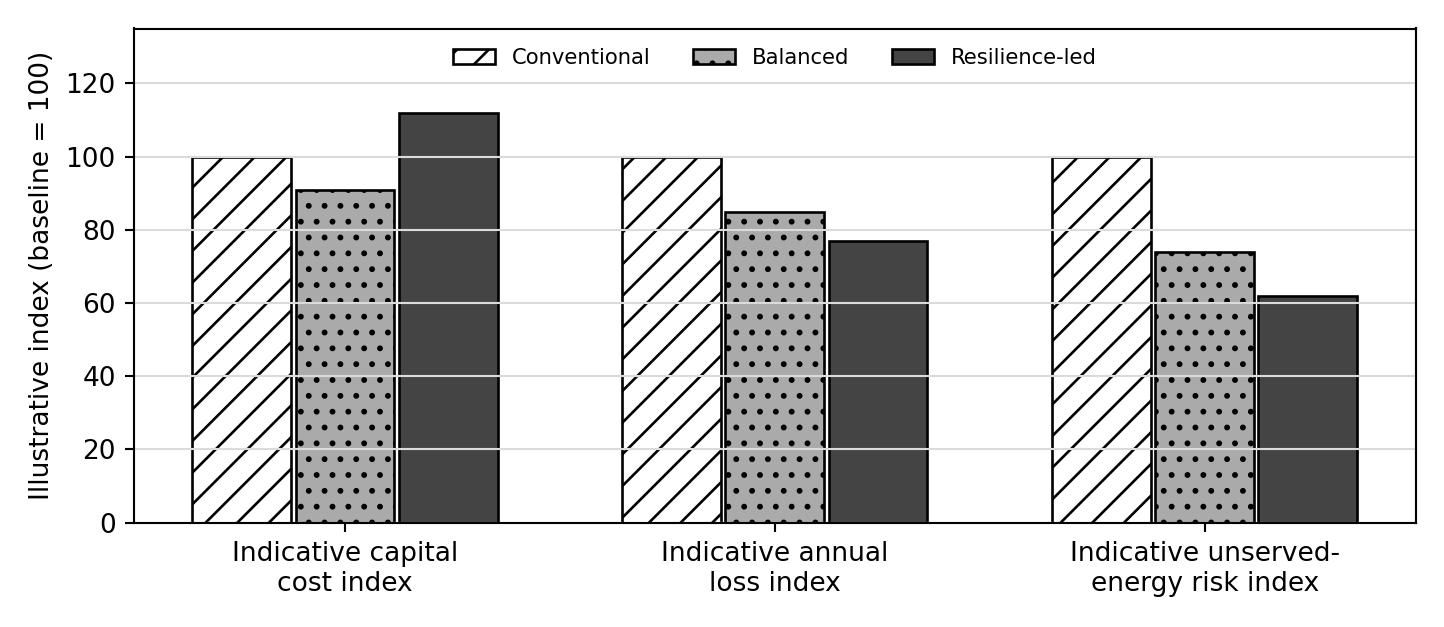
Table 2 presents qualitative design alternatives for a hypothetical mixed-use Saudi campus. It is a decision aid, not a measured case study. The alternatives assume a base radial distribution layout, a balanced option with closer transformer positioning and selected feeder upgrades, and a resilience-led option with additional switching or redundancy for priority loads. Exact rankings would depend on site geometry, load profiles, equipment pricing and operator capability.
| Alternative | Capital-cost position | Loss exposure | Operational resilience | Key limitation |
|---|---|---|---|---|
| Conventional radial baseline | Lower first cost | Can be high for long LV feeders | Single-path vulnerability | Future load and fault capacity need review |
| Balanced network optimisation | Moderate initial outlay | Potentially lower via siting and sizing | Selective sectionalising | Requires accurate load profiles |
| Resilience-led configuration | Higher initial outlay | Site-dependent | Greater restoration flexibility | Protection and operating complexity |
Figure 2 uses arbitrary indices only to explain possible competing objectives: baseline values are assigned 100, while the other indices are assumed for visual illustration. The chart does not imply measured loss reductions or reliability improvements. A real comparative study would calculate time-series load flow, expected energy not supplied, replacement expenditure and maintenance effects for each alternative, then report uncertainty bounds.
4.5Saudi implementation priorities
Saudi airports, health facilities and industrial sites demonstrate why a uniform optimisation recipe is unsuitable. Airport systems can include long distribution routes, high continuity requirements, sensitive communications and phased expansion. Healthcare buildings require stringent segregation of critical electrical services and coordinated backup arrangements. Industrial plants may include large motors, variable-speed drives and abrupt load changes. Hospitality and commercial properties have seasonal cooling demands and considerable potential for metering-led operations. The same lifecycle framework can be applied across these assets, but reliability thresholds and acceptable trade-offs differ by function.
The alignment with Vision 2030 is strongest when distribution-system projects document outcomes that can be audited: delivered energy per unit of service, technical loss estimate, maintenance response time, fault isolation performance, equipment utilisation and capacity for future renewable connection. Claims of sustainability should distinguish modelled benefits from measured savings. Environmental assessment also needs a defined carbon factor and system boundary rather than assuming that every reduction in electrical losses has a constant national emissions effect.
5Proposed sustainable distribution optimisation framework
Figure 1 summarises the proposed sequence. A design team starts by validating connected-load inventories, demand diversity and physical constraints. It then produces an MV/LV model covering transformer location, feeder impedance, fault levels, critical demand and plausible future scenarios. Safety and regulatory constraints are applied before options move to lifecycle comparison. Alternatives are screened for costs, losses and reliability; the selected arrangement is then confirmed through detailed design, procurement review, field testing and data-based operational verification.
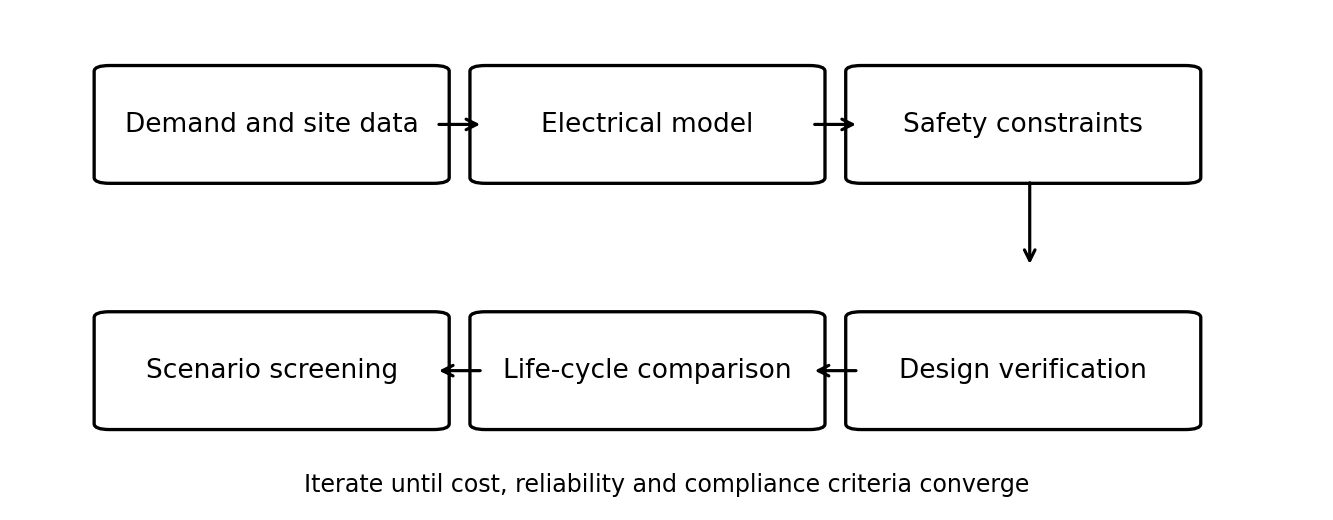
The model should be updated whenever a new material change occurs, such as altered feeder routes, revised cooling loads, added backup generation or new PV capacity. Value engineering is most defensible when it preserves applicable protection, thermal and voltage performance and has a transparent basis for comparing lifetime consequences. Document control should retain calculation assumptions, design revisions, equipment selections and commissioning acceptance records.
6Recommendations
6.1Establish scenario-based demand models
Design teams should develop demand profiles for initial occupation, peak seasonal operation, future expansion, emergency operating modes and substantial distributed generation where applicable. A single headline peak value is insufficient to optimise lifetime conductor and transformer selection. Assumptions should be agreed with the client and recorded alongside their confidence levels.
6.2Integrate engineering calculations with cost plans
Bills of quantities should be linked to feeder schedules, equipment ratings, transformer loss schedules and route lengths. Procurement decisions should compare verified technical alternatives over a defined study horizon and discount rate. Tender comparisons must distinguish compliant equipment from non-compliant lower-priced offers, particularly where different loss classes, temperature ratings or interrupting capabilities are proposed.
6.3Validate protection and power quality
Complete load-flow, short-circuit, arc-flash risk assessment where required by project practice, protective-device coordination and harmonic evaluations before installation commitments. Setpoints should be controlled through approved revisions. A commissioning regime should verify wiring, equipment identification, protective functions, earthing and monitoring-device performance with appropriate competent personnel and applicable procedures.
6.4Provide adaptable network infrastructure
Where expansion is credible, reserve realistic substation or cable-routing provisions rather than oversizing all assets indiscriminately. Evaluate hosting capability for rooftop generation, EV charging and storage at concept stage. Manage renewable interconnections through documented authority approvals, interoperability studies and safety verification.
6.5Use operational feedback
Post-commissioning interval metering, transformer loading records, power-quality captures, fault-event logs and maintenance observations can reveal discrepancies between forecasts and actual performance. Annual engineering reviews should update the network model and prioritise interventions using measurable evidence. This creates a feedback loop between initial estimation, commissioning and long-term facility management.
7Future research directions
Further Saudi-specific research is needed on measured feeder losses across diverse building typologies and climates. Longitudinal studies could compare design-model predictions with utility and building-meter data while controlling for occupancy and equipment changes. Particular value would come from case studies that report both physical energy outcomes and complete lifecycle costs, including civil works, maintenance, outages and replacement.
Comparative studies should also test how alternative transformer placements and network topologies perform under accelerated demand growth, distributed photovoltaic generation and grid-interactive loads. Multi-objective optimisation algorithms may identify feasible solution fronts, but their results must be independently checked using established protection and installation practices. Explainable optimisation models could help project owners understand why a technically sound alternative carries greater upfront cost.
A further research priority is cyber-physical reliability. Remote switching, smart meters and monitoring platforms create useful operational information but depend on communications and authorised control. Future pilot studies should examine how data quality, cyber resilience and maintenance training affect the realised benefits of digitally supported electrical distribution.
8Conclusion
Optimising MV/LV electrical distribution in Saudi infrastructure requires more than reducing initial equipment cost or minimising conductor losses in isolation. Network topology, transformer capacity, feeder geometry, voltage performance, fault protection, power quality, reliability and future renewable integration interact throughout the asset lifecycle. A suitable decision method must therefore begin with credible demand scenarios, impose safety and compliance constraints, compare complete lifecycle consequences and verify performance after commissioning.
This review proposes a staged framework connecting technical modelling with construction estimation, procurement and operational monitoring. The framework is relevant to airports, industrial estates, healthcare facilities and mixed-use developments, but its financial and reliability benefits remain conditional on local evidence. No original field measurements were collected, and the illustrative comparisons must not be represented as verified improvements. The most defensible contribution to Vision 2030 is a transparent engineering decision process that supports resilient infrastructure and enables project owners to track actual losses, service continuity and adaptability over time.
9Published network optimisation case study and boundaries
Khodr, El-Araby and Abdel-Halim (2014) studied reconfiguration of a real 13.8-kV distribution network with 2,344 nodes using a mixed-integer linear-programming formulation. The authors reported an 8% reduction in active power losses and approximately 6% reduction in energy losses. Those outcomes pertain to the network examined in that paper; the present review has not simulated a Saudi client network. Source: Journal of Engineering and Computer Sciences, 7(2), 157–199, https://jecs.qu.edu.sa/index.php/jec/article/view/1875.
For an original anonymised Saudi MV/LV study, minimum records would include a topology model, demand time series, conductor and transformer characteristics, protection settings, measured feeder energy and calibrated load-flow results. Baseline and candidate designs should be compared on losses, voltage limits, short-circuit duty, selectivity, reliability and lifecycle cost. Without those records, the paper’s numerical comparison remains hypothetical and is not evidence of an implemented project saving.
10Research data transparency statement
This manuscript reviews published evidence and proposes an engineering framework. No undisclosed client records are claimed, and no original project-specific empirical results are represented as observed outcomes. Reproducing or extending the framework with confidential project data requires documented access, anonymisation, technical validation and appropriate permission.
References
- [1]Saudi Building Code National Committee. Saudi Electrical Code (SBC 401): Code requirements [Internet]. 2024. Available from: https://sbc.gov.sa/en/BC/Pages/BuildingCode/BCDetails.aspx?codeId=401&year=2024
- [2]Saudi Building Code National Committee. Saudi Code for Energy Conservation—Nonresidential Building (SBC 601) [Internet]. 2024. Available from: https://www.sbc.gov.sa/en/BC/Pages/BuildingCode/BC.aspx?year=2024
- [3]Saudi Building Code National Committee. Saudi Green Construction Code (SBC 1001) [Internet]. 2024. Available from: https://www.sbc.gov.sa/en/Pages/default.aspx
- [4]Kingdom of Saudi Arabia. Vision 2030 Annual Report 2025 [Internet]. 2025. Available from: https://www.vision2030.gov.sa/media/ecdjfopq/vision2030_annual_report_2025_en.pdf
- [5]Kingdom of Saudi Arabia. Vision 2030 Annual Report 2024 [Internet]. 2024. Available from: https://www.vision2030.gov.sa/media/25042025ev1/En-Annual%20Report-Vision2030-2024.pdf
- [6]Kingdom of Saudi Arabia, National Platform. Power and Electricity: Optimal Energy Mix and Renewable Energy [Internet]. 2026. Available from: https://my.gov.sa/en/content/power-electricity
- [7]International Energy Agency. Saudi National Renewable Energy Program (NREP): Policy profile [Internet]. 2026. Available from: https://www.iea.org/policies/14658-saudi-national-renewable-energy-program-nrep
- [8]IEC. IEC 60364-5-52:2009+AMD1:2024, Low-voltage electrical installations—Wiring systems [Internet]. 2024. Available from: https://webstore.iec.ch/en/publication/103734
- [9]IEC. IEC 60364-4-43:2023, Low-voltage electrical installations—Protection against overcurrent [Internet]. 2023. Available from: https://webstore.iec.ch/en/publication/28432
- [10]IEC. IEC 61439-1:2020, Low-voltage switchgear and controlgear assemblies—General rules [Internet]. 2020. Available from: https://webstore.iec.ch/en/publication/32338
- [11]IEC. IEC 61000-4-30:2025, Power quality measurement methods [Internet]. 2025. Available from: https://webstore.iec.ch/en/publication/71611
- [12]IEC. IEC 60909-0:2026, Short-circuit currents in three-phase AC systems—Calculation of currents [Internet]. 2026. Available from: https://webstore.iec.ch/en/publication/68454
- [13]IEEE. IEEE Std 1547-2018, Interconnection and interoperability of distributed energy resources [Internet]. 2018. Available from: https://standards.ieee.org/ieee/1547/5915/
- [14]IEEE. IEEE Std 1547.1-2020, Conformance test procedures for equipment interconnecting distributed resources [Internet]. 2020. Available from: https://sagroups.ieee.org/scc21/ieee-1547-series/
- [15]IEC. IEC 60364-8-1:2019, Low-voltage electrical installations—Energy efficiency [Internet]. 2019. Available from: https://webstore.iec.ch/en/publication/33598
- [16]IEC. IEC 60364-5-52:2009/AMD1:2024, Amendment 1—Wiring systems [Internet]. 2024. Available from: https://webstore.iec.ch/en/publication/71254
- [17]IEC. IEC 61000-4-30:2015+AMD1:2021, Power quality measurement methods (consolidated) [Internet]. 2021. Available from: https://webstore.iec.ch/en/iec_catalog/product/preview/?id=L3B1Yi9wZGYvcHJldmlldy9pbmZvX2llYzYxMDAwLTQtMzB7ZWQzLjF9Yi5wZGY%3D
- [18]IEC. IEC 60909-0:2016, Short-circuit currents in three-phase AC systems (previous edition) [Internet]. 2016. Available from: https://webstore.iec.ch/en/publication/24100
- [19]IEEE. IEEE Std 1547a-2020, Amendment 1 to IEEE Std 1547-2018 [Internet]. 2020. Available from: https://sagroups.ieee.org/scc21/ieee-1547-series/
- [20]IEC. IEC 60076-1:2011, Power transformers—Part 1: General [Internet]. 2011. Available from: https://webstore.iec.ch/
- [21]ISO. ISO 15686-5:2017, Buildings and constructed assets—Service life planning—Life-cycle costing [Internet]. 2017. Available from: https://www.iso.org/standard/61148.html
- [22]ISO. ISO 50001:2018, Energy management systems—Requirements with guidance for use [Internet]. 2018. Available from: https://www.iso.org/standard/69426.html
- [23]IEC. IEC 61439-2:2020, Low-voltage switchgear and controlgear assemblies—Power switchgear and controlgear assemblies [Internet]. 2020. Available from: https://webstore.iec.ch/
- [24]IEEE. IEEE Std 80-2013, Guide for safety in AC substation grounding (reference framework) [Internet]. 2017. Available from: https://standards.ieee.org/
- [25]Saudi Building Code National Committee. Saudi Building Code correction and updates registry [Internet]. 2023. Available from: https://www.sbc.gov.sa/En/CodeUpdates/pages/codeupdates.aspx
- [26]Khodr HM, El-Araby EE, Abdel-Halim MA. Methodology for minimizing power losses in feeders of large distribution systems using mixed integer linear programming. Journal of Engineering and Computer Sciences. 2014;7(2):157–199. https://jecs.qu.edu.sa/index.php/jec/article/view/1875