Internet of Things
Design and Development of IoT-Based Smart Waste Management System
Department of Electrical and Electronics Engineering, Vel Tech Rangarajan Dr. Sagunthala R&D Institute of Science and Technology
Published November 2026
Abstract
Urban waste management is a major challenge in modern cities due to increasing population, rising waste generation, inefficient collection schedules, overflowing bins, and excessive fuel consumption. Traditional waste collection methods follow fixed routes and schedules regardless of the actual fill level of waste bins, resulting in unnecessary vehicle movement and poor resource utilization. To overcome these limitations, this project proposes an IoT-based Smart Waste Management System that enables real-time monitoring and intelligent waste collection. The system uses ultrasonic sensors installed inside waste bins to continuously measure garbage levels. The collected data is processed through ESP32 and NodeMCU microcontrollers and transmitted to a centralized monitoring platform using the MQTT communication protocol. Municipal authorities can access real-time information through a cloud-based dashboard, allowing timely collection and effective route planning. The proposed system helps optimize vehicle routes based on actual bin status, reducing fuel consumption by approximately 30-40% and minimizing waste overflow incidents. Furthermore, the platform provides valuable analytics for resource allocation, operational planning, and predictive maintenance. By reducing unnecessary fleet operations, the system lowers carbon emissions and supports environmental sustainability. Overall, the proposed solution enhances waste collection efficiency, improves urban cleanliness, reduces operational costs, and contributes to the development of smart and sustainable cities.
Keywords: Internet of Things (IoT); smart waste management; ultrasonic sensor; MQTT protocol; route optimization
1Introduction
Urban waste management has become a critical challenge due to rapid urbanization, population growth, and increasing waste generation. Conventional waste collection systems rely on fixed schedules and predefined routes, often resulting in inefficient operations, excessive fuel consumption, overflowing bins, and increased operational costs. In many cases, collection vehicles visit partially filled bins, leading to unnecessary trips and inefficient utilization of municipal resources. These limitations highlight the need for a smarter and more efficient waste management approach.
The proposed IoT-enabled Smart Waste Management System addresses these issues by integrating ultrasonic sensors, ESP32/NodeMCU microcontrollers, and wireless communication technologies. Ultrasonic sensors continuously monitor the fill level of waste bins and transmit the collected data in real time to a centralized dashboard through the MQTT protocol. The dashboard enables municipal authorities to monitor bin status remotely, identify bins requiring immediate attention, and optimize collection schedules accordingly.
By implementing dynamic route optimization, the system minimizes unnecessary pickups and reduces travel distance for collection vehicles, resulting in significant fuel savings and lower carbon emissions. Real-time monitoring also helps prevent bin overflow, improving cleanliness and public hygiene. Furthermore, data analytics support better resource allocation and planning. The proposed solution contributes to efficient waste collection, reduced operational costs, environmental sustainability, and the development of smart and cleaner cities.
2Methods and materials
2.1Methodology
- 1. Waste Level Monitoring: Ultrasonic sensors are installed inside waste bins to continuously measure the fill level of garbage.
- 2. Data Acquisition: The sensor data is collected and processed using ESP32 and NodeMCU microcontrollers.
- 3. Data Transmission: The measured fill-level data is transmitted in real time to a cloud server using the MQTT communication protocol.
- 4. Centralized Monitoring: A web-based dashboard receives and displays the data, allowing authorities to monitor the status of all bins remotely.
- 5. Route Optimization: Based on real-time bin fill levels, the system identifies bins requiring immediate collection and generates optimized collection routes.
- 6. Waste Collection: Collection vehicles follow the optimized routes, reducing unnecessary trips, fuel consumption, and operational costs.
- 7. Data Analytics: Collected data is analyzed to support decision-making, resource planning, and predictive maintenance activities.
- 8. Performance Evaluation: The system's effectiveness is evaluated through parameters such as collection efficiency, fuel savings, overflow reduction, and environmental impact.
Methodology flow: Waste Bin → Ultrasonic Sensor → ESP32/NodeMCU → MQTT Protocol → Cloud Server → Dashboard Monitoring → Route Optimization → Waste Collection → Data Analytics & Performance Evaluation.
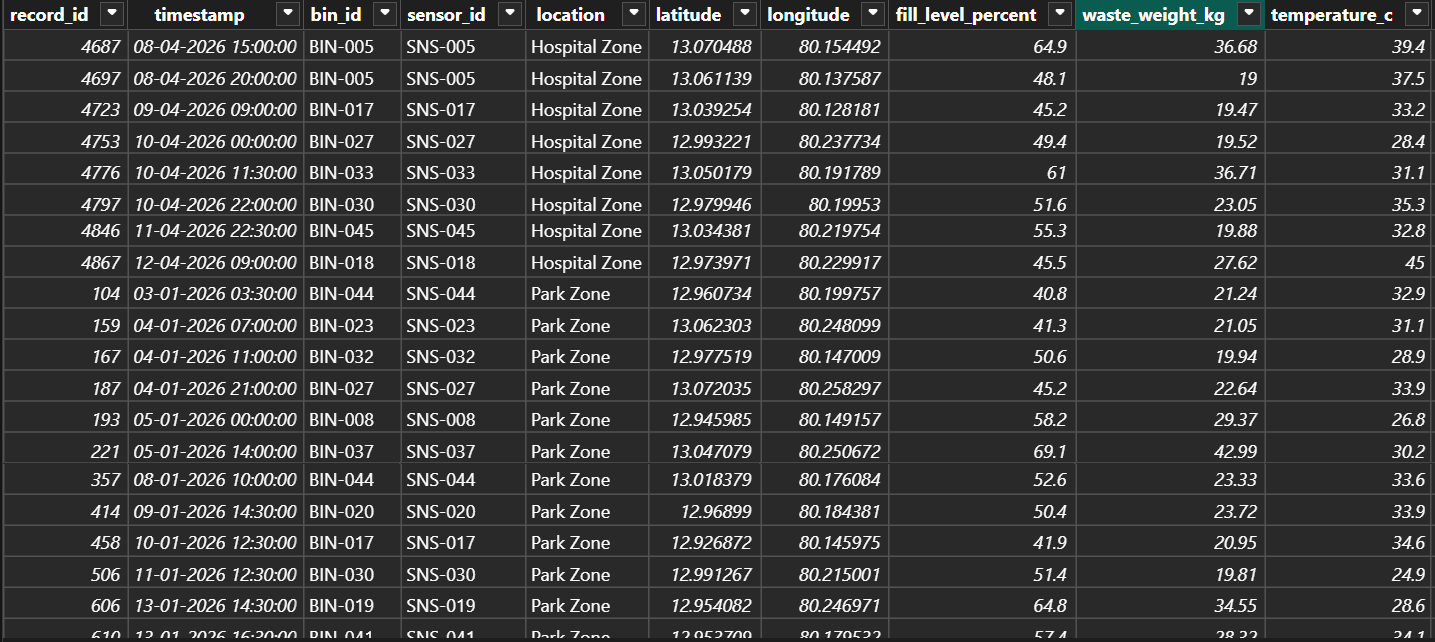
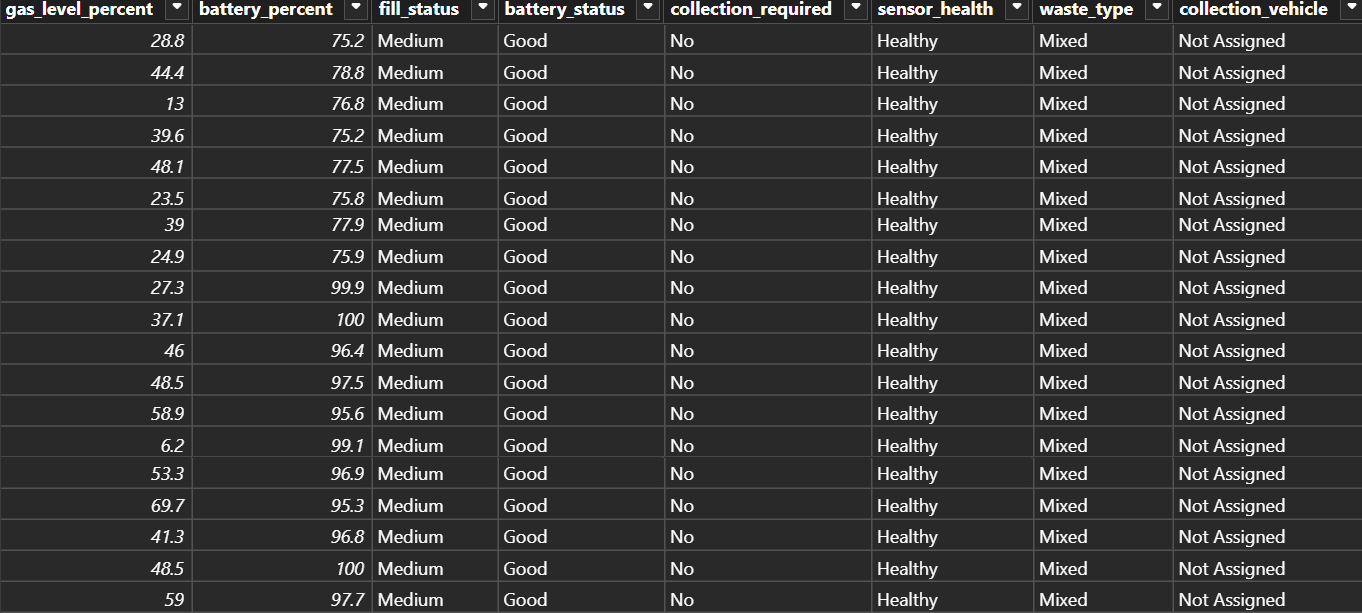
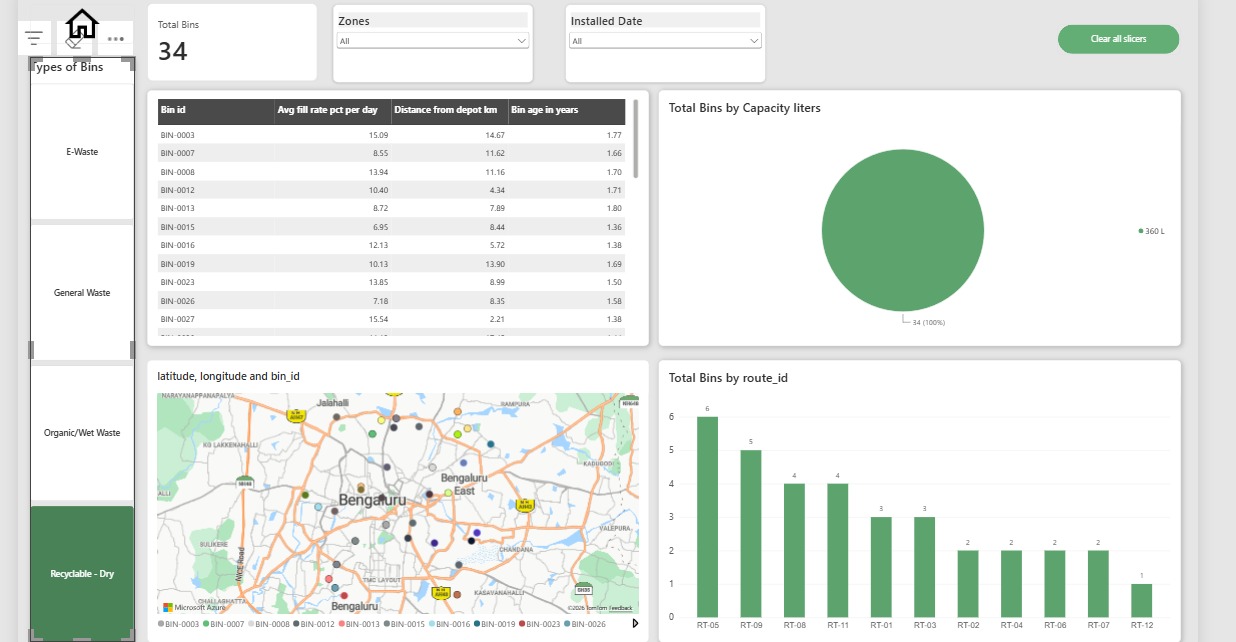
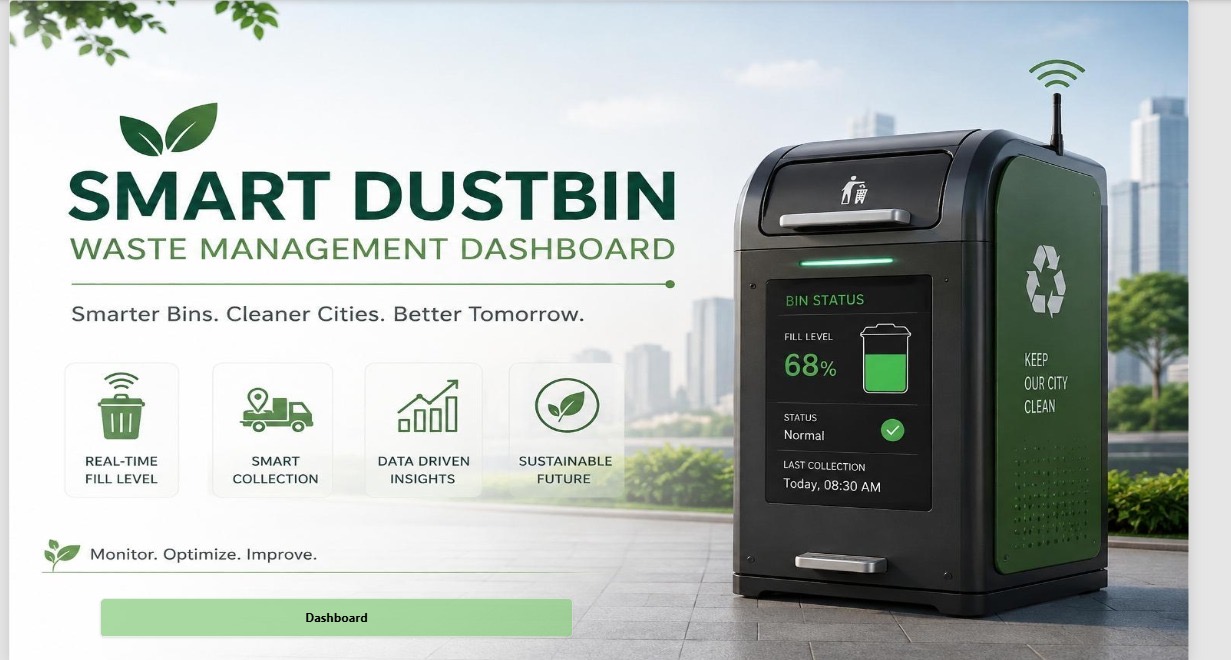
The data recorded for multiple bins are shown in Figures 1 and 2, the dashboard of the overall dustbin data in Figure 3 and the smart dustbin in Figure 4.
3Literature survey
- 1. “Advancing Smart City Sustainability with Internet of Things and Artificial Intelligence Aided Low-Cost Digital Twin Systems for Waste Management” [1], Microsystem Technologies, Volume 31, 2025. This paper presents an innovative IoT-based smart waste management system integrated with Artificial Intelligence (AI) and low-cost Digital Twin technology to improve urban waste collection efficiency. The proposed system uses IoT sensors for real-time monitoring of waste bin levels and AI algorithms for predictive analytics, enabling optimized collection schedules and route planning. Machine learning techniques help identify waste generation patterns, reducing fuel consumption, operational costs, and bin overflow incidents. The system also supports sustainability by lowering carbon emissions and improving resource utilization. Although challenges such as cybersecurity, data management, and large-scale deployment exist, the research demonstrates that combining IoT, AI, and Digital Twin technologies can significantly enhance the efficiency, reliability, and sustainability of smart city waste management systems.
- 2. “Advancing Smart City Sustainability with Internet of Things and Artificial Intelligence Aided Low-Cost Digital Twin Systems for Waste Management” [1], Microsystem Technologies, Volume 31 (2025), doi: 10.1007/s00542-024-05827-4. This research presents an advanced smart waste management framework that integrates Internet of Things (IoT), Artificial Intelligence (AI), and Digital Twin technology to improve urban waste collection and sustainability. The proposed system uses IoT sensors installed in waste bins to collect real-time data such as fill levels, environmental conditions, and usage patterns. These data are transmitted to a cloud platform, where a Digital Twin model creates a virtual representation of the physical waste management infrastructure. Artificial Intelligence algorithms analyze the collected information to predict waste generation trends, optimize collection schedules, and improve route planning. The working principle involves continuous sensing, cloud-based data processing, digital twin simulation, predictive analytics, and adaptive decision-making. The study demonstrates that this approach significantly reduces waste overflow incidents, operational costs, and fuel consumption while improving collection efficiency and environmental sustainability. The major advantages of the system include real-time monitoring, predictive maintenance, optimized resource utilization, reduced carbon emissions, and enhanced decision-making capabilities for municipal authorities. However, the system also has certain limitations, including the requirement for reliable communication infrastructure, increased cybersecurity risks, large-scale data management challenges, and higher initial implementation costs. Despite these challenges, the research establishes Digital Twin-enabled waste management as a promising solution for future smart city ecosystems and sustainable urban development.
- 3. “Internet of Things-Driven Waste Management: Paving the Way for Sustainable Smart Cities” [2], Processes, Vol. 13, Issue 4, 2025, doi: 10.3390/pr13041140. This paper presents an IoT-driven waste management system designed to improve waste collection efficiency in rapidly growing urban environments. The proposed framework incorporates ultrasonic sensors installed in waste bins, GPS tracking systems, and Artificial Intelligence (AI)-based route optimization techniques. The working principle involves continuous monitoring of waste-bin fill levels through IoT sensors. The collected data are transmitted to a centralized cloud platform where AI algorithms analyze the bin status and generate optimized waste collection routes. The system enables collection vehicles to visit only bins that require immediate attention, thereby eliminating unnecessary trips and reducing operational inefficiencies. Experimental results presented in the study demonstrate noticeable reductions in fuel consumption and operational expenses while improving collection performance. The major advantages of the system include real-time waste monitoring, better route planning, lower fuel usage, reduced carbon emissions, and improved municipal resource utilization. The integration of GPS and AI technologies further enhances waste collection accuracy and responsiveness. However, the system also faces certain limitations such as dependency on reliable internet connectivity, maintenance of sensor networks, high deployment costs, and cybersecurity concerns associated with IoT devices. Despite these challenges, the study concludes that IoT-enabled intelligent waste management provides an effective solution for sustainable urban development and smart city initiatives.
- 4. “Artificial Intelligence and Digital Twins for Sustainable Waste Management: A Bibliometric and Thematic Review” [3], Applied Sciences, Vol. 15, Issue 11, 2025, doi: 10.3390/app15116337. This paper provides a comprehensive review of Artificial Intelligence (AI) and Digital Twin technologies applied to sustainable waste management systems. The study analyzes existing research trends, major technological developments, and emerging applications for waste collection, processing, and recycling operations. The working principle discussed in the paper involves creating a Digital Twin, which acts as a virtual representation of physical waste management infrastructure. Real-time data from IoT sensors are continuously fed into the Digital Twin platform, enabling simulation, monitoring, and predictive analysis of waste management processes. AI algorithms further enhance system performance by forecasting waste generation patterns, optimizing collection routes, and supporting decision-making processes. The research highlights that combining Digital Twins with AI enables predictive maintenance, intelligent resource allocation, and improved operational efficiency. Major advantages include enhanced visibility of waste operations, accurate forecasting, improved sustainability, reduced operational costs, and support for circular economy practices. Additionally, municipalities can use Digital Twins for scenario analysis and long-term planning. However, the implementation of such systems requires significant computational resources, advanced data integration techniques, and skilled personnel. Other limitations include cybersecurity concerns, interoperability challenges, and high initial investment costs. The paper concludes that AI-enabled Digital Twin technology has the potential to transform waste management systems by creating intelligent, data-driven, and sustainable urban infrastructures.
- 5. “IoT-Enabled AI Solutions for Efficient Smart City Waste Management” [4], Annals of Process Engineering and Management, 2024, doi: 10.48314/apem.v1i1.20. This research proposes an integrated Artificial Intelligence and Internet of Things (IoT) framework to improve waste management performance in smart cities. The paper addresses common urban challenges such as overflowing waste bins, inefficient collection schedules, and increasing operational costs. The working principle is based on smart waste bins equipped with IoT sensors that continuously monitor parameters such as fill level, temperature, and weight. These data are transmitted through wireless communication networks to a cloud-based platform where AI algorithms perform predictive analytics and route optimization. Machine learning techniques analyze historical waste patterns to forecast future waste generation and improve collection scheduling. The study also discusses the use of computer vision techniques for waste classification and automated sorting processes. The major advantages of this system include improved collection efficiency, lower operational expenditure, reduced fuel consumption, enhanced recycling rates, and minimized waste overflow incidents. Moreover, predictive maintenance capabilities increase the reliability of waste management infrastructure. However, the system requires significant investment in sensor deployment, cloud infrastructure, and AI integration. Additional challenges include network reliability, privacy concerns, device maintenance requirements, and scalability issues in large urban environments. The study concludes that AI and IoT integration can significantly improve waste collection efficiency while supporting sustainable smart city development and environmental conservation objectives.
- 6. “AI-IoT-Graph Synergy for Smart Waste Management: A Scalable Framework for Predictive, Resilient, and Sustainable Urban Systems” [5], Frontiers in Sustainability, 2025, doi: 10.3389/frsus.2025.1675021. This paper introduces a smart waste management framework that combines Artificial Intelligence (AI), Internet of Things (IoT), and graph-theoretic optimization techniques to enhance urban waste collection systems. The proposed framework focuses on predicting waste overflow events and optimizing collection routes through intelligent data analysis. The working principle involves deploying IoT sensors in waste bins to gather real-time information regarding fill levels and usage conditions. The collected data are processed using AI-based predictive models capable of identifying overflow-prone bins. Graph-based optimization algorithms then evaluate spatial relationships among waste bins and generate efficient collection paths for waste collection vehicles. The integrated system enables dynamic scheduling and adaptive route planning based on actual waste conditions. The major advantages include accurate overflow prediction, reduced fuel consumption, lower operational costs, improved waste collection efficiency, and enhanced sustainability. The framework also supports urban resilience through intelligent decision-making and real-time responsiveness. However, certain limitations are identified, including dependence on large datasets for model training, computational complexity, infrastructure costs, and the requirement for continuous sensor maintenance. Furthermore, communication failures or inaccurate sensor data may affect prediction performance. Overall, the research demonstrates that AI-IoT integration combined with graph optimization can significantly improve municipal waste management operations and contribute to the realization of sustainable and data-driven smart cities.
- 7. “IoT-Based Solid Waste Management Solutions: A Survey”, Journal of Sensor and Actuator Networks (JSAN), 2019, doi: 10.3390/jsan8010005. This survey paper reviews various Internet of Things (IoT)-based waste management solutions developed to address the challenges of urban waste collection and environmental sustainability. The study analyzes different sensing technologies, communication protocols, cloud platforms, and smart bin architectures used in intelligent waste management systems. The working principle of most reviewed systems involves installing sensors, such as ultrasonic, infrared, and weight sensors, inside waste bins to monitor fill levels in real time. Data collected from these sensors are transmitted through wireless communication networks to cloud-based platforms where the information is analyzed and displayed for municipal authorities. The survey highlights that IoT-based systems significantly improve waste collection efficiency by enabling dynamic scheduling and route optimization. Major advantages include real-time monitoring, reduced operational costs, improved resource utilization, reduced fuel consumption, and prevention of bin overflows. These systems also support environmental sustainability by minimizing unnecessary vehicle movement and reducing carbon emissions. However, several challenges remain, including communication reliability, sensor calibration issues, battery maintenance, and high implementation costs in large-scale deployments. Security and privacy concerns associated with IoT devices are also highlighted. The paper concludes that IoT technologies have substantial potential to modernize waste management systems and form a critical component of future smart city infrastructure.
- 8. “Waste Management with the Use of Heuristic Algorithms and Internet of Things Technology”, Sensors, 2022, doi: 10.3390/s22228729. This paper investigates the integration of IoT technology and heuristic algorithms for optimizing waste collection operations in urban areas. The study proposes a smart waste management framework in which sensor-equipped bins continuously report fill-level information to a central monitoring system. The working principle involves collecting real-time waste data through IoT sensors and processing it using heuristic optimization algorithms that determine the most efficient collection routes for waste transport vehicles. The system dynamically adjusts collection schedules according to actual waste accumulation rather than predefined routes. Experimental results indicate significant improvements in collection efficiency and resource utilization. The main advantages of the proposed system include reduced travel distances, lower fuel consumption, decreased operational costs, enhanced route optimization, and improved waste collection performance. Furthermore, municipal authorities can make informed decisions using real-time waste status information. The use of heuristic algorithms enables fast solutions for complex routing problems and supports large-scale urban deployments. However, the paper also identifies limitations such as dependence on sensor accuracy, computational requirements for optimization, maintenance costs, and difficulties in integrating with existing municipal infrastructure. Network interruptions and data inaccuracies may also affect system performance. Overall, the research demonstrates that the combination of IoT sensing and intelligent optimization algorithms can significantly improve the effectiveness and sustainability of waste management services.
- 9. “IoT-Based Waste Management System in Formal and Informal Public Areas in Mecca”, International Journal of Environmental Research and Public Health, 2022, doi: 10.3390/ijerph191912481. This paper presents an IoT-based smart waste management system developed for public areas in Mecca, focusing on improving waste collection efficiency in both formal and informal urban environments. The proposed system uses smart bins equipped with sensors that continuously monitor waste levels and environmental conditions. The working principle involves collecting waste-bin data through IoT devices, transmitting the information to a cloud platform, and providing real-time visibility to waste management authorities through a monitoring dashboard. The system enables timely intervention whenever bins approach maximum capacity, thereby preventing overflow incidents. The study demonstrates that smart waste management improves urban cleanliness and operational efficiency while reducing unnecessary waste collection trips. Major advantages include real-time data visibility, improved waste monitoring accuracy, reduced collection costs, enhanced public hygiene, and efficient utilization of collection resources. The implementation also contributes to environmental sustainability by reducing carbon emissions associated with waste transportation. Despite these benefits, the research highlights certain challenges, including installation and maintenance costs, communication network dependency, and cybersecurity risks. Sensor malfunctions and power management issues may also affect reliability. The paper concludes that IoT-enabled waste management can effectively support large-scale urban environments and provides a practical foundation for developing intelligent city services that enhance both environmental and operational performance.
- 10. “Smart Waste Management Using IoT Sensors and Machine Learning Techniques for Sustainable Cities”, Sustainability, 2024, doi: 10.3390/su16041562. This paper proposes a smart waste management framework that combines IoT sensors with machine learning techniques to improve the efficiency and sustainability of urban waste collection operations. The system utilizes sensor-enabled smart bins that collect real-time information regarding waste levels, environmental conditions, and usage patterns. The working principle involves transmitting sensor data to a centralized cloud platform where machine learning algorithms analyze waste accumulation trends and predict future collection requirements. Based on these predictions, optimized collection schedules and routes are generated to improve service efficiency. The study demonstrates that predictive analytics can significantly reduce unnecessary collections and improve resource allocation. Major advantages include accurate demand forecasting, reduced fuel consumption, lower operational expenses, better route planning, and prevention of waste overflow incidents. The integration of machine learning further enhances decision-making by enabling predictive maintenance and long-term planning. Environmental sustainability is also improved through reduced carbon emissions and optimized vehicle utilization. However, the system faces limitations related to data quality, model training requirements, sensor reliability, and computational complexity. Large datasets are necessary to achieve high prediction accuracy, and communication failures may affect system performance. Despite these challenges, the research confirms that combining IoT sensing with machine learning offers an effective and intelligent solution for sustainable waste management in future smart cities.
- 11. “Digital Twin and Artificial Intelligence Approaches for Smart City Waste Optimization: A Review”, Sustainability, 2025, doi: 10.3390/su17010089. This review paper examines the application of Digital Twin and Artificial Intelligence technologies for optimizing waste management systems in smart cities. The research discusses how Digital Twins create virtual representations of physical waste infrastructure, allowing real-time monitoring, simulation, and predictive analysis. The working principle involves collecting operational data from IoT sensors deployed throughout the waste management network and synchronizing this information with a digital replica of the system. Artificial Intelligence algorithms then analyze the data to forecast waste generation, optimize container utilization, improve route planning, and support decision-making processes. The study highlights that Digital Twin technology enables municipalities to evaluate different operational scenarios without affecting actual infrastructure. Major advantages include enhanced visibility of waste operations, predictive maintenance capabilities, improved operational efficiency, reduced collection costs, lower carbon emissions, and better resource utilization. AI-driven analytics further support proactive waste management and long-term urban planning. However, implementing Digital Twin systems requires substantial computational resources, advanced software infrastructure, reliable communication networks, and strong cybersecurity measures. High deployment costs and integration challenges with legacy systems are also identified as significant barriers. The paper concludes that the combination of Digital Twins, AI, and IoT technologies provides a powerful framework for developing intelligent, scalable, and sustainable waste management systems capable of supporting future smart city initiatives. Provide your feedback on BizChat.
- 12. “AI-IoT-Graph Synergy for Smart Waste Management: A Scalable Framework for Predictive, Resilient, and Sustainable Urban Systems” [5], Frontiers in Sustainability, 2025, doi: 10.3389/frsus.2025.1675021. This paper presents an advanced smart waste management framework that combines Artificial Intelligence (AI), Internet of Things (IoT), and graph-theoretic optimization techniques to improve urban waste collection efficiency. The proposed system utilizes IoT-enabled smart bins to continuously monitor waste levels and transmit real-time information to a centralized management platform. The working principle involves collecting sensor data, applying machine learning algorithms to predict overflow incidents, and using graph-based optimization methods to determine the most efficient collection routes. The framework was evaluated using a large-scale simulated waste collection environment, demonstrating significant improvements in collection performance. By predicting overflow-prone areas and dynamically adjusting vehicle routing, the system minimizes missed collections and unnecessary travel. The major advantages of this approach include improved waste collection efficiency, reduced fuel consumption, decreased operational costs, enhanced sustainability, and better utilization of municipal resources. The integration of AI allows predictive decision-making, while graph optimization improves route efficiency. However, the system has limitations such as dependence on accurate sensor data, complex computational requirements, infrastructure investment costs, and the need for continuous system maintenance. Communication failures or erroneous data may also reduce prediction accuracy. Overall, the proposed framework provides a scalable and intelligent solution for future smart city waste management systems.
- 13. “Artificial Intelligence and Digital Twins for Sustainable Waste Management: A Bibliometric and Thematic Review” [3], Applied Sciences, 2025, doi: 10.3390/app15116337. This review paper examines recent developments in Artificial Intelligence (AI) and Digital Twin technologies for sustainable waste management. The study investigates how advanced digital technologies can improve waste collection, monitoring, recycling, and decision-making processes. The working principle discussed involves creating a digital replica of physical waste management infrastructure that continuously receives information from IoT devices and sensors. AI algorithms process the collected data to forecast waste generation trends, optimize waste collection schedules, and improve overall operational performance. The paper identifies several major application areas including predictive waste analytics, smart recycling systems, route optimization, and environmental monitoring. Advantages of Digital Twin technology include real-time system visibility, predictive maintenance, improved planning accuracy, reduced operational costs, enhanced sustainability, and support for circular economy initiatives. AI integration further improves forecasting capabilities and resource utilization. However, the paper identifies several challenges, including high implementation costs, data integration difficulties, cybersecurity risks, computational complexity, and interoperability issues among different platforms. The effectiveness of Digital Twin solutions also depends on reliable sensor networks and high-quality data acquisition systems. The study concludes that AI and Digital Twin technologies have the potential to revolutionize urban waste management by enabling intelligent monitoring, simulation, and optimization capabilities for future smart cities.
- 14. “Internet of Things-Driven Waste Management: Paving the Way for Sustainable Smart Cities” [2], Processes, 2025, doi: 10.3390/pr13041140. This research proposes an IoT-driven smart waste management system designed to address increasing waste generation challenges in urban environments. The study integrates IoT sensors, GPS tracking technologies, and artificial intelligence-based route optimization methods to improve collection efficiency and environmental sustainability. The working principle involves deploying ultrasonic sensors inside waste bins to continuously measure fill levels and transmit data through wireless communication networks to a cloud-based platform. AI algorithms analyze the collected information and identify the most efficient routes for waste collection vehicles. The system only schedules collection when bins approach full capacity, reducing unnecessary transportation activities and improving resource utilization. Experimental results demonstrate reductions in fuel consumption and operational costs while improving collection effectiveness and response time. Major advantages include real-time monitoring, intelligent route planning, reduced waste overflow incidents, lower carbon emissions, and efficient fleet management. Additionally, municipal authorities benefit from data-driven decision-making and improved service reliability. However, some limitations include dependence on communication infrastructure, sensor maintenance requirements, implementation expenses, and cybersecurity concerns. Network failures can impact system reliability and lead to delayed decision-making. Overall, the paper demonstrates that IoT-enabled waste management systems can significantly enhance urban cleanliness, operational efficiency, and environmental sustainability within evolving smart city ecosystems.
- 15. “IoT-Enabled AI Solutions for Efficient Smart City Waste Management” [4], Annals of Process Engineering and Management, 2024, doi: 10.48314/apem.v1i1.20. This paper introduces an integrated Artificial Intelligence (AI) and Internet of Things (IoT) framework aimed at improving waste management operations in smart cities. The proposed solution addresses challenges such as overflowing bins, inefficient collection schedules, excessive fuel usage, and increasing operational expenses. The working principle is based on smart waste bins equipped with sensors that continuously measure waste levels, temperature, and weight. Real-time data are transmitted through wireless communication systems to cloud servers where AI algorithms analyze waste accumulation trends. Machine learning models are used to forecast future waste generation and optimize collection schedules and vehicle routes. In addition, computer vision technologies are incorporated to improve waste classification and recycling effectiveness. The main advantages include increased collection efficiency, reduced transportation costs, lower fuel consumption, improved recycling performance, and minimized waste overflow incidents. Predictive maintenance features also improve system reliability and reduce maintenance expenses. However, the implementation requires investment in IoT devices, cloud infrastructure, and AI software systems. Other limitations include communication reliability issues, sensor maintenance, data privacy concerns, and scalability challenges for large metropolitan regions. Despite these challenges, the study demonstrates that AI-IoT integration can significantly enhance the sustainability and intelligence of modern waste management systems while supporting smart city development objectives.
- 16. “Advancing Smart City Sustainability with Internet of Things and Artificial Intelligence Aided Low-Cost Digital Twin Systems for Waste Management” [1], Microsystem Technologies, 2025, doi: 10.1007/s00542-024-05827-4. This paper proposes a low-cost Digital Twin-based waste management system integrating Internet of Things (IoT), Artificial Intelligence (AI), and machine learning technologies to improve urban sustainability. The system creates a virtual model of physical waste management infrastructure, enabling real-time monitoring and predictive decision-making. The working principle involves collecting waste-bin data through IoT sensors and transmitting the information to a Digital Twin platform in the cloud. AI algorithms continuously analyze the incoming data to forecast waste generation patterns, predict service requirements, and optimize collection schedules. The Digital Twin environment enables municipalities to simulate different operational scenarios and evaluate decision outcomes before implementation. Advantages of the proposed framework include improved operational efficiency, reduced waste overflow incidents, lower transportation costs, enhanced planning accuracy, and reduced environmental impact through optimized resource utilization. The system also supports predictive maintenance and long-term infrastructure planning. However, implementation challenges include cybersecurity requirements, communication network dependency, large-scale data management complexity, and higher initial deployment costs. Additional technical expertise is required to maintain Digital Twin infrastructure and AI models. Despite these limitations, the study demonstrates that combining IoT, AI, and Digital Twin technologies can create a highly intelligent and sustainable waste management ecosystem capable of supporting the evolving needs of future smart cities.
- 17. “Smart Waste Collection System Based on IoT and Cloud Computing for Sustainable Cities” This paper presents a smart waste collection system that integrates Internet of Things (IoT) devices with cloud computing technology to improve municipal waste management operations. The proposed system uses ultrasonic sensors mounted inside waste bins to continuously monitor waste levels and transmit data to a cloud platform. The working principle involves real-time sensing, wireless communication, cloud-based storage, and centralized monitoring through a web dashboard. Municipal authorities can access up-to-date information about bin conditions and schedule waste collection only when necessary. The study demonstrates that cloud-integrated waste monitoring improves collection efficiency while reducing fuel consumption and operational costs. Major advantages include real-time monitoring, reduced collection frequency, optimized workforce utilization, improved cleanliness, and lower environmental impact. The cloud platform also enables historical data analysis, predictive planning, and easy scalability across multiple locations. However, the system depends heavily on stable internet connectivity and cloud infrastructure. Additional limitations include maintenance requirements for sensors, cybersecurity concerns, data privacy issues, and initial deployment costs. In large urban environments, communication failures may affect real-time decision-making. Despite these challenges, the research concludes that IoT and cloud computing technologies provide an efficient and scalable approach for modern smart city waste management and contribute significantly to sustainable urban development.
- 18. “Machine Learning-Based Smart Waste Monitoring and Prediction System for Urban Areas” This paper proposes a machine learning-based smart waste management framework that focuses on predicting waste generation and improving collection efficiency in urban environments. The system combines IoT sensors, cloud computing platforms, and predictive analytics models to support intelligent waste monitoring. The working principle involves collecting waste-level data from sensor-equipped smart bins and transmitting it to a cloud server for processing. Machine learning models analyze historical and real-time information to forecast future waste accumulation trends and generate optimized collection schedules. The proposed framework helps municipalities proactively manage waste before overflow situations occur. Major advantages include accurate waste prediction, improved route planning, reduced fuel consumption, enhanced resource utilization, and lower collection costs. The implementation of predictive analytics allows authorities to make informed decisions and allocate resources more effectively. Furthermore, the system contributes to environmental sustainability by minimizing unnecessary transportation activities. However, the effectiveness of the framework depends on the availability of high-quality datasets and properly trained machine-learning models. Sensor failures, communication interruptions, and inaccurate predictions can negatively impact system performance. Additionally, computational resources and data management requirements increase with system scale. Overall, the study demonstrates that machine learning can significantly improve the intelligence and efficiency of waste management systems in developing smart cities.
- 19. “Artificial Intelligence-Based Route Optimization for Smart Waste Collection Systems” This research focuses on the use of Artificial Intelligence (AI) techniques to optimize waste collection routes in urban waste management operations. Traditional collection methods often follow fixed schedules, leading to unnecessary vehicle movement and increased operational costs. The proposed system introduces AI-driven optimization algorithms that analyze real-time waste information collected through IoT-enabled smart bins. The working principle involves monitoring waste levels using sensors, transmitting data to a central server, and applying AI optimization models to identify the most efficient collection paths. The system dynamically updates routes according to current waste conditions and traffic information. Experimental results indicate reductions in travel distance, fuel consumption, collection time, and operational expenses. Advantages of the system include intelligent route planning, improved fleet utilization, lower maintenance costs, reduced greenhouse gas emissions, and enhanced service quality. The AI models also support adaptive decision-making and rapid response to unexpected operational changes. However, the framework requires significant computational resources and reliable communication networks for real-time operation. Model accuracy depends on continuous data availability and proper algorithm training. Infrastructure costs and cybersecurity risks are additional concerns. Nevertheless, the study confirms that AI-based route optimization can play a vital role in developing efficient and sustainable smart city waste collection systems.
- 20. “Digital Twin-Enabled Waste Management for Smart City Infrastructure” This paper explores the application of Digital Twin technology in modern waste management systems. The proposed framework develops a virtual representation of physical waste collection infrastructure, enabling real-time monitoring and simulation of operational activities. The working principle involves integrating IoT sensors installed in waste bins, collection vehicles, and transfer stations with a Digital Twin platform. Real-time operational data are synchronized with the virtual model, allowing authorities to evaluate system performance, predict failures, and optimize collection operations. The Digital Twin framework provides a comprehensive view of waste management activities and facilitates predictive decision-making. Major advantages include improved operational visibility, predictive maintenance, reduced system downtime, optimized resource allocation, and enhanced planning capabilities. The technology also supports sustainability initiatives by reducing unnecessary transport operations and improving collection efficiency. However, implementation requires advanced software infrastructure, reliable communication systems, and significant investment in digital technologies. Cybersecurity vulnerabilities and data synchronization challenges may affect system performance. Furthermore, technical expertise is required to manage and maintain Digital Twin platforms. Despite these limitations, the research demonstrates that Digital Twin technology offers substantial opportunities for improving the efficiency, resilience, and sustainability of urban waste management infrastructure.
- 21. “IoT and Artificial Intelligence Integrated Waste Segregation and Smart Recycling System” This paper proposes an intelligent waste segregation and recycling system that combines Internet of Things (IoT) technology with Artificial Intelligence (AI) to improve waste processing efficiency. The system addresses challenges associated with manual waste sorting, contamination of recyclable materials, and increasing waste generation in urban areas. The working principle involves collecting waste through sensor-enabled smart bins and using AI-based image processing and computer vision algorithms to automatically identify and classify different waste categories. The segregated waste is monitored through IoT-enabled tracking systems that provide real-time visibility into recycling operations. The proposed framework improves recycling efficiency and supports sustainable waste management practices. Major advantages include automated waste classification, increased recycling rates, reduced human intervention, improved resource recovery, and enhanced environmental sustainability. The integration of AI enables accurate classification of waste materials and supports continuous system learning. However, implementation challenges include high hardware and software costs, image-processing complexity, maintenance requirements, and the need for large training datasets. Variations in waste appearance may affect classification accuracy. Despite these challenges, the study demonstrates that combining AI and IoT technologies can significantly improve waste segregation efficiency and contribute to the development of intelligent and sustainable recycling systems for future smart cities.
4Algorithm
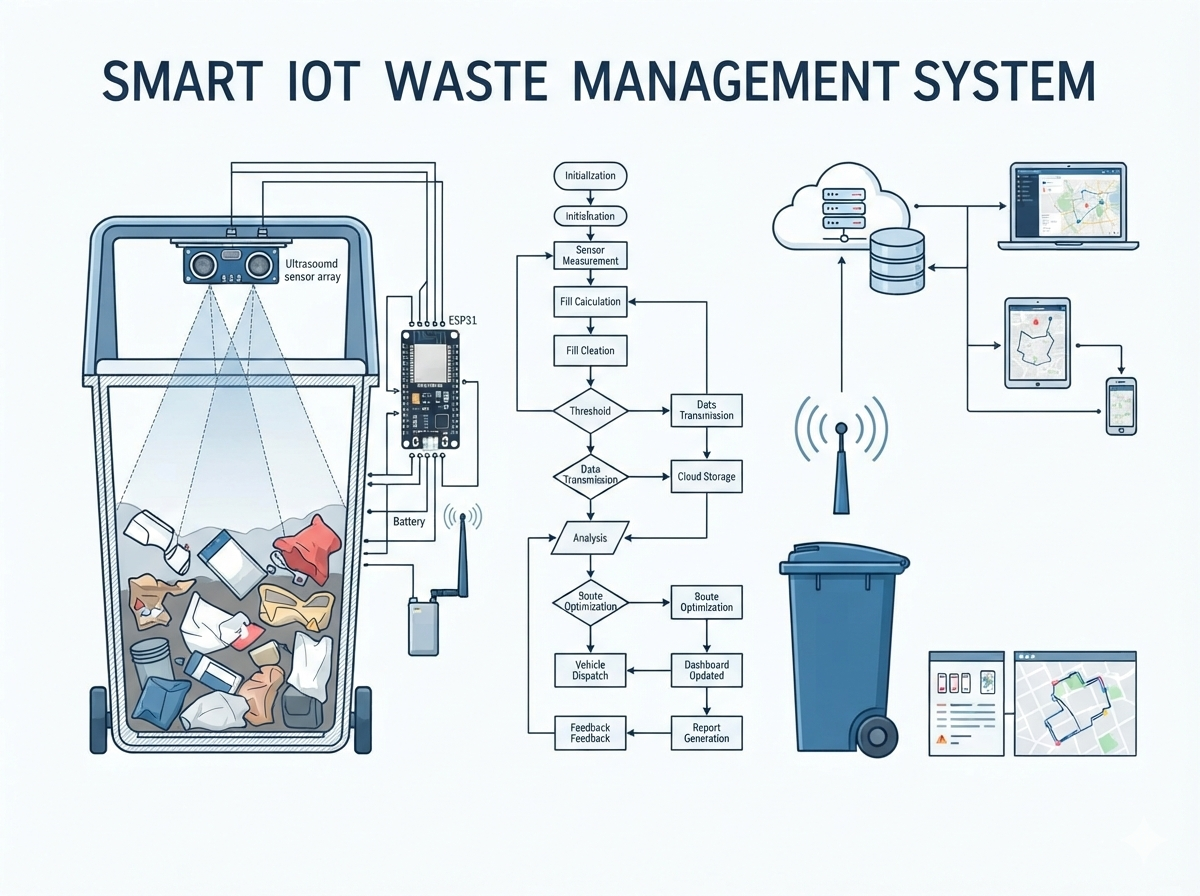
The steps of the monitoring and collection algorithm are listed below; the architecture of the system is shown in Figure 5.
Step 1: Start the system.
Step 2: Initialize ultrasonic sensor, ESP32/NodeMCU controller, Wi-Fi module, and cloud server connection.
Step 3: Measure the distance between the ultrasonic sensor and the waste surface inside the bin.
Step 4: Calculate the bin fill level percentage using the measured distance.
Step 5: Check the fill level condition: If Fill Level < 70%, display "Bin Normal". If Fill Level ≥ 70% and < 90%, display "Bin Nearly Full". If Fill Level ≥ 90%, display "Bin Full".
Step 6: Transmit bin ID, location, timestamp, and fill-level data to the cloud server through MQTT protocol.
Step 7: Store and update the received data in the centralized database.
Step 8: Analyze real-time data and identify bins requiring collection.
Step 9: Apply route optimization algorithm to determine the shortest collection path.
Step 10: Send optimized route and collection schedule to waste collection vehicles.
Step 11: Monitor collection status continuously through the dashboard.
Step 12: After collection, update the bin status as empty and reset monitoring.
Step 13: Generate reports for waste volume, collection efficiency, fuel savings, and overflow incidents.
Step 14: Repeat Steps 3–13 continuously for all smart bins.
Step 15: Stop the system when required.
5Objectives
The primary objective of this project is to develop an intelligent, scalable, and cost-effective IoT-based Smart Waste Management System capable of addressing the growing challenges associated with municipal solid waste collection in urban environments. Rapid urbanization, population growth, and industrial development have significantly increased waste generation, creating a need for more efficient waste management practices. The proposed system aims to overcome the limitations of traditional waste collection methods, which rely on fixed schedules and manual monitoring, often resulting in unnecessary collection trips, overflowing bins, high fuel consumption, increased operational costs, and poor resource utilization. The project focuses on implementing ultrasonic sensors integrated with ESP32/NodeMCU controllers to continuously monitor waste-bin fill levels and transmit real-time data to a centralized cloud platform using IoT communication technologies. Another key objective is to enable remote monitoring and data visualization through a web-based dashboard, allowing municipal authorities to make informed decisions regarding waste collection activities. The system also aims to incorporate predictive analytics and intelligent route optimization techniques to improve collection efficiency, reduce fuel usage, minimize carbon emissions, and prevent waste overflow situations. Furthermore, the project seeks to improve the reliability and scalability of waste management infrastructure by supporting seamless integration with existing smart city platforms and municipal systems. Special attention is given to challenges such as sensor accuracy, communication reliability, power efficiency, maintenance requirements, cybersecurity, and data privacy. The proposed solution also aims to enhance environmental sustainability by promoting cleaner urban surroundings, reducing greenhouse gas emissions, and enabling efficient utilization of available resources. In addition, the system is designed to support future expansion, allowing the integration of Artificial Intelligence, Digital Twin technology, and advanced analytics for smarter decision-making processes. Ultimately, the objective of this project is to develop a sustainable, intelligent, and user-friendly waste management framework that improves operational efficiency, reduces costs, enhances public health and urban cleanliness, and contributes to the development of smart and environmentally responsible cities.
The specific objectives are:
- 1. To develop an IoT-based smart waste management system for real-time monitoring of waste bins.
- 2. To continuously measure garbage levels using ultrasonic sensors installed inside waste bins.
- 3. To eliminate the limitations of conventional fixed-schedule waste collection methods.
- 4. To provide real-time waste-bin status information to municipal authorities.
- 5. To prevent waste-bin overflow through continuous monitoring and timely alerts.
- 6. To reduce unnecessary waste collection trips and improve operational efficiency.
- 7. To minimize fuel consumption through intelligent waste collection planning.
- 8. To optimize waste collection routes using real-time bin-fill data.
- 9. To reduce operational and maintenance costs associated with waste management.
- 10. To improve urban cleanliness and enhance public health conditions.
- 11. To support data-driven decision-making through centralized monitoring dashboards.
- 12. To integrate cloud-based data storage and management for efficient information processing.
- 13. To implement predictive analytics for forecasting waste generation patterns.
- 14. To reduce greenhouse gas emissions by optimizing collection vehicle movements.
- 15. To improve resource utilization and workforce productivity in municipal operations.
- 16. To ensure reliable communication between smart bins and the monitoring platform.
- 17. To enhance system scalability for deployment across large smart city environments.
- 18. To provide secure data transmission and protect user and operational information.
- 19. To facilitate integration with existing smart city and municipal infrastructure.
- 20. To develop a sustainable, intelligent, and cost-effective waste management framework that contributes to cleaner, greener, and smarter cities.
6Working principle of the IoT-based smart waste management system
The proposed IoT-Based Smart Waste Management System is designed to monitor waste-bin status in real time and optimize waste collection operations using sensor technology, wireless communication, cloud computing, and data analytics. The system primarily consists of ultrasonic sensors, ESP32/NodeMCU microcontrollers, a communication network, cloud storage, and a centralized monitoring dashboard. The working process begins with the installation of ultrasonic sensors inside waste bins. These sensors continuously measure the distance between the sensor and the waste surface, which is used to calculate the fill level of the bin. As garbage accumulates, the measured distance decreases, enabling the system to determine the percentage of waste present in the bin accurately. The collected sensor data are processed by ESP32 or NodeMCU microcontrollers, which act as the central processing units of the system. These controllers convert the sensor readings into meaningful information and transmit the data through Wi-Fi using the MQTT communication protocol. The transmitted data include waste-bin identification, fill-level percentage, location information, and time stamps. The information is then sent to a cloud server where it is securely stored and continuously updated. The cloud platform acts as a centralized database that collects information from multiple bins distributed across different locations within a city. A web-based monitoring dashboard retrieves the stored data from the cloud and displays the current status of all waste bins in real time. Municipal authorities and waste management operators can access the dashboard remotely and monitor which bins are empty, partially filled, nearly full, or completely full. Based on predefined threshold values, the system automatically generates notifications and alerts whenever a bin reaches a critical fill level. This ensures timely waste collection and prevents overflow situations. To further improve operational efficiency, the system incorporates data analytics and route optimization techniques. The collected waste data are analyzed to identify collection priorities and generate optimized routes for waste collection vehicles. Instead of following fixed schedules, collection vehicles are dispatched only to locations where bins require immediate attention. This dynamic routing mechanism significantly reduces unnecessary trips, minimizes fuel consumption, lowers operational costs, and decreases vehicle emissions. The system also supports predictive analytics by analyzing historical waste-generation patterns. This feature helps authorities forecast future waste accumulation trends and prepare collection schedules accordingly. Reports regarding waste volume, collection frequency, fuel savings, overflow incidents, and operational performance can be generated automatically from the collected data. These reports assist municipalities in planning resources and improving waste management strategies. In addition, the proposed system supports scalability and integration with smart city infrastructure. Multiple bins can be connected to the same cloud platform, allowing city-wide deployment. By combining real-time monitoring, intelligent decision-making, automated alerts, route optimization, and predictive analytics, the IoT-Based Smart Waste Management System provides a sustainable and efficient solution for modern urban waste management. The system improves cleanliness, reduces environmental impact, enhances operational efficiency, and contributes to the development of cleaner, smarter, and more sustainable cities.
7Research gap
The rapid growth of urban populations and increasing waste generation have created significant challenges for municipal waste management systems. Although several researchers have proposed Internet of Things (IoT)-based waste management solutions, many existing systems remain limited in terms of functionality, scalability, and practical implementation. Most current studies primarily focus on waste-bin fill-level monitoring and alert generation using sensors, but they do not provide comprehensive solutions that support intelligent decision-making, predictive analytics, and city-wide waste optimization. As a result, waste collection operations continue to experience inefficiencies such as unnecessary vehicle trips, high fuel consumption, delayed responses to overflowing bins, and increased operational costs. Another major research gap is the limited integration of advanced technologies such as Artificial Intelligence (AI), Machine Learning (ML), Digital Twin systems, and smart route optimization algorithms. While some studies have demonstrated the individual benefits of these technologies, very few have successfully combined them into a unified and practical waste management framework. Existing solutions often lack the capability to forecast waste generation patterns, predict collection requirements, and dynamically allocate resources based on real-time conditions. Consequently, municipalities are unable to fully utilize data-driven approaches for improving waste collection efficiency. Scalability remains another critical limitation. Many reported systems have been tested only in laboratory environments or small prototype setups and have not been validated for large-scale smart city deployment. Issues related to handling large volumes of sensor data, interoperability with existing municipal infrastructure, and integration with smart city platforms are insufficiently addressed in current research. Furthermore, the reliability of sensors and communication networks under real-world conditions remains a concern. Environmental factors such as dust, moisture, temperature variations, and network failures can affect data accuracy and system performance. In addition, challenges related to energy consumption, maintenance requirements, cybersecurity, and data privacy have not been adequately resolved. Continuous monitoring systems require reliable power management and secure communication channels to prevent data loss and unauthorized access. Economic barriers, including high installation costs and lack of standardization, also limit widespread adoption, particularly in developing countries. Therefore, there is a need for a comprehensive, scalable, secure, and cost-effective IoT-based Smart Waste Management System that combines real-time monitoring, predictive analytics, intelligent route optimization, cloud-based data management, and seamless integration with existing urban infrastructure. Such a system can improve operational efficiency, reduce environmental impact, support sustainable urban development, and contribute significantly to the realization of future smart cities.
8Problem statement
The rapid growth of urban populations, industrial activities, and changing lifestyles has significantly increased the generation of municipal solid waste across cities worldwide. Efficient waste management has become one of the most critical challenges faced by urban authorities, particularly in developing countries where infrastructure and resources are often limited. Traditional waste collection systems typically operate on fixed schedules and predefined routes, regardless of the actual waste levels in collection bins. As a result, many bins are emptied before reaching capacity, leading to unnecessary collection trips, while others overflow before the next scheduled pickup. This inefficient approach increases fuel consumption, labor costs, vehicle wear and tear, and overall operational expenses, while simultaneously reducing the effectiveness of waste management services. Overflowing waste bins create numerous environmental and public health concerns, including unpleasant odors, pest infestation, contamination of surrounding areas, and the spread of diseases. Poor waste management also contributes to environmental pollution, lowers the quality of urban life, and negatively impacts the appearance of cities. Furthermore, conventional monitoring methods rely heavily on manual inspection and reporting, making it difficult for municipal authorities to obtain accurate and real-time information regarding waste-bin status. The absence of proper monitoring often results in delayed waste collection and inefficient utilization of available resources. Recent advancements in Internet of Things (IoT) technology have introduced new possibilities for improving waste management through real-time monitoring and automated data collection. However, many existing IoT-based waste management solutions focus only on detecting bin fill levels and generating alerts when bins become full. These systems often lack advanced features such as predictive analytics, intelligent route optimization, centralized monitoring dashboards, and integration with existing municipal infrastructure. Additionally, several proposed solutions are limited to prototype-level implementations and have not been validated for large-scale deployment in real urban environments. Another significant challenge is ensuring system reliability under varying environmental conditions. Sensor errors, communication failures, power consumption issues, and maintenance requirements can affect the accuracy and effectiveness of smart waste management systems. Moreover, concerns related to cybersecurity, data privacy, scalability, and implementation cost continue to hinder widespread adoption. Most existing systems also fail to address long-term sustainability requirements and do not fully utilize data-driven approaches for intelligent decision-making. Therefore, there is a need to develop a comprehensive IoT-Based Smart Waste Management System capable of providing real-time waste-bin monitoring, reliable communication, centralized data management, predictive analytics, and intelligent route optimization. The proposed system should minimize waste overflow incidents, reduce fuel consumption and operational costs, improve resource utilization, enhance urban cleanliness, and support sustainable smart city development. By addressing the limitations of traditional and existing smart waste management approaches, the system aims to provide an efficient, scalable, secure, and environmentally friendly solution for modern urban waste management challenges.
9Key components
- 1. Ultrasonic sensor: Measures the distance between the sensor and garbage surface. Calculates the fill level of the waste bin.
- 2. ESP32 / NodeMCU microcontroller: Acts as the main processing unit. Reads sensor data and controls communication.
- 3. Smart waste bin: Physical container equipped with sensors and electronic components. Stores waste and enables intelligent monitoring.
- 4. Wi-fi communication module: Provides internet connectivity for data transmission. Enables communication between bins and cloud servers.
- 5. MQTT protocol: Lightweight communication protocol used for IoT data transfer. Ensures efficient real-time data transmission.
- 6. Cloud server: Stores waste-bin data received from multiple locations. Supports centralized data management.
- 7. Database system: Maintains historical and real-time waste collection records. Supports data analysis and reporting.
- 8. Web-based dashboard: Displays real-time status of waste bins. Allows authorities to monitor and manage waste collection remotely.
- 9. GPS module: Provides location information of waste bins and collection vehicles. Supports route optimization.
- 10. Route optimization algorithm: Determines the shortest and most efficient collection route. Reduces fuel consumption and travel time.
- 11. Alert and notification system: Generates alerts when bins reach critical fill levels. Prevents overflow situations.
- 12. Real-time monitoring system: Continuously tracks waste levels and operational status. Enables instant decision-making.
- 13. Predictive analytics module: Analyzes historical waste-generation patterns. Forecasts future collection requirements.
- 14. Data analytics engine: Processes collected data to generate insights and reports. Supports resource planning and performance evaluation.
- 15. Power supply unit: Provides electrical power to sensors and controllers. Can use batteries or solar power systems.
- 16. Mobile application (optional): Allows remote access to system information. Supports field monitoring and management.
- 17. Artificial intelligence module (optional): Predicts waste generation trends. Improves collection scheduling accuracy.
- 18. Digital twin platform (optional): Creates a virtual model of the waste management system. Supports simulation and decision-making.
- 19. Security and encryption module: Protects data during transmission and storage. Prevents unauthorized access.
- 20. Waste collection vehicle interface: Provides optimized collection routes to drivers. Improves collection efficiency and reduces operational costs.
- 21. Main hardware components: ultrasonic sensor, ESP32/NodeMCU, smart bin, GPS module, power supply.
- 22. Main software components: MQTT protocol, cloud server, database, web dashboard, route optimization algorithm, predictive analytics module.
9.1Hardware assembly
The hardware assembly phase involves integrating all electronic components required for the IoT-Based Smart Waste Management System into a functional prototype. The primary objective of this phase is to establish a reliable connection between sensors, controllers, communication modules, and the power supply to enable real-time waste monitoring and data transmission. Initially, the ultrasonic sensor is mounted at the top of the waste bin to measure the distance between the sensor and the waste surface. The sensor is connected to the ESP32 or NodeMCU microcontroller using appropriate digital input and output pins. The microcontroller serves as the central processing unit, receiving distance measurements from the sensor and converting them into waste-level information. A stable power supply is then connected to the controller and sensor to ensure uninterrupted operation of the system. Next, the Wi-Fi communication functionality of the ESP32/NodeMCU is configured to establish internet connectivity. Through this connection, the controller can transmit waste-level data to the cloud server using the MQTT protocol. If location tracking is required, a GPS module can also be interfaced with the microcontroller to provide real-time location information for waste bins or collection vehicles. After assembling the hardware components, all wiring connections are verified and secured to prevent signal interruptions and electrical faults. The assembled circuit is then installed inside a protective enclosure to shield the electronics from dust, moisture, and environmental conditions. Functional testing is performed to verify sensor accuracy, controller operation, data transmission, and cloud connectivity. Once the individual components operate correctly, the complete hardware system is integrated with the cloud platform and monitoring dashboard for real-time waste management operations.
The hardware components used are:
- 1. Ultrasonic sensor (HC-SR04)
- 2. ESP32 / NodeMCU microcontroller
- 3. Smart waste bin
- 4. Wi-fi communication module (built-in ESP32)
- 5. GPS module (optional)
- 6. Power supply/battery
- 7. Connecting wires and breadboard/pcb
- 8. Cloud server interface
- 9. Protective enclosure
- 10. Monitoring dashboard interface
10Challenges faced in the IoT-based smart waste management system
- 1. Sensor accuracy issues: Ultrasonic sensors may provide inaccurate readings due to irregular waste surfaces, dust, moisture, or obstructions inside the bin.
- 2. Network connectivity problems: Continuous internet connectivity is required for real-time data transmission. Poor network coverage can cause data loss and delayed updates.
- 3. Power management: IoT devices require continuous power supply. Battery replacement and energy consumption management become challenging in large deployments.
- 4. High initial implementation cost: Installation of sensors, controllers, cloud infrastructure, and communication systems increases the initial project investment.
- 5. Maintenance requirements: Sensors and electronic components require periodic maintenance and calibration to ensure reliable performance.
- 6. Data security and privacy: Real-time waste management systems continuously transmit data, making them vulnerable to cyberattacks and unauthorized access.
- 7. Scalability challenges: Handling data from thousands of bins across a city requires robust cloud infrastructure and efficient data management.
- 8. Environmental conditions: Rain, dust, humidity, extreme temperatures, and physical damage can affect sensor performance and hardware reliability.
- 9. Route optimization complexity: Dynamic route planning requires processing large amounts of real-time data and accurate traffic information.
- 10. Integration with existing infrastructure: Integrating smart waste systems with existing municipal operations and smart city platforms can be complex.
- 11. Data management issues: Large volumes of sensor data require efficient storage, processing, and analysis techniques.
- 12. Communication delays: Latency in wireless communication may affect real-time monitoring and alert generation.
- 13. System reliability: Hardware failures, server downtime, or communication interruptions can impact the overall system performance.
- 14. Waste-type variations: Different types of waste may affect sensor measurements and bin-filling calculations.
- 15. User adoption and awareness: Effective implementation requires cooperation from municipal workers and public awareness regarding proper waste disposal.
- 16. Limited technical expertise: Deployment and maintenance of IoT systems require skilled personnel, which may not always be available.
- 17. Cloud service dependence: The system depends heavily on cloud platforms for storage, analytics, and monitoring functions.
- 18. Cost of large-scale deployment: Expanding the system across multiple cities or municipalities requires substantial financial resources.
- 19. Real-time processing requirements: Continuous monitoring and analytics demand high computational resources and efficient software architecture.
- 20. Standardization issues: Lack of common standards for IoT devices and communication protocols can create compatibility challenges between different systems.
10.1Summary of the major challenges
- Sensor reliability and accuracy
- Internet connectivity issues
- Power consumption management
- High implementation and maintenance cost
- Cybersecurity and data privacy concerns
- Scalability and data management
- Environmental impact on hardware
- Integration with existing municipal systems
- Route optimization complexity
- User adoption and operational training
11Impact on the international market
The implementation of an IoT-Based Smart Waste Management System can have a significant impact on the international market by transforming traditional waste collection practices into intelligent, data-driven operations. With increasing urbanization and population growth across the world, municipalities are facing enormous challenges in managing solid waste efficiently. The adoption of smart waste management solutions enables cities to monitor waste-bin levels in real time, optimize collection routes, and reduce operational inefficiencies. This creates a growing global demand for IoT devices, sensors, cloud computing platforms, Artificial Intelligence (AI) software, and smart city technologies. As governments and private organizations invest in sustainable urban infrastructure, the market for intelligent waste management systems is expected to expand rapidly. The system also contributes to environmental sustainability by reducing fuel consumption, minimizing greenhouse gas emissions, and preventing waste overflow situations. These benefits align with international sustainability goals and environmental regulations, making the technology attractive to cities aiming to become smarter and greener. Furthermore, the integration of AI, predictive analytics, and Digital Twin technologies creates opportunities for innovation and technological advancement in the waste management sector. Companies specializing in IoT hardware, software development, cloud services, and smart city infrastructure can benefit from increased market demand and business opportunities. In addition, the widespread adoption of smart waste management systems supports the circular economy by improving waste segregation, recycling efficiency, and resource recovery processes. This encourages sustainable resource utilization and reduces landfill dependency. The technology also generates employment opportunities in areas such as IoT development, data analytics, cloud computing, system maintenance, and smart city management. Developing countries can particularly benefit by improving waste collection efficiency while reducing operational costs. Overall, IoT-based smart waste management systems strengthen environmental protection, promote technological innovation, support economic growth, and contribute to the development of sustainable smart cities, making them highly valuable in the international market and future urban infrastructure development.
12Impact on the Indian market
The implementation of an IoT-Based Smart Waste Management System can have a significant impact on the Indian market by addressing the growing challenges of waste generation, urbanization, and environmental sustainability. India generates a large volume of municipal solid waste every day, and traditional waste collection methods often struggle with inefficiencies such as overflowing bins, irregular collection schedules, traffic-related delays, and high operational costs. The adoption of smart waste management technologies can help municipal corporations improve waste collection efficiency through real-time monitoring, automated alerts, and optimized collection routes. This reduces fuel consumption, lowers transportation expenses, and improves the utilization of vehicles and manpower. The project also creates substantial opportunities for the Indian technology sector by increasing demand for IoT devices, sensors, microcontrollers, cloud computing services, Artificial Intelligence (AI) applications, and data analytics platforms. Domestic manufacturers and startups can benefit from the growing market for smart city technologies under initiatives such as Smart Cities Mission, Digital India, and Swachh Bharat Abhiyan. The deployment of intelligent waste management systems encourages innovation, supports local manufacturing, and promotes the development of indigenous smart-city solutions. From an environmental perspective, the system helps reduce waste overflow, improve urban cleanliness, minimize greenhouse gas emissions, and promote sustainable waste disposal practices. Better waste monitoring and segregation can increase recycling rates and support India's transition toward a circular economy. Technology can also generate employment opportunities in areas such as IoT development, software engineering, cloud management, system maintenance, waste analytics, and smart infrastructure operations. Furthermore, smaller municipalities and developing urban regions can benefit from cost-effective and scalable waste management solutions that improve service quality without requiring extensive infrastructure investments. Although challenges such as implementation cost, network connectivity, and technical expertise remain, the long-term benefits in terms of operational efficiency, environmental protection, public health, and economic growth make IoT-based smart waste management a highly promising solution for India's future urban development. The widespread adoption of such systems can contribute significantly to cleaner cities, smarter governance, sustainable resource management, and the overall growth of the Indian smart city ecosystem.
13Advantages
- 1. Real-time monitoring: Continuously monitors waste-bin fill levels and provides accurate real-time information.
- 2. Prevents bin overflow: Generates alerts when bins are nearly full, reducing overflow incidents and maintaining cleanliness.
- 3. Optimized collection routes: Enables waste collection vehicles to follow the shortest and most efficient routes.
- 4. Reduced fuel consumption: Minimizes unnecessary collection trips, resulting in significant fuel savings.
- 5. Lower operational costs: Reduces transportation, labor, and maintenance expenses for municipal authorities.
- 6. Improved resource utilization: Ensures efficient use of waste collection vehicles, workforce, and infrastructure.
- 7. Enhanced urban cleanliness: Helps maintain cleaner streets and public spaces by ensuring timely waste collection.
- 8. Environmental sustainability: Reduces carbon emissions and environmental pollution through efficient waste management practices.
- 9. Data-driven decision making: Provides valuable insights and analytics for planning and resource allocation.
- 10. Scalability and smart city integration: Can be easily expanded and integrated with existing smart city infrastructure to support future urban development.
14Disadvantages
- 1. High initial cost: Installation of sensors, microcontrollers, cloud infrastructure, and communication networks requires significant initial investment.
- 2. Dependence on internet connectivity: The system relies on continuous network connectivity for real-time monitoring and data transmission. Network failures can affect system performance.
- 3. Maintenance and sensor reliability: Sensors and electronic components require regular maintenance and may produce inaccurate readings due to dust, moisture, or physical damage.
- 4. Cybersecurity and data privacy risks: Continuous transmission and storage of data in cloud platforms make the system vulnerable to cyberattacks and unauthorized access.
15Results and discussion
The proposed IoT-Based Smart Waste Management System was successfully designed and simulated to monitor waste-bin fill levels in real time using ultrasonic sensors, ESP32/NodeMCU controllers, cloud-based communication, and intelligent monitoring techniques. The system effectively measured the distance between the sensor and the waste surface, calculated the fill percentage of the bin, and transmitted the collected data to a centralized dashboard through wireless communication. The real-time monitoring capability enabled authorities to continuously track waste-bin status and identify bins requiring immediate collection. The implemented system successfully generated alerts when bins reached predefined threshold levels, thereby preventing waste overflow and ensuring timely waste collection. The simulation results demonstrated significant improvements in waste collection efficiency compared to conventional fixed-schedule collection systems. By collecting bins based on actual fill levels rather than predetermined schedules, the proposed approach reduced unnecessary collection trips and optimized the utilization of collection vehicles. The route optimization mechanism further contributed to lowering travel distance, fuel consumption, and operational costs. The system also provided historical data storage and visualization features, which supported data analysis and improved decision-making for waste management authorities. The study showed that integrating IoT technology with cloud computing enables centralized monitoring of multiple waste bins across different locations. This feature is highly beneficial for smart city applications where large numbers of bins must be monitored simultaneously. The proposed framework also demonstrated the capability to support predictive analytics by analyzing historical waste-generation patterns and forecasting future waste collection requirements. Such functionality allows municipalities to proactively plan resources and collection schedules. Although the obtained results indicate excellent performance, certain challenges were identified during implementation. Sensor accuracy may be affected by irregular waste shapes, environmental conditions, and communication network interruptions. In addition, large-scale deployment would require reliable internet connectivity, proper maintenance, and robust cybersecurity measures to ensure long-term system reliability. Despite these limitations, the proposed system proved to be an effective, scalable, and cost-efficient solution for intelligent waste management. Overall, the results confirm that the IoT-Based Smart Waste Management System can significantly improve collection efficiency, reduce operational expenses, minimize environmental impact, prevent bin overflow incidents, and enhance urban cleanliness. The system provides a strong foundation for the development of sustainable smart city infrastructure and future integration with Artificial Intelligence, Machine Learning, and Digital Twin technologies for more advanced waste management applications.
16Conclusion
The proposed IoT-Based Smart Waste Management System successfully enables real-time waste monitoring, efficient collection scheduling, and optimized route planning. By integrating sensors, cloud computing, and data analytics, the system reduces operational costs, fuel consumption, and waste overflow incidents. It supports sustainable urban development and contributes to smarter, cleaner cities.
References
- [1]Advancing smart city sustainability with Internet of Things and artificial intelligence aided low-cost digital twin systems for waste management. Microsystem Technologies. 2025;31. https://doi.org/10.1007/s00542-024-05827-4
- [2]Al Yarubi KS, Khairy SOF, Hossain SME, Hayder G. Internet of Things-driven waste management: paving the way for sustainable smart cities. Processes. 2025;13(4):1140. https://doi.org/10.3390/pr13041140
- [3]Campana P, Censi R, Tarola AM, Ruggieri R. Artificial intelligence and digital twins for sustainable waste management: a bibliometric and thematic review. Applied Sciences. 2025;15(11):6337. https://doi.org/10.3390/app15116337
- [4]Sah RR. IoT-enabled AI solutions for efficient smart city waste management. Annals of Process Engineering and Management. 2024;1(1). https://doi.org/10.48314/apem.v1i1.20
- [5]Parthiban RA. AI-IoT-Graph synergy for smart waste management: a scalable framework for predictive, resilient, and sustainable urban systems. Frontiers in Sustainability. 2025;6. https://doi.org/10.3389/frsus.2025.1675021