Artificial Intelligence, Machine Learning, NLP
Career Recommendation System
Department of Computer Science and Engineering, Hyderabad Institute of Technology and Management, Hyderabad, Telangana, India
Published November 2026
Abstract
The Career Recommendation System is a proposed web-based application designed to help students identify suitable career paths based on their skills, educational qualifications, interests and experience. In today’s competitive job market, students often face difficulties in choosing the right career, understanding industry requirements, identifying skill gaps and preparing professional resumes. Traditional career guidance methods may not always provide personalized recommendations based on an individual’s profile and career goals.
The proposed Career Recommendation System provides a centralized platform where users can create and manage their profiles, receive personalized career recommendations, analyze the skills required for specific careers and build professional resumes. The system also incorporates AI-based assistance to generate relevant career suggestions and internship or job recommendations, helping students explore opportunities that align with their qualifications and interests. Additionally, the resume builder enables users to create and preview resumes and download them in PDF format.
The project aims to make career planning more accessible, personalized and efficient by combining profile management, career guidance, skill gap analysis and AI-assisted recommendations in a single platform. It provides a foundation for future enhancements such as real-time job portal integration, advanced machine learning-based recommendation algorithms, aptitude assessment, career trend analysis and personalized learning path suggestions.
Keywords: Career Recommendation System; Career Guidance; Artificial Intelligence; Personalized Recommendations; Skill Gap Analysis; Resume Builder; Job Recommendations; Internship Recommendations; Student Profile Management; Career Planning
1Introduction
Choosing the right career has become an important challenge for students and job seekers in today’s competitive world. Individuals need to consider various factors, including educational qualifications, technical skills, personal interests, abilities and industry requirements, before selecting a suitable career path. However, many students face difficulties in identifying careers that match their profiles, understanding the skills required for specific job roles and finding suitable internships or employment opportunities.
Career guidance plays an important role in helping individuals make informed decisions about their professional future. Traditional career guidance methods often depend on general advice, manual assessments or limited information about available opportunities. These methods may not always provide personalized recommendations based on an individual's unique skills, interests and qualifications. As a result, students may select unsuitable career paths or miss opportunities that align with their potential.
Artificial Intelligence (AI) and recommendation systems offer new possibilities for improving career guidance. By analyzing user profiles, educational backgrounds, skills and career preferences, intelligent systems can suggest relevant career options and help users understand the requirements of different professions. AI-based assistance can also support resume preparation, identify skill gaps and recommend suitable jobs or internships, making career planning more efficient and accessible.
Another important aspect of career development is preparing a professional resume. Students and fresh graduates may find it difficult to organize their qualifications, technical skills, projects and achievements into an effective resume. A built-in resume builder can simplify this process by allowing users to enter their details, generate a structured resume, preview the final document and download it in PDF format.
Based on these challenges, the Career Recommendation System is proposed as a web-based platform that helps users explore suitable career opportunities through personalized recommendations and AI-assisted guidance. The system allows users to manage their profiles, receive career suggestions based on their qualifications and interests, explore relevant job and internship opportunities, and create professional resumes. By combining career guidance, skill analysis, recommendation features and resume generation in a single platform, the proposed system aims to simplify career planning and support students in making informed decisions about their future.
The system can also serve as a foundation for future enhancements, including advanced machine learning algorithms, aptitude assessments, real-time job portal integration, career trend analysis and personalized learning recommendations. These improvements can further enhance the relevance of career suggestions and help users develop the skills required to achieve their professional goals.
2Problem statement
Students and job seekers often face difficulties in choosing suitable career paths based on their skills, qualifications, interests and goals. Traditional career guidance may not provide personalized recommendations, and identifying skill gaps, finding relevant job and internship opportunities, and preparing professional resumes can be time-consuming. Therefore, there is a need for a Career Recommendation System that provides personalized career suggestions, helps users explore suitable opportunities and simplifies resume creation through a single platform.
3Objectives
- Provide a web-based platform for user registration, login, and profile management.
- Recommend career options by comparing user skills and interests with predefined career records.
- Display matched skills and missing required skills for a selected career.
- Provide AI-assisted suggestions for entry-level job and internship role types.
- Offer a conversational assistant for career and learning-related questions.
- Provide career descriptions, required skills, interests, salary information, and learning roadmaps where available.
4Research gap
Existing research on career guidance and recommendation systems focuses on career selection, skill assessment, job matching and professional development. However, many existing approaches address these aspects separately rather than providing a complete career planning solution. Students often struggle to identify suitable career paths, understand the skills required for specific job roles and discover opportunities that match their qualifications and interests.
Another important gap is the lack of personalized and integrated career support. General career guidance may not fully consider an individual's academic background, technical skills, preferences and professional goals. Students may also find it difficult to identify their skill gaps and determine which areas they need to improve to become eligible for their desired careers.
Additionally, searching for relevant jobs and internships and preparing a professional resume often require users to access multiple platforms. This can make the career planning process time-consuming and less organized. Integrating these features into a single platform can improve accessibility and provide a more convenient user experience.
The proposed Career Recommendation System addresses these gaps by combining profile management, personalized career suggestions, AI-assisted guidance, skill gap analysis, job and internship recommendations, and resume generation. The system aims to provide students with a centralized platform for exploring career opportunities, improving their employability and making informed decisions about their professional future.
5Literature review
The literature review examines existing career recommendation systems and AI-based job recommendation approaches to understand their methods, features, advantages and limitations.
PCRS: Personalized Career-Path Recommender System (Qamhieh et al., 2020) focuses on providing personalized career paths for engineering students. It uses career recommendation techniques to suggest suitable professional options based on students’ profiles and interests. However, its primary focus is career-path selection rather than a complete job search and placement support system.
Student Career Recommendation System (Abdul Rashid et al., 2022) uses content-based filtering to recommend careers based on students’ educational backgrounds, skills and preferences. This approach helps users identify career options that match their profiles. However, its recommendations may be limited by the quality of user information and the range of career options available in the system.
AI-Based Job Recommendation System Using BERT (Panchasara et al., 2023) applies Natural Language Processing (NLP) and the BERT language model to improve job recommendations. By understanding the semantic meaning of job descriptions and user profiles, it can provide better job-user matching than simple keyword-based approaches. However, its focus is job recommendation rather than comprehensive career planning.
Career Craft AI (Rajput et al., 2024) combines NLP, machine learning and cosine similarity techniques to analyze resumes and recommend relevant jobs. It helps users identify suitable employment opportunities based on their skills and qualifications. However, broader career guidance, skill development planning and end-to-end placement support may require additional features.
The reviewed systems demonstrate the potential of recommendation algorithms, machine learning and NLP in improving career guidance and job matching. However, there remains an opportunity to integrate personalized career recommendations, skill gap analysis, job and internship suggestions, and resume generation into a single platform. The proposed Career Recommendation System aims to address this need by providing students with a centralized and user-friendly solution for career planning and professional development.
6Proposed system flow
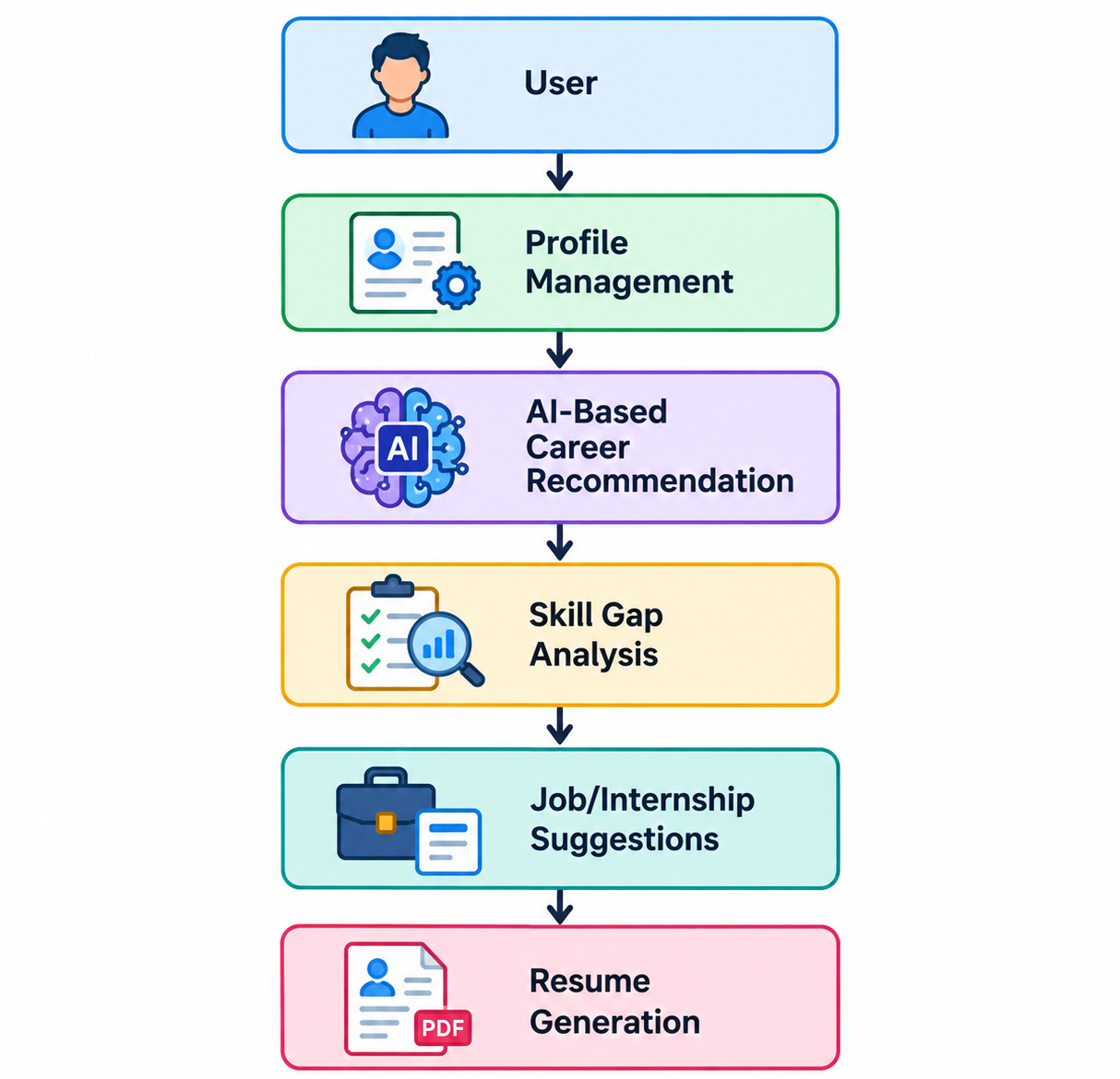
The Career Recommendation System is a web-based application designed to help students identify suitable career paths based on their educational qualifications, skills, interests and professional goals. Users create and manage their profiles, receive personalized career recommendations, identify skill gaps, explore relevant job and internship opportunities, and generate professional resumes. The system uses AI-assisted recommendations to support career planning and help users make informed decisions about their future.
Main system flow: User → Profile Management → AI-Based Career Recommendation → Skill Gap Analysis → Job/Internship Suggestions → Resume Generation The logical workflow of the system is shown in Figure 1.
7Major modules
- User Registration and Authentication – supports account creation, login, password hashing, and token-based authentication.
- Profile Management – stores profile information including education, branch, skills, interests, and experience.
- Career Recommendation – compares user skills and interests with predefined career requirements and ranks career records.
- Skill-Gap Analysis – displays matched skills, missing required skills, and a skill-match percentage.
- AI Job-Role Recommendations – requests suggestions for entry-level job or internship role types based on profile information.
- AI Career Assistant – responds to user questions related to careers, learning, programming, resumes, and projects.
- Career Information – stores descriptions, required skills, interests, salary ranges, and roadmap steps for predefined careers.
- Resume Builder – provides a form-based resume creation and preview workflow.
8Methodology
The project methodology consists of requirement identification, profile and career data modelling, backend API development, frontend implementation, integration of matching logic, AI-service integration, and interface-level verification. The backend uses Mongoose schemas for user and career data. The career seed file contains 15 predefined career records. The supplied archive does not include a separate labelled dataset for training a machine-learning model.
For each career, the matching controller compares the user's skills and interests with the corresponding required lists. Input strings are converted to lowercase and trimmed. Matching uses substring inclusion, so the method is simple and explainable but may produce partial-term matches that are not semantically equivalent.
The final score assigns 70% weight to the skill score and 30% to the interest score. Careers are sorted in descending score order. A component with no required items is assigned zero by the implementation. The project does not provide experimental evidence that the selected weights are optimal.
For skill-gap analysis, the user's current skills are compared with the selected career's required skills. Skills identified as present are displayed as matched, while required skills not found in the profile are displayed as missing. The AI job-role endpoint sends profile information to the configured language model and requests five role suggestions in a structured format. These suggestions are model-generated and are not verified live job listings.
9Security and privacy considerations
The Career Recommendation System is designed to protect user information and maintain the confidentiality of personal data. It stores student profiles, educational details, skills, resumes, and job application information in an SQLite database. Authentication mechanisms help ensure that only authorized users can access the application's features.
User passwords are protected using secure hashing techniques, ensuring that the original passwords are not directly stored in the database. This helps safeguard user credentials and reduces the possibility of unauthorized account access
The system handles uploaded resumes and profile information for career analysis and job recommendations. Input validation and secure file handling are important to reduce risks associated with invalid data and malicious uploads. Access to personal information should be limited to the functions that require it.
The system should also ensure that personal information is not unnecessarily shared with third parties. User data should be used only for its intended purposes, and appropriate measures should be taken to prevent unauthorized access, data leakage, and misuse. Regular testing and security updates can further improve the reliability and safety of the application.
10Expected outcomes
- A centralized platform for managing user profiles, uploading resumes, and exploring career opportunities.
- Ranked job recommendations based on profile content similarity and required skill matching scores.
- Clear identification of matched and missing skills for suitable job roles.
- Resume analysis with suggestions to improve resume quality and completeness.
- Career path suggestions based on existing skills and predefined career requirements.
- Learning resource recommendations to help users develop missing skills.
- Job application management and candidate matching based on profile information and job requirements.
- A structured collection of career paths with descriptions, required skills, and relevant learning resources.
- A foundation for future improvements through labelled profiles and recommendation performance metrics.
11Results
The Career Recommendation System was examined by inspecting the available project source code. The system consists of a React frontend, Node.js and Express backend, and MongoDB database using Mongoose. The implemented components include a rule-based career recommendation module, a skill-gap analysis interface, AI-related controllers for job-role suggestions and conversational career guidance, and a resume builder with a preview feature. The career data file contains 15 predefined career records. The main pages of the application are shown in Figures 2–10.
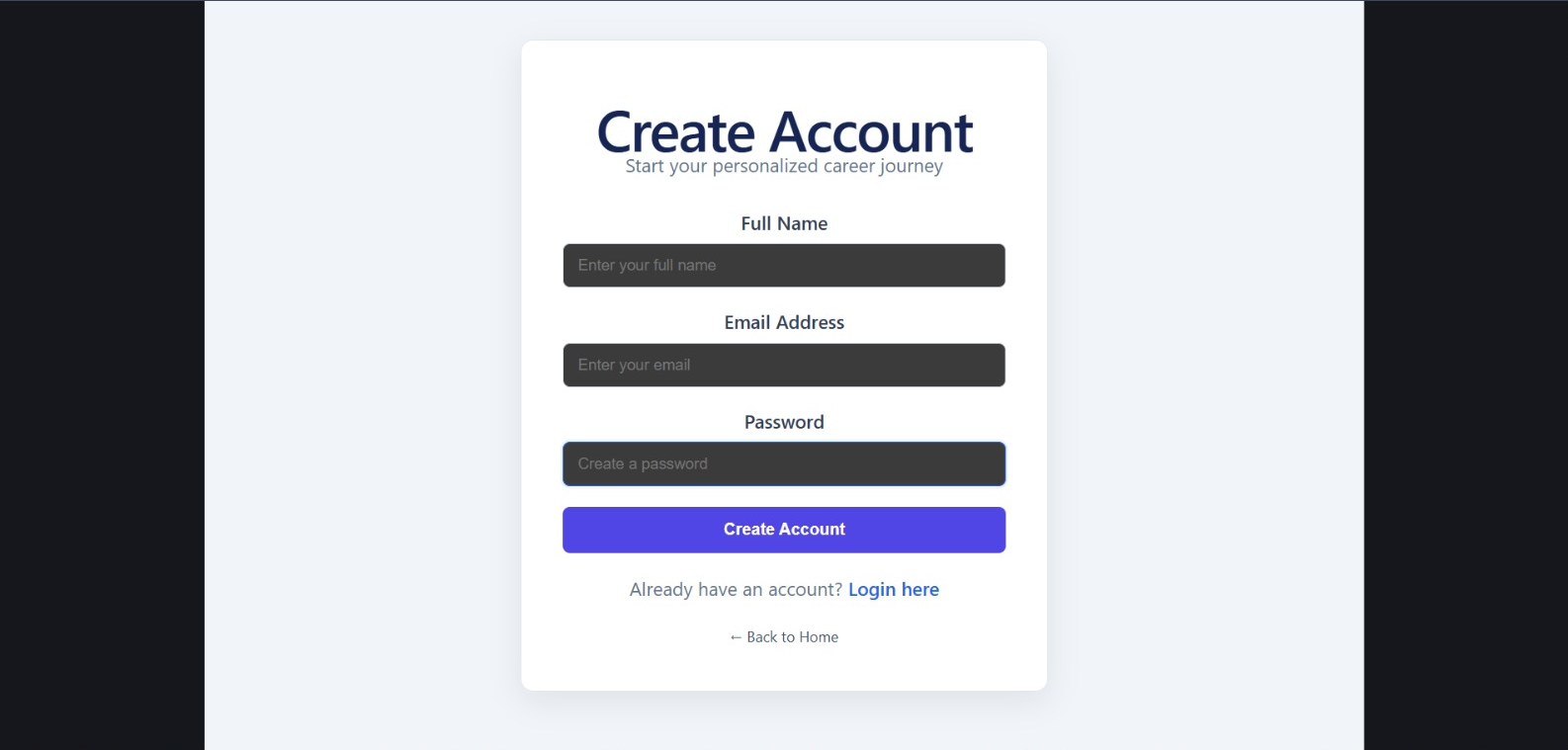
The registration page allows new users to create an account by entering their full name, email address, and password. This process helps users securely register and access the web application.
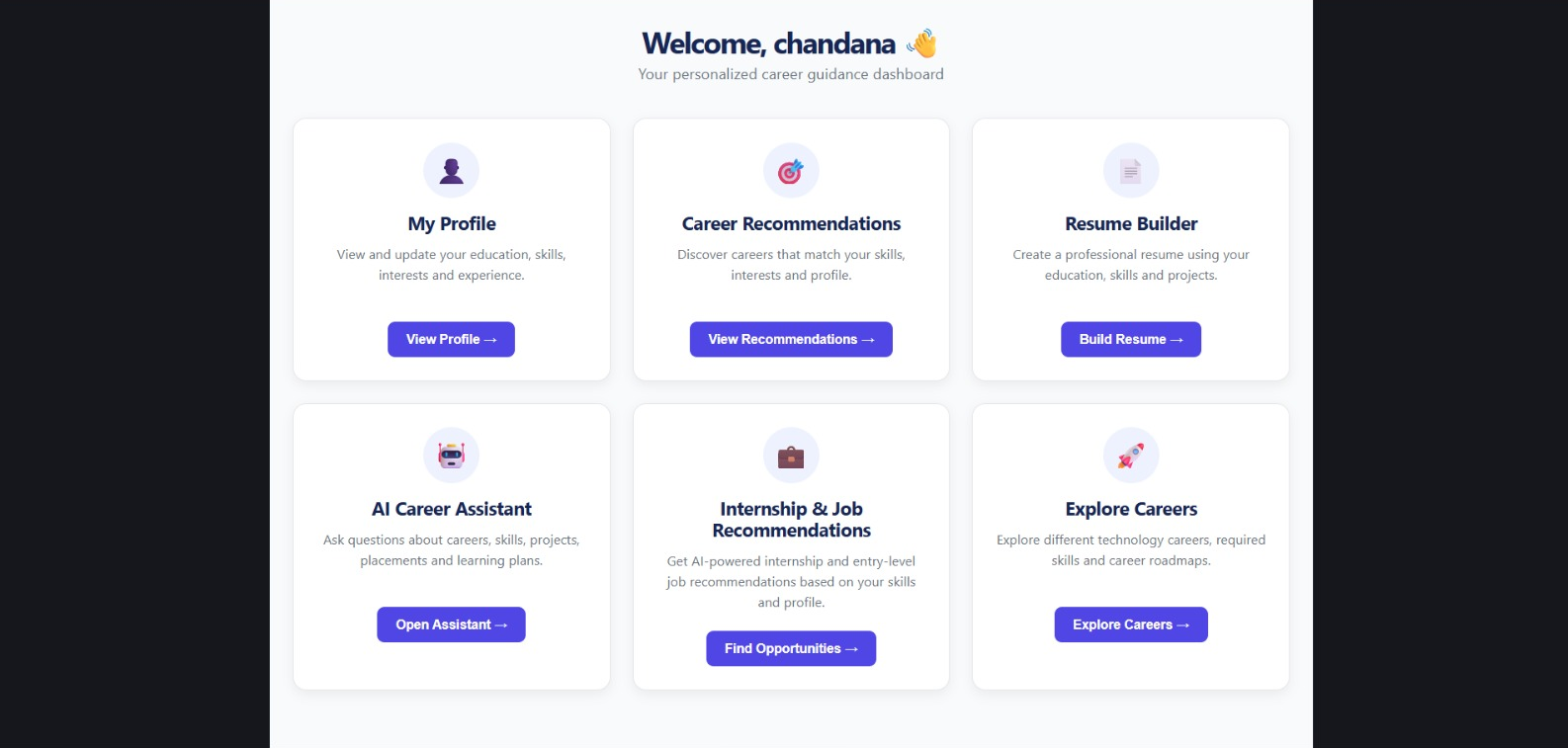
The dashboard provides users with personalized career guidance through features such as profile management, career recommendations, resume building, an AI career assistant, internship and job recommendations, and career exploration. It helps users identify suitable career paths and plan their professional development.
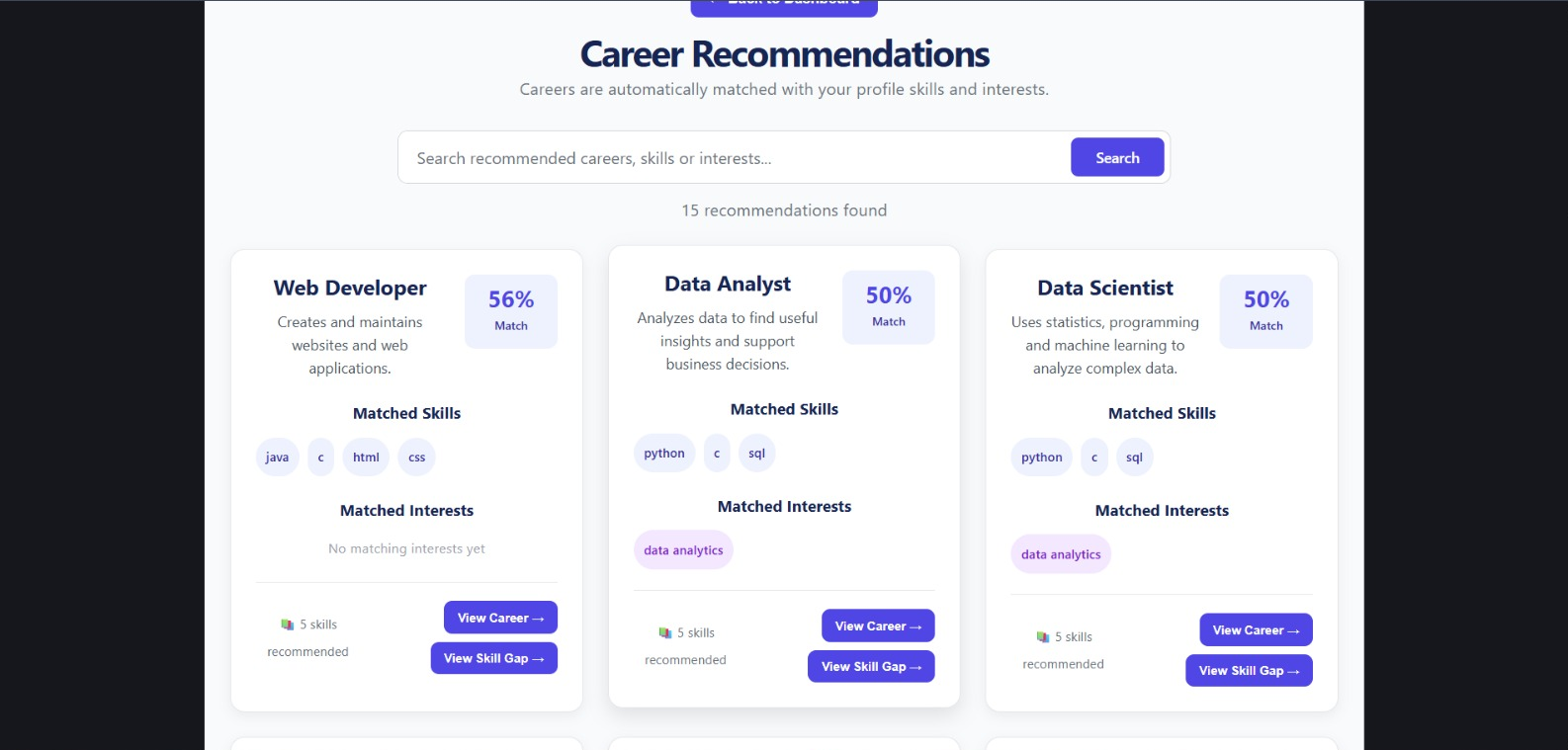
This page displays personalized career recommendations based on the user's skills and interests. It provides a list of suitable career options, including match percentages, required skills, and options to explore career details.
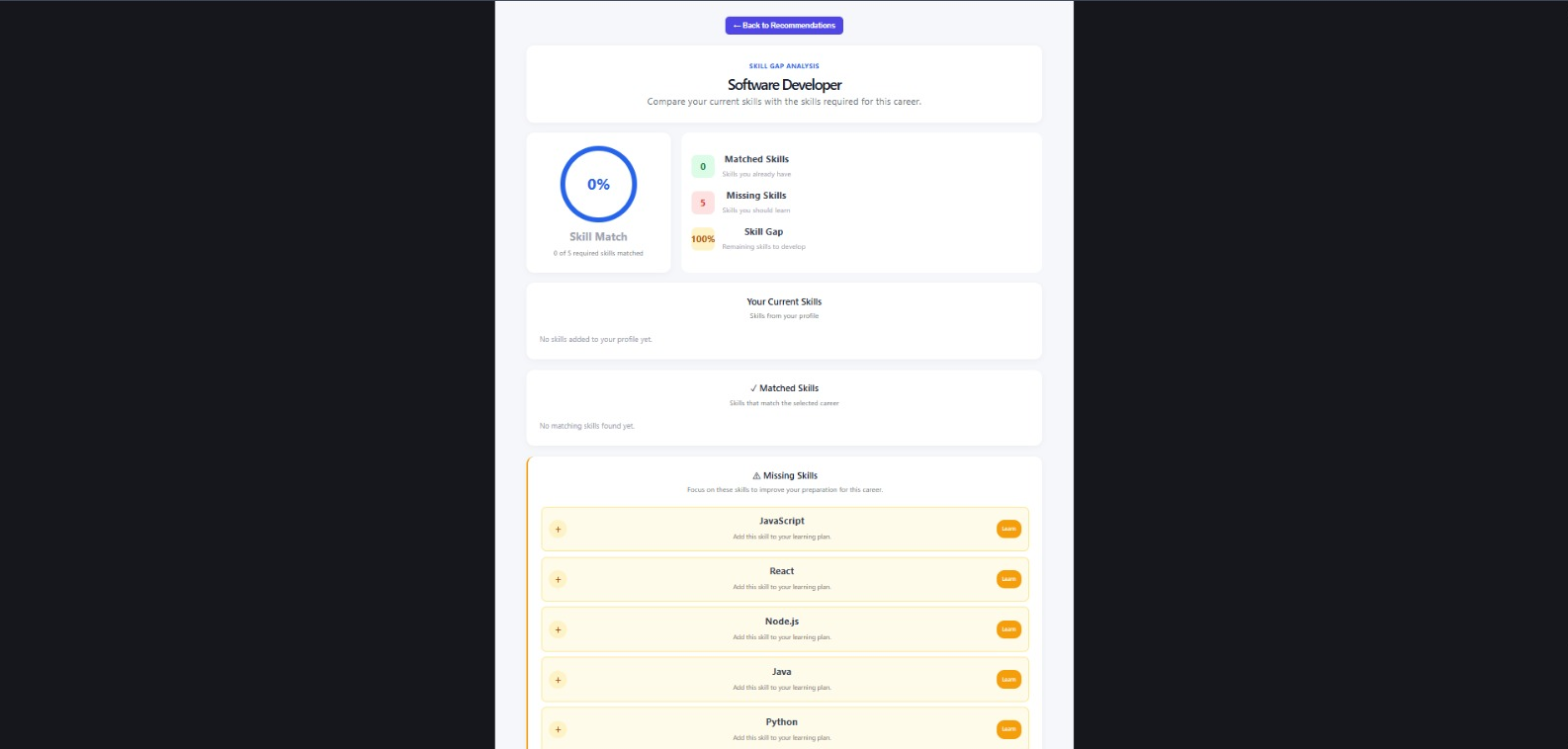
This page helps users identify the skills they need to develop for their selected career. It compares their existing skills with the required skills and highlights areas for improvement, helping users create a focused learning plan to achieve their career goals.
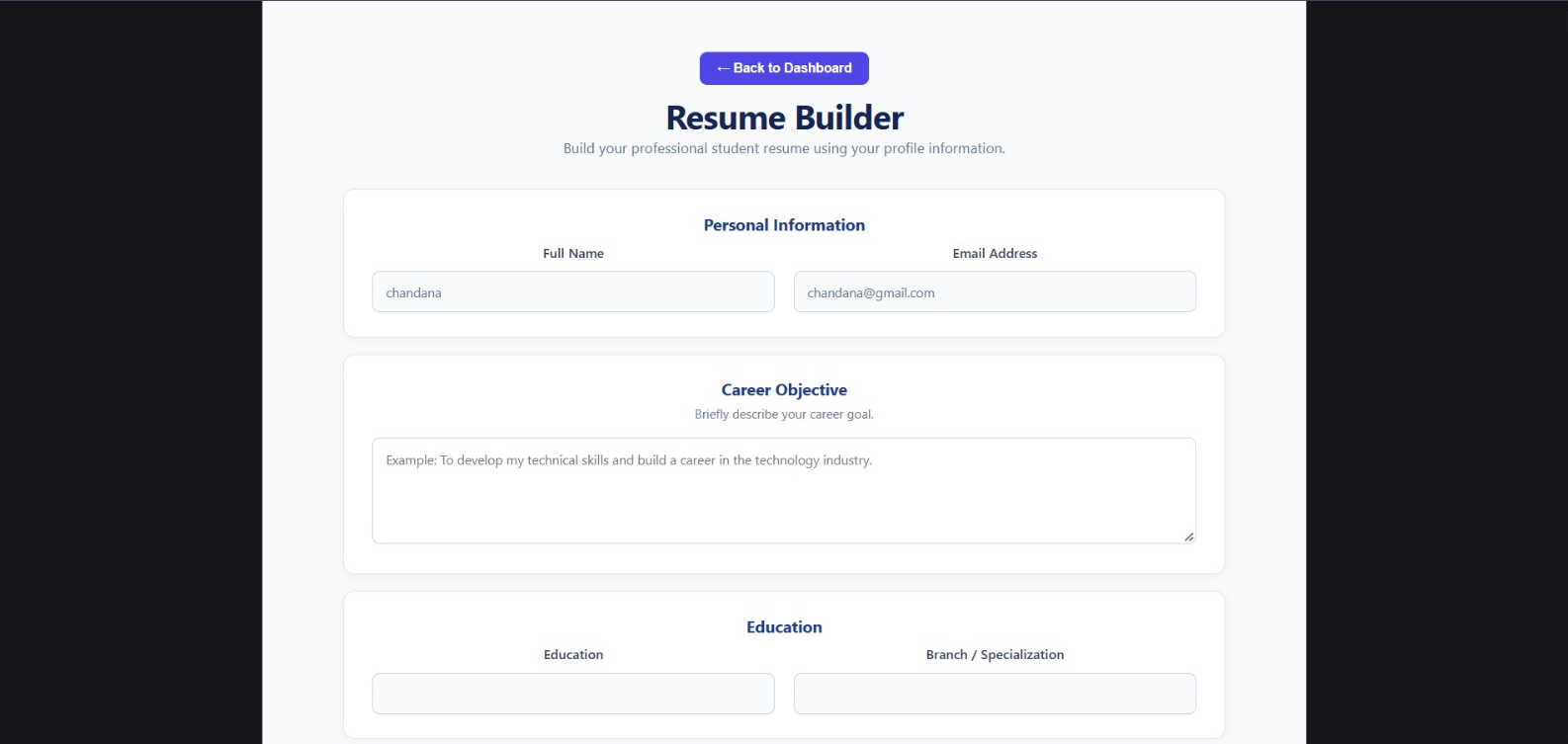
The Resume Builder page allows users to create a professional resume by entering their personal details, educational qualifications, skills, projects, and work experience.
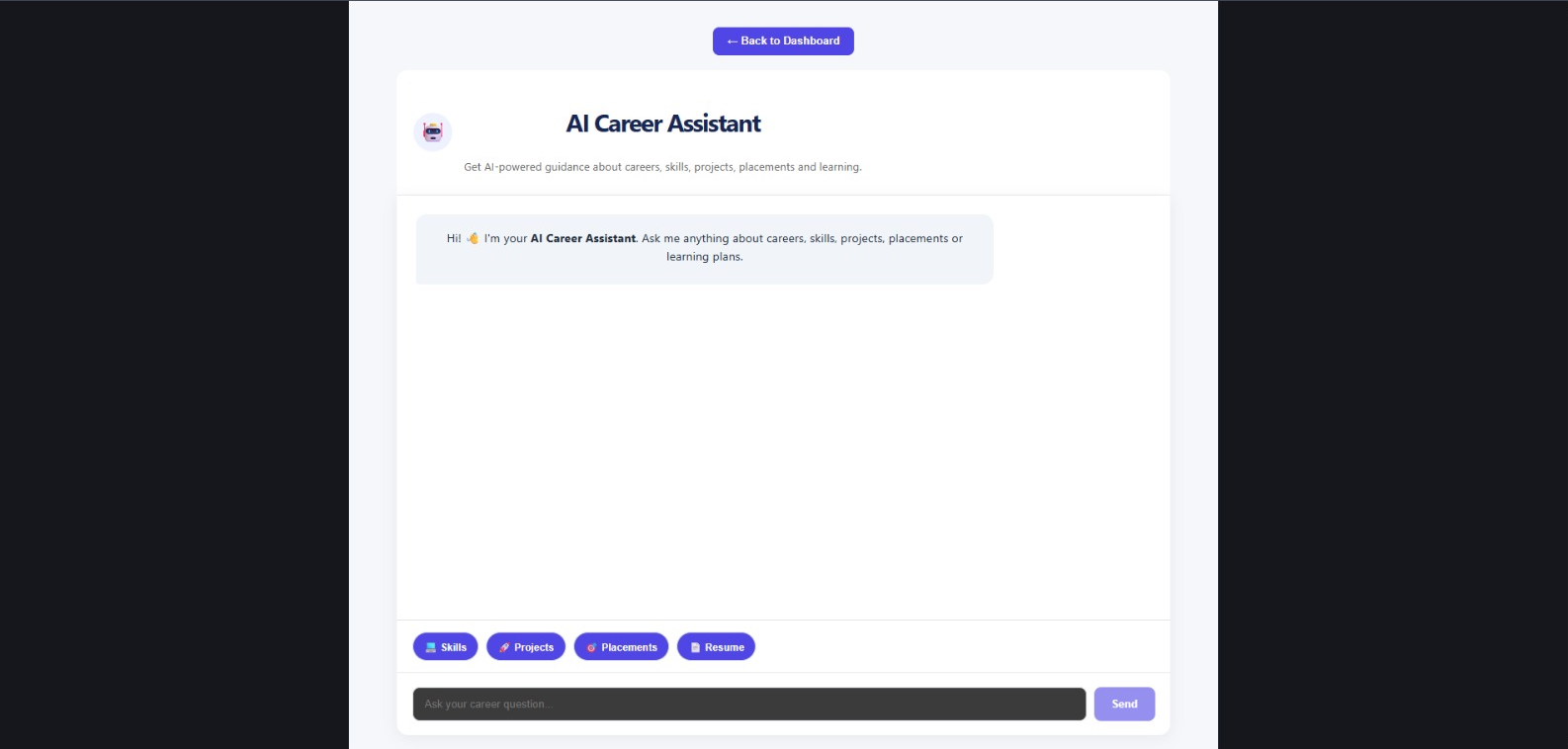
The AI Career Assistant page helps users get personalized guidance on career choices, required skills, projects, and learning paths.
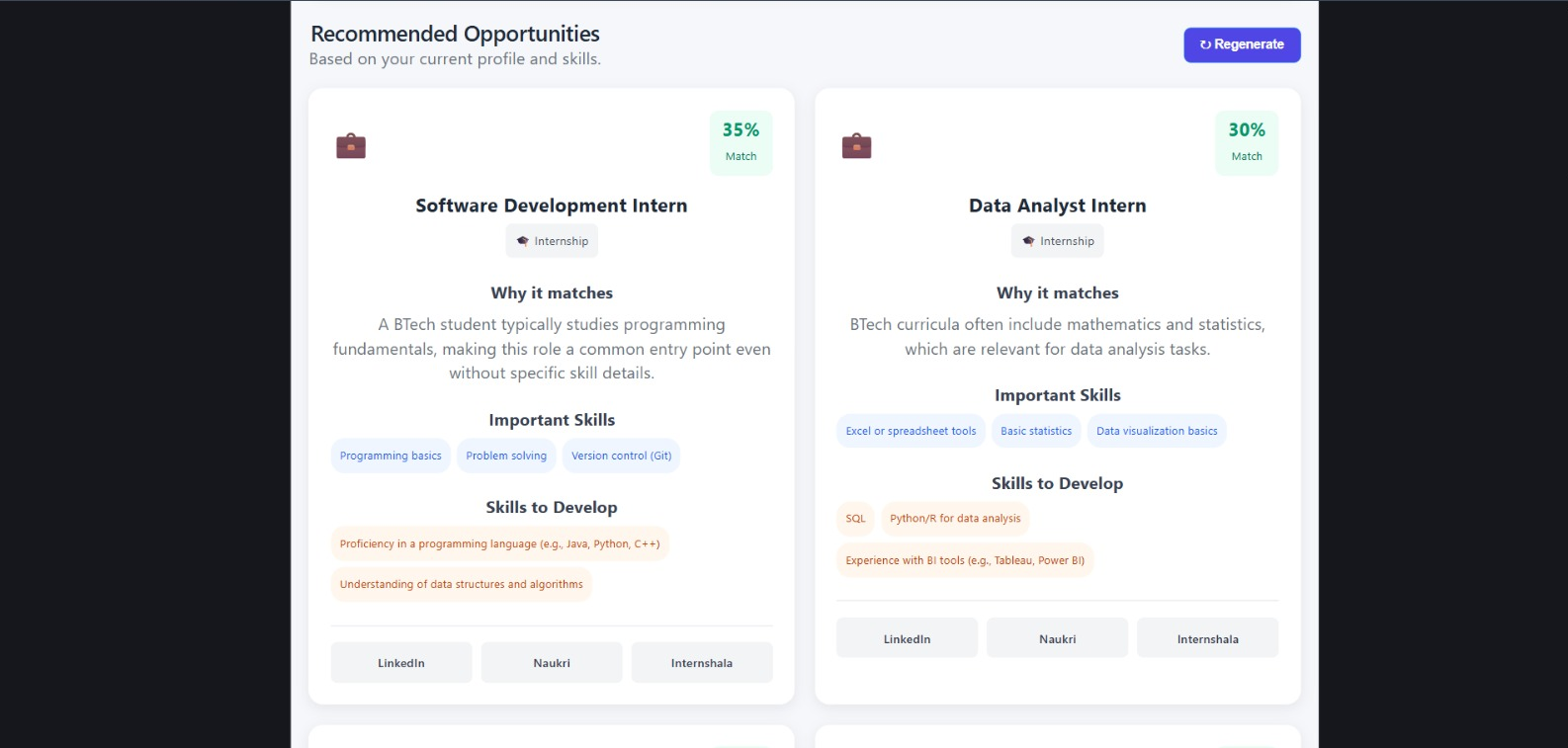
By clicking the Generate Recommendations button, users can discover relevant internship opportunities and entry-level jobs that match their career goals and help them gain practical experience.
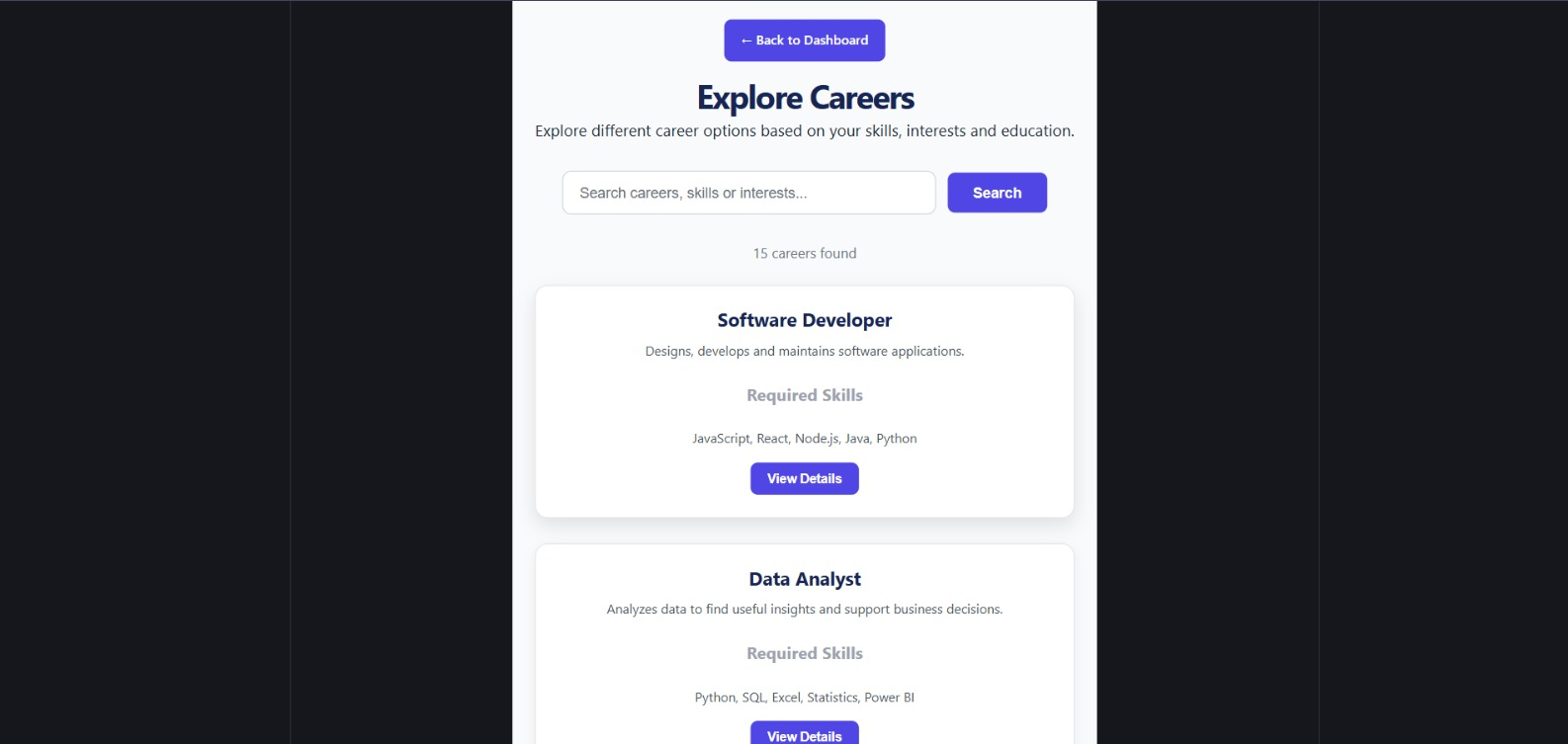
The Explore Careers page helps users discover different career paths based on their interests, skills, and professional goals.
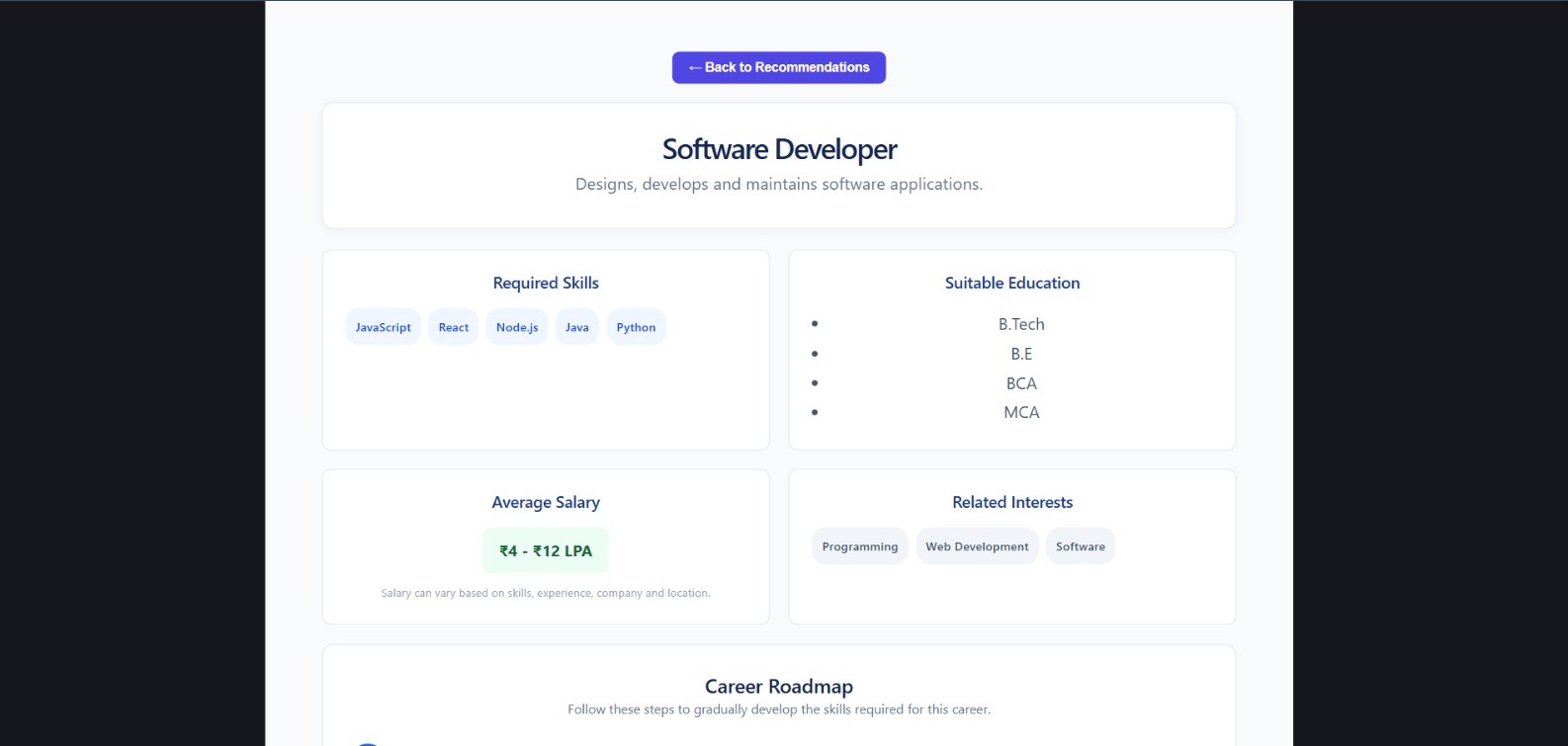
The View Details page provides detailed information about a selected career, including required skills, suitable educational qualifications, expected salary, and a step-by-step career roadmap.
12Discussion
The Career Recommendation System provides a centralized platform for career guidance, resume analysis, job recommendations, and skill-gap identification. By comparing user profiles with job requirements, the system ranks relevant opportunities and helps students understand which skills they need to develop. The resume analysis and learning resource features further support users in preparing for their desired careers.
The system uses TF-IDF, cosine similarity, and skill matching to identify relevant job opportunities. These techniques make the recommendation process more structured and explainable. The application also provides career path suggestions and learning resources, helping students make informed decisions about their professional development.
However, the system has certain limitations. The recommendations depend on the available job data, predefined career information, and the accuracy of user profiles. Text similarity may not always reflect the actual suitability of a candidate, and AI-generated suggestions may require verification. Furthermore, the recommendation algorithm needs additional evaluation to establish its accuracy and effectiveness.
In the future, the system can be enhanced by expanding the job database, improving semantic skill matching, and incorporating updated industry requirements. Testing with real user profiles, expert feedback, and evaluation metrics such as Precision@K and Recall@K can help measure recommendation quality. Overall, the project provides a useful foundation for developing a more accurate, personalized, and reliable career recommendation platform.
13Future scope
- Expand and regularly validate the career catalogue against reliable occupational information.
- Improve skill matching with synonyms, standardized skill taxonomies, or semantic similarity.
- Select matching weights through a documented validation study.
- Evaluate recommendations using labelled profiles, expert review, and ranking metrics.
- Add automated resume parsing with user consent and a review step for extracted data.
- Validate AI responses against a schema and ground them in reliable career information.
- Improve security, authorization, privacy controls, accessibility, and deployment testing.
14Conclusion
The Career Recommendation System provides an effective approach to bridging the gap between students' existing skills and industry requirements. By integrating resume analysis, job recommendations, skill-gap identification, and AI-assisted career guidance, the system helps users discover suitable career opportunities and understand the steps needed to achieve their professional goals.
The system combines text similarity and skill matching to generate relevant job recommendations, enabling students to make more informed career decisions. It also supports employers in identifying potential candidates based on their profiles and job requirements. By bringing these functionalities together in a single platform, the project simplifies career exploration and promotes skill development.
Overall, the project demonstrates how technology can make career guidance more accessible, personalized, and practical. With further improvements in recommendation accuracy, job data integration, and personalized learning, the system has the potential to become a valuable tool for preparing students for the evolving demands of the job market.
References
- [1]Nandi S, Mohit M, Nayak BA, Babu BS (2025). Sankalp: AI-powered career guidance system. IEEE Access, 13, 202376–202394. https://doi.org/10.1109/ACCESS.2025.3638596
- [2]Sribharathi B, Balamurugan SV, Megavarmaraj S, Deepak S, Kajendhiran S (2025). Scopira: An AI-driven career guidance system using resume parsing, skill gap analysis, and intelligent job matching. In: Proceedings of the International Conference on Smart Structures and Systems (ICSSS), pp. 1–8. https://doi.org/10.1109/ICSSS66939.2025.11346170
- [3]Tejwani R, Mehta A, Sabale S, Pannase O, Dedgaonkar SG, Lal B (2025). Real-time job recommendation using transformer embeddings and vector similarity matching. In: Proceedings of the IEEE International Conference on ICT in Business Industry & Government (ICTBIG), pp. 1–8. https://doi.org/10.1109/ICTBIG68706.2025.11323827
- [4]Deshmukh S, Bajaj A (2024). CareerBoost: A hybrid RAG-NLP job recommendation framework. In: Proceedings of the International Conference on I-SMAC (IoT in Social, Mobile, Analytics and Cloud), pp. 853–858. https://doi.org/10.1109/I-SMAC61858.2024.10714727
- [5]Mirajkar R, Shinde GR, Shelke PM, Yadav S, Shinde B, Shinde G (2024). Skill recommendation system and resume analysis using AI. In: Proceedings of the IEEE Pune Section International Conference (PuneCon), pp. 1–3. https://doi.org/10.1109/PuneCon63413.2024.10895306
- [6]Qamhieh M, Sammaneh H, Demaidi MN (2020). PCRS: Personalized career-path recommender system for engineering students. IEEE Access, 8, 214039–214049. https://doi.org/10.1109/ACCESS.2020.3040338
- [7]Abdul Rashid AH, Mohamad M, Masrom S, Selamat A (2022). Student career recommendation system using content-based filtering method. In: Proceedings of the International Conference on Artificial Intelligence and Data Sciences (AiDAS), pp. 60–65. https://doi.org/10.1109/AiDAS56890.2022.9918766
- [8]Panchasara S, Gupta RK, Sharma A (2023). AI based job recommendation system using BERT. In: Proceedings of the 7th International Conference on Computing, Communication, Control and Automation (ICCUBEA), pp. 1–6. https://doi.org/10.1109/ICCUBEA58933.2023.10392119
- [9]Rajput A, Dubey A, Thakur R, Singh D, Singh UP (2024). Career Craft AI: A personalized resume analysis and job recommendations system. In: Proceedings of the 1st International Conference on Innovative Sustainable Technologies for Energy, Mechatronics, and Smart Systems (ISTEMS), pp. 1–6. https://doi.org/10.1109/ISTEMS60181.2024.10560126