AI-Based Crop Recommendation & Disease Detection
Smart Crop Advisor and Disease Detector
Department of Computer Science & Engineering, Sanjay Ghodawat Institute, Atigre, Kolhapur, Maharashtra, India
Published November 2026
Abstract
The agricultural economy in India is currently in a critical position, and farmers need correct information on which crops they should grow. This literature review examines how artificial intelligence and machine learning algorithms can be applied to recommend crops and detect plant diseases. The study looks at recommending crops based on soil factors and climate data and at identifying diseases from plant leaves. Previous studies show that machine learning algorithms, for example Random Forest, can be used to recommend crops, and that plant diseases can be detected from images using deep learning tools such as convolutional neural networks; however, these results can be affected by poor-quality data. The proposed application, Smart Crop Advisor and Disease Detector, has several features to support agriculture. Optical character recognition is used to extract soil data from uploaded soil reports, and a Random Forest algorithm then recommends the top three crops to plant. Plant diseases are detected using the Plant.id API. The My Farm module gives farmers crop guidance and a Daily Farm Diary, which includes an AI chatbot.
Keywords: Crop Recommendation; Plant Disease Detection; Soil Report OCR; Random Forest; Artificial Intelligence; Crop Selection; Farm Wise Crop; Farm Management
1Introduction
Agriculture is a major part of the economy in India. Traditionally, farmers learn which factors matter from experience or from agricultural experts. The farmer must also think about soil characteristics, weather conditions and previous crops. Knowing about plant diseases is also necessary for the farmer.
Most of the time, traditional methods based on the knowledge of farmers or the suggestions of agricultural experts are used. However, sometimes it is hard to get information. Digital applications can help. These applications can give farmers data such as the type of crops, soil characteristics and plant diseases.
Using machine learning, these data can be used to find patterns that suggest which crops should be grown. For example soil data such as nutrients, pH, temperature, humidity and rainfall can be used as input to recommend crops. We can detect patterns in plant leaf images using a neural network with deep learning techniques.
There has been work on using machine learning to recommend crops and detect plant diseases through image detection. There has also been work on creating applications for agriculture. A farmer may need tools to recommend crops, detect plant diseases and manage farm data.
This work proposes an Android application called Smart Crop Advisor and Disease Detector that offers tools for farmers. This application has three sections: Crop Advisor, Disease Detection and My Farm. The My Farm section contains two parts: Crop Guidance and Daily Farm Diary. An AI chatbot is also included in the Daily Farm Diary to help farmers.
2Literature review
2.1Crop recommendation using machine learning
2.1.1Crop recommendation using soil properties and climate
This research used machine learning techniques to recommend crops suited to the soil nutrients, soil pH and climate variables. Crop recommendation provides farmers with advice on which crop to grow based on environmental data. However, crop recommendation relies on the quality of the data supplied; poor-quality input data will reduce its benefits [1].
2.1.2Crop recommendation using sensor information for fertile regions in Maharashtra
Sensor information can be used with machine learning to give crop recommendations for areas of Maharashtra. Crop recommendation can be useful in certain areas, as certain crops are suitable for the local soil and conditions. The use of sensor data is helpful for Crop Recommendation, however the right type of sensors and good quality data collection is required for building models of recommendation [2].
2.1.3Hybrid deep-Q Elman neural network for crop prediction
A hybrid deep-Q Elman neural network can be used to predict crop suitability. Crop prediction can be aided by networks that analyse agricultural conditions. However, such crop prediction can be complicated, requires training and depends on the right data [3].
2.1.4Deep reinforcement learning for recommender systems in smart agriculture
Deep reinforcement learning can be used to provide crop recommendations in smart agriculture. Reinforcement learning can be useful for recommender systems in making decisions. However, the effectiveness of recommender systems can be limited due to the training environment and data available [4].
2.1.5AI-based framework for crop recommendation
An AI-based framework for crop recommendation was developed to provide a solution for crop recommendation using AI techniques to support decision making. The framework also merges data from different sources to improve the quality of the advice. The model structure and evaluation results are described in [5].
2.2Plant disease detection using deep learning
2.2.1Plant disease detection and classification: A systematic literature review
This systematic literature review examined the methods used for plant disease detection and classification. Many techniques can be employed. Numerous datasets and challenges exist. Image-based systems can help diagnose symptoms; however, the quality of Plant Disease Detection can be affected by lighting conditions, image quality, background and differences between laboratory and field images [6].
2.2.2Advanced deep learning models for plant disease detection: A review
This review examined the use of deep learning models to detect plant diseases. Deep learning can extract visual features and classify patterns for plant disease detection, but the results depend on the dataset chosen and on real images of plants [7].
2.2.3Evaluation of plant disease detection mobile applications
A study was conducted to assess the usefulness of plant disease detection mobile applications, which are intended to provide a digital diagnosis. Such apps have to be easy to use and reliable and must provide clear results; simply providing a single label for the plant disease is not sufficient [8].
2.2.4P2OP: Plant pathology on palms
This study introduced the P2OP mobile application to help detect plant diseases in palms using deep learning. This can help demonstrate how mobile technology can be used to detect diseases in the field. However, if it has been designed for a certain crop or set of diseases it may not be suitable for others without proper training and evaluation [9].
2.2.5Tomato disease identification using fine-tuned CNNs
This study looked into using fine-tuned CNNs to identify diseases in tomato plants. Fine-tuning can help adapt a previously trained model for specific classifications. However, it would need to be tested with various stages of disease, plant variety and field conditions [10].
2.2.6Maize leaf disease detection using a mobile application
This study looked into using a mobile application for maize leaf disease detection using deep learning. This can help demonstrate how image based models can help diagnose crops. However, the results will depend on the diseases and image conditions present in the training and test data [11].
2.2.7mPD-APP for plant disease diagnosis
This study looked into creating a mobile application to help diagnose plant diseases using a convolutional neural network. This can help demonstrate how mobile and deep learning can be used for disease diagnosis. However, the results should be clear, easy to understand and properly evaluated. [12].
2.2.8Smartphone image processing and transfer learning for rice disease and nutrient deficiency detection
This study looked into using smartphone image processing and transfer learning for rice diagnosis. Transfer learning can help adapt a pre-trained model for specific image classification tasks. However, results can be impacted by similar symptoms, image quality and field conditions [13].
2.2.9Deep learning techniques for plant diseases: A review
This study looked into using deep learning techniques for plant disease detection. This can help researchers understand which methods are currently being used and the common issues. Deep learning can help with automatically classifying diseases; however, reliable results will depend on suitable training data, consistent evaluation and consideration of real-world conditions [14].
2.3Integrated decision support for agriculture
2.3.1Machine learning for sustainable farm management
This study looked into using machine learning for sustainable farm management. This can help integrate crop recommendations and disease identification. This can be useful for applications looking to integrate various agricultural functions. However, this depends on how accurate the individual parts are and how useful the information is. This should be properly evaluated using suitable agricultural data [15].
3Comparison table
Table 1 compares the reviewed studies by method or technology, main contribution and limitation.
| Author(s), Year | Method / Technology | Main Contribution | Limitation / Consideration |
|---|---|---|---|
| Dey et al., 2024 | SVM, XGBoost, Random Forest, KNN, Decision Tree | Crop recommendation using soil and climate features | Recommendation quality depends on the data and conditions represented in the dataset |
| Shingade & Mudhalwadkar, 2023 | Sensor information and ML classifiers | Regional crop recommendation for Maharashtra | Regional coverage and input availability must be considered when applying the approach elsewhere |
| Shingade & Mudhalwadkar, 2022 | Deep-Q Elman neural network | Crop prediction under changing environmental conditions | Model complexity and generalization require consideration |
| Bouni et al., 2022 | Deep reinforcement learning | Reinforcement-learning-based crop recommendation | Practical deployment and performance need to be assessed for the intended farming context |
| Youssef et al., 2026 | CNN, soil images, geospatial and climate data | Integrated and explainable crop recommendation | The authors discuss dataset size, field-image variability, and the need for expert and field validation |
| Ramanjot et al., 2023 | Systematic literature review | Review of plant disease detection methods | A review synthesizes existing studies rather than introducing a single deployable application |
| Shoaib et al., 2023 | Deep learning review | Analysis of recent plant disease detection approaches | Practical performance depends on the datasets and models used in individual studies |
| Siddiqua et al., 2022 | Mobile application evaluation | Assesses app quality and disease-related functionality | The study notes missing functionality in many reviewed apps |
| Janarthan et al., 2022 | Deep metric learning and mobile deployment | Lightweight in-field disease detection | Performance must be assessed for the crops and conditions in which it will be deployed |
| Nag et al., 2023 | Fine-tuned CNNs | Mobile tomato disease identification with multilingual support | The reported results concern the study’s dataset and tomato disease classes |
| Khan et al., 2023 | Deep learning, object detection and transfer learning | Mobile maize leaf disease detection | Crop-specific performance should not automatically be generalized to other crops |
| Asani et al., 2023 | CNN-based mobile application | Mobile plant disease diagnosis | Performance and usability should be evaluated for intended users and field conditions |
| Nayak et al., 2023 | Image processing and transfer learning | Smartphone-based rice disease and deficiency detection | The study focuses on rice and its defined disease/deficiency categories |
| Pacal et al., 2024 | Systematic deep learning review | Reviews deep learning techniques for plant diseases | Review findings depend on the studies included and their evaluation methods |
| Krishna et al., 2024 | Machine learning for farm management | Crop recommendation and disease identification | The precise capabilities and limitations should be stated only after checking the full paper |
4Research gap
The studies have shown that machine learning can help with crop recommendations using soil and weather data. Deep learning techniques can also be used to detect plant diseases using images of plant leaves. Mobile applications can help make these technologies more accessible to farmers.
However, farmers may need to use separate tools to recommend crops, detect plant diseases, receive crop guidance and keep track of their farming data.
From the research there is an opportunity to create an easy-to-use mobile application for farmers with integrated features. The Smart Crop Advisor and Disease Detector will help farmers with crop recommendations, plant disease detection and provide guidance for farming.
The My Farm section has two subsections: Crop Guidance and Daily Farm Diary. Crop guidance aims to provide useful information for caring for crops. The Daily Farm Diary aims to help farmers keep track of their daily farming activities. The AI chatbot has been added to help farmers with questions.
This aims to provide a single source of agriculture support. The effectiveness, reliability and usability should be tested appropriately.
5Proposed work
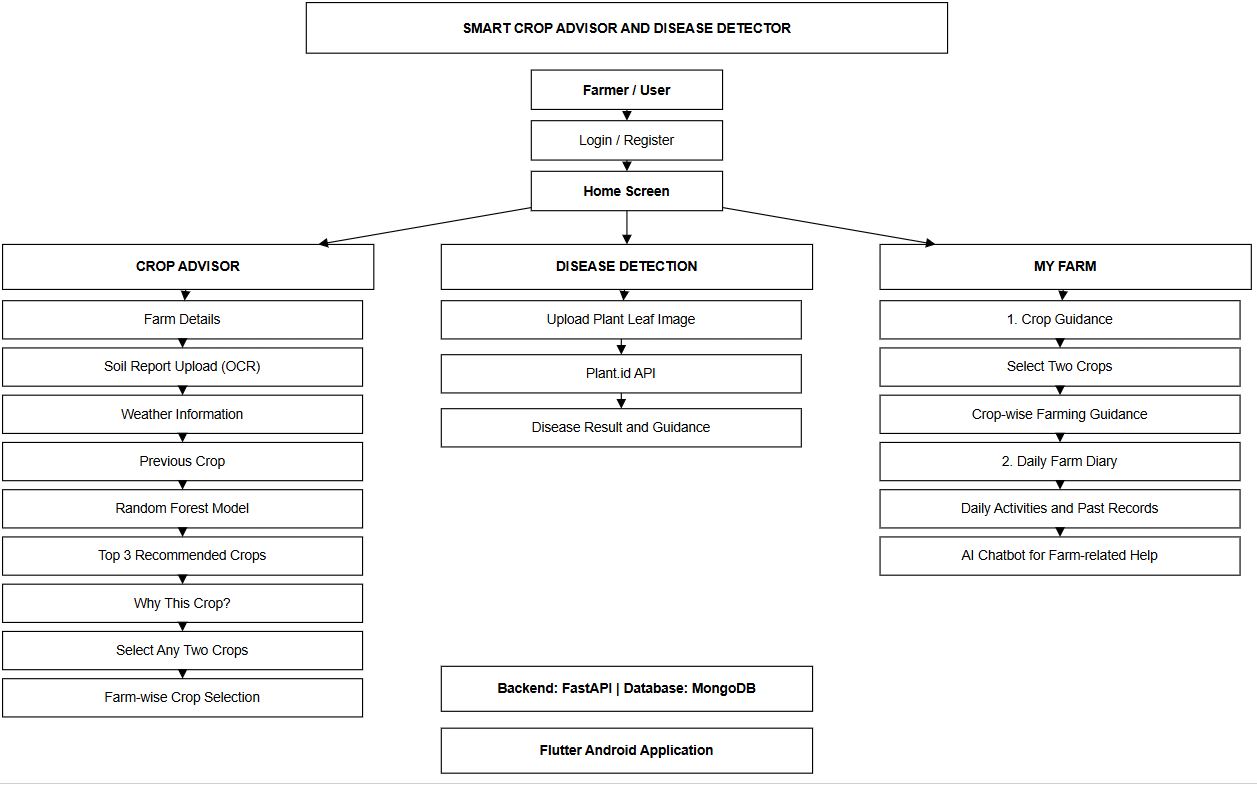
The Smart Crop Advisor and Disease Detector is a mobile application aiming to provide agriculture support using a single source. It has three main sections: Crop Advisor, Disease Detection, and My Farm. The system architecture of the application is shown in Figure 1.
5.1Crop advisor
This section aims to help farmers by identifying suitable crops to grow based on current soil and weather data. Farmers can upload their soil reports and Optical Character Recognition is used to extract the relevant information.
The extracted data and other inputs are passed into the crop recommendation model. The Random Forest algorithm has been used to recommend suitable crops. The application aims to provide the top three recommendations with relevant information.
Reliable results will depend on the quality of the extracted data, training data and model.
5.2Disease detection
This section aims to help farmers by providing information on possible plant diseases. Farmers can upload an image of plant leaves and the Plant.id API will analyse the image. This will provide information on possible plant identification or plant diseases.
This information will be displayed to the user along with any guidance. However, the results may not be fully reliable as the results depend on image quality, lighting and similar symptoms. This should be seen as guidance for making decisions.
5.3My farm
This section aims to help farmers by providing guidance on crops and keeping track of their farming activities. There are two subsections: Crop Guidance and Daily Farm Diary.
5.3.1Crop guidance
This subsection aims to provide farmers with useful information for caring for crops. This should help provide farmers with relevant guidance for their crops. This aims to provide easy access to crop related information.
This will depend on the relevance and accuracy of the information. The guidance should be easy to understand.
5.3.2Daily farm diary
This subsection aims to help farmers keep track of their daily farming activities. Farmers can add notes on their farming activities.
This also has an AI chatbot to help farmers with questions. This provides a conversation style for farmers to get help. The results of the chatbot will depend on the AI service it is connected to and the information it has access to. This should be seen as guidance and verified for important farming decisions.
Keeping a daily diary can help farmers keep all their farming information in one place. What information can be added and how the previous entries can be viewed will depend on what features have been implemented.
6Conclusion and future work
The study found machine learning can be used to recommend crops according to soil and weather information. Deep learning and image-based services may assist in detecting potential plant diseases. Mobile apps can provide easy access to agriculture information but their usefulness depends on quality of the data, reliability of recommendations, clear guidance and proper testing.
The Smart Crop Advisor and Disease Detector aims to provide farmers with a single application to help with crop recommendations, plant disease detection and provide farming support. It has three main sections: Crop Advisor, Disease Detection, and My Farm. My Farm has two subsections: Crop Guidance and Daily Farm Diary. The AI chatbot has been added to help farmers with general agriculture information. This could be improved in the future by adding support for more crops and diseases, improving the extraction of data from soil reports and adding updated market price information. More regional languages and location specific guidance may also be considered. Further testing with suitable real-world data and feedback from farmers could help improve the reliability and usefulness of the application.
References
- [1]Dey B, Ferdous J, Ahmed R. Machine learning based recommendation of agricultural and horticultural crop farming in India under the regime of NPK, soil pH and three climatic variables. Heliyon. 2024;10(3):e25112. https://doi.org/10.1016/j.heliyon.2024.e25112
- [2]Shingade SD, Mudhalwadkar RP. Sensor information-based crop recommendation system using machine learning for the fertile regions of Maharashtra. Concurrency and Computation: Practice and Experience. 2023;35(23):e7774. https://doi.org/10.1002/cpe.7774
- [3]Shingade SD, Mudhalwadkar RP. Hybrid deep-Q Elman neural network for crop prediction and recommendation based on environmental changes. Concurrency and Computation: Practice and Experience. 2022;34(17):e6991. https://doi.org/10.1002/cpe.6991
- [4]Bouni M, Hssina B, Douzi K, Douzi S. Towards an efficient recommender systems in smart agriculture: A deep reinforcement learning approach. Procedia Computer Science. 2022;203:825–830. https://doi.org/10.1016/j.procs.2022.07.124
- [5]Youssef S, Gamage K, Zablith F. An integrated AI framework for crop recommendation. Horticulturae. 2026;12(4):416. https://doi.org/10.3390/horticulturae12040416
- [6]Ramanjot, Mittal U, Wadhawan A, Singla J, Jhanjhi NZ, Ghoniem RM, et al. Plant disease detection and classification: A systematic literature review. Sensors. 2023;23(10):4769. https://doi.org/10.3390/s23104769
- [7]Shoaib M, Shah B, El-Sappagh S, Ali A, Ullah A, Alenezi F, et al. An advanced deep learning models-based plant disease detection: A review of recent research. Frontiers in Plant Science. 2023;14:1158933. https://doi.org/10.3389/fpls.2023.1158933
- [8]Siddiqua A, Kabir MA, Ferdous T, Ali IB, Weston LA. Evaluating plant disease detection mobile applications: Quality and limitations. Agronomy. 2022;12(8):1869. https://doi.org/10.3390/agronomy12081869
- [9]Janarthan S, Thuseethan S, Rajasegarar S, Yearwood JL. P2OP—Plant Pathology on Palms: A deep learning-based mobile solution for in-field plant disease detection. Computers and Electronics in Agriculture. 2022;202:107371. https://doi.org/10.1016/j.compag.2022.107371
- [10]Nag A, Chanda PR, Nandi S. Mobile app-based tomato disease identification with fine-tuned convolutional neural networks. Computers & Electrical Engineering. 2023;112:108995. https://doi.org/10.1016/j.compeleceng.2023.108995
- [11]Khan F, Zafar N, Tahir MN, Aqib M, Waheed H, Haroon Z. A mobile-based system for maize plant leaf disease detection and classification using deep learning. Frontiers in Plant Science. 2023;14:1079366. https://doi.org/10.3389/fpls.2023.1079366
- [12]Asani EO, Osadeyi YP, Adegun AA, Viriri S, Ayoola JA, Kolawole EA. mPD-APP: A mobile-enabled plant diseases diagnosis application using convolutional neural network toward the attainment of a food secure world. Frontiers in Artificial Intelligence. 2023;6:1227950. https://doi.org/10.3389/frai.2023.1227950
- [13]Nayak A, Chakraborty S, Swain DK. Application of smartphone-image processing and transfer learning for rice disease and nutrient deficiency detection. Smart Agricultural Technology. 2023;4:100195. https://doi.org/10.1016/j.atech.2023.100195
- [14]Pacal I, Kunduracioglu I, Alma MH, Deveci M, Kadry S, Nedoma J, et al. A systematic review of deep learning techniques for plant diseases. Artificial Intelligence Review. 2024;57(11):304. https://doi.org/10.1007/s10462-024-10944-7
- [15]Krishna PA, Padhy N, Patnaik A. Applying machine learning for sustainable farm management: Integrating crop recommendations and disease identification. Engineering Proceedings. 2024;67(1):73. https://doi.org/10.3390/engproc2024067073